Your Rights Under the Fair Credit Reporting Act
Understand how the Fair Credit Reporting Act protects your credit data, gives you control, and helps you fix mistakes in your reports.
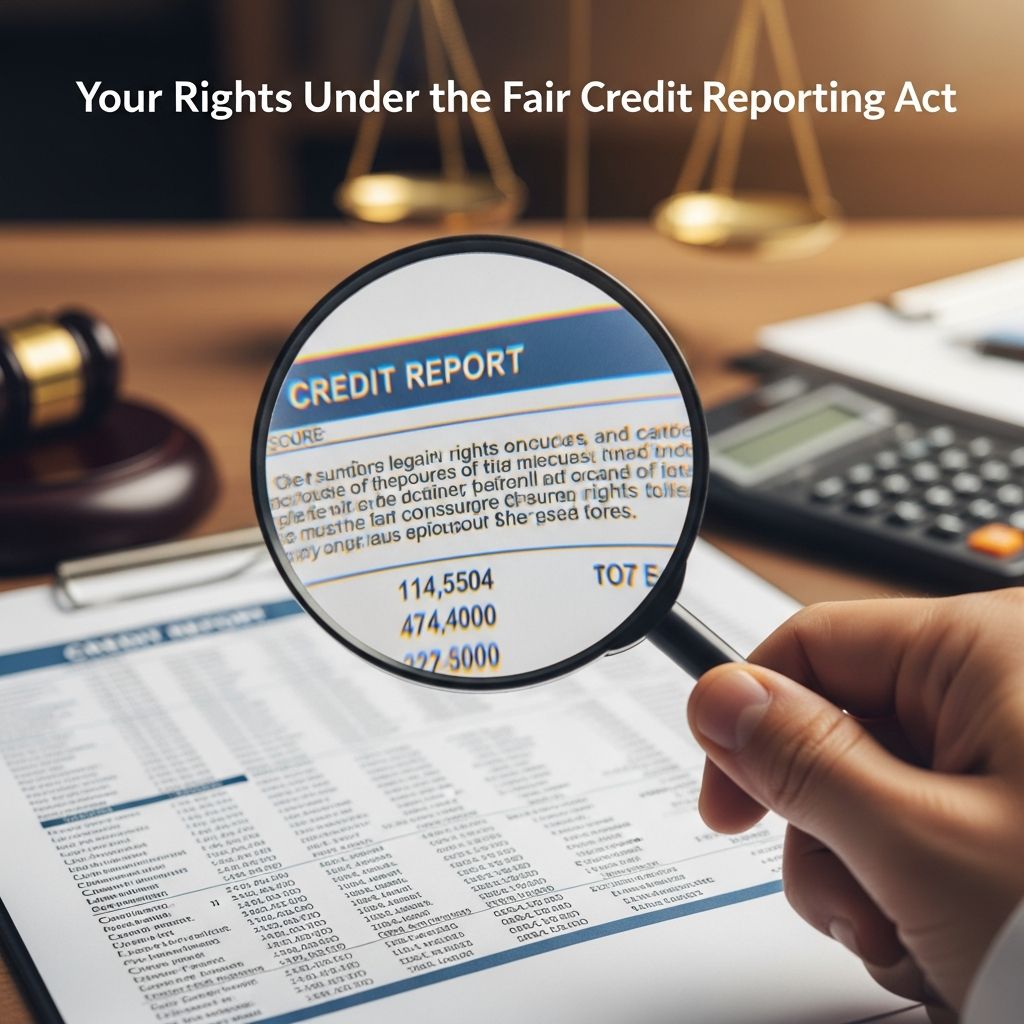
The federal Fair Credit Reporting Act (FCRA) is a cornerstone U.S. law that protects the accuracy, fairness, and privacy of information in your credit and other consumer reports. It gives you specific rights to see what is in your file, correct errors, limit who can see your data, and seek remedies when the law is violated.
This guide explains those rights in plain language and shows how to use them to protect your financial life.
1. What the FCRA Is and Why It Matters
The FCRA, first enacted in 1970 and later updated by laws such as the Fair and Accurate Credit Transactions Act and the Dodd–Frank Act, regulates how companies collect, share, and use consumer report information. It covers not only traditional credit reports, but also many background, tenant, and insurance reports that rely on your personal data.
1.1 Who Is Covered by the FCRA?
Several types of organizations must follow the FCRA:
- Consumer reporting agencies (CRAs) – companies that compile and sell consumer reports, such as credit bureaus and specialty agencies (for example, tenant-screening or check-writing history services).
- Information furnishers – businesses that send data about you to CRAs, like banks, credit unions, lenders, landlords, and collection agencies.
- Users of reports – employers, landlords, insurers, and lenders that request and rely on consumer reports to make decisions about you.
1.2 What Is a Consumer Report?
Under the FCRA, a consumer report includes many types of information about your personal finances and background, when used to make decisions about credit, insurance, employment, or certain other purposes.
Reports can include:
- Credit accounts and payment history (tradelines)
- Balances, limits, and collection accounts
- Public record data such as bankruptcies or tax liens
- Certain employment or rental history information
2. Your Core Rights Under the FCRA
The FCRA gives you a set of powerful, ongoing rights. Knowing them makes it far easier to manage your credit health.
2.1 Right to Accurate and Fair Reporting
CRAs and information furnishers must use reasonable procedures to ensure maximum possible accuracy of the information in your file. They cannot report data that they know or reasonably should know is inaccurate, and they must correct or delete information that cannot be verified.


The Future of AI: Preventing a Big Tech Monopoly >

2.2 Right to Privacy and Limited Access
Your report cannot be accessed by just anyone. A CRA may only provide your consumer report to parties with a legally recognized permissible purpose, such as:
- Reviewing an application for credit, insurance, or rental housing
- Certain employment purposes, with your written permission
- Court orders and some government needs
- Legitimate business needs in connection with a transaction you initiated
2.3 Right to Access Your Own Reports
You have the right to know what is in your consumer file. Federal law requires nationwide CRAs to give you a free annual credit report on request, and additional free copies in specific situations, such as when you are a fraud victim.
In addition, you may request a disclosure of your file directly from any CRA that maintains information about you.
2.4 Right to Dispute Errors
If you see information that is inaccurate, incomplete, or outdated, you may dispute it. The CRA must investigate, usually within 30 days, forward your evidence to the furnisher, and correct or delete any data that is found to be wrong or cannot be verified.
2.5 Right to Know About Adverse Actions
If information in your consumer report is used to take an adverse action against you—such as denying credit, charging higher rates, refusing insurance, or declining employment— the person or company must notify you.
This notice must include key details, such as the CRA that supplied the report and your right to obtain a free copy and dispute the information.
2.6 Right to Credit Score Disclosures in Key Situations
Amendments to the FCRA require that when your credit score is used in connection with certain mortgage transactions or in an adverse action or risk-based pricing decision, you must receive disclosures that include the score, the range of possible scores, and key factors affecting it.
3. How to Get Your Credit Reports
Checking your own reports is one of the most important steps you can take to use your FCRA rights effectively.
3.1 Free Annual Credit Reports
Under federal law, you are entitled to a free report every 12 months from each of the three nationwide CRAs, plus certain other specialty agencies. You can request these reports online, by phone, or by mail.
Requesting your own report does not affect your credit score.
3.2 Additional Free Reports in Special Situations
You may also be entitled to an extra free report if:
- You are denied credit, insurance, or employment based on a consumer report
- You are a victim of identity theft and place a fraud alert in your file
- Your file contains inaccurate information due to fraud
- You are unemployed and plan to apply for jobs
- You receive public assistance
3.3 What to Look for When Reviewing Your Reports
When you receive your report, carefully review:
- Personal information – name, Social Security number, addresses, and employers
- Accounts – balances, limits, payment status, and dates
- Public records – bankruptcies and civil judgments, to the extent they may still appear
- Inquiries – who has accessed your file and why
4. Disputing Errors: Step-by-Step
The FCRA sets out a clear dispute process that CRAs and furnishers must follow.
4.1 Common Types of Errors
- Accounts that do not belong to you
- Incorrect balances or credit limits
- Late payments reported in error
- Outdated negative information that should no longer be reported
- Duplicate entries of the same debt
4.2 Filing a Dispute with a CRA
To start a dispute:
- Identify the item you believe is wrong and explain why it is inaccurate or incomplete
- Provide copies (not originals) of supporting documents, such as statements or letters
- Send your dispute online, by mail, or by phone as instructed by the CRA, keeping copies for your records
The CRA must forward all relevant information you provide to the furnisher and investigate within the timeframe set by law, usually 30 days.
4.3 Results of the Investigation
After the investigation, the CRA must:
- Provide you with written results
- Give you a free copy of your report if the dispute leads to a change
- Remove or correct any item that is inaccurate, incomplete, or unverified
If the CRA does not change the information, you can request that a brief statement of dispute be added to your file and included in future reports.
4.4 Disputing Directly with the Furnisher
In many cases, you can also send a written dispute directly to the company that furnished the information (for example, your lender or credit card issuer). Furnishers have obligations under the FCRA and related regulations to investigate and correct errors that they report.
5. Limits on How Long Information Can Be Reported
The FCRA generally limits how long negative information may appear in your report, helping prevent very old events from following you indefinitely.
| Type of Information | Typical Reporting Time Limit* |
|---|---|
| Most negative information (late payments, collections) | Up to about 7 years |
| Certain bankruptcies | Up to about 10 years |
| Positive account history | May be reported for longer |
*Exact time frames and application depend on the FCRA and related regulations; check official guidance or legal advice for details.
6. Special Rules for Employment and Background Checks
The FCRA applies not only to lending, but also to many employment background checks and similar reports.
6.1 Your Consent Is Required
Before an employer gets a consumer report from a CRA for employment purposes, it must:
- Provide you with a clear, stand-alone written disclosure that it may obtain a report
- Obtain your written authorization
6.2 Before an Employer Takes Adverse Action
If an employer intends to take an adverse action (such as denying a job or promotion) based in whole or in part on information in a report, it must first give you:
- A copy of the report it relied on
- A summary of your FCRA rights
This gives you an opportunity to review the information and dispute any errors.
6.3 Notice After Adverse Action
Once the employer makes a final adverse decision based on the report, it must notify you and provide information similar to other adverse action notices, including the CRA’s contact details and your rights to obtain a free report and dispute inaccuracies.
7. Identity Theft, Fraud Alerts, and Security Freezes
The FCRA, as amended, contains important protections for identity theft victims.
7.1 Fraud Alerts
If you suspect or know that you are a victim of identity theft, you may place a fraud alert on your credit file. This alert tells potential creditors to take extra steps to verify your identity before opening new accounts.
7.2 Extended Alerts and Identity Theft Reports
With appropriate documentation (such as an identity theft report filed with law enforcement), you may be able to place an extended fraud alert for a longer period, which gives you heightened protection.
7.3 Security Freezes
Separate federal and state laws allow you to place a security freeze on your credit reports, restricting new creditors from accessing your file to open new accounts in your name unless you lift the freeze.
8. If Your FCRA Rights Are Violated
The FCRA provides enforcement through federal agencies and private lawsuits.
8.1 Government Enforcement
Several agencies help oversee FCRA compliance, including:
- Federal Trade Commission (FTC) – enforces FCRA for many non-bank entities.
- Consumer Financial Protection Bureau (CFPB) – has rulemaking and enforcement authority over many financial institutions and large CRAs.
- Banking regulators such as the NCUA for credit unions and other agencies for banks.
8.2 Private Lawsuits and Damages
Consumers may have the right to sue entities that willfully or negligently violate the FCRA, potentially recovering damages, costs, and attorney’s fees, depending on the circumstances. Legal outcomes vary by case, so consulting an attorney for specific advice is important.
9. Practical Tips to Use Your FCRA Rights
To make the most of your legal protections, consider the following steps:
- Order your free credit reports regularly and keep copies for comparison over time.
- Dispute any errors promptly, in writing when possible, and keep proof of everything you send.
- Review adverse action notices carefully to understand which CRA supplied the information.
- Use fraud alerts or security freezes if you suspect identity theft or data breaches.
- Read and understand any forms you sign that authorize background or credit checks.
Frequently Asked Questions (FAQs)
Q1: Does checking my own credit report hurt my credit score?
No. When you request your own report, it is treated as a “soft inquiry” and does not affect your credit score under the FCRA and industry practices.
Q2: How quickly must a credit reporting agency respond to my dispute?
In most cases, a CRA must investigate your dispute and report back to you within about 30 days of receiving it, and must delete or correct any inaccurate or unverifiable information.
Q3: Can an employer get my credit report without my permission?
For employment purposes, the FCRA requires your written authorization before an employer can obtain a consumer report from a CRA, except in a few narrow situations defined by law.
Q4: How long do negative items stay on my credit report?
Most negative information, such as late payments or collection accounts, can generally be reported for about seven years, while certain bankruptcies may appear for up to about ten years, subject to statutory rules.
Q5: What should I do if a company misuses my credit report?
You can file a complaint with the FTC or CFPB and may also wish to consult an attorney about potential rights to bring a lawsuit under the FCRA for improper access or other violations.
References
- Fair Credit Reporting Act — Federal Trade Commission. 2023-03-01. https://www.ftc.gov/legal-library/browse/statutes/fair-credit-reporting-act
- The Fair Credit Reporting Act (FCRA) — Electronic Privacy Information Center (EPIC). 2022-06-15. https://epic.org/fcra/
- Credit Clarity: How the Fair Credit Reporting Act Empowers Your Financial Journey — National Credit Union Administration (NCUA/MyCreditUnion.gov). 2023-04-10. https://mycreditunion.gov/about/news-blog/credit-clarity-how-fair-credit-reporting-act-empowers-your-financial-journey
- Fair Credit Reporting Act (Regulation V) — National Credit Union Administration. 2022-11-18. https://ncua.gov/regulation-supervision/manuals-guides/federal-consumer-financial-protection-guide/compliance-management/lending-regulations/fair-credit-reporting-act-regulation-v
- A Summary of Your Rights Under the Fair Credit Reporting Act — Consumer Financial Protection Bureau. 2015-04-01. https://files.consumerfinance.gov/f/201504_cfpb_summary_your-rights-under-fcra.pdf
- Fair Credit Reporting Act — U.S. Code, 15 U.S.C. § 1681 et seq. 2018-01-03. https://www.govinfo.gov/content/pkg/USCODE-2018-title15/html/USCODE-2018-title15-chap41-subchapIII.htm
- Fair Credit Reporting Act (Reg V) — American Bankers Association. 2021-09-30. https://www.aba.com/banking-topics/compliance/acts/fair-credit-reporting-act
Similar Articles







Read full bio of medha deb