
The Architecture of Economic Exclusion After Enslavement
Uncovering the policies and terror that engineered the wealth gap.
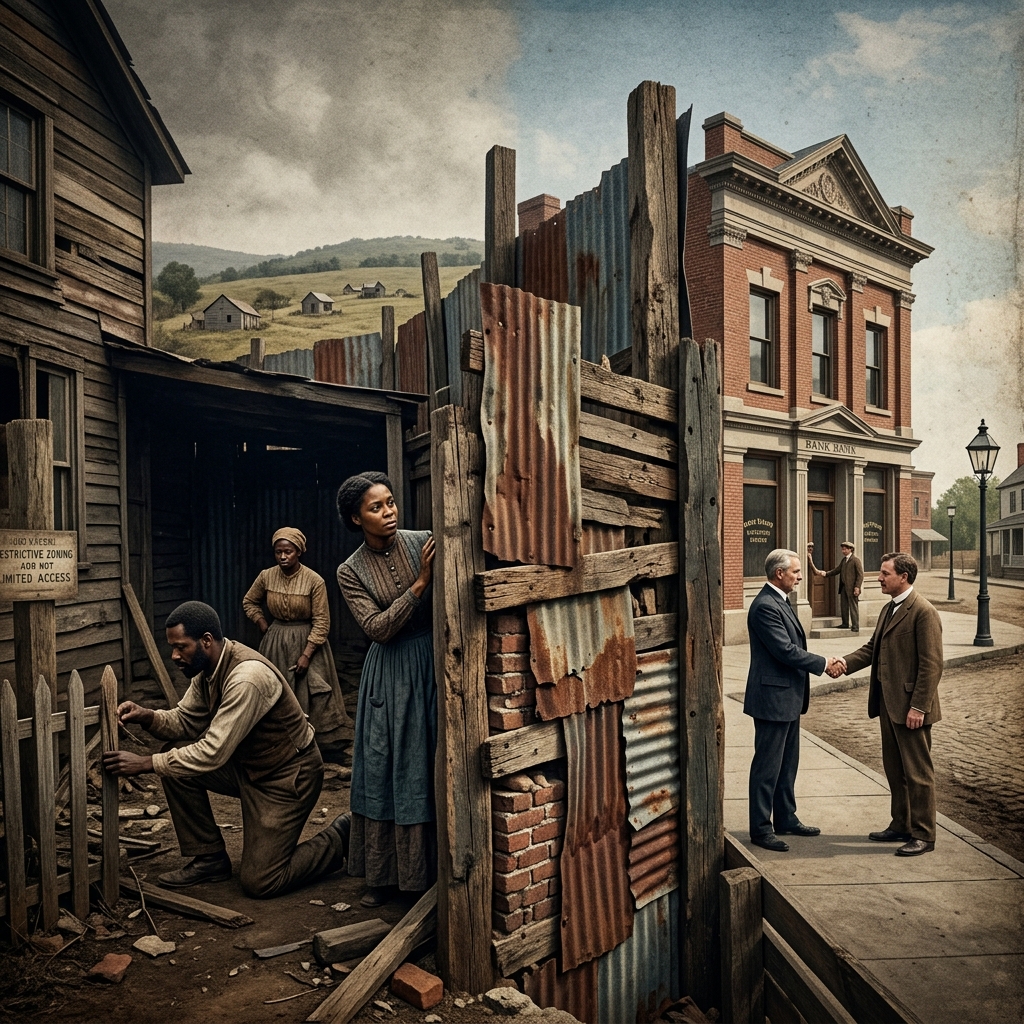
The Enduring Blueprint of Financial Disenfranchisement
The narrative of American progress often frames the abolition of chattel slavery as the definitive end of racial subjugation in the United States. However, historical and economic data reveal a much darker reality: the end of legalized slavery did not yield true emancipation. Instead, it catalyzed the creation of a sophisticated, multi-layered architecture of economic exclusion designed to maintain the subjugation of Black Americans and preserve a racially stratified social order. The modern racial wealth gap is not a coincidence of free-market economics, nor is it the result of individual failings. It is the highly engineered outcome of generations of targeted policies, localized violence, and systemic deprivation that deliberately intercepted the economic mobility of Black communities.
Understanding the current disparities in American wealth requires looking back to the immediate aftermath of the Civil War. When four million enslaved individuals were freed, they entered a capitalist society devoid of capital, land, or resources. The federal governments brief attempt at reparationsfamously remembered as “40 acres and a mule” was swiftly rescinded, returning confiscated Confederate lands to their former treasonous owners. This initial betrayal set the stage for more than a century of systemic financial strangulation, where local, state, and federal mechanisms worked in tandem to suppress Black economic independence. The legacy of these intersecting systems of oppression is vividly quantifiable today.
The New Mechanisms of Exploitation: Sharecropping and Convict Leasing
In the absence of land ownership, the vast majority of newly freed Black Americans were forced into the sharecropping system. This agricultural model was heavily weighted in favor of white landowners, who provided seed, tools, and land in exchange for a massive share of the crop. Because Black farmers were routinely denied access to fair credit, they were forced into exploitative debt arrangements at local furnishing stores, often owned by the very same landlords. This dynamic created a permanent cycle of debt peonage, effectively tethering Black laborers to the land they worked, stripping them of their ability to accumulate savings, and preventing intergenerational wealth transfers.
Parallel to the sharecropping system was the insidious rise of convict leasing, a practice made legally permissible by the loophole in the 13th Amendment, which abolished slavery “except as a punishment for crime whereof the party shall have been duly convicted.” Southern legislatures quickly enacted “Black Codes”—a series of draconian laws that criminalized benign behaviors such as vagrancy, loitering, and even the inability to prove employment. Black men, women, and sometimes children were disproportionately arrested under these arbitrary laws and subsequently leased out by state and county governments to private corporations .
These leased convicts were forced to labor in coal mines, lumber camps, and on railroads under conditions that often surpassed the brutality of antebellum slavery. Because the private companies did not own the laborersthey merely rented themthere was no economic incentive to keep them alive. The mortality rates in convict leasing camps were extraordinarily high, with brutal beatings, malnourishment, and lethal disease running rampant . This system not only enriched Southern states and private corporations, but it effectively neutralized the economic potential of hundreds of thousands of Black Americans, siphoning away their labor without compensation.
The Era of Racial Terror and Community Erasure
When systemic legal barriers occasionally failed to suppress Black economic advancement, outright physical violence was deployed as a corrective tool. The period following Reconstruction through the mid-20th century was defined by an epidemic of white supremacist terror. While lynchings are frequently remembered as acts of pure racial hatred, they were inextricably linked to economic anxiety and control. Black farmers who managed to acquire land, business owners who dared to compete with white merchants, and individuals who challenged exploitative debt systems were frequent targets of extrajudicial violence.
This violence was not limited to individuals; it was routinely directed at entire communities that exhibited signs of prosperity. The destruction of the Greenwood District in Tulsa, Oklahoma, in 1921often referred to as Black Wall Streetis the most famous example of this phenomenon, but it was far from unique. Similar massacres occurred in Wilmington, North Carolina (1898); Atlanta, Georgia (1906); Elaine, Arkansas (1919); and Rosewood, Florida (1923). In each instance, thriving Black economic hubs were burned to the ground by white mobs, often with the complicity or direct participation of local law enforcement. The wealth accumulated in these communitieshomes, businesses, banks, and generational savingswas literally reduced to ashes overnight.
Economic Fear as a Mechanism of Control
The psychological impact of this violence served as a powerful economic deterrent. The omnipresent threat of lynching and property destruction sent a clear message: economic success for Black Americans was inherently dangerous. Consequently, the natural pathways to wealth buildinginvesting in highly visible businesses, acquiring large tracts of land, or asserting labor rightswere fraught with mortal peril. This environment of terror successfully stifled enterprise and reinforced the economic subordination of the Black population for decades, ensuring that the primary beneficiaries of regional economies remained white.
The Mid-Century Federal Subsidies That Excluded Black Americans
As the United States moved into the 20th century and navigated the Great Depression and World War II, the federal government enacted a series of sweeping policies that effectively built the modern American middle class. However, these programs were deliberately structured to exclude Black citizens, thereby supercharging the racial wealth gap on a national scale.
The Servicemen’s Readjustment Act of 1944, commonly known as the GI Bill, provided unprecedented benefits to returning veterans, including low-cost mortgages, low-interest loans to start businesses, and dedicated funds for college tuition. While the legislation was written as race-neutral, it was administered at the local level. In a heavily segregated society, this local administration allowed for widespread discrimination. White veterans used the GI Bill to buy homes in rapidly appreciating suburbs and attain advanced degrees. Conversely, Black veterans were routinely steered toward vocational training rather than university education, and they were systemically denied mortgage loans by banks unwilling to lend to Black borrowers .
This localized discrimination in GI Bill allocation functioned alongside the federal policy of “redlining.” The Home Owners’ Loan Corporation (HOLC) and the Federal Housing Administration (FHA) created color-coded maps of American cities, outlining neighborhoods with high Black populations in red and designating them as “hazardous” for investment. The FHA explicitly refused to back mortgages in these neighborhoods and subsidized the mass production of subdivisions on the condition that the homes not be sold to Black buyers. Because homeownership is the primary engine of wealth accumulation for most American families, this systemic exclusion meant that while white families were building immense generational equity in the post-war boom, Black families were trapped in predatory rental markets or structurally devalued urban centers.
Quantifying the Modern Legacy of Historical Injustice
The compound interest of this centuries-long economic exclusion is staggering. Today’s racial wealth gap is the direct mathematical result of unpaid slave labor, stolen land, the destruction of prosperous communities, and systemic exclusion from the greatest wealth-building federal programs in history. Wealth is fundamentally iterative; the ability to pay for a child’s college tuition, assist with a down payment on a home, or leave an inheritance is contingent on the capital accumulated by previous generations.
Data from the Federal Reserve Board and the U.S. Department of the Treasury repeatedly confirms the severity of this crisis . The disparities persist across all income levels, demonstrating that the gap is not merely a symptom of current educational attainment or individual financial literacy, but a structural deficiency rooted deep in historical deprivation.
Snapshot of the Wealth Divide
| Economic Metric | White Families | Black Families | Historical Root Cause |
|---|---|---|---|
| Average Wealth Multiplier | Baseline (1x) | Approx. 1/8th of Baseline | Lack of inherited assets due to centuries of asset stripping and exclusion . |
| Homeownership Rates | Significantly Higher (Approx 70%+) | Significantly Lower (Approx 40%+) | FHA Redlining and localized discrimination in GI Bill mortgage distribution . |
| Poverty Over-representation | Under-represented relative to population | Over-represented | Sharecropping, convict leasing, and employment discrimination . |
Breaking the Chains of Systemic Disenfranchisement
Addressing a disparity this vast and structurally ingrained requires interventions that go far beyond standard financial literacy campaigns or broad economic stimuli. Recognizing the specific, historical nature of the racial wealth gap is the first step toward meaningful repair. The legacy of post-abolition economic terrorism and targeted federal exclusion means that race-neutral policies often fail to bridge the divide, as they do not account for the multi-generational head start afforded to white families.
Scholars and policymakers are increasingly examining targeted systemic interventions designed to inject capital directly into disenfranchised communities. Proposals such as “Baby Bonds” (federally funded trust accounts set up for children at birth, scaled inversely to family wealth), aggressive enforcement of fair housing laws, systemic debt relief, and formal reparations programs are critical elements of the ongoing discourse. Only by confronting the intentional historical architecture of the racial wealth gap can the United States begin to dismantle its enduring economic inequalities.
Frequently Asked Questions (FAQs)
- What is the 13th Amendment loophole?
While the 13th Amendment to the U.S. Constitution abolished slavery and involuntary servitude in 1865, it included an exception: “except as a punishment for crime whereof the party shall have been duly convicted.” This loophole allowed southern states to criminalize Black Americans via “Black Codes” and lease their forced labor to private industries .
- How did the GI Bill contribute to the racial wealth gap?
Although the 1944 GI Bill provided exceptional benefits like low-cost mortgages and tuition assistance, its administration was localized. In a heavily segregated America, local banks and VA offices routinely denied Black veterans access to these funds, preventing them from participating in the post-war housing and education boom that built the white middle class .
- What was redlining?
Redlining was a government-sanctioned practice that began in the 1930s where the Federal Housing Administration (FHA) and other agencies mapped out cities and drew red lines around Black neighborhoods, explicitly deeming them “hazardous” for investment. This led to the widespread denial of mortgages and capital for Black Americans, crippling their ability to build wealth through homeownership.
- Why is the wealth gap different from the income gap?
Income refers to the money a person earns through work on a regular basis, whereas wealth (or net worth) is the sum of all accumulated assets (homes, savings, investments) minus debts. The wealth gap is much wider than the income gap because wealth is cumulative and intergenerational , heavily influenced by historical policies that prevented Black families from accumulating and passing down assets.
References
- The Fed – Wealth Inequality and the Racial Wealth Gap Federal Reserve. 2021-10-22. https://www.federalreserve.gov/econres/notes/feds-notes/wealth-inequality-and-the-racial-wealth-gap-20211022.htm
- Racial Inequality in the United States U.S. Department of the Treasury. 2022-07-21. https://home.treasury.gov/news/featured-stories/racial-inequality-in-the-united-states
- Not all WWII veterans benefited equally from the GI Bill The Heller School for Social Policy and Management at Brandeis University. 2023-11-07. https://heller.brandeis.edu/news/items/releases/2023/gi-bill-inequity.html
- Dark Heritage in the New South: Remembering Convict Leasing in Southern Middle Tennessee through Community Archaeology National Center for Biotechnology Information (PMC). 2021-06-17. https://www.ncbi.nlm.nih.gov/pmc/articles/PMC8211068/
Similar Articles








Read full bio of Sneha Tete




