
Financial Gatekeeping: Payment Policies and Digital Work
How corporate payment regulations reshape digital economies and human rights.
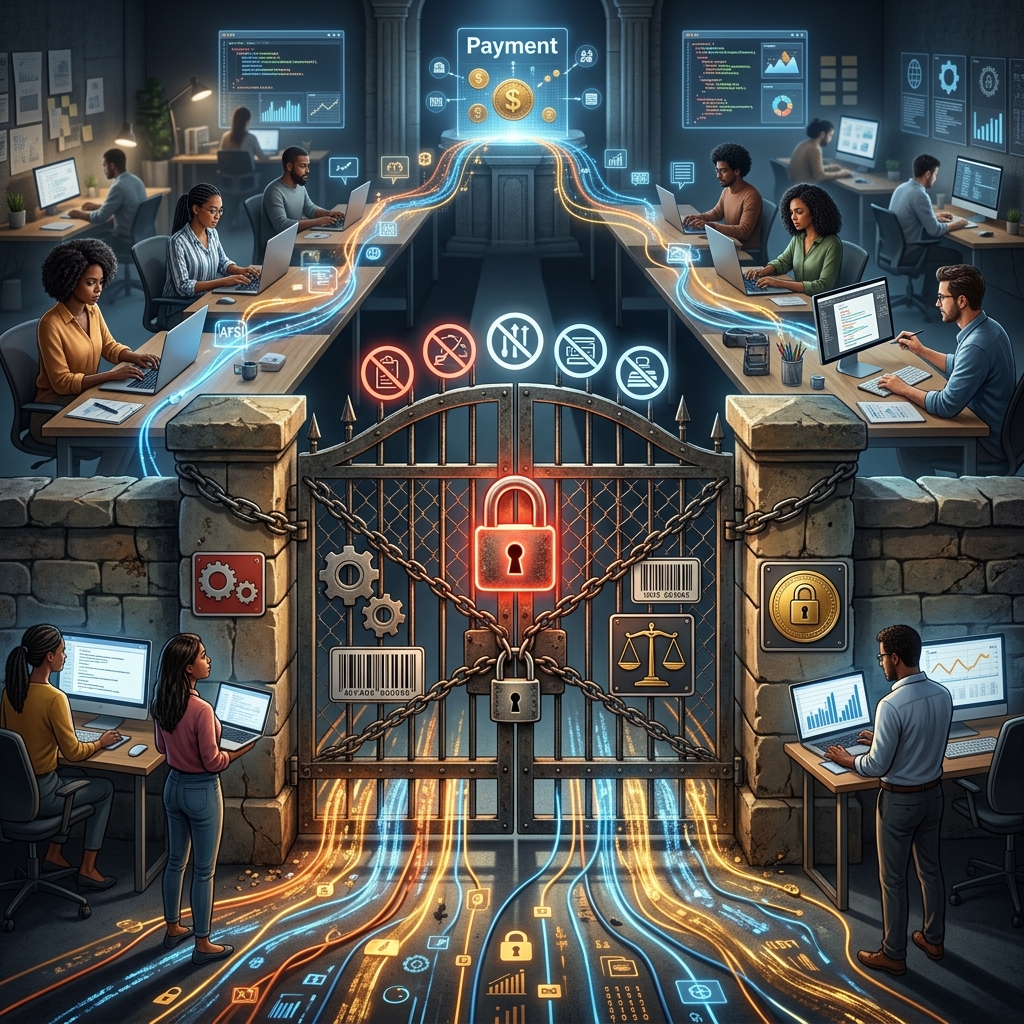
Introduction: The Intersection of Corporate Policy and Digital Livelihoods
Over the last decade, the global workforce has experienced a massive migration toward the digital gig economy. For many, internet platforms offer unprecedented opportunities to build independent businesses, connect with niche audiences, and secure a livelihood outside the confines of traditional corporate structures. However, this digital frontier is far from a borderless, unregulated utopia. It is heavily governed by a hidden layer of digital infrastructure: the payment processing networks. These financial intermediaries wield immense power over the digital economy, dictating not only who is allowed to participate in modern commerce but also what kind of speech, art, and labor is deemed acceptable for monetization.
The concept of financial censorship occurs when institutions restrict access to banking and payment services to curtail specific types of commerce or expression. Recently, civil liberties advocates have raised alarms regarding the updated compliance standards implemented by major credit card networks. By imposing sweeping, overly broad requirements on adult content platforms and independent creators, these financial entities have inadvertently constructed a labyrinthine compliance architecture. While ostensibly designed to prevent illegal activities and protect brand reputation, these policies often have a devastating ripple effect. They disproportionately harm marginalized digital workers—particularly independent sex workers, LGBTQ+ creators, and marginalized artists—pushing them off secure platforms and effectively cutting off their primary means of economic survival.
The Mechanics of Financial Gatekeeping
To understand the profound impact of these policies, one must first examine how payment networks operate. Entities like Visa and Mastercard function as a global duopoly in the transaction space. They do not hold consumer funds directly like traditional banks; instead, they provide the essential infrastructure that enables merchants, acquiring banks, and issuing banks to communicate and transfer capital. Because of this central position, when these networks update their specialty merchant standards, the rules cascade down through the entire digital economy.
In recent years, these networks introduced stringent new mandates for platforms hosting mature content. These requirements included mandatory pre-approval of all digital content prior to publication, the retention of extensive biometric and identity verification records for all participants, and strict, expedited complaint resolution protocols. For massive, multi-billion-dollar technology conglomerates, building the automated systems and hiring the vast moderation teams necessary to comply with these rules is a manageable, albeit expensive, cost of doing business.
However, for independent platforms, creator-owned cooperatives, and solo digital entrepreneurs, these requirements present an insurmountable barrier. The cost of integrating enterprise-grade artificial intelligence moderation tools and maintaining legally rigorous data privacy vaults is simply out of reach for small businesses. Consequently, many independent platforms are forced to over-comply—banning entirely legal forms of expression, art, and commerce just to ensure they do not accidentally run afoul of the payment networks’ ambiguous guidelines. If a platform is deemed non-compliant, it risks losing its merchant account entirely, which equates to an immediate death sentence in the digital economy.
Economic Marginalization and the LGBTQ+ Community
The implementation of restrictive financial policies does not impact all demographics equally. The consequences are acutely felt by marginalized populations who rely on alternative digital economies to escape systemic discrimination in the traditional workforce. The LGBTQ+ community, in particular, has historically faced immense barriers to conventional employment, making the accessibility of the digital gig economy a vital lifeline.
According to comprehensive 2024 data published by the Williams Institute at the UCLA School of Law, nearly half of all LGBTQ+ employees in the United States have experienced workplace discrimination or harassment during their careers. Transgender and nonbinary individuals face even steeper hurdles, with a staggering majority reporting adverse professional actions based on their gender identity. Faced with hostile corporate environments, unequal pay, and discriminatory hiring practices, many queer individuals turn to independent digital content creation as a safe and autonomous method of generating income.
When payment processors arbitrarily restrict the flow of capital to platforms that host mature or queer-themed content, they are effectively severing this economic lifeline. Civil rights organizations have repeatedly pointed out that vague community guidelines and sweeping adult content bans frequently result in the disproportionate flagging and removal of LGBTQ+ content. By blocking the financial infrastructure that supports these creators, corporate payment policies inadvertently reinforce real-world economic inequalities, forcing vulnerable individuals back into precarious, and often dangerous, financial situations.
The Precedent of FOSTA-SESTA and Its Lingering Effects
The contemporary landscape of financial gatekeeping cannot be analyzed in a vacuum. It is the direct descendant of legislative actions that fundamentally altered the liability of internet platforms. The most notable precedent is the 2018 passage of the Allow States and Victims to Fight Online Sex Trafficking Act and the Stop Enabling Sex Traffickers Act, collectively known as FOSTA-SESTA. This legislation amended Section 230 of the Communications Decency Act, stripping platforms of their long-standing safe harbor protections if their networks were found to facilitate prostitution or trafficking.
While the stated intent of FOSTA-SESTA was to protect vulnerable individuals, the real-world application created a chilling effect that decimated the digital safety nets of independent sex workers. A peer-reviewed study published in the Anti-Trafficking Review revealed that the immediate aftermath of the legislation severely compromised the financial stability of digital workers. Because platforms feared crippling legal liability, they aggressively purged user-generated content, shuttering verification forums, safety screening tools, and advertising spaces. Independent workers, who had utilized the internet to safely screen clients and maintain autonomy away from exploitative third parties, were abruptly pushed into riskier, underground environments.
The actions of modern payment processors are effectively a privatized continuation of the FOSTA-SESTA era. Where the government used legislative liability to force content moderation, financial networks are now using the threat of economic excommunication to enforce a sanitized version of the internet. This privatized regulation is arguably more insidious, as it operates entirely outside of democratic oversight, legislative debate, or constitutional free speech protections.
The Evolution of Digital Content Regulation
| Year | Policy or Catalyst | Primary Mechanism | Market Impact |
|---|---|---|---|
| 2018 | FOSTA-SESTA Legislation | Amended CDA Section 230 to increase civil and criminal platform liability. | Mass closure of digital safety tools; displacement of independent workers to precarious environments. |
| 2021-2022 | Mastercard Specialty Standards | Mandated strict identity verification, biometric retention, and content pre-approval. | Independent platforms faced insurmountable compliance costs; surge in over-compliance and censorship. |
| 2024-2025 | Payment Processor Pressure on Gaming | Threatened transaction blocking for platforms hosting mature or LGBTQ+ themed digital media. | Removal of hundreds of independent video games from digital storefronts like Steam and Itch.io. |
Privatized Censorship and Freedom of Expression
Beyond the immediate economic devastation, the tightening grip of financial institutions raises profound questions regarding the future of free expression online. Because payment processors are private corporate entities, they are not strictly bound by the First Amendment, which limits government censorship. However, due to their monopolistic control over digital commerce, their internal policy decisions function as a form of global, privatized censorship.
This phenomenon is not limited to adult entertainment. The chilling effect of financial gatekeeping regularly spills over into art, health education, and digital media. For example, recent reports from major news outlets like The Guardian have detailed how payment networks pressured massive video game distribution platforms, such as Steam and Itch.io, to indiscriminately remove hundreds of mature and LGBTQ+-themed video games under the threat of losing payment processing capabilities. Educational platforms providing critical sexual health information, independent filmmakers, and queer artists frequently find their accounts frozen or terminated without recourse.
When a handful of financial executives are allowed to dictate the boundaries of acceptable digital expression, the internet fundamentally shifts from an open marketplace of ideas to a heavily curated corporate environment. The lack of a formalized appeals process leaves creators entirely at the mercy of opaque, automated risk-assessment algorithms.
Navigating the Future: Alternatives and Regulatory Oversight
As traditional financial networks become increasingly restrictive, the digital economy is actively searching for alternatives. One potential avenue is the adoption of decentralized financial technologies, such as cryptocurrencies and blockchain-based payment gateways. Because these networks operate without a centralized corporate authority, they are theoretically immune to the type of policy-driven censorship enforced by major credit card companies. However, the volatility of digital currencies and the steep technical barriers to entry currently prevent them from serving as a universal replacement for mainstream fiat processing.
Another vital path forward involves regulatory intervention. Digital rights advocates and civil liberties organizations are increasingly lobbying agencies like the Federal Trade Commission (FTC) to investigate the monopolistic practices of major payment networks. There is a growing consensus that financial infrastructure should be treated akin to a public utility—entities that provide essential services should not be permitted to arbitrarily discriminate against lawful commerce based on internal moral posturing or brand management strategies.
Conclusion
The tension between corporate compliance and human rights represents one of the most critical digital policy battles of our era. While the desire to eliminate exploitation and illegal activity on the internet is a necessary and universal good, the blunt instruments deployed by payment processors have proven disastrous. By mandating draconian compliance frameworks, financial institutions are actively destroying the economic livelihoods of the internet’s most vulnerable populations. Protecting the safety of marginalized individuals requires empowering them with secure, accessible digital tools and financial independence, rather than pushing them into the shadows through algorithmic exclusion and corporate gatekeeping. A truly equitable digital economy must balance robust safety measures with an unwavering commitment to financial inclusivity and freedom of expression.
Frequently Asked Questions (FAQs)
- What is financial censorship?
Financial censorship occurs when banks, credit card networks, or payment processors restrict or terminate access to financial services in order to silence specific groups, control digital expression, or curtail lawful commerce. It effectively removes a business or individual’s ability to participate in the modern digital economy. - How do payment processors influence internet content?
Because almost all digital platforms rely on networks like Visa and Mastercard to process transactions, these networks can dictate what content is allowed. If a platform refuses to comply with a processor’s content guidelines, the processor can revoke their merchant account, effectively bankrupting the platform. This forces platforms to aggressively moderate and often over-censor user content to maintain financial access. - Why are LGBTQ+ individuals disproportionately affected by these policies?
Due to systemic discrimination in traditional employment, a higher percentage of LGBTQ+ individuals rely on independent digital work and the gig economy for their livelihood. Broad, poorly defined adult content bans frequently flag queer art, education, and expression as policy violations, cutting these creators off from their income streams. - What was the impact of the FOSTA-SESTA legislation?
Passed in 2018, FOSTA-SESTA increased platform liability for user-generated content. Instead of solely stopping trafficking, it caused platforms to panic and shut down vital communication and safety tools used by consensual, independent digital workers. This displaced workers, reduced their income, and pushed them into more dangerous economic situations.
References
- How Mastercard is Endangering Sex Workers — American Civil Liberties Union (ACLU). 2023-08-30. https://www.aclu.org/news/free-speech/how-mastercard-is-endangering-sex-workers
- Mastercard statement reinforcing adult content standards — Mastercard Official Press Release. 2022-08-04. https://www.mastercard.com/news/press/2022/august/mastercard-statement-reinforcing-adult-content-standards/
- LGBTQ People’s Experiences of Workplace Discrimination and Harassment — The Williams Institute, UCLA School of Law. 2024-08-15. https://williamsinstitute.law.ucla.edu/publications/lgbtq-workplace-discrimination/
- Erased: The impact of FOSTA-SESTA and the removal of Backpage on sex workers — Blunt, D., and Wolf, A. Anti-Trafficking Review. 2020. https://doi.org/10.14197/atr.201220148
- Mastercard and Visa face backlash after hundreds of adult games removed from online stores Steam and Itch.io — The Guardian. 2025-07-28. https://www.theguardian.com/australia-news/2025/jul/28/mastercard-and-visa-face-backlash-after-hundreds-of-adult-games-removed-from-online-stores-steam-and-itchio
Similar Articles








Read full bio of Sneha Tete




