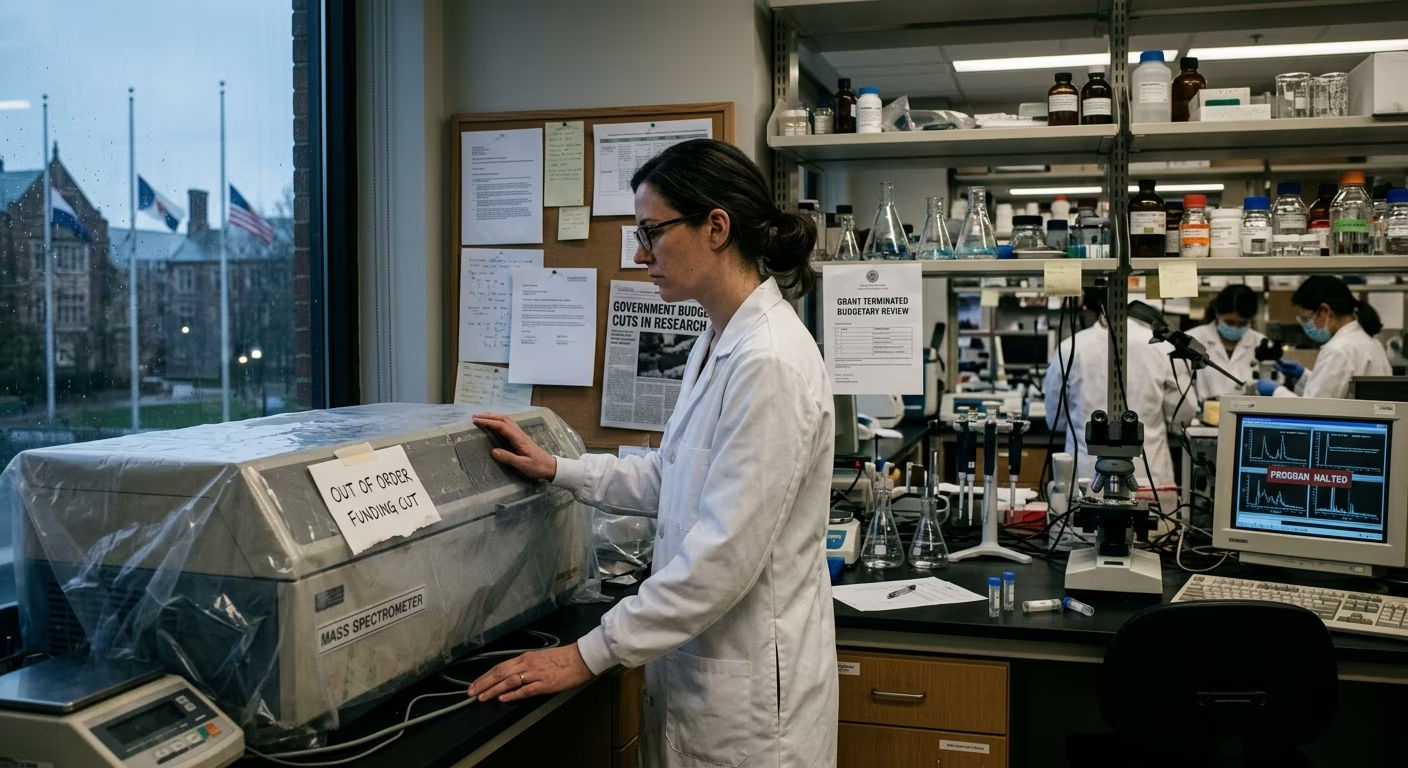
The relationship between scientific discovery and federal governance has long been considered a foundational pillar of modern public health. For decades, the United States has led the globe in biomedical innovation, driven largely by robust, independent funding mechanisms. The National Institutes of Health (NIH) has historically operated as the crown jewel of this system, dispersing billions of dollars annually to academic institutions, clinical laboratories, and healthcare facilities. These investments have catalyzed breakthroughs in cancer therapeutics, infectious disease management, and chronic illness interventions. However, the early months of 2025 witnessed a seismic disruption in this established ecosystem. An unprecedented wave of sudden grant cancellations sent shockwaves through the scientific community, leaving prominent researchers bewildered and halting years of meticulous public health progress.
This crisis did not emerge from a lack of scientific rigor or a failure in ethical compliance on the part of the researchers. Instead, it was the direct result of political directives that prioritized ideological alignment over empirical advancement . Projects targeting specific demographics—particularly those involving diversity, equity, and inclusion (DEI) frameworks, LGBTQ+ health disparities, and vaccine hesitancy—were systematically dismantled. This abrupt shift marked a dangerous departure from the objective, peer-reviewed standards that have historically insulated scientific inquiry from the volatile winds of partisan politics. The resulting fallout has not only jeopardized critical medical discoveries but has also sparked intense legal and ethical debates regarding the autonomy of federal research institutions.
The Anatomy of the 2025 Funding Crisis
To truly understand the magnitude of this disruption, one must examine the rigorous protocols that normally govern federal biomedical grants. Traditionally, securing capital from the NIH is a highly competitive and exhaustive process. Researchers spend months, sometimes years, drafting comprehensive proposals that outline their methodologies, anticipated public health impacts, and ethical safeguards. These proposals are then subjected to a dual-level peer review system. The first level involves an evaluation by a Scientific Review Group comprised of non-federal experts who assess the project’s significance, innovation, and feasibility . The second level involves an Advisory Council that aligns the top-scoring proposals with the overarching mission of the specific health institute .
The 2025 funding purge entirely bypassed this established meritocracy. Without prior warning or scientific justification, federal administrators issued directives to terminate hundreds of active projects. Investigators who had successfully navigated the grueling peer-review process and had been actively conducting research for years suddenly found their accounts frozen. The justifications provided in termination letters were notably devoid of scientific critique. Instead, they relied on vague assertions that projects addressing “gender identity” or “equity” no longer aligned with shifting agency priorities. This arbitrary revocation of resources undermined the foundational integrity of the peer-review system, signaling that political buzzwords could instantly invalidate years of objective scientific consensus.
| Process Stage | Traditional Scientific Protocol | The 2025 Ideological Intervention |
|---|---|---|
| Initial Evaluation | Proposals judged purely on significance, innovation, and methodology by independent scientists. | Projects flagged via automated keyword searches targeting DEI, gender, or infectious disease topics. |
| Funding Approval | Recommendations made by an Advisory Council based on long-term public health needs and data. | Grants unilaterally terminated by administrative directives, bypassing the Advisory Council completely. |
| Project Oversight | Continuous funding guaranteed contingent upon passing annual ethical and milestone reviews. | Active accounts frozen mid-cycle without warning or formal scientific review of the data collected. |
Disrupting Lifesaving Innovation: The Ethical Toll on Patients
Beyond the bureaucratic turmoil, the ideological defunding of science carries a profound human cost. The most immediate casualties of these abrupt cancellations are the patients and volunteers participating in active clinical trials. Bioethical standards mandate that human subjects are treated with the utmost care and that their participation directly contributes to generalizable knowledge. When a federally funded clinical trial is halted mid-stream due to arbitrary financial withdrawal, it creates a severe ethical breach. Participants who assumed the inherent physical and emotional risks of experimental treatments are abruptly abandoned without follow-up care or alternative therapies.
Furthermore, the incomplete data resulting from prematurely terminated studies is frequently deemed statistically insignificant. This means that the sacrifices made by study participants, along with millions of taxpayer dollars already invested in the early phases of the research, are effectively squandered. Lifesaving breakthroughs in oncology, neurology, and infectious diseases require longitudinal stability. They rely on consistent data collection over extended periods. Breaking this continuity does not merely delay a project; it destroys the viability of the entire study, forcing researchers to abandon promising therapeutic avenues that could have alleviated suffering for millions of individuals.
Vulnerable Populations at the Center of the Storm
Vulnerable populations were placed directly at the center of this storm. By specifically targeting research that addresses health disparities, the directives effectively erased crucial investigations into the unique medical challenges faced by marginalized communities. This targeted defunding created massive blind spots in the national healthcare apparatus, including the disruption of:
- Neurological Studies: Long-term projects examining the disproportionate prevalence of Alzheimer’s disease and other forms of dementia within Black American populations.
- Maternal Health: Interventions designed to reduce the severely elevated maternal mortality rates among minority demographics.
- LGBTQ+ Healthcare: Specialized therapeutic care protocols and mental health resources optimized for transgender and queer youth.
- Infectious Disease: Public health outreach programs targeting communities with historically high rates of HIV or profound vaccine hesitancy.
This selective eradication of data collection guarantees that future medical advancements will lack the necessary demographic inclusivity, thereby exacerbating existing health inequities and leaving the most vulnerable populations without targeted medical solutions.
The Chilling Effect on the Scientific Workforce
The secondary impact of this crisis is the chilling effect it has cast over the scientific workforce. A major biomedical research grant is not merely a check written to a principal investigator; it is the economic lifeblood of a complex laboratory ecosystem. These funds support the salaries of postdoctoral fellows, clinical coordinators, laboratory technicians, and graduate students. When a multi-million-dollar grant vanishes overnight, principal investigators are forced into the agonizing position of dismantling their teams. Layoffs ripple through academic institutions, halting the career progression of emerging scientists and driving top-tier talent out of the public research sector.
This environment of extreme instability fosters a pervasive culture of self-censorship. If federal funding is perceived as contingent upon the political palatability of the research topic rather than its scientific necessity, researchers are likely to alter their areas of focus. Early-career scientists, who are particularly vulnerable to funding insecurities, may intentionally avoid investigating critical but controversial public health issues—such as reproductive health, environmental justice, or systemic health disparities—to ensure their professional survival. Over time, this self-censorship drastically narrows the scope of scientific inquiry, leaving society ill-equipped to handle complex, multifaceted public health crises.
Legal Resistance: Public Health Organizations Defend Scientific Integrity
In response to this unprecedented administrative overreach, a coalition of scientific researchers, civil liberties advocates, and public health organizations mobilized to defend the integrity of the scientific process. Major entities, including the American Public Health Association (APHA), labor unions representing academic workers, and prominent civil rights groups, filed federal lawsuits against the Department of Health and Human Services and the NIH . These legal challenges, most notably the landmark litigation that took place in federal district courts, sought an immediate injunction against the grant cancellations, arguing that the directives represented an unlawful ideological purge.
The core legal argument centered on the Administrative Procedure Act (APA), a federal statute that governs the process by which administrative agencies develop and issue regulations. Under the APA, agency actions that are “arbitrary, capricious, an abuse of discretion, or otherwise not in accordance with law” can be invalidated by federal courts. The plaintiffs successfully argued that terminating heavily vetted, active research grants based on undefined political criteria—without offering a rational scientific justification—met the exact definition of arbitrary and capricious behavior. Furthermore, legal representatives highlighted that the targeting of specific demographics constituted a violation of fundamental protections, effectively weaponizing the federal budget to enact discriminatory policies.
The judicial system responded with decisive rebukes of the administration’s actions. In mid-2025, federal judges delivered blistering rulings against the NIH directives. The courts recognized that allowing political appointees to override the established scientific peer-review process would cause irreparable harm to the nation’s public health infrastructure. These rulings not only mandated the immediate reinstatement of the unlawfully terminated grants but also set a crucial legal precedent. They reaffirmed that while executive agencies have discretion in setting broad research priorities, they cannot retroactively destroy standing contracts and active clinical trials based on partisan animus.
Safeguarding the Future: Restoring the Bedrock of Independent Research
While the legal victories provided temporary relief to devastated researchers, the crisis exposed deep structural vulnerabilities within the federal research funding apparatus. Safeguarding the future of biomedical innovation requires a multifaceted approach to insulate scientific endeavors from executive overreach. Lawmakers must establish stronger legislative firewalls that legally bind active grant funding to the outcomes of objective peer review, preventing mid-cycle terminations without explicit scientific or ethical cause.
Additionally, rebuilding the shattered trust between the federal government and the scientific workforce will require transparent commitments to academic freedom and demographic inclusivity. The advancement of human health is a universal imperative; it must remain anchored in empirical evidence, rigorous methodology, and a steadfast dedication to serving all populations, entirely independent of the political zeitgeist. Without these guarantees, the United States risks forfeiting its position as a global leader in medical innovation, ultimately failing the patients who rely on the promise of scientific discovery.
Frequently Asked Questions (FAQs)
What led to the sudden disruption of biomedical funding in 2025?
In early 2025, federal administrators issued unprecedented directives to the National Institutes of Health (NIH) to halt funding for hundreds of active research projects. These cancellations were not based on scientific failure but were politically motivated, targeting research associated with diversity, equity, inclusion (DEI), gender identity, and infectious disease public health policies.
How does the standard peer-review process for public health research work?
Traditionally, NIH grants are awarded after a rigorous dual-level peer-review process. First, independent scientists evaluate proposals for methodology, innovation, and public health impact. Second, an Advisory Council ensures the research aligns with long-term institute goals. This process ensures funding is distributed based on scientific merit rather than political preference.
Why did civil rights and public health organizations file lawsuits against the government?
Organizations like the American Public Health Association (APHA) and various civil liberties groups sued the government arguing that the arbitrary cancellation of active grants violated the Administrative Procedure Act (APA). They maintained that terminating contracts without scientific justification was an unlawful, discriminatory, and “arbitrary and capricious” abuse of executive power.
What happens to clinical trial patients when research funding is abruptly canceled?
When a trial is halted mid-stream due to funding cuts, patients who assumed the risks of experimental treatments are often left without follow-up care or alternative therapies. Furthermore, the partial data collected usually becomes statistically invalid, meaning the patients’ sacrifices and the taxpayer dollars invested are entirely wasted.
How did the judicial system respond to the funding cuts?
Federal district courts delivered decisive rulings against the government’s ideological purge. Judges found that the NIH directives were arbitrary, capricious, and discriminatory. The courts ordered the immediate reinstatement of the unlawfully terminated grants, reinforcing the necessity of protecting scientific research from political interference.
References
- American Public Health Association et al. v. National Institutes of Health et al., Docket No. 1:25-cv-10787 (D. Mass. 2025) — Civil Rights Litigation Clearinghouse. 2026-04-20. https://clearinghouse.net/case/
- First Level: Peer Review — National Institutes of Health (NIH). 2026-04-28. https://grants.nih.gov/grants/peer/peer.htm
- Background – NIH Peer Review Process — National Institutes of Health (NIH). 2026-04-28. https://grants.nih.gov/grants/peer-review.htm
- NIH v. APHA: Supreme Court ‘Shadow Docket’ Ruling Casts a Long Shadow Over Health Care Research — American Public Health Association. 2025-09-18. https://www.apha.org/