
Washington Last Will and Testament Guide
Comprehensive guide to creating a valid last will and testament in Washington State, covering requirements, execution, and probate essentials.
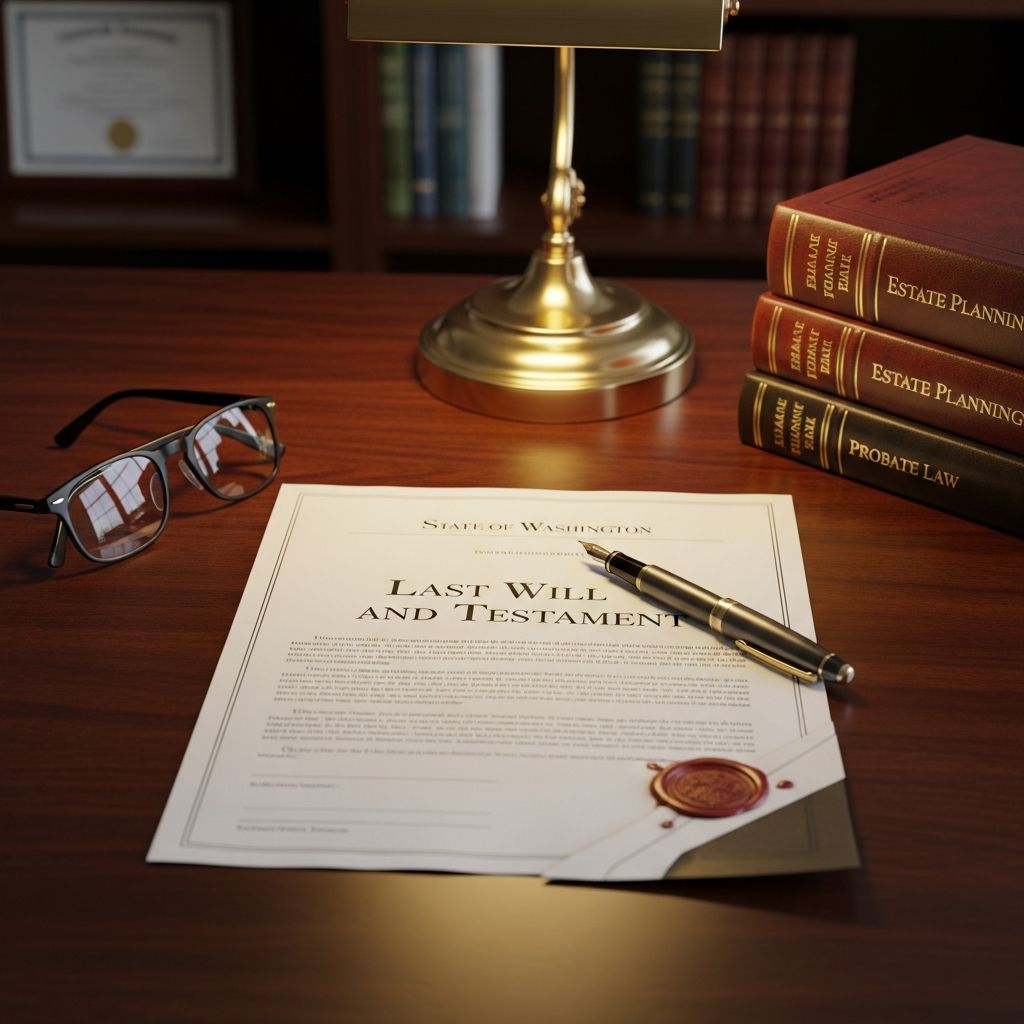
Creating a last will and testament in Washington State ensures your assets are distributed according to your wishes after your passing. This legal document outlines who receives your property, appoints guardians for minors, and names an executor to manage the process. Washington law sets specific rules for validity, emphasizing written form, signatures, and witnesses to prevent disputes.
Essential Legal Requirements for a Valid Will
To qualify as a valid will in Washington, the document must meet strict criteria established by state statutes. Primarily, the creator, known as the testator, must be at least 18 years old and possess sound mental capacity, meaning they understand the nature of their assets, relationships, and the will’s implications.
The will must be in writing, which includes typed, printed, or handwritten formats. Washington does not mandate typing; even handwriting by someone else is acceptable if signed properly by the testator. Oral or video wills are invalid, though electronic wills are permitted under narrow conditions requiring text readability and electronic signatures with witnesses present via live audio-video.
- Age and Capacity: 18+ years, sound mind
- Form: Written (paper or qualified e-will)
- Signature: Testator’s or proxy in their presence
Signature and Witness Protocols
Execution demands the testator’s signature at the document’s end, ideally dated, in the presence of at least two competent witnesses who are 18+, of sound mind, and preferably disinterested—not beneficiaries. Witnesses must sign the will or a separate affidavit attesting to the signing.
Disinterested witnesses reduce challenges, though interested ones may only be disqualified for provisions benefiting them. The signature authenticates intent; anything after it risks invalidation if material.
| Element | Requirement | Purpose |
|---|---|---|
| Testator Signature | At end, in witness presence | Confirms intent |
| Witnesses | 2 minimum, competent, sign will/affidavit | Validates execution |
| Notarization | Optional for self-proving | Streamlines probate |
Making Your Will Self-Proving
While notarization is unnecessary for validity, a self-proving affidavit enhances efficiency. Witnesses sign a notarized declaration under penalty of perjury, or an affidavit, confirming the testator’s capacity, voluntary signing, and their witnessing. This eliminates court testimony needs during probate. Only Louisiana mandates notarization; Washington’s approach prioritizes probate speed.
For electronic wills, similar affidavits apply with electronic notarization where allowed.
Key Components to Include in Your Will
A comprehensive will covers several critical elements beyond basic validity.
- Revocation Clause: Explicitly revoke prior wills to avoid conflicts.
- Beneficiaries: Detail asset recipients, including contingencies for predecease.
- Executor (Personal Representative): Name a trusted individual to collect assets, pay debts, and distribute per will. Alternates prevent delays.
- Guardians for Minors: Appoint caregivers for children under 18, with successors.
- Charitable Bequests: Support causes for legacy building.
Publication—declaring it your last will—strengthens via clear title and statements.
Step-by-Step Process to Create Your Washington Will
Drafting follows a structured approach:
- Assess Assets: Inventory property, accounts, real estate.
- Choose Method: Online makers for simplicity, attorneys for complexity. Avoid rigid templates prone to errors.
- Draft Content: Identify beneficiaries, guardians, executor.
- Review Capacity: Ensure soundness; video optional for clarity.
- Execute: Sign with witnesses; add self-proving affidavit.
- Store Safely: Inform executor; avoid safe deposit boxes inaccessible post-death.
Include supporting documents like medical history, funeral wishes, account lists in a will packet.
The Role and Responsibilities of an Executor
The executor, termed personal representative in Washington, manages probate: inventories assets, notifies creditors, pays taxes/debts, distributes remainders. They must act diligently; courts supervise if needed. Naming co-executors or professionals suits large estates.
Probate Process in Washington State
Upon death, the will enters probate in superior court for asset validation/distribution. Self-proving wills expedite; others require witness testimony. Informal probate suits uncontested estates; formal resolves disputes. Duration varies; fees are statutory percentages.
Foreign wills may validate if compliant with execution locale or domicile laws.
What Happens Without a Will: Intestacy Laws
Dying intestate triggers Washington’s intestacy statutes. Assets go to spouse/children first; absent those, parents/siblings, then state if no heirs. This overrides personal wishes, potentially sparking family conflicts or unfavorable distributions.
- Spouse + children: Spouse inherits all community property, shares separate.
- No spouse/children: Parents, siblings cascade.
- No relatives: Escheats to state.
Special Considerations: Electronic and Holographic Wills
Washington permits e-wills if text-readable, signed electronically with two witnesses (physical or audio-video), intent clear. Holographic (fully handwritten) wills lack witness needs but risk validity challenges; better typed with formalities.
Updating and Revoking Your Will
Life changes—marriage, birth, divorce—necessitate codicils or new wills. Marriage/divorce may revoke portions automatically. Destroy old versions; execute revocations witnessed.
Common Pitfalls to Avoid
- Interested witnesses without extras.
- Unsigned/post-signature additions.
- Improper storage leading to loss.
- Ignoring digital assets.
Frequently Asked Questions
Who can make a will in Washington?
Anyone 18+ of sound mind.
Does a will need to be notarized?
No, but self-proving affidavits recommended.
How many witnesses are required?
Two competent witnesses.
What if I die without a will?
Intestacy laws distribute to heirs.
Can I use an online will maker?
Yes, if meeting all requirements.
Are electronic wills legal?
Yes, with specific protocols.
References
- Minimum Requirements for a Valid Will — Washington Wills. Accessed 2026. https://wa-wills.com/legal-library/minimum-requirements-for-a-valid-will/
- Last Will & Testament — Puget Law. Accessed 2026. https://www.pugetlaw.com/estate-planning-wills-and-trusts/last-will-and-testament/
- How to Execute a Will in Washington State — DBL Lawyers. Accessed 2026. https://www.dbllawyers.com/how-do-i-execute-a-will-in-washington-state/
- Requirements to Make a Valid Will in Washington State — Washington Wills. Accessed 2026. https://www.washington-wills.com/wills/what-is-will/
- How to make a will in Washington State — FreeWill. Accessed 2026. https://www.freewill.com/learn/how-to-make-a-will-in-washington-state
- Making a Will in Washington — Nolo. 2025. https://www.nolo.com/legal-encyclopedia/washington-make-will-31675.html
- Will Packet — Pierce County, WA Official Website. Accessed 2026. https://www.piercecountywa.gov/726/Will-Packet
Similar Articles








Read full bio of medha deb




