
Understanding Your Mortgage Payment Breakdown
Learn how principal, interest, taxes, insurance, and other costs fit together in your monthly mortgage payment.
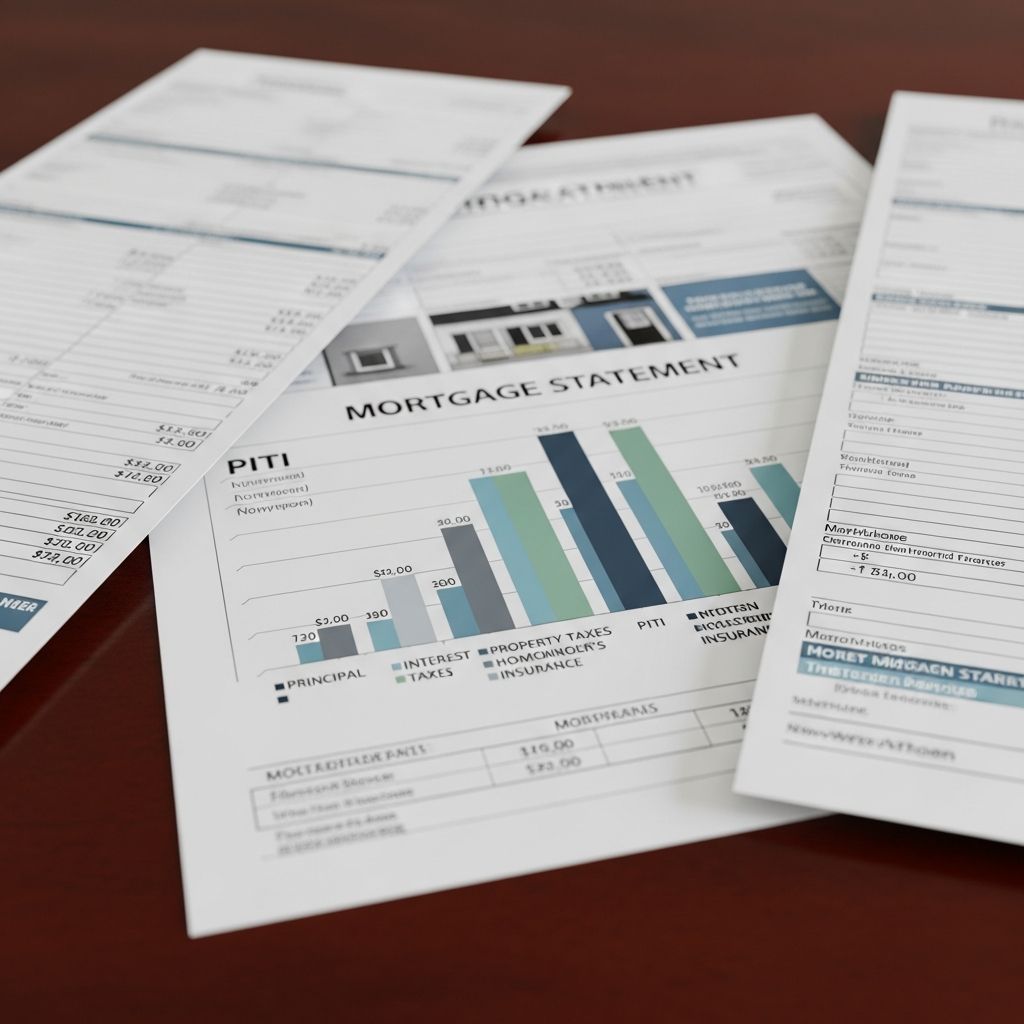
When you start paying a mortgage, it can be confusing to see one total amount due each month but several different line items on your statement. The most important distinction is between your principal and interest payment and your total monthly payment, which usually includes additional costs like taxes and insurance held in escrow.
Knowing how these pieces fit together helps you budget more accurately, compare loan offers, and understand how quickly you are building equity in your home.
Core Idea: Principal and Interest vs. Total Payment
Your mortgage bill typically has two levels of amounts:
- Principal and interest (P&I): The part that goes to repaying what you borrowed and the cost of borrowing.
- Total monthly payment: P&I plus other charges, such as property taxes, homeowners insurance, and possibly mortgage insurance, often collected in an escrow account.
In many cases, the principal and interest amount is only one portion of what you actually send to your mortgage company each month.
What Is Mortgage Principal?
The principal is the amount you borrowed to buy your home and still owe on the loan at any point in time.
- At closing, the principal is generally the purchase price minus your down payment.
- Every month, part of your payment reduces this outstanding principal balance.
- As principal goes down, you build equity and later pay less interest because interest is calculated on the remaining balance.
Most mortgages are amortizing loans, which means the lender structures your payment schedule so that making all scheduled payments in full and on time reduces the principal to zero by the end of the term (for example, 30 years).
What Is Mortgage Interest?
Interest is the cost you pay to borrow money from the lender. It is usually expressed as an annual percentage rate applied to your outstanding principal.
- Your monthly interest charge is based on your current principal balance and your interest rate.
- Early in the life of the loan, a relatively large portion of your payment goes toward interest and a smaller portion toward principal.
- Over time, as principal is paid down, the interest portion shrinks and the principal portion grows.
Your interest rate may be:
- Fixed-rate: Stays the same for the entire loan term.
- Adjustable-rate (ARM): Can change after an initial fixed period, based on a benchmark index and the terms of your loan.
How Principal and Interest Create Your Base Payment
The combination of principal and interest is commonly referred to as your P&I payment. This is the basic loan repayment amount, before taxes, insurance, or other costs.
For a standard fixed-rate mortgage, lenders use an amortization formula to calculate a level monthly P&I payment so you pay the same amount of principal plus interest every month throughout the term, even though the split between principal and interest changes over time.
| Component | What It Covers | Who It Benefits | Included in P&I? |
|---|---|---|---|
| Principal | Repays the amount you borrowed | You (builds equity) | Yes |
| Interest | Cost of borrowing from the lender | Lender | Yes |
| Property taxes | Local government taxes on your property | Local government | No |
| Homeowners insurance | Protects against damage and certain losses | You and lender | No |
| Mortgage insurance (if required) | Protects lender if you stop paying | Lender | No |
What Goes Into Your Total Monthly Mortgage Payment?
For many borrowers, the total monthly payment includes more than just principal and interest. Your mortgage company may collect funds for several other items and hold them in an escrow account. When the bills come due, the servicer pays them on your behalf.
Common components of the total payment include:
- Principal
- Interest
- Property taxes
- Homeowners insurance
- Mortgage insurance (if applicable)
- Escrow-related adjustments
Some housing-related expenses, such as homeowners association (HOA) or condominium fees, are usually paid separately and may not appear in the mortgage payment total.
Understanding Escrow
An escrow account is a separate account managed by your mortgage servicer that holds money collected with your monthly payment to cover certain bills:
- Property taxes
- Homeowners insurance premiums
- Mortgage insurance premiums (when required)
Each month, the servicer adds the escrow portion of your payment to this account, then pays the tax and insurance bills when they are due.
Key points about escrow:
- The amount can change from year to year if your taxes or insurance premiums go up or down.
- Your servicer is generally required to review your escrow at least annually and may adjust your monthly payment if needed.
- If there is a shortage (not enough money in escrow), your monthly payment may increase, or you may be asked to make a lump-sum payment.
In some situations, you may be allowed to pay taxes and insurance on your own without escrow, but you must still budget for those costs carefully, as they can be substantial.
Property Taxes and Your Mortgage
Property taxes are charged by local governments and based on the assessed value of your home and land. These taxes help fund services such as public schools, police, fire departments, and infrastructure.
- They are typically due once or twice a year, but your lender will often estimate the annual total and divide it into twelve monthly installments added to your mortgage bill.
- The amount can change over time due to reassessments, local tax rate changes, or improvements to your property.
- Because taxes are part of the escrow portion, changes in property taxes can cause your total monthly mortgage payment to rise or fall.
Homeowners Insurance in Your Payment
Homeowners insurance protects your property from covered events such as fire, windstorms, theft, and certain other hazards. Lenders typically require you to maintain a policy for at least the amount of the mortgage or the replacement cost of the home.
- Premiums are often paid annually, but your servicer may collect 1/12 of the premium each month via escrow.
- If your premium changes (for example, after a claim or policy adjustment), your escrow portion and total monthly payment can change as well.
- Shopping for coverage and comparing deductibles and limits can sometimes lower your insurance costs.
Mortgage Insurance and When It Applies
Mortgage insurance is different from homeowners insurance. It is designed to protect the lender if you fail to repay the loan, not to protect your home or belongings.
You might see it in several forms:
- Private mortgage insurance (PMI): Common with conventional loans when the down payment is less than 20%.
- Government-backed mortgage insurance: For example, Federal Housing Administration (FHA) loans include a mortgage insurance premium (MIP) that can be paid both upfront and annually.
Mortgage insurance premiums are frequently included as part of the total monthly mortgage payment and may be collected through escrow.
Putting It Together: Typical Payment Formula
One simple way to think about your mortgage payment is:
Principal + Interest + Mortgage Insurance (if any) + Escrow for Taxes and Insurance = Total Monthly Payment
Each of these numbers can change over time:
- The principal portion grows as you pay down the loan.
- The interest portion shrinks for an amortizing loan, and may also change if you have an adjustable interest rate.
- Taxes and insurance may increase or decrease, leading to escrow adjustments.
- Mortgage insurance can eventually fall off in some loan programs once you reach a stated level of equity, or it may be required for the life of the loan on some government-backed mortgages.
How Changes in Each Component Affect You
Understanding each part of your payment can help you anticipate changes:
- Interest rate changes: With an adjustable-rate mortgage, your P&I amount can go up or down at adjustment periods, which changes the total payment even if taxes and insurance stay the same.
- Property tax reassessment: If your home value is reassessed and taxes rise, your lender will increase the escrow portion, raising your total monthly payment.
- Insurance premium changes: Higher or lower premiums alter what must be collected in escrow.
- Elimination of mortgage insurance: When mortgage insurance is removed, that portion of your monthly payment drops and your total payment can decrease significantly.
Tips for Reading Your Mortgage Statement
To see how your payment is being used, review your monthly mortgage statement for:
- The P&I amount
- The escrow amount (for taxes, homeowners insurance, and mortgage insurance if applicable)
- The current principal balance
- Any fees charged, such as late fees
Most servicers provide an amortization schedule or an online breakdown showing how much of each payment goes to principal versus interest. If anything is unclear, you can contact your servicer and ask for a detailed explanation of your payment allocation.
Frequently Asked Questions (FAQs)
Q1: Why is my principal and interest amount lower than my total monthly payment?
The principal and interest cover only the loan itself. Your total payment often includes property taxes, homeowners insurance, and possibly mortgage insurance collected through escrow, which makes the total higher than the P&I portion.
Q2: Can I pay just the principal and interest and handle taxes and insurance on my own?
Some loans allow you to pay taxes and insurance directly, but many lenders require an escrow account, especially if your down payment or credit profile presents more risk. Check your loan documents or ask your servicer whether escrow is mandatory for your mortgage.
Q3: How can I reduce the interest I pay over the life of the loan?
You can reduce total interest by making extra principal payments, choosing a shorter loan term, or refinancing to a lower interest rate when possible. Extra payments applied directly to principal lower your balance faster, which reduces future interest charges.
Q4: Does paying extra each month change my required monthly payment?
If you simply pay more than the required amount and instruct your servicer to apply the extra to principal, your scheduled payment typically stays the same. However, you may pay off the loan sooner and pay less total interest. A formal refinance is usually required to change the required monthly payment amount.
Q5: Are HOA or condo fees part of my mortgage payment?
Homeowners association (HOA) or condo fees are usually billed separately by your association and are not part of the mortgage payment, unless your lender or community has a specific arrangement to collect them. You should budget for them in addition to your mortgage payment.
References
- On a mortgage, what’s the difference between my principal and interest payment and my total monthly payment? — Consumer Financial Protection Bureau. 2023-06-15. https://www.consumerfinance.gov/ask-cfpb/on-a-mortgage-whats-the-difference-between-my-principal-and-interest-payment-and-my-total-monthly-payment-en-1941/
- The Components of a Mortgage Payment — Wells Fargo. 2023-02-10. https://www.wellsfargo.com/mortgage/learn/components-of-a-mortgage-payment/
- What Are the 4 Parts of a Mortgage Payment? — Experian. 2022-07-20. https://www.experian.com/blogs/ask-experian/what-are-the-four-parts-of-mortgage-payment/
- Understanding Mortgage Payments — Assurance Financial. 2021-11-03. https://assurancemortgage.com/what-is-a-mortgage-payment/
- The 7 Parts of a Mortgage Payment — Freddie Mac, My Home. 2021-09-17. https://myhome.freddiemac.com/blog/homeownership/20210917-7-parts-mortgage-payment
Similar Articles








Read full bio of medha deb




