
The Case for Tenant Right to Counsel in Evictions
How legal representation for renters prevents displacement and saves money.
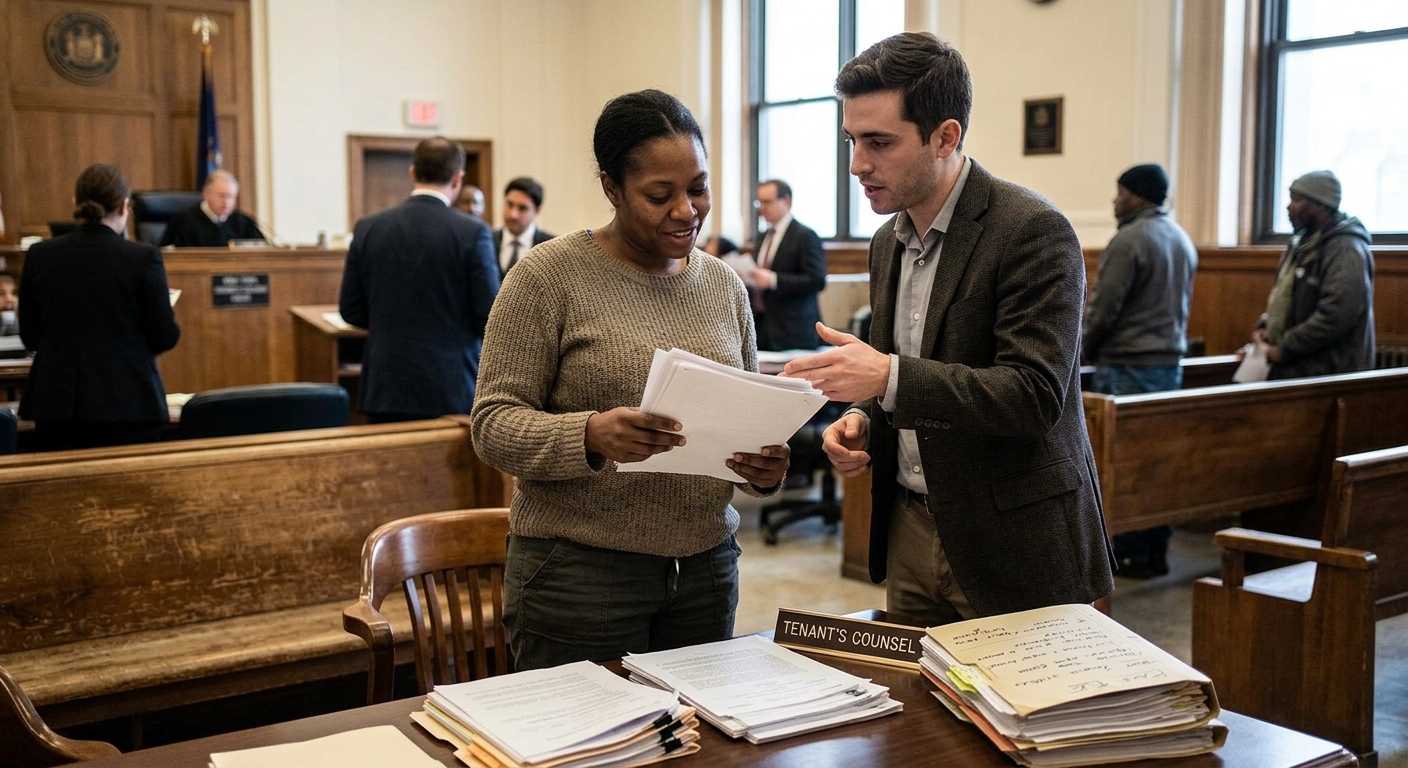
The Silent Crisis in America’s Housing Courts
Every weekday morning, a silent crisis unfolds in courthouse hallways across the United States. Thousands of Americans gather in overcrowded housing courts, waiting for their names to be called in cases that will determine whether they can keep a roof over their heads. For most of these individuals, the stakes could not be higher: losing an eviction case often means facing immediate homelessness, severe disruptions to a child’s education, and the devastating loss of personal property. Yet, despite the life-altering consequences of eviction proceedings, the vast majority of renters enter the courtroom entirely alone, without legal guidance or support.
The movement to establish a “right to counsel” for tenants facing eviction aims to fundamentally reshape this reality. Proponents argue that legal representation in housing court should not be a luxury reserved for those who can afford it, but rather a fundamental baseline for justice. This article delves into the profound imbalances within the current eviction system, examines the stark demographic disparities among those facing displacement, and analyzes why providing legal representation for renters is not just a moral imperative, but a highly effective, fiscally responsible public policy choice.
The Imbalance of Power: David vs. Goliath
In the American criminal justice system, the 1963 landmark Supreme Court decision in Gideon v. Wainwright guaranteed that any defendant who cannot afford an attorney will have one appointed by the state. This constitutional protection recognizes that navigating the complexities of the legal system is virtually impossible for an untrained individual. However, this critical safeguard does not extend to civil matters, including housing court disputes.
The absence of a guaranteed attorney in civil court has created an environment defined by extreme power imbalances. Eviction proceedings are essentially a battle between seasoned legal professionals and unrepresented laypeople. According to comprehensive data synthesized by the National Coalition for a Civil Right to Counsel, an estimated 81 percent of landlords are represented by legal counsel in eviction proceedings nationwide. In stark contrast, a mere 3 percent of renters have a lawyer by their side .
This systemic disparity turns the legal process into an assembly line of displacement. Housing law is notoriously complex, governed by a web of local ordinances, state statutes, and procedural rules that dictate everything from the formatting of a notice to quit to the timeline of an appeal. An unrepresented tenant might have a completely valid legal defense—such as a landlord’s failure to maintain habitable living conditions or an improper calculation of rent owed—but without the knowledge to raise that defense properly, the judge will likely rule in favor of the property owner. Tenants often agree to highly unfavorable settlements in the hallway outside the courtroom simply because they feel intimidated by opposing counsel.
The Disproportionate Toll on Communities of Color
The burden of this unbalanced legal system is not distributed equally. Eviction in America is deeply intertwined with systemic racial and economic disparities, effectively functioning as an engine of ongoing inequality. Without adequate legal representation, vulnerable populations are pushed out of their homes at alarming rates.
A comprehensive 2023 demographic analysis published in the Proceedings of the National Academy of Sciences (PNAS), utilizing data compiled by the Eviction Lab at Princeton University, laid bare the extent of these inequities. The researchers found that while Black Americans account for only 18.6 percent of all renters in the United States, they make up a staggering 51.1 percent of the individuals affected by eviction filings, and 43.4 percent of those who are ultimately evicted .
The statistics are particularly dire for families with children. The same research indicates that the annual eviction filing rate among Black adults living with kids exceeds 25 percent—more than double the risk faced by members of any other demographic group . For Black and Latina women, the threat of displacement is a constant, looming reality that severely impacts both mental health and economic stability.
Eviction is not merely a consequence of poverty; it is a profound cause of it. An eviction record makes it nearly impossible to secure safe, affordable housing in the future, frequently forcing families into substandard living conditions or the shelter system. Because these outcomes are heavily concentrated in communities of color, the lack of legal representation in housing court effectively accelerates the racial wealth gap and perpetuates a cycle of intergenerational poverty.
The Tangible Impact of Legal Representation
When tenants are provided with a lawyer, the entire dynamic of housing court changes. A legal representative steps in to scrutinize the landlord’s claims, demand proper documentation, and assert the tenant’s rights. Lawyers can negotiate alternative resolutions, secure emergency rental assistance, identify housing code violations that nullify eviction attempts, or at least buy a family enough time to find a new home without an eviction judgment staining their permanent record.
The data overwhelmingly demonstrates the effectiveness of this intervention. Across multiple jurisdictions that have instituted right to counsel pilot programs or permanent legislation, the outcomes for renters have dramatically improved.
| Jurisdiction | Key Program Outcome |
|---|---|
| Chicago, IL | Between 92% and 95% of represented tenants seeking to avoid formal eviction achieved that goal through early intervention services . |
| Davidson County, TN | Attorneys achieved approximately 87% of clients’ stated case goals, keeping hundreds of at-risk families stably housed . |
| New York City, NY | In established intervention areas, the vast majority of represented tenants have successfully avoided disruptive displacement, resulting in a dramatic drop in overall eviction filings. |
By transforming eviction from a rapid administrative procedure into a rigorous judicial process, right to counsel laws force landlords to pursue eviction only as a last resort. This paradigm shift often leads to an overall reduction in the total number of eviction filings, easing the administrative burden on the court system as a whole.
Cost-Benefit Analysis: A Smart Fiscal Choice
One of the most persistent arguments against establishing a guaranteed right to counsel is the perceived cost to taxpayers. Funding a fleet of attorneys to represent thousands of low-income renters requires a significant initial budget allocation. However, an emerging body of financial research illustrates that failing to provide counsel is actually far more expensive for local and state governments.
When families are evicted, the government inevitably bears the financial fallout. The direct and indirect costs of displacement include funding emergency homeless shelters, increased reliance on emergency medical services and psychiatric care, costs associated with children entering the foster care system, and the loss of local tax revenue due to neighborhood and job instability.
Recent independent evaluations have quantified these savings, proving that legal representation generates an exceptional return on investment (ROI). In April 2026, an independent fiscal evaluation of Nashville’s Eviction Right to Counsel pilot program found that every single dollar spent on free legal representation for tenants generated $4.18 in total economic and fiscal returns . The program yielded an estimated $4.3 million in quantifiable public fiscal benefits by keeping residents out of the shelter system and preventing job loss.
Similarly, a late 2025 analysis by the American Civil Liberties Union of New Jersey (ACLU-NJ) in collaboration with economic analysts found an estimated return of $2.30 to $3.14 for every dollar invested in an eviction right to counsel program statewide . The math is undeniable: it is dramatically cheaper to pay a lawyer to keep a family stably housed than it is to manage the sprawling, devastating societal fallout of mass homelessness.
Overcoming Implementation Barriers
Despite the clear moral and economic arguments, expanding the right to counsel movement nationwide is not without its challenges. Implementing a universal guarantee requires a concerted, long-term effort from policymakers, the legal community, and housing advocates.
The most immediate barrier is funding consistency. Many current right to counsel initiatives were launched as pilot programs using temporary federal relief funds, such as the American Rescue Plan Act. As these funds expire, local governments must find permanent revenue streams to sustain the programs. Furthermore, the sheer volume of eviction filings creates a logistical challenge. There is a documented shortage of legal aid attorneys across the country, largely due to the massive disparity in compensation between public interest law and private practice.
To overcome these hurdles, states must commit to structural changes. These include:
- Establishing Permanent Funding Streams: Passing dedicated taxes or fees—such as modest increases in document recording fees or specific real estate transfer taxes—to create an enduring financial pool.
- Expanding the Legal Workforce: Collaborating with law schools and state bar associations to aggressively recruit, train, and properly compensate the next generation of public interest housing attorneys.
- Executing Phased Rollouts: Initially guaranteeing counsel to households living below a certain poverty threshold or targeting specific zip codes with the highest historical eviction rates, before expanding to a universal mandate.
Conclusion: Housing as a Foundation for Human Dignity
The American judicial system promises equal justice under the law, yet the reality of housing court frequently falls short of this ideal. The eviction process, unchecked by adequate legal defense, disproportionately destabilizes communities of color, traumatizes children, and drains public resources. The statistics and financial models point to a singular, undeniable conclusion: providing legal representation to tenants facing eviction is a critical intervention that works.
Establishing a civil right to counsel in housing court is more than just a procedural reform; it is a recognition of the profound importance of home. A safe, stable residence is the bedrock upon which people build their lives, maintain their health, and raise their families. By ensuring that no one has to face the loss of their home without a dedicated legal advocate by their side, society can take a vital step toward genuine housing justice, transforming courts from sites of systemic displacement into arenas of genuine, balanced adjudication.
Frequently Asked Questions (FAQs)
What is a civil right to counsel?
A civil right to counsel is a legislative mandate ensuring that individuals facing severe legal consequences in civil court—such as the loss of housing, child custody, or basic healthcare—are guaranteed a lawyer, regardless of their ability to pay. Unlike criminal court, where legal representation is constitutionally guaranteed, civil courts currently offer no such federal protection.
How does an eviction affect a tenant’s future?
An eviction filing leaves a permanent mark on a tenant’s public record, acting as a red flag in the competitive housing market. Future landlords routinely screen for past evictions and will automatically reject applicants with a history in housing court. This forces evicted individuals into unsafe neighborhoods, overcrowded living situations, or prolonged homelessness.
Does a right to counsel stop all evictions?
No, a right to counsel does not prevent all evictions, nor does it absolve tenants of their lease obligations. However, it ensures the legal process is fair and that landlords must prove their case according to the law. In many instances, attorneys can negotiate payment plans, uncover illegal landlord practices, or secure alternative housing arrangements that prevent a formal eviction judgment from being entered.
References
- A comprehensive demographic profile of the US evicted population — Proceedings of the National Academy of Sciences (PNAS). 2023-10-02. https://www.pnas.org/doi/10.1073/pnas.2305860120
- Nashville’s Eviction Right to Counsel program paid off, study finds — Legal Aid Society of Middle Tennessee and the Cumberlands. 2026-04-13. https://las.org/
- ACLU-NJ and Seton Hall Law School’s Center for Social Justice Release Report on the Fiscal Benefits of Eviction Right to Counsel — American Civil Liberties Union of New Jersey. 2025-11-17. https://www.aclu-nj.org/
- Right to Counsel — City of Chicago. 2025-01-01. https://www.chicago.gov/city/en/depts/doh/provdrs/renters/svcs/right-to-counsel.html
- Guaranteed Right to Counsel in Eviction Proceedings — Prenatal-to-3 Policy Impact Center. 2026-04-23. https://pn3policy.org/
Similar Articles








Read full bio of medha deb




