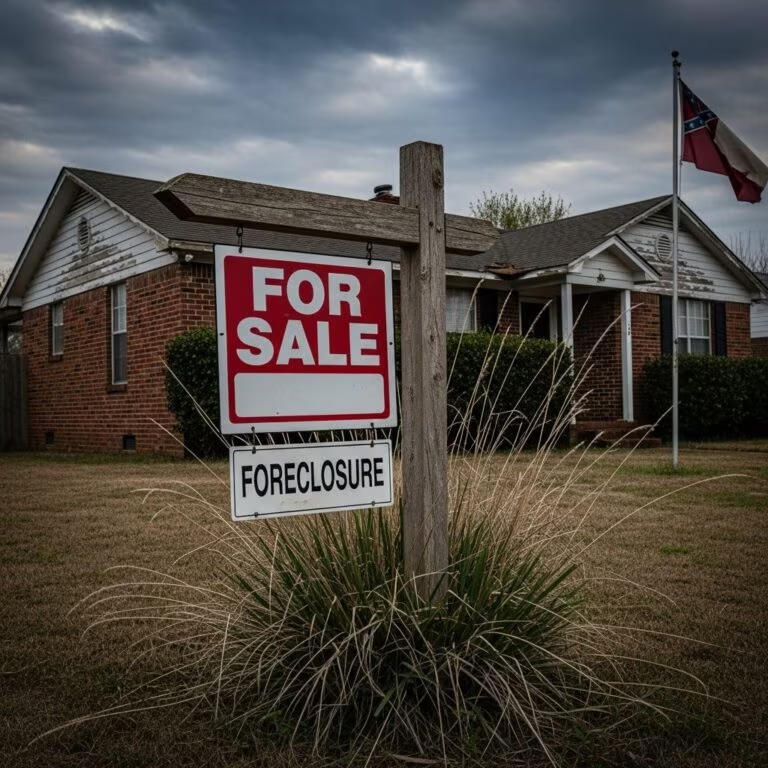
The homestead exemption in South Carolina plays a crucial role in bankruptcy proceedings, allowing individuals to retain equity in their primary residence despite overwhelming debts. This protection is vital for homeowners seeking financial fresh starts through Chapter 7 or Chapter 13 filings, preventing the total loss of their homes to creditors.
Understanding the Core Purpose of Homestead Exemptions
Homestead exemptions stem from state laws designed to shield a portion of a debtor’s home equity from liquidation or creditor claims during bankruptcy. In essence, equity refers to the market value of the property minus any outstanding mortgages or liens. South Carolina’s version prioritizes family stability by exempting a fixed dollar amount of this equity, ensuring debtors aren’t left homeless after filing.
Without such protections, bankruptcy courts could force the sale of homes to pay unsecured creditors, exacerbating financial hardship. South Carolina opts out of federal exemptions, mandating the use of its state-specific list, which includes the homestead provision as a cornerstone for real property owners.
Current Limits on Home Equity Protection
As of recent updates, South Carolina permits a single filer to protect up to $76,125 in homestead equity. For married couples filing jointly who co-own their home, this doubles to $152,250. These figures apply to the debtor’s primary residence, defined broadly as the fixed dwelling where the family lives.
If no home is owned, the exemption can extend to equity in a burial plot, capped at $59,100 for individuals. Note that amounts adjust periodically through legislative action or inflation indexing, so filers should verify the latest via official state resources.
| Filing Status | Homestead Exemption Amount | Additional Notes |
|---|---|---|
| Single Filer | $76,125 | Applies to primary residence equity |
| Married Couple (Joint Filing, Co-owned Home) | $152,250 | Doubles for spouses |
| No Home (Burial Plot) | $59,100 | Alternative use for single filers |
Property Eligibility and Key Requirements
- Primary Residence Only: The exemption covers houses, condos, or mobile homes permanently affixed to land used as the debtor’s main home. Vacation properties or rentals do not qualify.
- Equity Calculation: Subtract all secured debts (e.g., mortgages, home equity loans) from the appraised fair market value. Only the remaining equity is at risk, up to the exemption limit.
- Ownership Duration: Federal law imposes a 40-month residency rule before filing to access full state exemptions. Shorter tenures cap protection at $189,050 (adjusted for cases after April 1, 2022), rising to $214,000 for filings between April 1, 2025, and March 31, 2028.
- Joint Ownership Nuances: Spouses must file together to maximize protection; separate filings may limit each to the single amount.
Debtors must demonstrate the property serves as their legal domicile, often via utility bills, voter registration, or driver’s license records.
How It Works in Chapter 7 Liquidation
In Chapter 7, the trustee reviews assets for nonexempt equity. If home equity stays under $76,125 ($152,250 joint), the residence is typically safe from sale. Excess equity could prompt a buyout offer from the debtor or forced liquidation, though trustees often abandon properties if sales costs outweigh benefits.
For example, a home valued at $300,000 with a $250,000 mortgage yields $50,000 equity—fully protected for a single filer. But $100,000 equity exceeds the limit by $23,875, potentially requiring payment to retain the home.
Strategies for Chapter 13 Reorganization
Chapter 13 allows debtors to keep all property, including homes with nonexempt equity, by funding a 3-5 year repayment plan. The plan must compensate creditors for the unprotected equity amount, plus catch up on arrears.
This pathway suits homeowners with steady income facing foreclosure threats. South Carolina’s homestead limit influences plan feasibility—higher equity demands larger payments, but the exemption still reduces the total owed.
Federal Caps and Anti-Abuse Measures
U.S. Bankruptcy Code section 522(p) prevents abuse by capping homestead exemptions at $214,000 for homes acquired within 40 months of filing (2025-2028 figures). This applies even in generous states, overriding full state amounts if triggered.
Section 522(q) further limits to $214,000 for fraud convictions. Exceptions exist for in-state home sale proceeds reinvested timely.
Distinguishing Bankruptcy from Property Tax Relief
South Carolina offers a separate homestead exemption for property taxes, exempting the first $50,000 of fair market value for residents aged 65+, totally disabled, or blind. This reduces annual taxes, not bankruptcy equity risks, and requires annual county auditor applications.
Proposed Bill 768 (2025-2026 session) seeks to raise this to $100,000 and lower age eligibility to 60, with reimbursement from state funds. While related, tax exemptions don’t impact bankruptcy proceedings.
Practical Steps to Claim the Exemption
- Appraise Your Home: Obtain a professional valuation to compute equity accurately.
- Gather Documentation: Prove residency and ownership via deeds, tax records, and residency proofs.
- List on Schedules: Declare the exemption on Schedule C of bankruptcy forms, citing S.C. Code Ann. § 15-41-30(1).
- File Timely: Submit with the petition; amendments possible but may incur fees.
- Consult Professionals: Attorneys ensure compliance, maximizing protections.
No pre-filing declaration is needed in South Carolina, unlike some states.
Common Pitfalls and How to Avoid Them
- Overlooking Liens: Judicial liens on the homestead can be stripped if impairing the exemption (11 U.S.C. § 522(f)).
- Recent Transfers: Fraudulent conveyances within 10 years may void protections.
- Mobile Homes: Only qualify if classified as real property (affixed with title surrendered).
- Non-Primary Residences: Equity in second homes remains fully exposed.
Frequently Asked Questions (FAQs)
Can renters claim a homestead exemption in South Carolina bankruptcy?
No, it applies solely to owners with equity in real property residences or burial plots.
Does the exemption cover manufactured homes?
Yes, if permanently affixed to land and titled as real property.
What if my equity exceeds the limit?
In Chapter 7, negotiate a buyout or face potential sale; Chapter 13 allows repayment over time.
Can I use federal exemptions instead?
No, South Carolina requires state exemptions.
How often do exemption amounts change?
They adjust every three years per federal inflation rules and state legislation.
Recent Developments and Future Outlook
With housing costs rising, advocates push for higher limits. The 2025 legislative session’s Bill 768 signals potential expansions in related tax relief, possibly influencing bankruptcy policy. Debtors should monitor S.C. State House updates.
Federal adjustments continue triennially; post-2028 caps may rise further. Local variations, like Lexington County’s residency proofs, underscore county-specific applications.
Ultimately, South Carolina’s homestead exemption balances creditor rights with debtor dignity, enabling home retention for most filers. Professional advice tailors it to individual circumstances, enhancing successful outcomes.
References
- What Are the South Carolina Bankruptcy Exemptions? — Upsolve. 2025. https://upsolve.org/learn/sc-exemptions/
- 2025-2026 Bill 768: Homestead exemption — SC Legislature. 2025. https://www.scstatehouse.gov/sess126_2025-2026/bills/768.htm
- What Is a Homestead Exemption? — Synovus. 2025. https://www.synovus.com/personal/resource-center/home-ownership/what-is-a-homestead-exemption/
- South Carolina Bankruptcy Exemptions — TheBankruptcySite.org. 2025. https://www.thebankruptcysite.org/exemptions/southcarolina.html
- The Homestead Exemption in Bankruptcy — Nolo. 2025. https://www.nolo.com/legal-encyclopedia/homestead-exemption-bankruptcy.html
- How Does South Carolina’s Exemption System Work — Reed Law SC. 2025. https://www.reedlawsc.com/blog/what-assets-can-i-protect-in-bankruptcy/
- Homestead Exemption Program — Lexington County, SC. 2025. https://lex-co.sc.gov/departments/auditor/homestead-exemption-program