
Social Security Offsets and Student Loan Default
How Social Security benefits can be reduced to collect defaulted federal student loans, and what vulnerable borrowers can do.
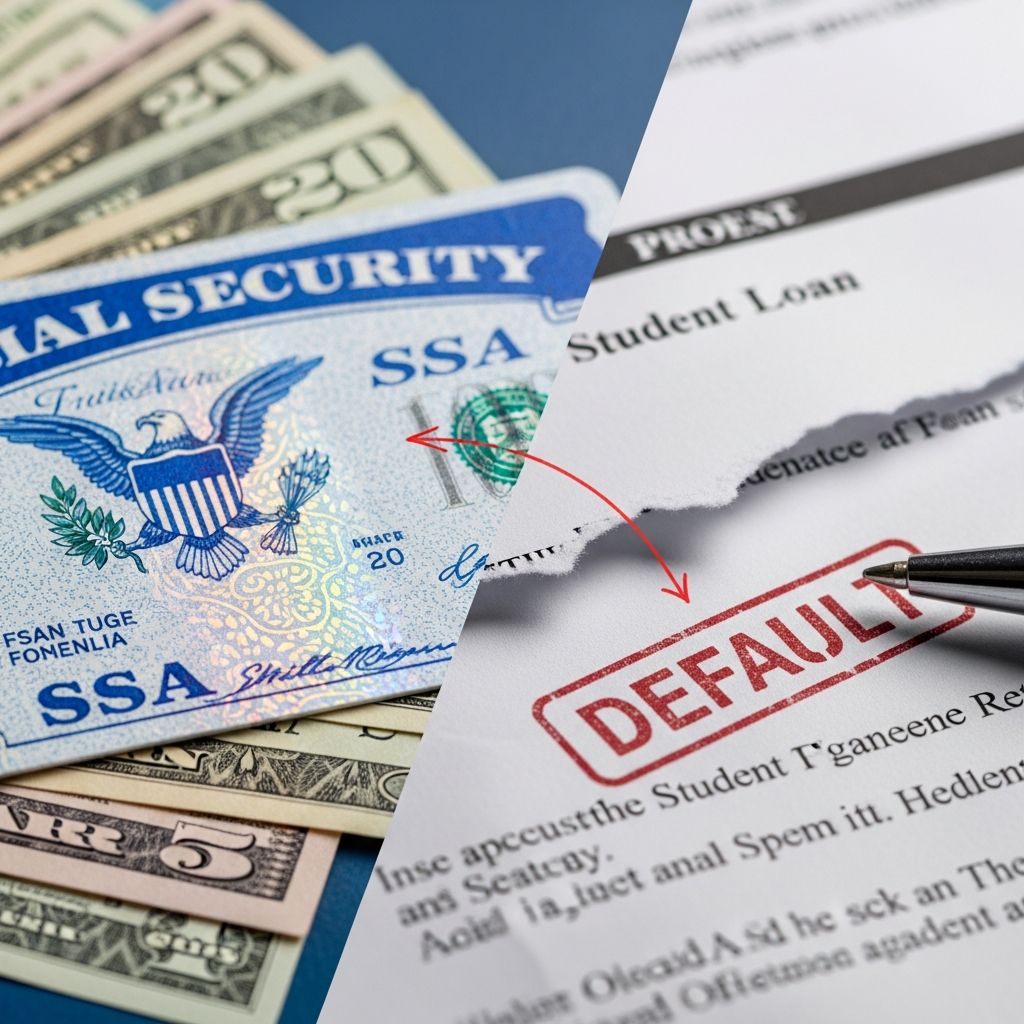
For many older Americans and people with disabilities, Social Security is the primary source of income in retirement. When federal student loans go into default, however, part of these benefits can be taken through a process called Social Security offset to pay back the debt. This practice can push vulnerable borrowers deeper into hardship, even when they could qualify for reduced payments or full loan cancellation.
This article explains how Social Security offsets work, who is most likely to be affected, and what protections and policy reforms can reduce harm to borrowers with limited means.
1. How Student Loans End Up in Default and Collections
Federal student loans move through distinct stages before Social Security benefits can be withheld.
- Delinquency: A loan generally becomes delinquent after a missed payment and remains delinquent until payments are brought current.
- Default: Most federal student loans are considered in default after 270 days of nonpayment.
- Transfer to collections: Around one year of nonpayment, defaulted loans are transferred to the U.S. Department of Education’s default collections program.
- Involuntary collection tools: Once in collections, the government can:
- Offset federal tax refunds
- Garnish a portion of wages
- Withhold part of certain federal benefits, including Social Security retirement and disability benefits, through the Treasury Offset Program
During the COVID-19 emergency, the Department of Education paused most collections on defaulted federal student loans, including Social Security offsets, but the agency has announced that these activities are resuming.
2. What Is a Social Security Offset?
A Social Security offset is the reduction of a person’s monthly Social Security benefit to collect on a federal debt, such as a defaulted federal student loan. The U.S. Department of the Treasury administers this process on behalf of the Department of Education.
2.1 Legal framework and basic limits
Under the Debt Collection Improvement Act, the federal government can withhold a portion of Social Security retirement or disability benefits to recover defaulted federal debts, with certain protections:
- Only specific types of benefits can be offset (for example, Social Security retirement and Social Security Disability Insurance).
- Supplemental Security Income (SSI) benefits, which serve the poorest older and disabled adults, are exempt and cannot be offset.
- A protected amount must remain after the offset, meaning a portion of benefits cannot be touched to help preserve a minimal standard of living.
In practice, the government may withhold up to a set percentage of the benefit—often up to 15 percent—as long as the remaining benefit stays above a minimum floor. Exact thresholds and calculations can change over time, but the result is that many borrowers see a meaningful reduction in their already limited income.
2.2 When offsets begin
Social Security offsets do not start without notice. Before benefits are first reduced, borrowers should receive:
- An initial notice that a federal agency intends to collect through benefit offsets
- Information about the debt and how to dispute its validity
- A subsequent letter typically at least 30 days before the first offset with:
- The planned offset amount
- The date offsets will begin
- Contact information for the agency holding the debt
However, many older borrowers report difficulty understanding or responding to these notices, especially if they are dealing with cognitive decline, disability, or complex financial stressors.
3. Who Is Most Affected by Social Security Offsets?
Student debt among older Americans has grown sharply over the past decade. A significant share of borrowers in default are now age 62 or older, and many depend heavily on Social Security as their main or only income.
| Group | Key Characteristics | Risks from Offsets |
|---|---|---|
| Older borrowers (62+) | Likely retired or working limited hours; rely heavily on Social Security income. | Higher risk of poverty if benefits reduced; less time and capacity to increase earnings. |
| Borrowers with disabilities | May depend on Social Security Disability Insurance; often face higher medical and caregiving costs. | Offsets may compromise ability to pay for housing, utilities, and health care. |
| Low-income Social Security beneficiaries | Expenses often equal or exceed income; little to no financial cushion. | Even modest offsets can trigger food insecurity, utility shutoffs, or eviction. |
Research using federal survey data indicates that a large majority of Social Security beneficiaries with defaulted student loans have expenses that match or exceed their income, suggesting that many could qualify for hardship protections if those protections were automatic and accessible.
4. The Financial Impact of Offsets on Retirement Security
Social Security is designed to provide a foundation of income in retirement, especially for workers with modest lifetime earnings. When benefits are reduced to repay student loans, several harms can follow.
4.1 Reduced monthly income
Analyses of federal data show that during years when Social Security offsets were broadly active, the average affected borrower lost close to two hundred dollars per month in benefits. For low-income retirees, losing this amount can mean:
- Skipping or rationing prescription drugs
- Cutting back on food, transportation, or heating
- Falling behind on rent or utility bills
Because Social Security is often the main income source for affected borrowers, there may be few realistic options to replace the lost funds.
4.2 Compounding interest and fees
Default on federal student loans often leads to the capitalization of interest and the addition of collection fees, which can significantly increase the total amount owed. The Department of Education may also pass along per-offset fees charged by the Treasury. These added costs:
- Prolong the period during which Social Security offsets continue
- Reduce the effectiveness of each offset in lowering the principal balance
- Can lead to older borrowers paying for years without ever fully resolving the debt
4.3 Long-term retirement consequences
Research from the Center for Retirement Research at Boston College finds that withholding benefits for unpaid student loans directly erodes retirement security, particularly for borrowers with limited savings. Because many older borrowers began receiving Social Security with little or no private retirement wealth, offsets can make it nearly impossible to meet essential expenses, let alone handle unexpected costs such as medical emergencies or home repairs.
5. Relief Options Too Often Go Unused
A striking feature of Social Security offsets for defaulted student loans is that many affected borrowers could qualify for significant relief—or even complete loan discharge—but have not accessed these programs.
5.1 Disability discharges
Borrowers who are totally and permanently disabled may be eligible for a Total and Permanent Disability (TPD) discharge of their federal student loans. This discharge can eliminate the debt entirely, ending the need for any future offsets. Yet, many eligible borrowers are not identified or do not complete the required steps.
Reasons may include:
- Lack of awareness that TPD discharge exists
- Complex application requirements and documentation standards
- Cognitive decline, mental health challenges, or physical limitations that make paperwork difficult
5.2 Hardship-based reductions or suspensions
The Department of Education can reduce or temporarily suspend Social Security offsets when borrowers demonstrate financial hardship. To qualify, borrowers must typically show that their documented income and allowable expenses leave little or no room to cover offsets.
- If eligible expenses equal or exceed income, a hardship exemption or reduction may be granted.
- Data suggest that roughly eight in ten Social Security beneficiaries with defaulted student loans could meet this standard based on reported budgets.
Despite this, only a small fraction of affected borrowers receive hardship relief. Barriers include burdensome paperwork, limited outreach, and confusion about how to request a review.
5.3 Challenges with data matching and automation
Many relief programs rely on administrative data matching—for example, comparing Education Department records with Social Security Administration or disability records to identify borrowers likely eligible for discharge or hardship protections. When these systems are incomplete or outdated:
- Eligible borrowers are not automatically protected from offsets
- People with significant disabilities must apply and provide duplicative documentation
- Older borrowers with limited digital access can easily fall through the cracks
Recent policy direction emphasizes leveraging data held by the Department of Education to better identify borrowers facing hardship and apply protections without requiring complex actions from them.
6. Policy Responses and Evolving Protections
As collections resume after pandemic-era pauses, federal policymakers and regulators are reassessing how Social Security offsets interact with borrower protections and broader student loan reforms.
6.1 Resumption of collections
The U.S. Department of Education has announced the restart of the Treasury Offset Program and other involuntary collection activities on defaulted loans, while also rolling out measures intended to help borrowers reenter repayment. These actions include:
- Outreach and notices encouraging borrowers to contact the Default Resolution Group
- Opportunities to enroll in income-driven repayment plans once loans are brought out of default
- Transitional protections to smooth the shift from paused collections to active repayment
6.2 Strengthening hardship protections
Policy guidance and advocacy efforts have focused on making hardship protections more automatic and effective for Social Security recipients.
- Using income and benefit data already available to the government to pre-identify borrowers whose expenses likely exceed income
- Reducing documentation burdens for older and disabled borrowers
- Ensuring that hardship determinations take into account health expenses, caregiving costs, and housing instability
Analysts estimate that applying such protections more systematically could halt Social Security offsets for more than half of affected borrowers and lower offset amounts for many others.
6.3 Expanded access to income-driven repayment
Newer income-driven repayment (IDR) plans, including recently updated options, are designed to reduce payment burdens by tying monthly payments to income and family size. Historically, borrowers in default were excluded from many IDR plans, but policy changes are gradually opening these options to certain defaulted loans after rehabilitation or consolidation.
For older borrowers who can exit default and enroll in IDR, monthly payments may be reduced to a small fraction of income—or even to zero—helping prevent future delinquencies and defaults while eliminating the need for offsets.
7. Practical Steps for Borrowers Facing Social Security Offsets
Individual options vary depending on loan type, health status, and income, but several broad strategies can help borrowers protect limited benefits.
7.1 Respond quickly to notices
- Read all mail from the Department of Education, loan servicers, or the Treasury carefully.
- Note any deadlines for disputing the debt or requesting a review of the planned offset.
- Keep copies of letters, bills, and any medical or financial documents you may need to support a hardship claim.
7.2 Ask about hardship protections
- Contact the Department of Education’s Default Resolution unit or the agency listed in your notice.
- Explain your current income, expenses, and any urgent hardships (such as eviction, foreclosure, or utility shutoff risks).
- Request information on applying for a hardship reduction or suspension of Social Security offsets.
7.3 Explore discharge and repayment options
- If you are unable to work or have a long-term disability, ask about Total and Permanent Disability discharge of your loans.
- Ask whether your loans can be:
- Rehabilitated (a process that can remove loans from default after a series of on-time payments)
- Consolidated into a new Direct Loan eligible for income-driven repayment
- After resolving default, request an income-driven repayment plan that bases payments on your current income, which may be very low or even zero.
7.4 Seek independent counseling
- Nonprofit legal aid organizations and consumer advocacy groups often provide free advice to low-income borrowers.
- State or local agencies on aging may help older adults navigate benefits and debt issues.
- Certified financial counselors experienced with student loan issues can explain tradeoffs among rehabilitation, consolidation, and discharge.
8. Frequently Asked Questions (FAQs)
Q1: Can the government take all of my Social Security benefits for student loans?
No. Federal law protects a portion of your Social Security benefits from offset, and Supplemental Security Income (SSI) cannot be taken for student loan debt. However, up to a set percentage of Social Security retirement or disability benefits may be withheld for defaulted federal student loans.
Q2: Are Social Security Disability Insurance (SSDI) benefits treated differently from retirement benefits?
Both SSDI and retirement benefits can generally be subject to offset for federal student loan debts, while SSI benefits are exempt. Borrowers with disabilities may qualify for a Total and Permanent Disability discharge, which can eliminate the underlying debt.
Q3: What if my expenses are higher than my income?
If your necessary expenses equal or exceed your income, you may qualify for a hardship-based reduction or suspension of Social Security offsets. You will typically need to provide documentation of your income and essential costs, such as housing, utilities, and medical expenses.
Q4: Do I still owe my student loans after an offset is applied?
Yes. Offsets are applied monthly until the debt is paid in full, you resolve the default, or you obtain relief such as a discharge or hardship suspension. Because interest and fees can continue to accrue, it is important to explore long-term solutions, not just short-term reductions.
Q5: How did the COVID-19 payment pause affect Social Security offsets?
During the COVID-19 emergency, the Department of Education paused most involuntary collections on defaulted federal student loans, including Social Security offsets. With the expiration of these temporary protections, collections are resuming along with new efforts to help borrowers enter affordable repayment arrangements.
References
- Social Security & Other Government Benefits Seizure — National Consumer Law Center / Student Loan Borrower Assistance. 2025-05-05. https://studentloanborrowerassistance.org/for-borrowers/dealing-with-student-loan-debt/default-debt-collection/collection-of-student-loan-debt/social-security-other-gov-benefits-seizure/
- Issue Spotlight: Social Security Offsets and Defaulted Student Loans — Consumer Financial Protection Bureau. 2024-10-24. https://www.consumerfinance.gov/data-research/research-reports/issue-spotlight-social-security-offsets-and-defaulted-student-loans/
- Policy Direction on Preventing Student Loan Default — U.S. Department of Education, Office of Federal Student Aid. 2025-01-15. https://ticas.org/wp-content/uploads/2025/01/Policy-Direction-Preventing-Student-Loan-Default-SIGNED_1.15.25.pdf
- U.S. Department of Education to Begin Federal Student Loan Collections, Other Actions to Help Borrowers Get Back into Repayment — U.S. Department of Education. 2025-04-21. https://www.ed.gov/about/news/press-release/us-department-of-education-begin-federal-student-loan-collections-other-actions-help-borrowers-get-back-repayment
- How Do Unpaid Student Loans Impact Social Security Benefits? — Center for Retirement Research at Boston College. 2018-03-01. https://crr.bc.edu/how-do-unpaid-student-loans-impact-social-security-benefits/
Similar Articles








Read full bio of medha deb




