
Section 179 vs Bonus Depreciation: Business Tax Strategies
Unlock maximum tax savings: Compare Section 179 expensing and bonus depreciation to optimize your business deductions in 2025 and beyond.
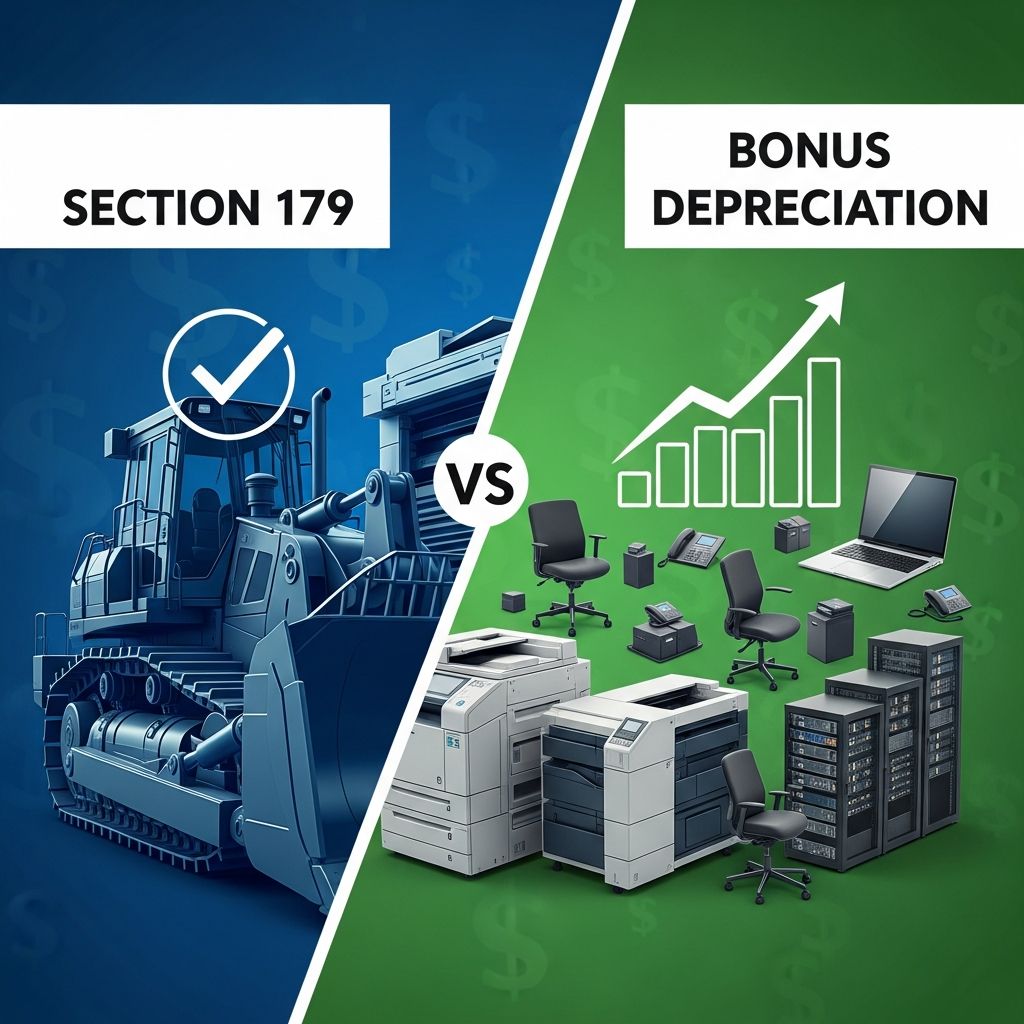
Business owners can significantly lower their tax liability by accelerating deductions on capital investments through
Section 179
expensing orbonus depreciation
. These IRS provisions allow immediate write-offs instead of spreading costs over years, providing cash flow advantages and incentivizing equipment purchases.Understanding Accelerated Depreciation Options for Businesses
Traditional depreciation spreads an asset’s cost over its useful life using methods like MACRS. However, Section 179 and bonus depreciation enable front-loading deductions to match expenses with revenue generation. This is particularly valuable for small and mid-sized enterprises investing in growth.
Section 179, part of the Internal Revenue Code since 1958, permits full expensing of qualifying property up to annual limits. Bonus depreciation, expanded by the 2017 Tax Cuts and Jobs Act (TCJA), allows percentage-based immediate deductions on broader asset classes.
Core Mechanics of Section 179 Expensing
Under Section 179, eligible businesses deduct the full purchase price of qualifying equipment and software in the year placed in service, up to a fixed annual cap. For 2025, the limit stands at approximately $1.25 million, subject to phase-outs if total qualifying purchases exceed $3.05 million (adjusted annually for inflation).
- Deduction capped by business income: Cannot exceed taxable income from the active trade or business; excess carries forward.
- Optional election: Taxpayers choose specific assets, offering flexibility to prioritize high-value items.
- Qualifying property: Tangible personal property (machinery, vehicles, furniture), off-the-shelf software, and certain real property improvements like roofs or HVAC systems.
- Business use requirement: Must be used more than 50% for business; personal use portion disqualifies.
A key advantage is covering real estate improvements, unlike bonus depreciation. However, selling the asset early triggers recapture, taxing the difference between claimed deduction and standard depreciation.
How Bonus Depreciation Functions in Practice
Bonus depreciation permits deducting a percentage of an asset’s cost immediately, without dollar limits or income restrictions. Originally temporary, it allowed 100% expensing through 2022, then phased down: 80% in 2023, 60% in 2024, and 40% in 2025.
- No spending cap: Ideal for large investments exceeding Section 179 limits.
- Mandatory for asset classes: If elected for one asset in a recovery class (e.g., 5-year property), applies to all in that class.
- Loss creation allowed: Deductions can exceed income, with net operating losses (NOLs) carried forward.
- Qualified assets: New or used depreciable property with recovery period of 20 years or less, including qualified improvement property but excluding many real estate upgrades.
Recent legislative debates, including potential extensions via bills like the One Big Beautiful Bill (OBBB), could restore 100% bonus rates permanently from 2025, enhancing its appeal.
Key Differences: A Side-by-Side Analysis
Choosing between these requires understanding their contrasts. The table below summarizes critical features based on 2025 rules.
| Feature | Section 179 | Bonus Depreciation |
|---|---|---|
| Deduction Type | Up to 100% fixed dollar amount | 40% of cost (2025); potentially 100% post-legislation |
| Annual Limit | $1.25M (phase-out over $3.05M) | None |
| Income Limitation | Limited to business income | No limit; creates losses |
| Asset Selection | Flexible; pick specific items | All or none per class |
| Real Property Improvements | Yes (e.g., roofs) | Limited |
| New/Used Assets | Both | Both (post-2017) |
| Recapture on Sale | Yes | Yes, proportional |
Strategic Ways to Combine Both Deductions
IRS rules mandate applying Section 179 first, then bonus depreciation on the remainder, followed by regular MACRS. This layering maximizes benefits.
Example Scenario: A manufacturing firm buys $5 million in machinery in 2025. It claims $1.25 million under Section 179 (adjusted for any phase-out). Bonus depreciation then applies 40% ($1.5 million post-Section 179 basis adjustment) to the remaining $3.75 million, yielding $1.5 million deduction. Total immediate write-off: $2.75 million, with the rest depreciated normally.
- High-spending businesses: Use Section 179 up to cap, bonus for overflow.
- Loss-making startups: Skip Section 179; opt for bonus to generate NOLs.
- Long-life assets: Prioritize bonus if rates are high, as it accelerates deductions on shorter recovery periods.
For pass-through entities like trusts, allocating Section 179 to beneficiaries while using bonus on retained basis optimizes planning.
Eligibility Rules and Common Pitfalls
Not all purchases qualify. Both require assets be placed in service by year-end and used predominantly for business. Vehicles have special limits: e.g., $30,500 for SUVs under Section 179 in 2025.
Pitfalls to avoid:
- Exceeding phase-out thresholds reduces Section 179 dollar-for-dollar.
- Bonus election is irrevocable per class, limiting flexibility.
- State conformity varies; some decouple from federal bonus rules.
- Recapture applies if business use drops below 50% or on early disposition.
Consult IRS Publication 946 for detailed lists. Timing purchases before December 31 maximizes current-year benefits.
Recent Changes and Future Outlook
Post-TCJA phase-down shifts reliance to Section 179, with 2024 limits at $1.22 million. Proposed 2025 reforms could raise Section 179 to $2.5 million and reinstate 100% bonus permanently, per bipartisan discussions. Businesses should monitor legislation, as OBBB-like bills aim to make full expensing standard.
Inflation adjustments continue annually; check IRS.gov for updates.
Practical Tips for Implementation
To leverage these:
- Track qualifying purchases meticulously.
- Elect on Form 4562; file with timely return.
- Model scenarios with tax software to compare outcomes.
- Consider cost segregation studies for real estate to isolate personal property.
- Pair with 100% meals deduction or QBI for holistic savings.
Financing equipment via loans doesn’t disqualify, as deduction bases on cost.
Frequently Asked Questions
Can I use Section 179 and bonus depreciation together?
Yes, apply Section 179 first up to limits, then bonus on the balance for maximum acceleration.
What if my business has a loss?
Bonus depreciation allows loss creation via NOL carryforwards; Section 179 does not.
Does bonus depreciation apply to used equipment?
Yes, since TCJA expanded to qualified used property.
Are there vehicle limits?
Yes, luxury auto rules cap deductions; heavier trucks/SUVs qualify higher under Section 179.
How do states treat these deductions?
Varies; some conform fully, others limit or decouple—check state tax authorities.
Advanced Planning for Maximum Savings
Beyond basics, consider entity structure impacts. S-corps and partnerships pass deductions to owners, subject to at-risk and basis rules. C-corps benefit directly. For estates/trusts, strategic allocation preserves benefits.
International aspects: Bonus may apply to foreign-use assets under sourcing rules. Always integrate with R&D credits or energy incentives for compounded effects.
2026 projections assume phase-down continuation unless extended, emphasizing proactive planning. Simulate via IRS tables: for a 5-year asset at 40% bonus, effective first-year deduction jumps significantly vs. straight-line.
References
- The 2025 Tax Debate: Section 179 Expensing for Small Businesses — Bipartisan Policy Center. 2025. https://bipartisanpolicy.org/explainer/the-2025-tax-debate-section-179-expensing-for-small-businesses/
- Section 179 Deduction vs. Bonus Depreciation: How They Work — Bankrate. 2024. https://www.bankrate.com/taxes/section-179-deduction-bonus-depreciation/
- Bonus Depreciation vs. Section 179: What’s the Difference? — National Funding. 2024. https://www.nationalfunding.com/blog/bonus-depreciation-section-179-difference/
- Planning opportunities: Sec. 179 expensing vs. bonus depreciation — The Tax Adviser (AICPA). 2024-12. https://www.thetaxadviser.com/issues/2024/dec/planning-opportunities-sec-179-expensing-vs-bonus-depreciation/
- Maximizing your deductions: Section 179 and Bonus Depreciation — U.S. Bank. 2024. https://www.usbank.com/corporate-and-commercial-banking/insights/credit-finance/equipment/maximize-deductions-section-179.html
Similar Articles








Read full bio of medha deb




