
Sales Tax Certificates: Your Guide to Compliance
Master sales tax certificates: registration, collection rules, exemptions, and multi-state strategies for business success.
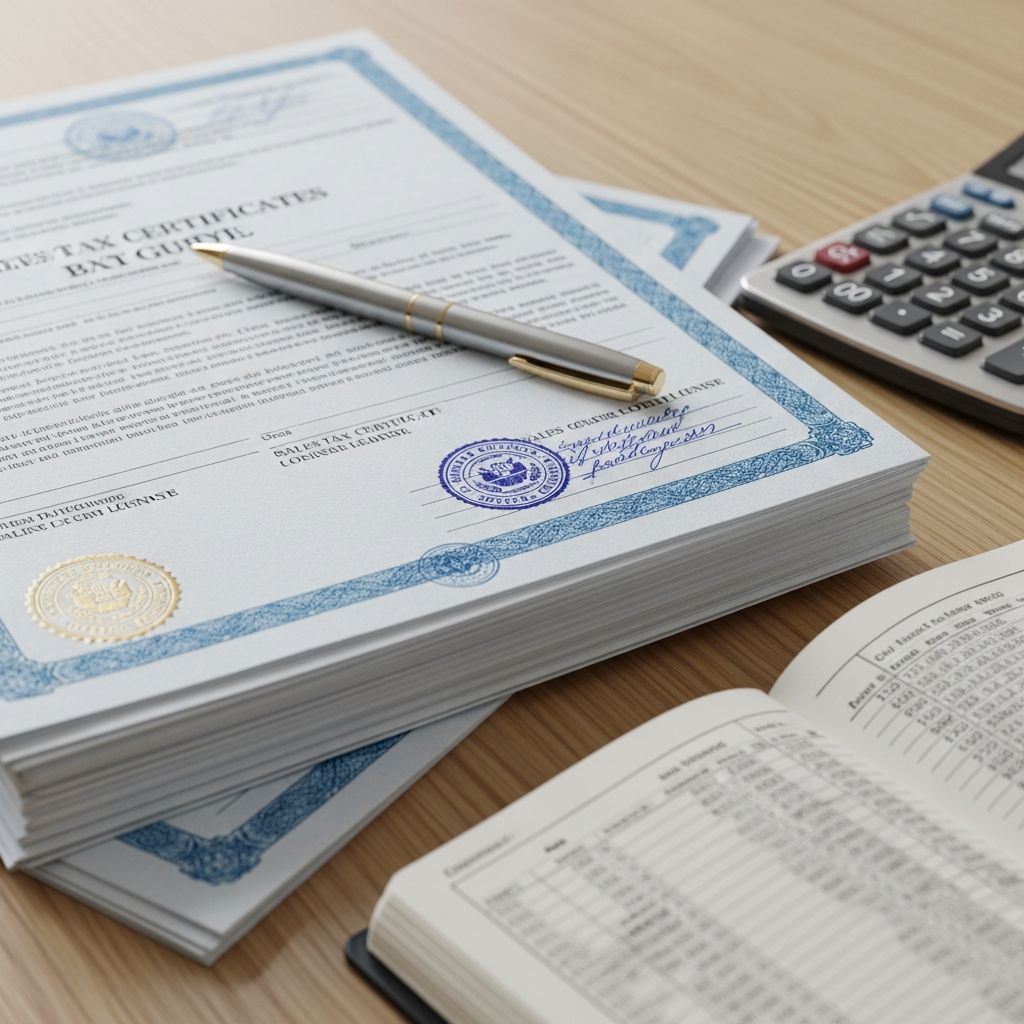
Sales tax certificates, often called Certificates of Authority or seller’s permits, are official documents issued by state tax authorities that authorize businesses to collect sales tax from customers. These permits are mandatory for most retailers selling taxable goods or services within a state, ensuring compliance with local tax laws and avoiding hefty penalties.
Understanding Sales Tax Permits and Their Role
A sales tax permit grants your business the legal right to collect tax on taxable transactions. Without it, you risk fines, back taxes, and even business closure. In essence, it proves to regulators that you are registered and accountable for remitting collected taxes to the state.
Taxable items typically include tangible personal property like clothing, electronics, and furniture, as well as certain services such as hotel stays, restaurant meals, and utility bills in some jurisdictions. Businesses must display or reference this permit during operations and use it to validate exemption claims from suppliers.
Who Must Register for a Sales Tax Certificate?
Registration requirements hinge on whether your business has a nexus in the state. Nexus refers to a sufficient connection triggering tax obligations, which can be physical or economic.
- Physical Nexus: Operating a store, office, warehouse, or employing workers in the state automatically requires registration.
- Economic Nexus: Post-2018 Wayfair ruling, states like New York mandate permits if you exceed sales thresholds, such as $300,000 in annual tangible property sales and over 100 transactions.
- Remote Sellers: E-commerce platforms shipping to state residents often hit these limits, necessitating multi-state compliance.
Sole proprietors selling from home count if they meet criteria, though some states exempt unregistered individuals unless scaling up. Always verify with the state’s department of revenue.
Step-by-Step Process to Obtain Your Permit
Acquiring a sales tax certificate involves a straightforward online application in most states, often free and processed quickly.
- Prepare Documentation: Gather your EIN, business formation details, address, and estimated sales volume.
- Access State Portal: Visit sites like New York Tax Department’s registration page or California’s CDTFA portal.
- Complete Application: Provide business name, structure (LLC, corp), responsible party info, and sales projections. For foreign entities, include formation state docs.
- Submit and Await Approval: Receive your certificate digitally, often immediately. Print and post it visibly.
- Update as Needed: Notify authorities of address changes, ownership shifts, or closure.
| State | Permit Name | Key Threshold | Application Site |
|---|---|---|---|
| New York | Certificate of Authority | $300K sales + 100 txns | tax.ny.gov |
| California | Seller’s Permit | Any retail sales | cdtfa.ca.gov |
| Texas | Sales & Use Tax Permit | Varies by activity | comp.txcpa.gov |
Collecting and Remitting Sales Tax Legally
Once permitted, calculate tax based on rates at the point of sale, typically 4-10% combined state/local. Use software for accuracy across zip codes. Collect from customers at checkout and file returns monthly, quarterly, or annually based on volume.
File even if no sales occurred to stay compliant. Late payments incur interest and penalties up to 25% of tax due. Accurate record-keeping of invoices, receipts, and returns is crucial for audits.
Resale Certificates: Buying Tax-Free for Resale
Resellers use exemption certificates to purchase inventory without paying tax upfront, shifting the burden to end consumers. This tool requires your valid sales tax permit.
Key components of a resale certificate:
- Buyer and seller names/addresses
- Your permit number or EIN
- Item description confirming resale intent
- Authorized signature and date
Provide one per vendor or transaction as required. Retain copies for four years minimum. Invalid forms expose sellers to liability during audits.
State Variations in Certificate Rules
New York Specifics
New York’s Certificate of Authority from the Department of Taxation and Finance allows tax collection and exemption issuance. Home-based sellers qualify if selling taxable items. Economic nexus applies rigorously.
California Requirements
CDTFA issues Seller’s Permits for any retail engagement. Form CDTFA-230 validates resale buys. No out-of-state certificates accepted without a CA permit. Collect at sale time; no retroactive exemptions.
Other exemptions cover nonprofits (Form CDTFA-101), governments, or manufacturing inputs.
Common Pitfalls and Compliance Best Practices
Avoid these errors:
- Delaying Registration: Register before first sale.
- Incomplete Exemptions: Missing signatures or details void protection.
- Multi-State Oversights: Track nexus in all selling states; use automation tools.
- Poor Records: Digitize everything for audit defense.
Leverage tax software for rate updates, filing, and nexus monitoring. Annual reviews prevent surprises.
Frequently Asked Questions
Do sole proprietors need a sales tax certificate?
Yes, if selling taxable goods/services and meeting nexus; exemptions are rare.
Can I use one certificate for multiple states?
No, each state issues its own; manage separately.
What if I lose my permit?
Reprint via state portal or contact the agency promptly.
Are services taxable everywhere?
No, varies: NY taxes some like telecom; check state lists.
How long are resale certificates valid?
Often indefinite if signed properly, but renew if permit changes.
Advanced Strategies for Multi-State Sellers
E-commerce growth demands robust systems. Monitor 45 states’ economic nexus post-Wayfair. Centralize with ERP integrations. Outsource to CPAs for complex filings. Stay updated via state bulletins, as rules evolve—like California’s ongoing permit enforcement.
For foreign qualification (non-tax Certificate of Authority), register with Secretary of State for entity authority, separate from tax permits.
References
- Sales Tax Vendor Registration (Certificate of Authority) — New York City Business. Accessed 2026. https://nyc-business.nyc.gov/nycbusiness/description/sales-tax-vendor-certificate-of-authority
- What is a Certificate of Authority and Do I Need One — Wolters Kluwer. Accessed 2026. https://www.wolterskluwer.com/en/expert-insights/what-is-a-certificate-of-authority
- What Is a Sales and Use Tax Certificate and How It Works? — Inkle. Accessed 2026. https://www.inkle.io/blog/sales-and-use-tax-certificate
- California Sales Tax Exemption Rules & Compliance 2026 — Commenda. 2026. https://www.commenda.io/usa/california/sales-tax-exemption-certificate
- Your California Seller’s Permit — California Department of Tax and Fee Administration. Accessed 2026. https://cdtfa.ca.gov/formspubs/pub73.pdf
- Obtaining a Seller’s Permit – FAQs — California Department of Tax and Fee Administration. Accessed 2026. https://cdtfa.ca.gov/taxes-and-fees/faqseller.htm
- Sales & Use Tax Programs — California Department of Tax and Fee Administration. Accessed 2026. https://cdtfa.ca.gov/taxes-and-fees/sutprograms.htm
Similar Articles








Read full bio of Sneha Tete




