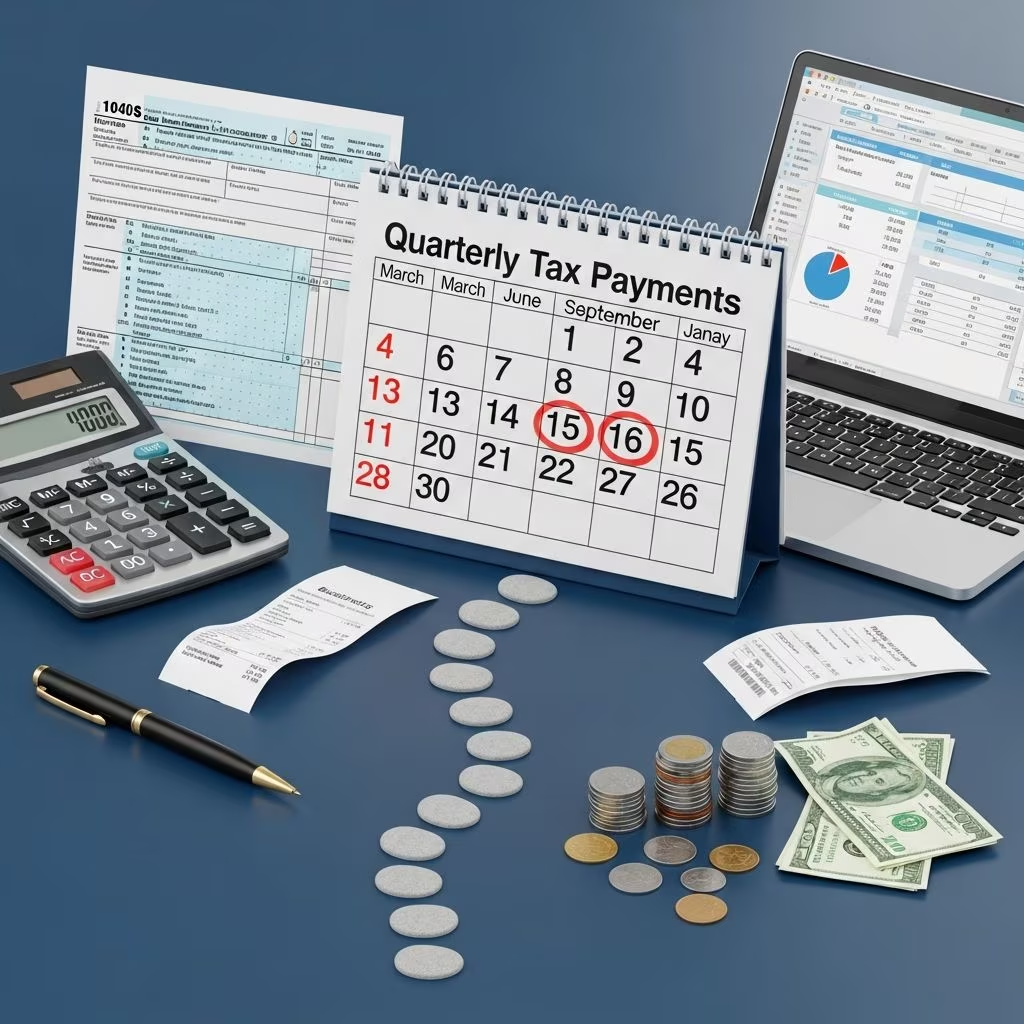
Navigating Quarterly Tax Obligations: A Comprehensive Overview
For individuals who are self-employed, work as independent contractors, or receive income without employer tax withholding, understanding quarterly estimated tax payments is essential to maintaining compliance with the Internal Revenue Service. Unlike traditional employees who have taxes automatically withheld from each paycheck, self-employed professionals and business owners must proactively manage their tax liability throughout the year. These quarterly payments serve as a bridge between earning income and filing the annual tax return, ensuring that taxpayers meet their federal and state tax obligations on a more frequent basis.
The concept of quarterly estimated taxes reflects the IRS’s philosophy of “pay as you go”—spreading your annual tax burden across four payment periods rather than facing a large bill when filing your return. This approach helps individuals manage cash flow more effectively and avoid penalties that can accumulate when taxes are not paid in a timely manner. Understanding when payments are due, how to calculate the correct amount, and which taxpayers are required to make these payments can significantly impact your financial planning and tax outcomes.
Who Must Make Quarterly Estimated Tax Payments
Not all taxpayers are required to make quarterly estimated tax payments. The IRS has established specific thresholds and circumstances that determine whether an individual must participate in this payment structure. If your situation involves irregular income, variable earnings, or sources of income that don’t have withholding mechanisms in place, you may fall into this category.
According to IRS guidelines, you generally need to make quarterly estimated tax payments if you expect to owe $1,000 or more in federal income taxes for the year after accounting for any withholding or refundable credits. Additionally, if your withholding and refundable credits are projected to cover less than 90% of your current year’s tax liability, or 100% of your previous year’s tax liability (whichever is smaller), you should make these payments. For higher-income earners with an adjusted gross income exceeding $150,000 (or $75,000 for those filing separately), the threshold increases to 110% of the prior year’s tax liability.
Common situations requiring quarterly payments include:
- Self-employed individuals operating sole proprietorships or partnerships
- Freelancers and independent contractors in various industries
- Business owners who have opted out of corporate structures
- Individuals receiving rental income from real estate investments
- Those with significant investment income such as capital gains or dividends
- Gig economy workers earning income through multiple platforms
- Artists, writers, and other creative professionals with variable income
Breaking Down the Tax Components Included in Quarterly Payments
Quarterly estimated tax payments encompass more than just federal income tax. Understanding the various components that make up these payments helps ensure you’re calculating and setting aside the correct amount throughout the year.
The primary components of estimated quarterly tax payments include federal income tax, state income tax (if your state has an income tax requirement), and self-employment tax. Self-employment tax covers Social Security and Medicare contributions, which self-employed individuals must pay themselves rather than having an employer contribute half of the amount. For many self-employed professionals, self-employment tax represents a significant portion of their overall tax obligation and should not be overlooked when calculating quarterly payments.
Some taxpayers may also have alternative minimum tax obligations or owe other types of federal taxes, which could factor into their estimated quarterly payments. Additionally, if you live in a state with income tax requirements, those state obligations should be calculated and paid alongside your federal estimates. Certain local jurisdictions may also impose income taxes, adding another layer to the calculation process. Taking time to account for all these components ensures your quarterly payments adequately cover your actual tax liability.
Establishing Your Payment Schedule: Key Dates for 2026
The IRS has established specific payment due dates throughout the year, though these dates don’t align with traditional calendar quarters. Instead, the payment schedule is structured to collect taxes at intervals that roughly align with when income is earned and reported. Understanding these deadlines is critical for compliance, as missing a payment date can trigger penalties and interest charges.
For 2026, the quarterly estimated tax payment schedule is as follows:
| Payment Period | Income Earned During | Payment Due Date |
|---|---|---|
| First Quarter | January 1 – March 31, 2026 | April 15, 2026 |
| Second Quarter | April 1 – May 31, 2026 | June 16, 2026 |
| Third Quarter | June 1 – August 31, 2026 | September 15, 2026 |
| Fourth Quarter | September 1 – December 31, 2026 | January 15, 2027 |
It’s important to note that if a due date falls on a weekend or federal holiday, the IRS typically extends the deadline to the next business day. Taxpayers should always verify exact dates on the IRS website, as emergency circumstances or technical difficulties could occasionally result in deadline adjustments. Setting calendar reminders well in advance of each due date helps prevent accidental missed payments.
Calculation Methods: Selecting the Right Approach for Your Situation
The IRS provides flexibility in how you calculate your quarterly estimated tax payments, recognizing that different taxpayers have different income patterns and financial situations. Selecting the appropriate calculation method depends on factors such as the consistency of your income, your ability to project future earnings, and whether your income fluctuates significantly throughout the year.
The Prior Year Method
One straightforward approach involves using your previous year’s tax liability as the basis for your current year’s quarterly payments. With this method, you take the total federal income tax you owed in the prior tax year and divide it by four, paying that equal amount each quarter. For example, if your tax bill last year was $8,000, you would make four quarterly payments of $2,000 each.
This method works particularly well for individuals with relatively stable income from year to year. It’s simple to calculate, requires minimal ongoing adjustments, and provides predictability in your cash flow planning. However, if your income has increased significantly compared to the prior year, this method could result in underpayment penalties. Conversely, if your income has decreased, you may be overpaying throughout the year, though you’ll recover the excess when filing your annual return.
For higher-income individuals with an adjusted gross income exceeding $150,000, the prior year calculation includes a 10% adjustment factor. Using the previous example, the quarterly payment would be $2,200 ($8,000 × 1.10 ÷ 4) rather than $2,000. This adjustment recognizes that higher-income taxpayers have historically had greater income variability.
The Annualization Method
An alternative approach involves calculating your estimated tax liability based on your actual income earned to date during the current year. With annualization, you estimate your tax bill at the end of each quarter based on a reasonable projection of your income and deductions through that point, then extrapolate to determine your full-year tax obligation.
This method proves especially valuable for individuals whose income is highly variable or concentrated in specific months or quarters. A freelancer who earns 60% of annual income during the final quarter, for instance, would make smaller payments during the first three quarters and a larger payment in October. The IRS provides worksheets and formulas to assist with annualization calculations, acknowledging the additional complexity this method requires.
Annualization requires more detailed record-keeping and attention to income fluctuations throughout the year, but it can help avoid both overpayment and underpayment penalties for those with irregular earning patterns. If you choose this method, you must file Form 2220 (Underpayment of Estimated Tax by Individuals, Estates, and Trusts) with your annual tax return to explain the annualized calculation.
The 90% Current Year Method
A third option involves estimating what you’ll owe for the current year, calculating 90% of that estimated tax liability, and dividing the result into four equal quarterly payments. This method requires you to project your full-year income, deductions, and tax liability relatively early in the year. It works well if you can reasonably estimate your annual income and have sufficient cash flow to cover the payments.
Mechanics of Making Your Quarterly Tax Payments
Once you’ve determined the correct amount for your quarterly estimated tax payments, the IRS provides multiple convenient methods for submitting these payments. The payment process is straightforward and offers flexibility to accommodate different taxpayer preferences and banking arrangements.
You can make estimated tax payments through the IRS’s online payment system, by phone, through a tax professional or financial institution, or by mail using Form 1040-ES vouchers. Electronic payment options are often the most convenient and provide immediate confirmation of payment. The IRS offers different payment platforms designed for individual taxpayers, businesses, and those paying on behalf of others.
One important consideration is that while you have the flexibility to make payments more frequently than quarterly if you wish, concentrating all annual payments into a single early payment is generally not advisable. Making one lump-sum payment in April, for instance, could result in underpayment penalties for the later quarters of the year, even if your total annual payment is sufficient. The IRS bases penalty calculations on whether adequate payments were made by each quarterly deadline, not merely on the total amount paid by year-end.
Understanding Penalties and Interest for Insufficient Payments
The IRS enforces the estimated tax payment requirement through penalties and interest charges that apply when taxpayers fail to pay adequate amounts by the required deadlines. Understanding these consequences helps motivate timely compliance and emphasizes the importance of accurate calculations.
If you don’t pay enough tax through withholding and quarterly payments, you may owe an underpayment penalty when filing your annual return.[10] This penalty applies if your total payments fall short of either 90% of your current year’s tax liability or 100% of your prior year’s liability (110% for higher-income taxpayers). The penalty calculation is somewhat complex and accounts for the time period during which the underpayment occurred. Additionally, the IRS charges interest on any unpaid taxes from the original due date until the payment date, compounding the cost of non-compliance.
These penalties and interest charges are separate from the taxes owed and represent additional costs that could have been avoided through proper planning. In some cases, if you had reasonable cause for the underpayment—such as significant unexpected changes in income or major life events—you may be able to request penalty relief from the IRS.
Adjusting Payments When Circumstances Change
Life and business circumstances often change during the tax year, potentially affecting your projected income and the appropriate quarterly payment amount. The IRS recognizes this reality and allows taxpayers to adjust their estimated tax payments to reflect changing conditions.
If your income is significantly higher than projected, you should increase your remaining quarterly payments to avoid an underpayment penalty. Conversely, if income is lower than anticipated, reducing your remaining payments may be appropriate. Rather than waiting until the next scheduled quarterly payment, you can adjust your current payment if you realize a significant discrepancy in your projections.
Some taxpayers, particularly those with additional employment, may have the option to adjust their employer withholding instead of making estimated quarterly payments. If you work both as an employee and in a self-employment capacity, asking your employer to withhold additional amounts from your regular paychecks could cover your self-employment tax liability, potentially eliminating the need for quarterly estimated payments.
Strategic Planning and Professional Guidance
Given the complexity of estimated tax calculations and the potential financial consequences of non-compliance, many self-employed individuals and business owners benefit from professional tax guidance. A tax professional can help you select the most appropriate calculation method, ensure accurate payments throughout the year, and identify opportunities to minimize your overall tax liability.
Strategic planning during the year—such as timing income recognition, managing deductible expenses, or making retirement plan contributions—can significantly impact your estimated tax liability and help optimize your after-tax cash flow. Professional guidance ensures these strategies are implemented correctly and in compliance with IRS regulations.
Frequently Asked Questions About Quarterly Tax Payments
Q: Can I pay all my quarterly taxes at once instead of making four separate payments?
A: While you technically could make one payment early in the year, this approach typically results in underpayment penalties for the subsequent quarters. The IRS bases penalties on whether adequate payments were made by each quarterly deadline, not solely on total annual payment amounts. It’s recommended to maintain the quarterly payment schedule.
Q: What should I do if my income changed dramatically midway through the year?
A: You can adjust your remaining estimated tax payments to reflect your new income projection. If income increased significantly, increase your remaining payments to avoid underpayment penalties. If income decreased, you may reduce your remaining payments accordingly. Documentation of the income change supports any adjustment decisions.
Q: Are state taxes included in estimated quarterly payments?
A: Yes, if your state imposes an income tax, you should calculate and include state estimated taxes alongside your federal estimates. Some individuals live in states without income taxes, while others may have multiple state tax obligations depending on where they earn income or reside.
Q: What if I miss a quarterly payment deadline?
A: You should make the payment as soon as possible. The longer the delay, the more interest and potential penalties accumulate. Contact the IRS if you need guidance on late payment procedures, and ensure subsequent quarterly payments are made on schedule.
Q: How do I know which calculation method to use?
A: The prior year method works best for those with stable income, while annualization suits those with variable income concentrated in specific periods. Consider consulting a tax professional who can evaluate your specific income pattern and recommend the most beneficial method.
Q: Do I need to make quarterly payments if I have a business loss?
A: If you project a net business loss for the year, you likely won’t owe quarterly estimated taxes. However, if you have other income sources that create a tax liability, you may still need to make payments based on that other income.
References
- Estimated Tax Payments and Quarterly Tax Guide — Fidelity Investments. 2025. https://www.fidelity.com/learning-center/smart-money/estimated-tax-payments
- Estimated Tax Payments: 2025-2026 Rules & Deadlines — NerdWallet. 2025. https://www.nerdwallet.com/taxes/learn/estimated-quarterly-taxes
- Federal Quarterly Estimated Tax Payments — Yale University, Financial Resources. 2025. https://your.yale.edu/financial-resources/internal-controls-compliance/tax-information/graduate-professional-school-3
- Guide to Managing and Paying Quarterly Taxes — Chase for Business. 2025. https://www.chase.com/business/knowledge-center/manage/guide-to-managing-and-paying-quarterly-taxes
- Estimated Taxes — Internal Revenue Service. 2025. https://www.irs.gov/businesses/small-businesses-self-employed/estimated-taxes
- Pay As You Go, So You Won’t Owe: A Guide to Withholding, Estimated Taxes and Ways to Avoid the Estimated Tax Penalty — Internal Revenue Service. 2025. https://www.irs.gov/payments/pay-as-you-go-so-you-wont-owe-a-guide-to-withholding-estimated-taxes-and-ways-to-avoid-the-estimated-tax-penalty