
Private Student Loans and Bankruptcy: Myths, Law, and Real Options
Understand how bankruptcy actually interacts with private student loans, and what legal options may exist to reduce or discharge this debt.
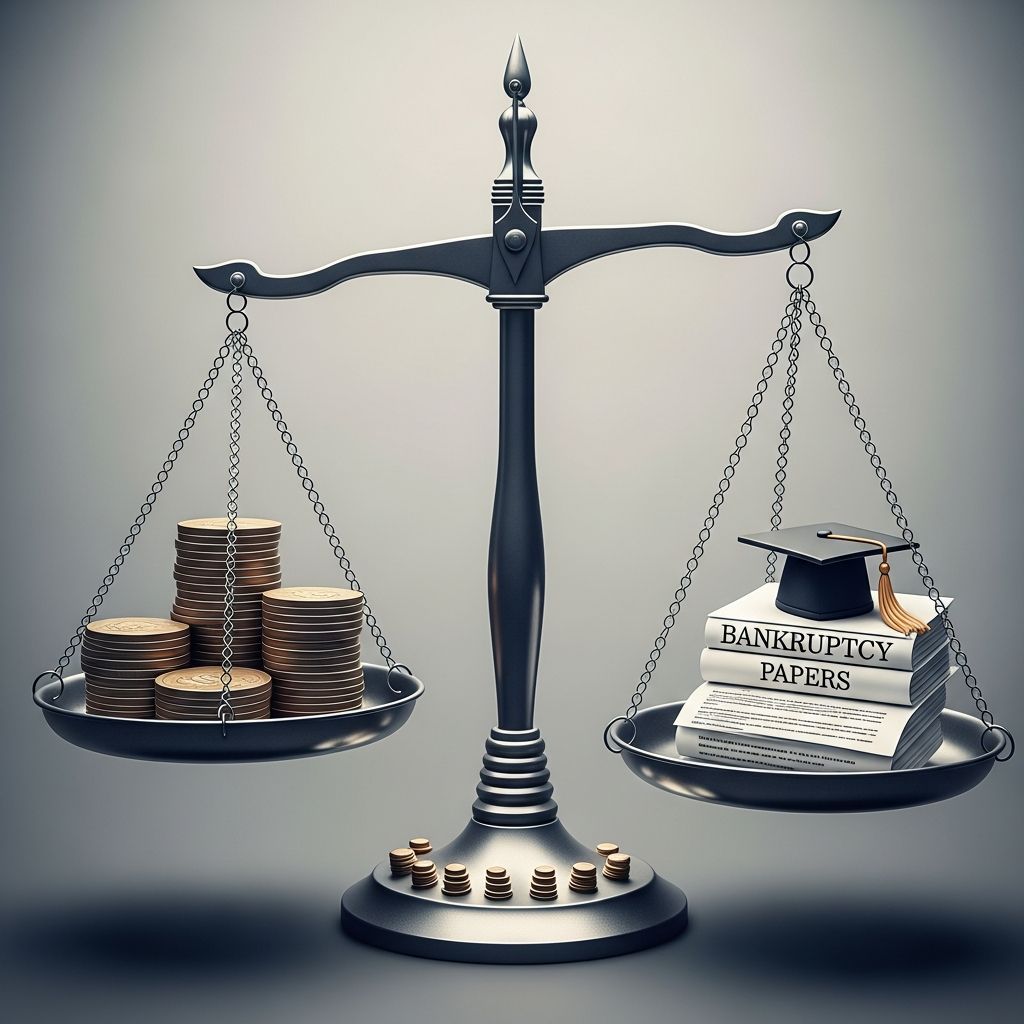
Private student loans are often marketed as flexible tools to pay for education, but many borrowers later discover just how rigid these loans can be when money is tight. Stories circulate online claiming that student loans can never be wiped out in bankruptcy, leaving many people afraid to even ask questions. In reality, the law is more complex: some private education loans can be discharged more easily than others, and recent policy developments around student loan bankruptcy are changing the landscape for borrowers.
This guide explains how bankruptcy interacts with private student loans, debunks common myths, and outlines practical steps you can take if you are buried under education debt. It is for informational purposes only and is not legal advice; if you are considering bankruptcy, you should speak with a qualified bankruptcy attorney.
1. Why Private Student Loan Debt Is So Hard to Escape
Unlike federal student loans, which are backed by the government and have standardized relief options like income-driven repayment, private student loans are contracts between borrowers and private lenders. These loans often:
- Have higher and more variable interest rates than federal loans.
- Provide limited options for forbearance, deferment, or modification.
- Require a creditworthy cosigner, who remains responsible if you stop paying.
- Include aggressive collection rights if you default.
Bankruptcy is often viewed as a last-resort tool to deal with unmanageable debts. But student loans are treated differently under the Bankruptcy Code, and that is where much of the confusion begins.
2. The Big Myth: “Student Loans Can Never Be Discharged”
One of the most persistent myths is that student loans are always excluded from bankruptcy relief, no matter the circumstances. That statement is false for both federal and private loans.
In broad terms, there are two categories of education-related loans under bankruptcy law:
- Loans protected from normal discharge: These include most federal student loans and many private loans that meet the definition of a qualified education loan under the Internal Revenue Code. To discharge them, a borrower must show that repayment would cause undue hardship in a separate court proceeding.
- Loans that behave like ordinary consumer debt: Some private loans for educational purposes do not meet the statutory definition of a qualified education loan. When that is true, they may be treated like credit cards or personal loans in bankruptcy and can be discharged in a regular Chapter 7 or Chapter 13 case, without any extra showing of undue hardship.
This second category is often overlooked. Consumer complaints and court decisions show that some lenders or collectors still tell borrowers that “student loans can’t be discharged in bankruptcy,” even when the specific debt is not protected by the special student loan rules.
3. Understanding “Qualified” vs. “Non-qualified” Private Education Loans
Whether a private student loan is subject to the special nondischargeability rules depends on how the loan was structured and used. Federal law treats a loan differently if it is a qualified education loan. Generally, a private loan is more likely to be qualified when:
- It was used solely to pay eligible educational expenses (like tuition and required fees) at an eligible institution.
- The school certified the loan, confirming your enrollment status and cost of attendance.
- The loan amount did not exceed the school’s official cost of attendance, minus scholarships and certain aid.
By contrast, a private loan may be non-qualified if, for example:
- It was made directly to you as a consumer loan without school certification.
- It exceeded the school’s published cost of attendance.
- It funded non-eligible programs or schools that do not qualify under federal rules.
Non-qualified private student loans generally do not receive the special protections that make student loans hard to discharge. In bankruptcy, they may be wiped out along with other unsecured debts, assuming you satisfy the usual requirements for Chapter 7 or Chapter 13 relief.
4. How Bankruptcy Usually Treats Student Loans
Bankruptcy in the United States is governed by federal law and primarily comes in two forms for individuals:
- Chapter 7: Liquidation bankruptcy, aimed at providing a relatively quick discharge of many unsecured debts for borrowers who do not have enough income to repay.
- Chapter 13: A court-supervised repayment plan, usually lasting 3–5 years, where some debts are repaid in part before discharge.
When it comes to student loans, the default rule is that they are not automatically discharged when your case ends. For loans protected by the special student loan provision, you must take additional steps in the bankruptcy case: you need to file an adversary proceeding, which is essentially a separate lawsuit asking the court to discharge those particular loans.
5. The Role of “Undue Hardship” for Protected Loans
For qualified private student loans (and virtually all federal student loans), the borrower must demonstrate that repayment would cause undue hardship in order to get a discharge in bankruptcy.
Bankruptcy courts have developed tests to interpret what qualifies as undue hardship. The most widely used standard is the Brunner test, which generally requires showing that:
- You cannot maintain a minimal standard of living for yourself and your dependents if forced to repay the loan.
- Your financial situation is likely to persist for a significant part of the repayment period.
- You have made good-faith efforts to repay, such as seeking work, cutting expenses, or exploring available repayment programs.
This is a high bar, and historically many borrowers assumed it was nearly impossible to meet. Research and case law, however, show that borrowers do occasionally succeed—especially when they present strong documentation of long-term hardship, disability, or other severe constraints.
Moreover, for federal student loans, the U.S. Department of Justice and the Department of Education issued guidance in 2022 designed to provide clearer criteria and a more consistent approach to undue hardship evaluations in bankruptcy cases, which may make relief more accessible in some circumstances.
6. When Private Student Loans May Be Discharged like Other Debt
Some private education loans sit outside the special student loan protections altogether. Examples may include:
- Loans for bar study or exam prep that do not meet the statutory criteria.
- Loans at unaccredited institutions that are not eligible education institutions under federal rules.
- Loans that clearly exceeded the cost of attendance and were not used for qualified expenses.
In these circumstances, courts have sometimes ruled that such debts are simply regular consumer loans, not protected student loans. In those cases, the borrower can obtain a discharge in a standard Chapter 7 or Chapter 13 case, without proving undue hardship or filing an adversary proceeding.
Yet some collectors continue attempting to collect after a borrower’s bankruptcy discharge, asserting that the debt is a nondischargeable student loan when the legal criteria aren’t actually satisfied. That is one reason borrowers are encouraged to:
- Review their loan documents and promissory notes carefully.
- Compare loan amounts against the school’s published cost of attendance for the relevant years.
- Consult an attorney to analyze whether the loan meets the definition of a qualified education loan.
7. Impact of Bankruptcy on Your Credit and Future Borrowing
Filing bankruptcy carries significant consequences, including credit score damage and possible difficulty obtaining new credit. However, the effect is not uniform, and for some borrowers deeply in default, the marginal impact may be less severe than expected.
| Aspect | Typical Effect of Bankruptcy | Relevance to Student Loan Borrowers |
|---|---|---|
| Credit report notation | Chapter 7 can remain up to 10 years; Chapter 13 up to 7 years. | May limit access to new private loans or credit cards; some lenders require a cosigner. |
| Access to private student loans | Many programs deny applicants with recent bankruptcy or require a strong cosigner. | Future education financing may be more difficult or costly, especially soon after discharge. |
| Interest rates on new credit | Often higher immediately after bankruptcy. | Borrowers must weigh the long-term relief of discharge against future borrowing costs. |
Even with these drawbacks, consumer advocates note that bankruptcy can provide meaningful relief for heavily indebted borrowers—especially when it eliminates non-qualified private student loans or other high-interest consumer debts, freeing up income for remaining obligations.
8. Practical Steps If You Think Your Private Loan Should Have Been Discharged
- Request documentation from the lender or collector explaining why they believe the loan is nondischargeable.
- Review your bankruptcy paperwork with your attorney to confirm how the debt was scheduled and what the discharge order covers.
- Compare the loan to legal criteria for qualified education loans, focusing on cost of attendance, school eligibility, and how the funds were used.
- Document all communications with collectors, including dates, statements made, and any written notices.
- Discuss enforcement options with a bankruptcy or consumer protection lawyer, especially if you suspect the collector is misrepresenting the law or violating the discharge injunction.
9. Alternatives to Bankruptcy for Struggling Private Loan Borrowers
- Refinancing or consolidation with a new private lender offering a lower rate or longer repayment period—though this usually requires good credit and can be difficult after payment problems.
- Negotiating a modified repayment plan, such as temporarily interest-only payments or an extended term.
- Hardship forbearance, where payments are paused or reduced for a short period, sometimes with continued interest accrual.
- Lump-sum settlement, where you or a third party pay part of the balance in exchange for forgiveness of the remainder, if the lender agrees.
10. Protecting Yourself as a Borrower
- Keep thorough records of all loan documents, disbursement statements, and school billing records.
- Monitor your credit reports regularly to verify how your loans and any bankruptcy are reported.
- Seek independent legal advice rather than relying solely on information provided by lenders or collectors.
- Learn basic bankruptcy concepts such as discharge, adversary proceedings, and undue hardship so you can ask better questions.
- Communicate early with your servicer if you anticipate trouble making payments; some options are only available before default.
Frequently Asked Questions (FAQs)
Q1: Are all private student loans automatically excluded from bankruptcy discharge?
No. Only loans that meet the legal definition of a qualified education loan (or fall under certain other education-related provisions) are protected from ordinary discharge rules. Some private loans for educational purposes are treated as regular consumer debts and can be discharged without proving undue hardship.
Q2: Do I need to file a separate lawsuit to get rid of my private student loans in bankruptcy?
You generally must file an adversary proceeding if you want to discharge loans that are presumed nondischargeable, such as qualified private student loans or federal student loans. For non-qualified private loans that function as standard consumer debts, an adversary proceeding may not be necessary because they are discharged along with other unsecured obligations.
Q3: How can I tell if my private student loan is a “qualified education loan”?
You usually need to look at the loan’s purpose, the type of school you attended, whether the school certified the loan, and whether the amount exceeded the school’s published cost of attendance. An attorney can compare your documents with the statutory definition to determine how bankruptcy law is likely to treat the loan.
Q4: If my private student loan was discharged, can the lender still report missed payments to credit bureaus?
Once a debt has been discharged in bankruptcy, creditors are not allowed to continue collection efforts, and inaccurate reporting of a discharged debt may raise legal issues. Borrowers who see post-discharge negative reporting should dispute it with the credit bureaus and consider speaking to a consumer attorney familiar with the bankruptcy discharge injunction.
Q5: Does a bankruptcy that includes student loans affect my eligibility for future federal student aid?
Federal law generally does not bar you from receiving new federal student aid solely because you filed bankruptcy, but certain defaulted federal loans or unresolved grant overpayments can affect eligibility until addressed. Bankruptcy may, however, make it harder to obtain new private education loans without a strong cosigner.
References
- Can Private Student Loans Be Discharged In Bankruptcy? — Tate Esq. 2025-06-06. https://www.tateesq.com/learn/student-loan-bankruptcy-private-discharge
- Can I Discharge a Private Student Loan in Bankruptcy? — Upsolve. 2024-04-15. https://upsolve.org/learn/private-student-loans/
- Bankruptcy — Student Loan Borrower Assistance (National Consumer Law Center). 2023-08-10. https://studentloanborrowerassistance.org/for-borrowers/dealing-with-student-loan-debt/loan-cancellation-forgiveness-bankruptcy/bankruptcy/
- Busting myths about bankruptcy and private student loans — Consumer Financial Protection Bureau. 2014-01-07. https://www.consumerfinance.gov/about-us/blog/busting-myths-about-bankruptcy-and-private-student-loans/
- Bankruptcy and Financial Aid — FinAid. 2022-10-01. https://finaid.org/questions/bankruptcy/
- Discharge in Bankruptcy — Federal Student Aid, U.S. Department of Education. 2023-11-01. https://studentaid.gov/manage-loans/forgiveness-cancellation/bankruptcy
- The Non-Dischargeability of Private Student Loans: A Looming Crisis — Emory Bankruptcy Developments Journal. 2015-01-01. https://scholarlycommons.law.emory.edu/ebdj/vol32/iss1/11/
Similar Articles








Read full bio of Sneha Tete




