
Can You Pay Off a Loan Early Without Fees?
Understand when you can pay a loan off early without penalty, how prepayment fees work, and the rules that protect many mortgage borrowers.
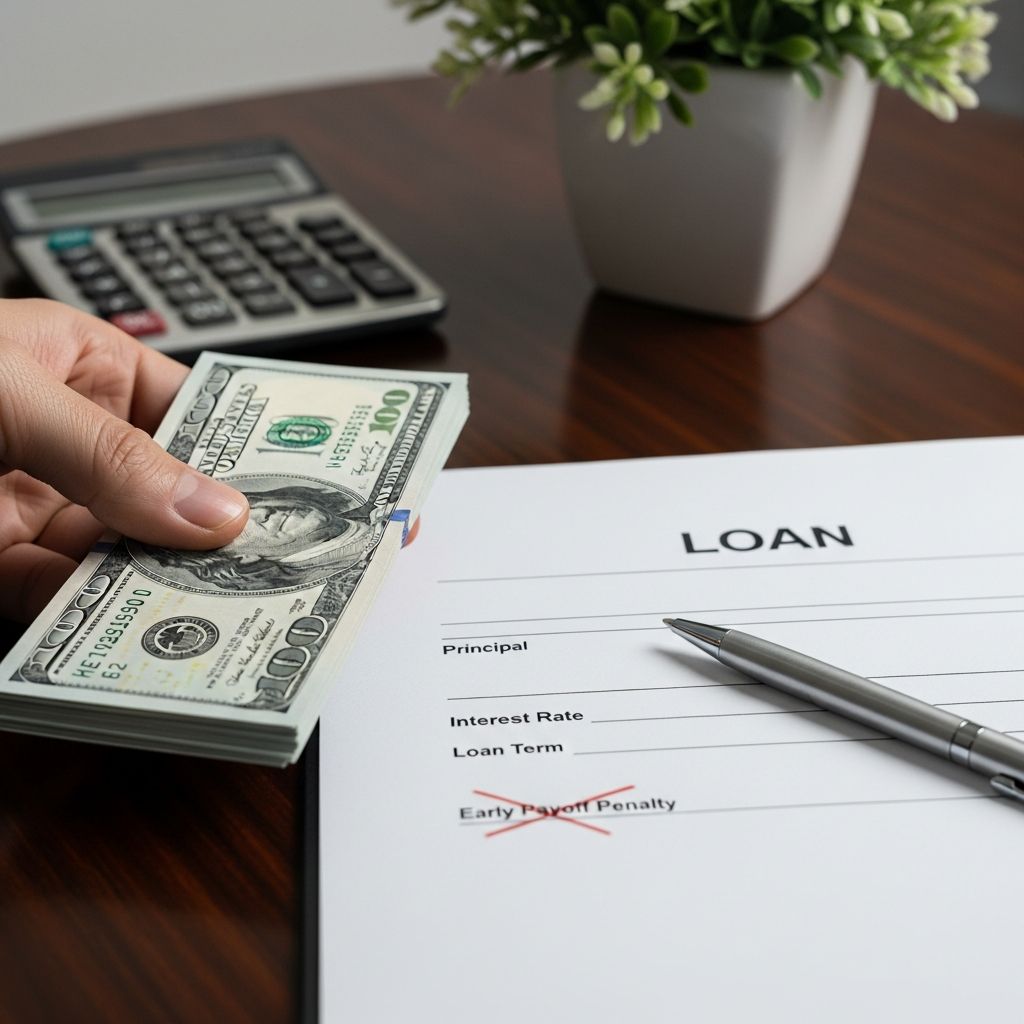
Many borrowers want to pay down debt as fast as possible, but some loans charge a prepayment penalty when you pay off the balance ahead of schedule. Understanding when these fees are allowed, how they work, and how to avoid them can save you hundreds or even thousands of dollars.
What Is a Prepayment Penalty?
A prepayment penalty is a contractual fee that a lender may charge if you pay off all or part of a loan before the date required in the loan agreement. These fees are most commonly associated with mortgage loans, but can also appear in some auto, personal, or other consumer loans depending on state law and the contract.
- “Prepayment” means paying earlier than scheduled – either a lump-sum payoff or extra payments on principal.
- “Penalty” means an added cost triggered by that early payment, above the normal interest and fees you already agreed to pay.
Prepayment penalties are designed to protect the lender’s expected interest income when a loan is paid off faster than planned.
Why Lenders Use Prepayment Penalties
From the lender’s perspective, a loan is an investment. The repayment schedule determines how much interest they expect to earn over time. When you pay off early:
- The lender collects less interest than expected.
- The lender may have upfront costs (such as underwriting or closing expenses) they expected to recoup through interest over several years.
- If the loan has a below-market rate, early payoff means the lender loses a relatively attractive return.
To offset these risks, some lenders include a clause that allows them to charge a fee if you refinance, sell the property, or otherwise pay the loan off before a specified period ends.
Common Ways Prepayment Penalties Are Structured
The exact formula is always defined in your contract. Typical approaches include:
- Percentage of the outstanding balance – For example, 2% of the remaining principal if you pay off the loan in the first two years.
- Number of months’ interest – For instance, the fee may equal three to six months of interest at your current rate.
- Step-down schedule – The penalty percentage decreases over time, such as 3% in year one, 2% in year two, and 1% in year three.
- Limited to certain events – Some contracts only apply the fee if you refinance with another lender, but not if you sell the home or make smaller extra payments.
Regardless of the formula, federal law limits prepayment penalties for many consumer mortgage loans secured by a home you live in.
Federal Limits on Mortgage Prepayment Penalties
Consumer protection rules significantly restrict when and how a lender can charge a prepayment penalty on many home loans. Under federal regulations for certain mortgages secured by a consumer’s principal dwelling:
- Prepayment penalties are generally not allowed after the first 36 months from loan closing.
- Total penalties across the loan term generally cannot exceed 2% of the amount prepaid.
- Separate rules for “high-cost mortgages” further limit the use and size of prepayment penalties, because large penalties can contribute to a loan being classified as high-cost.
| Loan period | General approach to penalties |
|---|---|
| First 2 years | Penalty may be allowed, often capped at up to about 2% of the outstanding principal (for certain covered mortgages). |
| Year 3 | Penalty may still be allowed, but at a lower level (for example, up to about 1% in some structures). |
| After 3 years | Prepayment penalties are generally prohibited on many consumer mortgages secured by a principal residence. |
These limits come from federal consumer financial laws and their implementing regulations; they are designed to reduce abusive loan terms that trap homeowners in costly mortgages.
Loans That Often Cannot Charge Prepayment Penalties
Some lenders and loan types are restricted by statute or regulation from charging prepayment penalties at all, or only in narrow circumstances:
- Many credit union loans – Federal credit unions are generally prohibited from charging prepayment penalties on member loans, including many business loans, under the Federal Credit Union Act and related regulations.
- Certain government-guaranteed or federally related loans – Specific federal programs may grant borrowers the right to prepay without penalty, or strictly control when a fee can be charged.
- Some state-regulated loans – State law can ban or limit prepayment penalties for particular categories of consumer credit, such as specific types of home equity loans or smaller consumer loans.
Whether you can be charged a penalty depends on both the governing law (federal and state) and the exact wording of your contract.
When You Can Usually Prepay Without a Penalty
Even if your loan agreement includes a prepayment clause, there are several scenarios where early payoff is often free or the fee may not apply:
- After the penalty window ends – On many home loans subject to federal rules, no penalty is allowed more than three years after the loan closes.
- Small additional principal payments – Some contracts allow you to pay extra principal up to a limit each year without triggering a fee (for example, up to 20% of the original balance annually).
- Loans without any prepayment clause – If your note and disclosures do not authorize a penalty, the lender generally cannot add one later.
- Certain program rules – Loans offered under government programs or specific investor guidelines may explicitly allow full prepayment with no fee for the life of the loan.
- Prohibited clauses under state law – In some states, prepayment penalties are banned for particular consumer loans; if a contract includes such a term, it may be unenforceable.
How to Check Your Own Loan for Prepayment Penalties
Before paying off a loan early or refinancing, review your documents carefully. Look for language about “prepayment,” “prepayment fee,” or “prepayment penalty.”
- Promissory note or credit agreement – This is the core contract; it typically includes any prepayment clause, describing when and how the fee applies.
- Mortgage or deed of trust (for home loans) – May cross-reference the note and spell out rights related to payoff.
- Truth in Lending disclosures – For covered consumer loans, federal disclosure rules require stating whether a prepayment penalty can apply.
- Closing documents and riders – Adjustable-rate riders or other add-ons sometimes include additional prepayment terms.
If you cannot locate or interpret the language, ask your lender or servicer for:
- A written “payoff quote” showing exactly how much you must pay to satisfy the loan on a specific date.
- Confirmation in writing of any prepayment fee that would be charged and how it is calculated.
Key Questions to Ask Your Lender
When shopping for a new loan or considering prepayment, use targeted questions to avoid surprises:
- “Does this loan include a prepayment penalty? If so, under what circumstances is it charged?”
- “How long does the prepayment penalty period last?”
- “Is the fee based on a percentage of the balance or a certain number of months of interest?”
- “Does the penalty apply if I refinance with another lender, but not if I sell the property?”
- “Can I make extra principal payments each year without any penalty? If yes, what is the limit?”
Get the answers in writing or in an official disclosure so you can rely on them later.
How State Law Affects Prepayment Penalties
In addition to federal restrictions, state law plays a major role in determining whether prepayment penalties are allowed and enforceable:
- Some states limit the maximum percentage a lender can charge as a prepayment penalty, or restrict penalties to specific types of loans.
- Other states may prohibit prepayment penalties entirely on certain consumer loan categories.
- In commercial lending, courts often enforce prepayment provisions when clearly written, but they may refuse to enforce excessive or unconscionable fees, or penalties that were not clearly disclosed.
If you are unsure about your rights under state law, it can be useful to consult a housing counselor, legal aid office, or attorney familiar with consumer credit in your state.
Strategies to Avoid or Reduce Prepayment Penalties
If your loan includes a prepayment clause, you may still have options to minimize or avoid the fee.
- Time your payoff – If the penalty period ends after a specific date (for example, three years after closing), waiting until that date can eliminate the fee.
- Use allowed partial prepayments – Make the largest extra payments you can within any annual penalty-free limit. This reduces the balance so that any eventual fee applies to a smaller amount.
- Negotiate before closing – When you are still shopping for a loan, ask for a version without a prepayment penalty or with a shorter penalty period. Sometimes you can trade a slightly higher interest rate for more flexibility.
- Compare total cost – If you are refinancing, calculate whether the interest savings from a new, lower-rate loan outweighs the cost of the penalty you would pay on your existing loan.
- Review for legal issues – If a fee violates federal or state limits, or was not properly disclosed, you may be able to challenge it. Legal advice is especially useful in complex situations.
Prepaying vs. Investing: Deciding What’s Best for You
Even when you can prepay a loan with no penalty, it is worth weighing the financial trade-offs:
- If your loan’s interest rate is higher than what you could realistically earn on safe investments, early repayment may be a strong choice.
- If your rate is relatively low, you might benefit more from building an emergency fund or contributing to retirement accounts before making extra principal payments.
- Eliminating certain debts, such as high-rate credit cards or personal loans, almost always provides a clear benefit.
- For mortgages, consider tax implications and your long-term housing plans; sometimes flexibility and liquidity are as valuable as an early payoff.
Your decision does not have to be all-or-nothing. You can combine regular saving and investing with periodic extra payments on higher-cost debts.
Frequently Asked Questions (FAQs)
Q1: Can my lender add a prepayment penalty after I sign the loan?
No. A prepayment penalty must be part of the original loan agreement and properly disclosed. Lenders generally cannot impose a new penalty later that you did not agree to in your signed documents.
Q2: Do all mortgages have prepayment penalties?
No. Many modern mortgage products, especially those conforming to mainstream investor and federal standards, do not include prepayment penalties. Federal rules also limit when such penalties can apply on many owner-occupied home loans.
Q3: If I sell my home, will I automatically pay a prepayment penalty?
Not necessarily. Whether selling your home triggers a penalty depends entirely on your contract. Some penalties apply to any early payoff, while others are limited to refinances or larger-than-allowed extra payments. Review your note and ask for a payoff quote before listing or closing on a sale.
Q4: Can state law stop a lender from charging a penalty that is in my contract?
In some cases, yes. If a state statute bans or caps prepayment penalties for your type of loan, a conflicting contract term may be invalid or limited. Enforcement rules vary, so legal advice or help from a consumer law expert in your state can be important.
Q5: Are business or commercial loans covered by the same protections?
Typically not. Many of the strongest prepayment protections apply to consumer mortgages on a borrower’s primary residence. Commercial and business-purpose loans often follow different legal standards, and courts may be more likely to enforce clearly drafted prepayment clauses in those agreements.
References
- Prepayment Penalty in the Member Business Loans (MBL) Context — National Credit Union Administration. 2008-08-01. https://ncua.gov/regulation-supervision/legal-opinions/2008/prepayment-penalty-member-business-loans-mbl-context
- Prepayment Fee Provisions: Enforceable or Not? — Baird Holm LLP. 2019-10-25. https://www.bairdholm.com/blog/prepayment-fee-provisions-enforceable-or-not/
- 12 CFR § 1026.32 – Requirements for high-cost mortgages — Consumer Financial Protection Bureau. 2022-10-01. https://www.consumerfinance.gov/rules-policy/regulations/1026/32/
- Prepayment Penalties in Commercial Real Estate — CommercialRealEstate.Loans. 2023-04-10. https://www.commercialrealestate.loans/commercial-real-estate-glossary/prepayment-penalties/
- 7 U.S. Code § 936a – Prepayment of loans — U.S. House of Representatives, Office of the Law Revision Counsel. 2018-01-03. https://www.law.cornell.edu/uscode/text/7/936a
- 7 U.S. Code § 936c – Refinancing and prepayment of FFB loans — U.S. House of Representatives, Office of the Law Revision Counsel. 2018-01-03. https://uscode.house.gov/view.xhtml?req=granuleid:USC-prelim-title7-section936c
- What Is a Mortgage Prepayment Penalty? — Bankrate. 2023-03-22. https://www.bankrate.com/mortgages/prepayment-penalty/
- What is a prepayment penalty? — Consumer Financial Protection Bureau. 2022-06-01. https://www.consumerfinance.gov/ask-cfpb/what-is-a-prepayment-penalty-en-1957/
Similar Articles








Read full bio of Sneha Tete




