
Reimagining Public Infrastructure: How Postal Banking Could Bridge the Economic Divide
How public postal banking can dismantle systemic financial barriers.
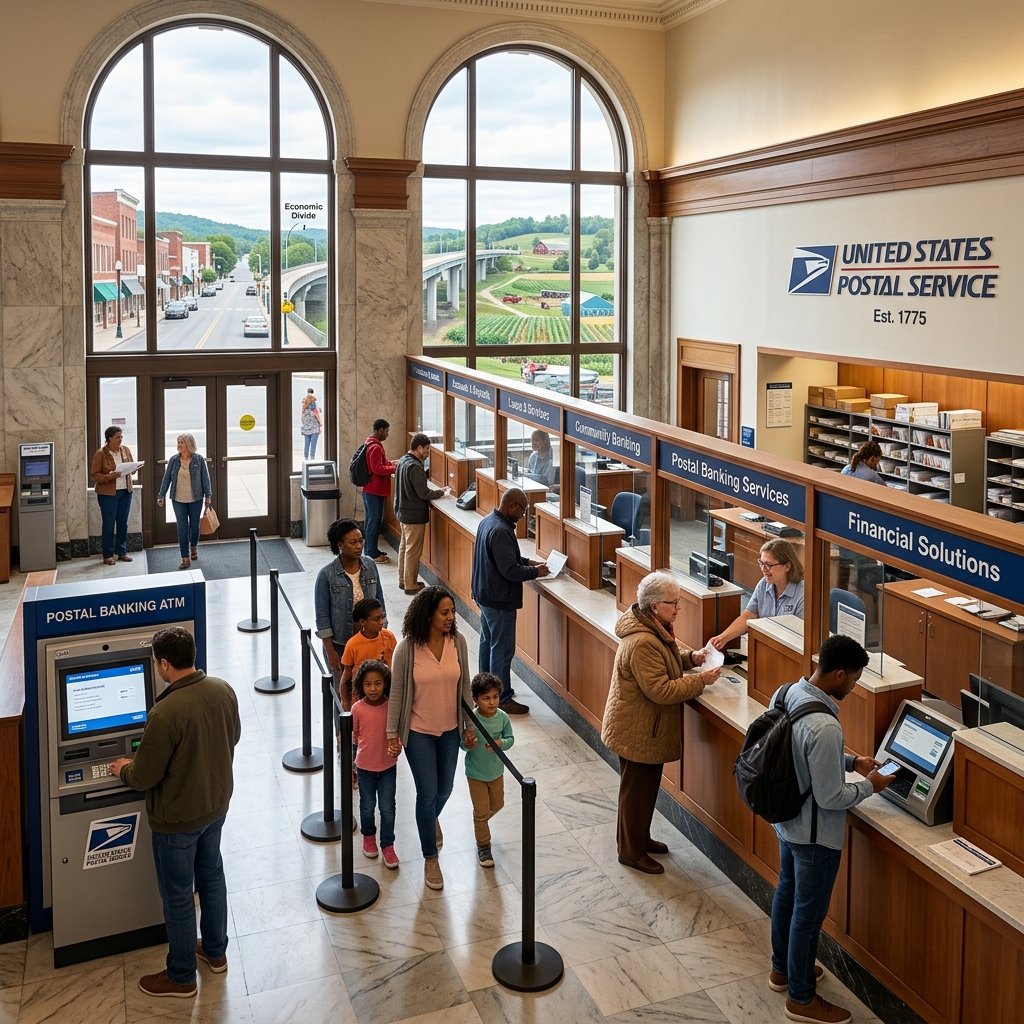
In the United States, the road to financial security is riddled with institutional barriers, leaving millions systematically excluded from the mainstream economy. This exclusion does not occur in a vacuum; it disproportionately affects Black, Hispanic, and Native American households, fueling a persistent and widening racial wealth gap. As policymakers and advocates search for robust mechanisms to foster economic equity, an unexpected yet highly practical solution has reemerged from the annals of American history: postal banking. Transforming the United States Postal Service (USPS) into a provider of basic financial services could radically democratize the banking industry, offering a lifeline to communities long abandoned by traditional financial institutions. By leveraging existing public infrastructure, a modern postal banking system could provide affordable, accessible, and transparent financial tools to every zip code in the nation. This article explores the staggering costs of financial exclusion, the historical context of banking inequality, and how equipping the post office with basic financial services could serve as a powerful engine for closing the racial wealth divide.
The Heavy Toll of Financial Exclusion
To understand the necessity of a public banking option, one must first recognize the heavy toll of being unbanked or underbanked in modern America. According to the 2023 Federal Deposit Insurance Corporation (FDIC) National Survey of Unbanked and Underbanked Households, approximately 4.2 percent of U.S. households—representing about 5.6 million households—lacked a checking or savings account. While this represents a record low nationally, the top-line metric masks deep demographic disparities. Unbanked rates among Black and Hispanic households are several times higher than those of their white counterparts.
When families are pushed out of the traditional banking system, they are forced to rely on alternative financial services. These include payday lenders, check-cashing storefronts, pawnshops, and auto title loans. These services are notoriously predatory, often charging exorbitant fees and triple-digit interest rates. A family living paycheck to paycheck might lose a significant percentage of their income simply to cash a payroll check or pay utility bills through money orders.
This parallel financial system operates as a relentless poverty trap. Instead of building savings or generating interest, marginalized families see their hard-earned income siphoned off by transactional fees and predatory debt cycles. The resources drained by these alternative financial services represent lost capital that could have been invested in homeownership, higher education, or small business ventures—the traditional building blocks of intergenerational wealth. The alternative financial services industry has commodified poverty, turning the lack of capital into a lucrative business model that directly exacerbates the racial wealth gap.
Historical Roots and the Banking Desert Phenomenon
The racial disparities in banking access are not accidental; they are the direct legacy of decades of systemic discrimination. For much of the 20th century, government-sponsored redlining explicitly denied credit and financial services to minority neighborhoods. While landmark civil rights legislation like the Fair Housing Act of 1968 and the Community Reinvestment Act of 1977 sought to dismantle these discriminatory practices, the structural economic damage was already deeply ingrained.
Today, the legacy of redlining has morphed into the modern phenomenon of banking deserts. In the aftermath of the 2008 financial crisis, traditional commercial banks consolidated operations and closed thousands of brick-and-mortar branches, disproportionately targeting low-income, rural, and minority communities. When bank branches leave a neighborhood, predatory lenders quickly move in to fill the void. Furthermore, traditional banks have increasingly relied on punitive fee structures, such as high overdraft fees and stringent minimum balance requirements, which disproportionately penalize low-income customers.
The 2023 FDIC survey noted that the most common reason people cited for not having a bank account was lacking enough money to meet these minimum balance requirements. This creates an impossible Catch-22: families are too poor to afford a mainstream bank account, and without a bank account, the high costs of alternative financial services keep them impoverished. Data from the Federal Reserve’s Survey of Consumer Finances continually highlights the stark reality of this systemic exclusion, showing that the median wealth of white families remains multiples higher than that of Black and Hispanic families. Addressing this gap requires a structural intervention that does not rely solely on the profit motives of private financial institutions that have historically underserved these communities.
The Strategic Case for Public Banking Infrastructure
This is where the United States Postal Service enters the equation as a strategic and viable solution. The USPS is a uniquely positioned public institution with an unmatched physical footprint. There are over 31,000 post offices in the United States, reaching every single ZIP code, including remote rural outposts and inner-city neighborhoods that traditional commercial banks have abandoned. Implementing basic financial services at these existing locations would instantly eradicate banking deserts and provide universal access to financial infrastructure.
Moreover, postal banking is not a novel or untested concept. It is a proven, reliable model utilized successfully in countries across the globe, from Japan and New Zealand to France and Italy. Even in the United States, postal banking has a highly successful historical precedent. From 1911 to 1967, the U.S. government operated the United States Postal Savings System. Initially established to provide a secure depository for immigrants and working-class citizens who distrusted private banks following the Panic of 1907, the system eventually grew to hold billions of dollars in deposits, peaking in utility during the Great Depression. It was phased out only when commercial banks began offering higher interest rates and federal deposit insurance became standard.
Reviving a modernized version of this system would leverage an institution that already holds significant public trust. A comprehensive 2014 white paper by the USPS Office of Inspector General found that the Postal Service is uniquely equipped to provide non-bank financial services. The report estimated that doing so could significantly benefit underserved populations while simultaneously providing a crucial new revenue stream of nearly nine billion dollars a year to stabilize the USPS’s own finances.
Essential Services a Modern Postal Bank Should Offer
To effectively combat financial exclusion and close the racial wealth gap, a modern postal bank would not need to offer complex investment vehicles, wealth management, or large-scale commercial lending. Instead, it should focus strictly on a targeted suite of basic, low-cost services designed to fulfill everyday transactional and credit needs.
- Affordable Transactional Accounts: The cornerstone of postal banking would be free or highly affordable checking and savings accounts without minimum balance requirements. These accounts would allow individuals to receive direct deposits, make digital payments, and securely store their funds without the looming threat of unexpected maintenance fees or crippling overdraft penalties.
- Accessible Small-Dollar Credit: Perhaps the most critical offering would be accessible, low-interest, small-dollar loans. When unexpected expenses arise—a medical emergency, a vital car repair, or a sudden drop in work hours—families without savings often have no choice but to turn to payday loans. By offering small loans at reasonable, legally capped interest rates, the postal service could provide a safe, viable off-ramp from the cycle of predatory debt.
- Bill Payment and Remittance Services: Millions of underbanked individuals rely on expensive wire transfers and money orders to pay rent, settle utility bills, or send money to family members. Private services often charge steep percentage-based fees. The USPS already offers domestic money orders, but expanding this to include comprehensive electronic bill pay, check cashing, and wire transfers at a fraction of the market rate would retain billions of dollars within working-class communities.
- Reloadable Prepaid Debit Cards: To integrate marginalized individuals into the digital economy safely, postal banking could offer universally accepted reloadable debit cards. This would enable individuals to shop online, pay for digital subscriptions, and participate in an increasingly cashless society without falling prey to the exorbitant activation and reload fees often associated with commercial prepaid cards.
Translating Financial Inclusion into Wealth Accumulation
The direct, mathematical connection between banking access and wealth building cannot be overstated. When a marginalized family transitions from relying on high-fee check cashers to utilizing a zero-fee postal bank account, they immediately increase their net disposable income. The USPS Office of Inspector General previously noted that underserved households spend nearly 10 percent of their income on fees and interest for alternative financial services. For a family earning $30,000 a year, reclaiming $3,000 annually is economically transformative.
Over a decade, that reclaimed income can become the down payment on a first home, the funding for vocational training or higher education, or the vital seed capital required for a small business venture. Furthermore, participation in the formal banking system is the fundamental first step toward building a verified credit history. Mainstream credit access is absolutely essential for securing favorable rates on mortgages, auto loans, and insurance premiums. Without a credit score, or with a severely damaged one resulting from predatory debt defaults, individuals are effectively locked out of the primary mechanisms for wealth generation in America.
By offering safe, manageable credit options and fee-free savings, a modernized postal banking system could help millions of Black, Hispanic, and rural Americans establish robust credit profiles. This directly addresses one of the most significant, quantifiable barriers to racial economic equality. It shifts the national paradigm from extracting wealth from vulnerable communities to actively protecting, stabilizing, and nurturing their financial assets for future generations.
Frequently Asked Questions (FAQs)
What exactly is postal banking?
Postal banking refers to the provision of basic financial services—such as savings accounts, check cashing, bill payment, and small-dollar loans—through the public post office infrastructure. Instead of relying entirely on private, for-profit banks, citizens can access secure and low-cost banking at their local post office branch.
How does postal banking relate to the racial wealth gap?
The racial wealth gap is heavily exacerbated by systemic financial exclusion. Black and Hispanic households are disproportionately unbanked and underbanked, forcing them to rely on costly alternative financial services like payday loans and check cashers. These predatory services drain their income and prevent long-term saving. Postal banking would provide equitable access to affordable financial tools, helping marginalized communities retain their earnings and build generational wealth.
Why can’t private banks solve the problem of unbanked populations?
Private commercial banks operate on a profit-driven model. They frequently find it unprofitable to maintain physical branches in low-income neighborhoods or to serve customers with low account balances. To offset administrative costs, traditional banks impose high minimum balance requirements and overdraft fees, which actively push low-income individuals out of the system. A public utility model like postal banking prioritizes universal access over maximizing shareholder profit.
Did the United States ever have a postal banking system?
Yes. From 1911 to 1967, the United States operated the United States Postal Savings System. It was originally created to provide a safe haven for deposits, particularly for recent immigrants and those who distrusted commercial banks. The system was highly successful and held billions in deposits at its peak before being phased out due to the rise of federal deposit insurance and higher private interest rates.
References
- 2023 FDIC National Survey of Unbanked and Underbanked Households — Federal Deposit Insurance Corporation (FDIC). 2024-11-14. https://www.fdic.gov/household-survey
- Survey of Consumer Finances (SCF) — Federal Reserve Board. 2023-10-18. https://www.federalreserve.gov/econres/scfindex.htm
- Providing Non-Bank Financial Services for the Underserved — United States Postal Service Office of Inspector General. 2014-01-27. https://www.uspsoig.gov/reports/white-papers/providing-non-bank-financial-services-underserved
Similar Articles








Read full bio of medha deb




