
Guide to the Huntington Voice Rewards Credit Card
Understand how the Huntington Voice Rewards Credit Card works, what it costs, and how to decide if it fits your spending and goals.
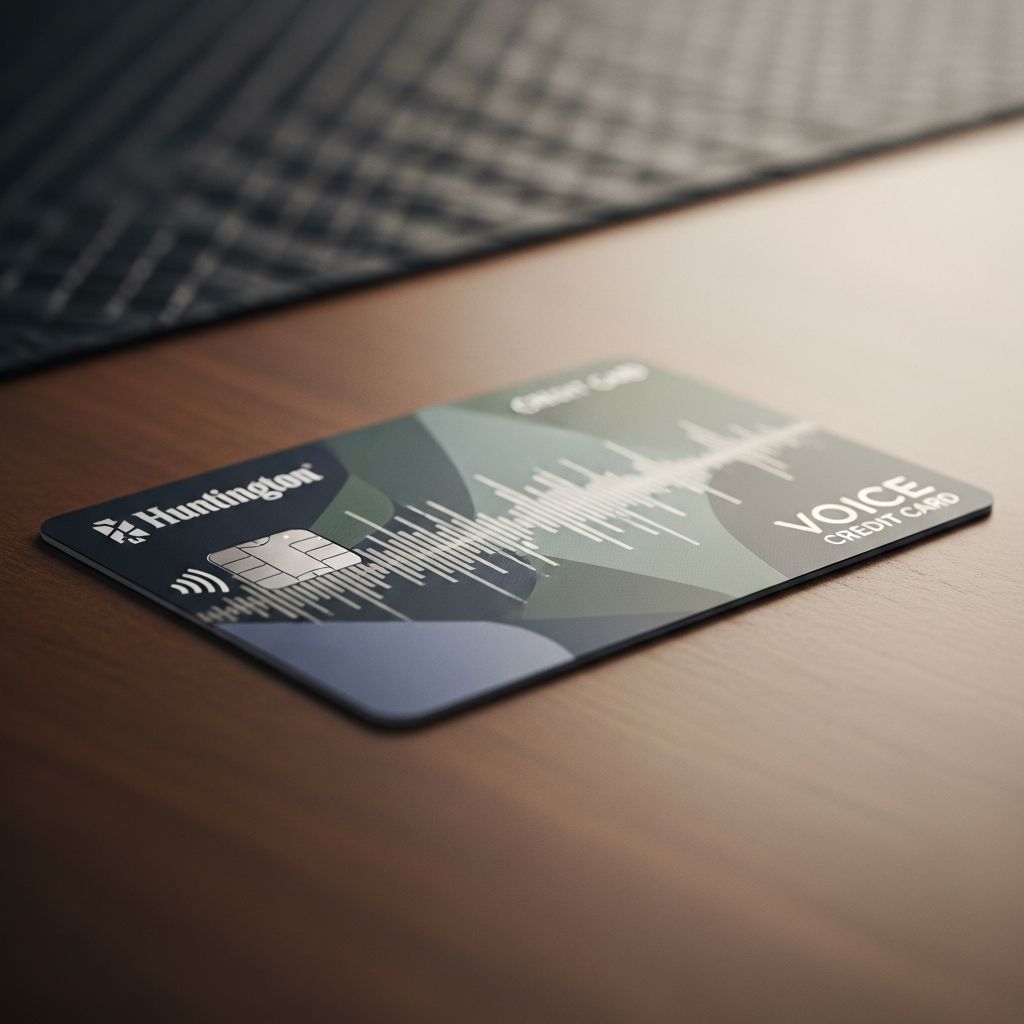
The Huntington Voice Rewards Credit Card is a no-annual-fee card that lets you earn elevated rewards in one category that you choose, while still earning base rewards on your other purchases. This guide explains how the rewards work, what the costs and protections look like, and how to evaluate whether the card fits your budget and spending habits.
Overview of the Huntington Voice Rewards Credit Card
Huntington Bank is a regional bank that offers a small lineup of credit cards, including the Voice Rewards product for people who want customizable rewards without an annual fee. The card centers on one main idea: pick a category where you spend frequently and earn higher rewards in that area, up to a quarterly cap.
- Issuer: Huntington Bank
- Card network: Major card network (varies by version; check application page)
- Annual fee: $0
- Intro APR (balance transfers): 0% for 12 months on transfers made in the first 90 days (terms can change, check current disclosures).
- Ongoing APR: Variable, based on creditworthiness (ranges published by Huntington and comparison sites; always review the latest Schumer box).
- Foreign transaction fees: None for the Voice Rewards card, according to Huntington’s current card comparison page.
Because this is a rewards card, it works best for people who can pay their statement balance in full and avoid interest charges. The Consumer Financial Protection Bureau (CFPB) notes that carrying a balance month to month can make rewards cards more costly than simpler low-rate cards.
How the 3X Rewards Category Works
The Huntington Voice Rewards Credit Card lets you pick one category that earns enhanced rewards, while all other purchases earn a base rate.
Available bonus categories
Huntington currently allows you to choose from a list of everyday and discretionary spending categories.
- Gas stations
- Grocery stores
- Restaurants
- Travel and entertainment
- Discount and warehouse stores
- Department, apparel, and sporting goods stores
- Electronics, computer, and camera stores
- Home improvement stores
- Auto parts and services stores
- Utilities and office supply stores
Huntington’s official description emphasizes that you can earn 3X rewards in one of these categories, up to a maximum of $2,000 in eligible purchases each calendar quarter. You may change your category periodically, within the rules of the program (for example, once per quarter, with a deadline before the next quarter starts).
Base rewards on other purchases
All other purchases that are not in your selected 3X category earn 1X rewards. After you hit the quarterly cap in your chosen category, spending in that category typically drops to the 1X rate for the rest of the quarter.
Quarterly cap: what it means for you
The $2,000 per quarter limit for 3X rewards is a key part of the card’s design.
- If you spend exactly $2,000 in the 3X category within a quarter, you earn 6,000 points from that category.
- Any additional spending in that category during the same quarter earns 1X instead of 3X.
- Non-bonus purchases earn 1X without a cap.
According to Huntington, 10,000 rewards points are generally worth about $100 in redemption value, or roughly 1 cent per point. That means the 3X category effectively functions like ~3% rewards, while 1X purchases behave like ~1% rewards, though actual value depends on how you redeem.
Choosing and Changing Your Bonus Category
Because you can update your category periodically, the card rewards people who take a few minutes each quarter to match their category to upcoming expenses.
How to select a category
After account opening, Huntington typically gives you a short window (for example, 30 days) to make your initial category choice. You can usually manage this setting via:
- Online or mobile banking account management tools
- Phone support with a Huntington representative
- In-branch assistance, if you live near Huntington’s footprint
Strategies for category selection
Aligning your category choice with predictable quarterly expenses can maximize the value of the card:
- Heavy commuting or road trips: Consider gas stations.
- Large home project: Home improvement stores could make sense for the quarter when the work occurs.
- Back-to-school season: Department, apparel, or discount stores may fit better.
- High utility or internet bills: Utilities and office supply stores can be useful if coded properly.
- Frequent dining out: Restaurants may be a straightforward pick.
The CFPB recommends matching rewards cards to your actual spending patterns rather than chasing categories you do not normally use. Reviewing a few months of bank and card statements can help you identify where your money regularly goes.
Rewards Earning and Redemption Basics
Huntington markets the Voice Rewards card as a flexible, category-based rewards product with simple redemptions.
Earning structure summary
| Purchase Type | Reward Rate | Quarterly Limit |
|---|---|---|
| Spending in selected 3X category | 3X points per dollar | $2,000 per quarter at 3X |
| Spending in selected category beyond cap | 1X points per dollar | Unlimited at 1X |
| All other eligible purchases | 1X points per dollar | Unlimited at 1X |
Redemption options
Specific redemption menus can evolve over time, but Huntington and independent reviews note several common options:
- Statement credits or cash-equivalent redemptions
- Gift cards
- Travel bookings or related rewards
- Merchandise via a rewards portal
Most sources indicate that points are usually valued around 1 cent each for typical redemptions, although some categories (such as merchandise) may provide different value. Always check Huntington’s current rewards terms for exact details and potential expiration rules.
Fees, Interest, and Key Costs
Rewards are only valuable if you are not giving back more in fees and interest. Understanding the card’s cost structure helps you decide if it’s appropriate for your situation.
Recurring and transactional fees
- Annual fee: $0 for the Voice Rewards card.
- Foreign transaction fees: None, according to current Huntington card descriptions.
- Balance transfer fee: Typically 3% or a minimum dollar amount, whichever is higher, on each transferred balance.
- Cash advance fees: Often a higher percentage or flat fee; review the cardholder agreement before using cash advances.
- Late payment and returned payment fees: Assessed according to Huntington’s fee schedule, subject to its Late Fee Grace feature (described below) and federal limits on penalty fees.
APR considerations
The card’s ongoing interest rate is variable and set based on your credit profile, market conditions, and the specific offer you receive. According to Federal Reserve data, average general-purpose credit card APRs in the U.S. are often in the mid-teens to upper-20s, especially for revolvers (people who carry a balance). Because of this, the Voice Rewards card is generally best for people who plan to avoid interest altogether by paying in full.
If you tend to carry a balance, the CFPB and consumer advocates commonly suggest focusing first on lower-rate cards or alternatives such as personal loans, rather than rewards cards, because even a few percentage points difference in APR can significantly change the total cost of borrowing over time.
Consumer-Friendly Features and Protections
Huntington pairs the Voice Rewards card with several features intended to make repayment more forgiving and card use more transparent.
Late Fee Grace and penalty policies
- Late Fee Grace: Huntington advertises a short grace period (often 24 hours) where a slightly late payment may not automatically trigger a late fee. Exact cut-off times and rules are defined in the cardholder agreement.
- No penalty APR: Independent reviews note that Huntington does not automatically raise your APR to a penalty rate solely because of a late payment. However, chronic delinquency can still affect your account status or credit standing.
These features align with broader regulatory expectations for clearer and fairer credit card terms after the U.S. Credit CARD Act of 2009, which requires transparent pricing and restricts unexpected rate increases.
Standard credit card protections
Like most major credit cards, Huntington Voice Rewards generally includes baseline protections such as:
- Zero-liability protection for unauthorized transactions (subject to timely reporting).
- Dispute rights under federal law if you have a problem with a purchase or billing error.
- Security measures such as EMV chip technology and fraud monitoring, and the ability to lock a misplaced card via digital banking tools (features can evolve over time).
The CFPB encourages cardholders to promptly review statements and dispute suspicious charges as soon as they appear to keep protections intact.
Who Might Benefit Most From This Card?
The Voice Rewards card is not a universal fit, but it aligns well with certain user profiles.
Good candidates for the card
- People who spend predictably in one or two areas: For example, commuters with high gas bills or families with regular grocery spending.
- Users who prefer simplicity and no annual fee: The fixed 3X structure in a single category can be easier to manage than rotating 5% calendars with activation requirements.
- Existing Huntington customers: Using the card alongside Huntington checking accounts may make account management and payments more convenient.
- People who pay in full monthly: Rewards value is maximized when you avoid interest charges altogether.
Who may want to look elsewhere
- Heavy travelers who favor airline or hotel ecosystems: Co-branded travel cards or general travel rewards programs may deliver more value, especially for frequent flyers.
- Big spenders across many categories: A flat-rate cash-back card with a higher base rate (such as 2% on all purchases) could outperform a capped 3X category.
- People carrying balances: A low-interest card or a credit union product with reduced APRs may be more appropriate than a rewards-focused card.
How to Evaluate the Card Against Alternatives
When comparing cards, consider both the reward side and the cost side. Federal agencies and consumer advocates generally recommend looking at total cost over a year or more, not just sign-up perks.
Key comparison factors
- Reward rate vs your spending: Estimate your annual spend in the likely 3X category and in other categories, then calculate approximate yearly rewards in dollars.
- Annual fee: The Voice Rewards card has no annual fee, which simplifies this part of the calculation.
- APR and fees: Compare the card’s APR range and fee schedule with other cards you are considering.
- Redemption flexibility: Check whether rival cards limit redemptions to travel, specific partners, or minimum thresholds.
- Sign-up bonuses: Some competing cards offer short-term bonuses; weigh those against the long-term earning structure.
Simple illustration of potential annual rewards
Suppose you spend $500 per month in a chosen 3X category and $1,000 per month on other eligible purchases:
- 3X category: $500 × 12 = $6,000 per year. The quarterly cap is $2,000, so only the first $2,000 each quarter earns 3X. If your spending is steady at $500 per month, you would stay under the cap and earn 18,000 points (worth roughly $180).
- Other purchases: $1,000 × 12 = $12,000 per year. At 1X, that yields 12,000 points (roughly $120).
- Estimated total: about 30,000 points, equating to around $300 in value at 1 cent per point, assuming no changes in category or redemption value.
Compare that figure to what you would earn on a flat 1.5% or 2% cash-back card with the same spending to see which pays more over time.
Responsible Use and Credit Health
Any rewards card, including the Huntington Voice Rewards Credit Card, can either help build your credit or make it worse, depending on how it is managed. The CFPB and Federal Reserve emphasize several best practices for maintaining healthy credit while using cards.
- Pay at least the statement balance by the due date to avoid interest and maintain positive payment history.
- Keep utilization low: Try not to use a large percentage of your available credit limit, as high utilization can negatively affect your credit score.
- Monitor statements monthly for errors or unfamiliar charges and report them quickly.
- Avoid opening multiple accounts within a short period solely for bonuses; frequent hard inquiries can temporarily lower your score.
Used thoughtfully, Voice Rewards can be one part of a broader strategy to manage regular expenses, gain modest rewards, and continue building a positive credit profile.
Frequently Asked Questions (FAQs)
Q: Is the Huntington Voice Rewards Credit Card truly free to hold?
The card has no annual fee, so you are not charged just for keeping the account open. However, you can still incur interest, late fees, balance transfer fees, or cash advance fees depending on how you use the card, so it is not cost-free if you carry balances or miss payments.
Q: How often can I change my 3X rewards category?
Huntington allows you to select one of ten categories and typically lets you change it on a quarterly basis, with a deadline before each new quarter begins. The exact rules and dates are listed in your rewards terms and may be updated by Huntington over time.
Q: Does the Voice Rewards card work outside the United States?
The card can be used at merchants that accept its network globally, and Huntington does not currently charge foreign transaction fees on Voice Rewards purchases. However, you should still check for dynamic currency conversion fees or other charges that foreign merchants might add.
Q: Will I lose points if I close my account?
Most credit card rewards programs require you to redeem your rewards before closing an account, because unused points can be forfeited at closure. Huntington’s specific policy will be outlined in your cardholder and rewards agreement, so review those documents and redeem points in advance if you plan to close the card.
Q: How do balance transfers work with this card?
For eligible new accounts, Huntington has offered a 0% introductory APR on balance transfers for a limited time window from account opening, with a balance transfer fee applied to each transferred amount. Exact promotional terms, duration, and fees can change, so always confirm the current offer before initiating any transfer.
References
- Credit cards — Consumer Financial Protection Bureau. 2023-08-10. https://www.consumerfinance.gov/consumer-tools/credit-cards/
- Regional bank credit card offers unique value proposition — Media Logic. 2014-01-29. https://www.medialogic.com/blog/financial-services-marketing/glance-huntington-voice/
- What is Huntington Bank, and are its credit cards right for you? — NerdWallet. 2024-01-30. https://www.nerdwallet.com/credit-cards/learn/huntington-bank-credit-cards
- Consumer Credit — G.19 — Board of Governors of the Federal Reserve System. 2024-09-09. https://www.federalreserve.gov/releases/g19/current/
- Credit Card Accountability Responsibility and Disclosure (CARD) Act of 2009 — U.S. Government Publishing Office. 2009-05-22. https://www.govinfo.gov/content/pkg/PLAW-111publ24/html/PLAW-111publ24.htm
- Compare Credit Cards & Apply Online — Huntington Bank. 2024-07-01. https://www.huntington.com/Personal/credit-card
Similar Articles








Read full bio of Sneha Tete




