
The Going and Coming Rule in Workers’ Comp
Understanding when commuting injuries are covered under workers' compensation law.
When Your Commute Isn’t Considered Work
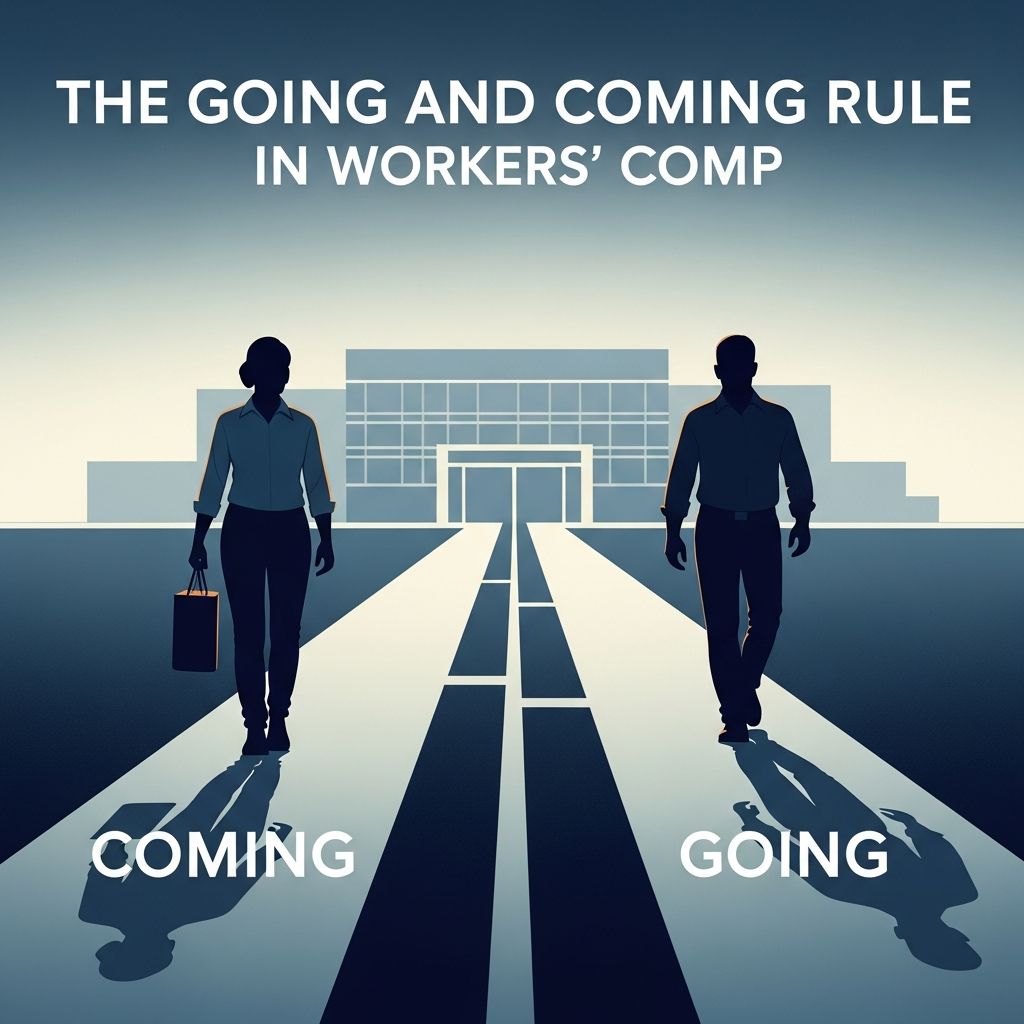
Most people assume that if they’re injured while traveling to or from their job, they should be eligible for workers’ compensation. After all, they’re on their way to perform work for their employer. Yet in the vast majority of cases, injuries that happen during a routine commute are not covered by workers’ comp. This limitation stems from a long-standing legal principle known as the going and coming rule, which draws a clear line between what counts as work and what counts as personal travel.
The going and coming rule is not a statute written into law by a legislature, but rather a doctrine developed over decades by courts and workers’ compensation boards. Its core idea is simple: the time an employee spends traveling between home and the workplace is not part of their employment, even though that travel is necessary to get to work. As a result, injuries that occur during this travel—whether from a car crash, a slip on ice in a parking lot, or a fall on a sidewalk—are generally treated as personal risks, not work-related risks.
Why the Rule Exists
At first glance, the going and coming rule may seem unfair. If an employee is injured because they were going to work, why shouldn’t that be covered? The answer lies in how workers’ compensation systems are designed to function.
Workers’ comp is a no-fault system created to protect both employees and employers. Employees receive benefits for work-related injuries without having to prove their employer was negligent, and in return, employers are shielded from most personal injury lawsuits. To keep this balance, the law must define what “work-related” actually means. If every injury that happened while an employee was en route to work were compensable, employers could face enormous and unpredictable liability for accidents that occur on public roads, sidewalks, and transit systems—risks that are shared by the general public, not unique to any particular job.
The going and coming rule helps contain that exposure. It reflects the idea that commuting is a normal part of life, not a job duty. The risks of traffic, weather, and public infrastructure are not created by the employer, and the employer does not control how the employee travels. Therefore, the law treats those risks as outside the scope of employment, even if the employee’s presence at the scene is job-related.
How Workers’ Comp Determines Coverage
For an injury to be covered under workers’ compensation, two key conditions must be met:
- The injury must arise out of the employment.
- The injury must occur in the course of the employment.
These two requirements work together to define what counts as a work injury. “Arising out of” means the injury must have a connection to the job—something about the work created or contributed to the risk. “In the course of” means the injury happened while the employee was engaged in work duties or activities that are part of the job.
During a typical commute, the second condition is usually not satisfied. Even if the employee is going to work, they are not yet performing job duties, and the employer is not receiving any direct benefit from the travel. The employee is acting in a personal capacity, using their own transportation, and making their own choices about route and timing. Because of this, the commute is not considered part of the course of employment, and the going and coming rule applies.
When the Rule Doesn’t Apply: Common Exceptions
While the going and coming rule is broad, it is not absolute. Over time, courts and compensation boards have recognized several important exceptions where commuting injuries can still be covered. These exceptions reflect situations where the travel is more closely tied to the job or where the employer has assumed some responsibility for the commute.
1. Traveling Employees
One of the most well-established exceptions is for employees whose job requires them to travel as part of their regular duties. This includes sales representatives, inspectors, repair technicians, and others who move between multiple job sites, client locations, or worksites each day.
For these workers, the time spent traveling between assignments is considered part of their workday. If they are injured while driving from one client to another, or while traveling to a remote job site, that injury is typically covered because the travel is an integral part of their job. The key factor is whether the employee is acting within the scope of employment during the travel, not just whether they are going to or from a fixed workplace.
2. Employer-Provided Transportation
When an employer provides transportation to and from work, the nature of the commute changes. If the employer operates a shuttle, pays for a company vehicle, or requires employees to use a specific mode of transport, the commute may be treated as part of the employment relationship.
In these cases, the employer has taken on a role in the commute and may be seen as benefiting from the arrangement. Because the employer controls or subsidizes the transportation, the risks of the commute are more closely tied to the job. As a result, injuries that occur while using employer-provided transportation are often covered, even if they happen during what would otherwise be a routine commute.
3. Employer-Paid Travel Time
Another important exception arises when an employer compensates an employee for travel time. If the employer pays the employee for the time spent traveling to and from work—either through hourly wages, a stipend, or inclusion in the regular pay—this can transform the commute into a work activity.
When travel time is paid, it signals that the employer values that time and considers it part of the workday. Courts and compensation boards often treat this as evidence that the travel is in the course of employment. In contrast, if the employer only reimburses expenses like gas or tolls but does not pay for the time, the going and coming rule usually still applies.
4. Special Errands and Work-Related Trips
If an employee is injured while running a work-related errand, the going and coming rule may not protect the employer. For example, if an employee is sent to pick up supplies, deliver documents, or attend a meeting at a location other than their usual workplace, the travel is considered part of the job.
Similarly, if an employee is injured while traveling from one work site to another during the workday, that travel is generally covered. The key is whether the travel is for the employer’s benefit and is directed or authorized by the employer. In these situations, the employee is clearly acting within the scope of employment, so the injury is compensable even if it occurs off the employer’s premises.
5. Employer-Sponsored Events
Injuries that occur while attending employer-sponsored events—such as company parties, training sessions, or team-building activities—can also fall outside the going and coming rule. If the event is mandatory or strongly encouraged, and the employee is expected to attend as part of their job, then the travel to and from the event may be considered part of the employment relationship.
For example, if an employee is injured in a car accident while driving home from a required company dinner, that injury might be covered because the travel is directly connected to a work-related activity. The same logic can apply to travel to and from off-site training or conferences that are part of the employee’s duties.
6. Premises and Parking Lot Injuries
The going and coming rule is often relaxed when an injury occurs on the employer’s premises or in a parking area controlled by the employer. If an employee slips and falls in a company parking lot, on a sidewalk leading to the building, or in a company-owned garage, that injury may be covered even if it happens before or after the official workday.
Courts and compensation boards recognize that once an employee enters the employer’s property, they are within the zone of employment. The employer has a duty to maintain safe conditions on its premises, and injuries that result from unsafe conditions (like icy walkways or poorly lit areas) are often treated as work-related, regardless of whether the employee was technically “on the clock.”
How Courts and Boards Apply the Rule
Whether the going and coming rule applies in a specific case depends on the facts and the jurisdiction. Different states interpret the rule and its exceptions in slightly different ways, but most follow a similar framework.
Adjudicators typically look at several factors, including:
- Whether the employee was performing a work duty at the time of injury.
- Whether the travel was required or directed by the employer.
- Whether the employer benefited from the travel.
- Whether the employer controlled or paid for the transportation or travel time.
- Whether the injury occurred on employer-controlled property.
There is no bright-line test; each case is evaluated based on its unique circumstances. A traveling salesperson injured on the highway may have a strong claim, while an office worker injured in a car crash on their way to the office will likely be denied benefits unless one of the recognized exceptions applies.
What to Do If You’re Injured While Commuting
If you are injured while traveling to or from work, it’s important not to assume that your injury is automatically excluded from workers’ compensation. Even if the going and coming rule seems to apply, there may be an exception that makes your claim compensable.
Here are some practical steps to take:
- Report the injury promptly. Notify your employer as soon as possible, even if you’re unsure whether it’s covered. Delayed reporting can hurt your claim.
- Document everything. Keep records of the accident, medical treatment, and any communication with your employer or insurer.
- Review your job duties. Consider whether your job involves travel, special assignments, or employer-provided transportation that might bring your case under an exception.
- Consult a workers’ comp attorney. An experienced lawyer can evaluate the facts, identify any applicable exceptions, and help you build a strong claim.
Common Misconceptions About Commute Injuries
Several myths persist about when commuting injuries are covered:
- Myth: If I’m going to work, my injury must be covered. Reality: The going and coming rule specifically excludes routine commutes unless an exception applies.
- Myth: If my employer knows I’m on my way to work, that’s enough. Reality: Knowledge alone is not enough; the travel must be part of the job or under the employer’s control.
- Myth: If I’m paid a salary, my commute is covered. Reality: Payment method (salary vs. hourly) doesn’t change the going and coming rule; what matters is whether travel time is paid and whether the travel is work-related.
- Myth: If I’m injured in a company parking lot, it’s always covered. Reality: While parking lot injuries are often covered, it depends on the circumstances and whether the area is under the employer’s control.
FAQs About the Going and Coming Rule
What is the going and coming rule?
The going and coming rule is a legal principle that generally excludes injuries sustained while commuting to and from work from workers’ compensation coverage. It holds that routine travel between home and the workplace is not part of the employment relationship.
Are there any situations where a commute injury is covered?
Yes. Exceptions include injuries to traveling employees, injuries while using employer-provided transportation, injuries during employer-paid travel time, injuries while running work-related errands, and injuries on employer premises (like parking lots or sidewalks).
Does it matter if I drive, take the bus, or walk to work?
The mode of transportation usually doesn’t change the application of the rule. Whether you drive, take public transit, bike, or walk, the commute is generally not covered unless one of the recognized exceptions applies.
What if I’m injured in a car accident on my way to work?
In most cases, a car accident during a routine commute will not be covered by workers’ comp. However, if you were on a work-related errand, using a company vehicle, or being paid for travel time, you may have a compensable claim.
Can I still sue my employer if workers’ comp doesn’t cover my commute injury?
Generally, no. Workers’ compensation is usually the exclusive remedy for work-related injuries, and since commute injuries are typically not considered work-related, you usually cannot sue your employer for negligence in these situations. You may, however, have a claim against a third party (like another driver) through a personal injury lawsuit.
How do I know if I qualify under an exception?
It depends on the specific facts of your job and the circumstances of the injury. Factors include whether your job requires travel, whether your employer provides or pays for transportation, and whether the injury occurred on employer property. A workers’ comp attorney can help you determine if an exception applies to your case.
Key Takeaways
The going and coming rule is a fundamental part of workers’ compensation law that limits coverage for injuries that happen during routine commutes. While it may seem harsh, it serves an important role in defining the boundaries of work-related risk.
However, the rule is not absolute. Exceptions exist for traveling employees, employer-provided or paid travel, work-related trips, employer-sponsored events, and injuries on employer premises. If you are injured while commuting, it’s worth exploring whether any of these exceptions might apply to your situation.
Because the outcome often depends on subtle factual and legal distinctions, consulting with a qualified workers’ compensation attorney is one of the best ways to protect your rights and ensure you receive the benefits you may be entitled to.
References
- California Workers’ Compensation: The Going and Coming Rule — California Department of Industrial Relations. 2023. https://www.dir.ca.gov/dwc/GoingAndComingRule.htm
- Virginia Workers’ Compensation Act — Virginia Workers’ Compensation Commission. 2023. https://www.vwc.gov
- Workers’ Compensation: Scope of Employment and Commuting Injuries — National Conference of State Legislatures (NCSL). 2022. https://www.ncsl.org/research/labor-and-employment/workers-compensation-overview.aspx
Similar Articles








Read full bio of medha deb




