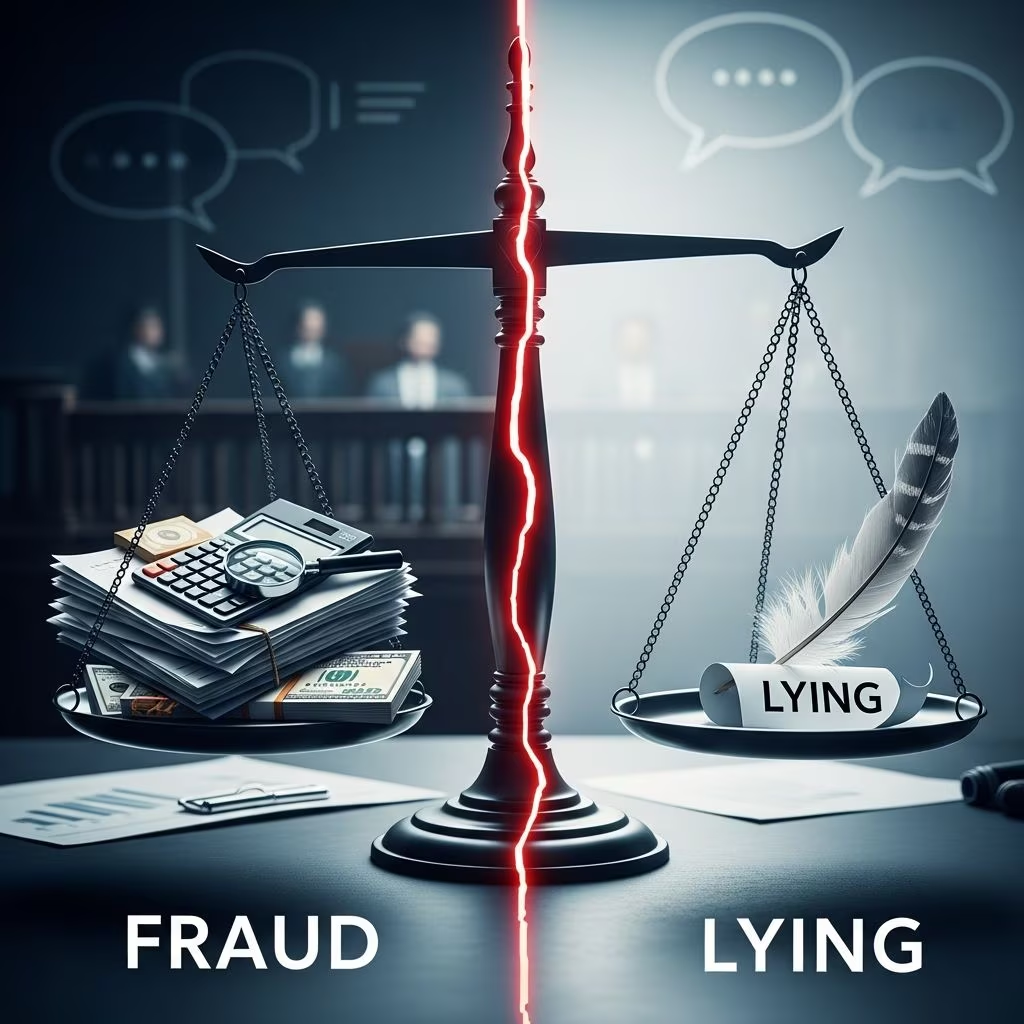
Lies are common in everyday life, but not every untrue statement is a legal problem. Some acts of deception, however, cross a line and become fraud, exposing the liar to lawsuits, financial penalties, and even criminal charges. This article explains how the law distinguishes casual dishonesty from legally actionable fraud, what must be proven in court, and how victims may seek compensation.
Everyday Lies vs. Legal Wrongdoing
From social white lies to exaggerated sales pitches, people routinely say things that are not strictly true. The legal system does not attempt to punish all of this behavior. Instead, it focuses on forms of deception that:
- Are intentional or reckless
- Concern important, material facts
- Are meant to induce someone to act or refrain from acting
- Cause measurable financial or other legally recognized harm
Fraud law exists to protect people from losing money, property, or legal rights because they believed false statements that were crafted to mislead them for the speaker’s benefit.
Legal Definition of a Lie
In everyday language, a lie is a statement that the speaker knows is false but presents as true. Moral philosophers and legal scholars often treat lying as one form of a broader category: deception. Deception may include:
- Direct lies: outright false statements
- Misleading conduct: half-truths, concealment, or omissions that create a false impression
- False denials: denying truthful accusations or important facts
In most situations, a lie is not automatically a civil wrong (tort) or a crime. The legal consequences depend not just on the falsity of the statement but on context, intent, and impact.
What Makes Fraud Different?
Fraud is a specific legal concept that involves more than simply saying something untrue. In civil law, courts typically use the concept of fraudulent misrepresentation to describe this type of wrongdoing. While exact wording varies by jurisdiction, a plaintiff generally must show that:
- The defendant made a representation (or remained silent where there was a duty to speak)
- The representation was false
- The defendant knew the statement was false, or acted with reckless disregard for the truth
- The statement was made with the intent that the plaintiff rely on it
- The plaintiff reasonably relied on the statement
- The plaintiff suffered actual harm as a result of that reliance
In short, fraud combines a lie (or equivalent deception), an intent to influence someone’s decision, and real-world damage that flows from that decision.
Side-by-Side Comparison: Lying vs. Fraud
| Feature | Simple Lying | Fraud (Fraudulent Misrepresentation) |
|---|---|---|
| Core conduct | False statement or deceptive impression | False or misleading statement about a material fact |
| Intent | May be for many reasons (avoid embarrassment, be polite, etc.) | Specific intent to induce another to act or refrain from acting |
| Reliance | Listener may or may not rely on it | Victim’s reliance is a required element |
| Harm required? | Not legally required; often no measurable damage | Must cause financial or other legally recognized loss |
| Legal consequence | Usually none; may matter only in special contexts (contracts, oaths) | Can trigger civil liability, rescission of contracts, and sometimes criminal charges |
| Scope | Broad, everyday concept | Narrow, technical legal category |
Elements of Civil Fraud in More Detail
Although wording differs across states, U.S. courts tend to analyze civil fraud through similar elements.
1. A False Representation of Fact
There must be some communication that conveys a falsehood about a fact, not merely an opinion or vague prediction. Examples include:
- Stating that a product is new when it is used
- Claiming a company’s financial statements are audited when they are not
- Assuring a tenant that a building has passed required safety inspections when it has not
In some circumstances, silence can qualify as a misrepresentation if a person has a legal duty to disclose information but intentionally withholds it to create a false impression.
2. Knowledge or Reckless Disregard of Falsity
The defendant must either know the statement is untrue or act with reckless indifference to whether it is true. Recklessness can include consciously avoiding information that would reveal the truth, sometimes called willful blindness. Courts often treat reckless disregard for truth as equivalent to knowledge in this context.
3. Intent to Induce Reliance
Fraud is purposeful deception. The misrepresentation must be made to cause the other person to do (or not do) something, such as:
- Sign a contract
- Transfer money or property
- Waive a legal right
- Refrain from enforcing a claim
This element distinguishes fraud from many everyday lies that are not aimed at changing legal or financial decisions.
4. Reasonable Reliance
The plaintiff must have actually believed and relied on the false statement in deciding to act. Courts often ask whether that reliance was reasonable under the circumstances, taking into account:
- The sophistication and knowledge of the parties
- Whether the truth was easily discoverable
- Any red flags that should have prompted further inquiry
Where a plaintiff could have discovered the truth through minimal effort, some courts are less willing to find reasonable reliance, particularly in commercial settings.
5. Actual Damages
To prevail, the plaintiff must show that the fraud caused real, compensable harm. This often involves financial losses, such as:
- Paying more for an item than it is worth
- Investing in a worthless or overvalued asset
- Losing the chance to pursue a better offer
- Incurring expenses based on false information
Courts may award compensatory damages to restore the plaintiff to the position they would have been in absent the fraud and, in some cases, punitive damages to punish egregious misconduct.
Criminal Fraud vs. Civil Fraud
Fraud can be addressed in two different arenas: civil courts (lawsuits between private parties) and criminal courts (prosecutions by the government). The basic idea of deception for gain appears in both, but the consequences and proof standards differ.
Criminal Fraud
Criminal fraud statutes target schemes to obtain money, property, or other benefits through lies, misrepresentations, or deceptive conduct. Common examples include:
- Mail and wire fraud schemes
- Securities and investment fraud
- Insurance fraud
- Credit card and identity fraud
Prosecutors typically must prove that the defendant acted knowingly and willfully—that is, with awareness of the falsity and a deliberate intent to mislead. However, many statutes do not require proof of a specific intent to deprive someone of property, so long as there is an intent to deceive or mislead in a material way.
Civil Fraud
Civil fraud actions are brought by private plaintiffs seeking money damages or other relief. The burden of proof is generally lower than in criminal cases (often a preponderance of the evidence). Remedies may include:
- Repayment of money lost
- Cancellation (rescission) of a contract induced by fraud
- In some jurisdictions, punitive damages for egregious or malicious conduct
Where Lying Becomes a Crime Without Fraud
Some lies can be criminal even when they are not part of a broader scheme to defraud. Examples include:
- Perjury: Lying under oath in court or in sworn statements
- False statements to federal officials: Under U.S. law, 18 U.S.C. § 1001 makes it a crime to knowingly and willfully make a materially false statement in matters within federal jurisdiction, even without intent to defraud.
- False declarations on official forms: Such as immigration documents, tax returns, or regulatory filings
In these contexts, the legal system treats the integrity of the process itself—courts, investigations, and government functions—as a protected interest, so deliberate falsehoods may be criminal even without proof of economic loss.
Misrepresentation That Falls Short of Fraud
Not every inaccurate statement that causes harm is classified as intentional fraud. The law recognizes different levels of misrepresentation, sometimes including:
- Negligent misrepresentation: A false statement made without reasonable care to ensure accuracy, even if there was no intent to deceive
- Innocent misrepresentation: A statement believed to be true when made, which later turns out to be false
The key distinction is intent. Fraud always involves intentional or reckless deception; negligent and innocent misrepresentations lack that deliberate element, though they may still lead to certain civil remedies in contract or tort law.
Deception, Morality, and the Law
Legal rules about fraud also reflect moral judgments about different kinds of dishonesty. Scholarship on lying and deception suggests that:
- Direct lies are often viewed as more blameworthy than subtle or nonverbal deception
- Misleading through half-truths may feel less wrong morally but can be treated similarly in fraud law if it causes harmful reliance
- False denials (e.g., denying wrongdoing when accused) occupy a special category, sometimes judged more leniently from a moral standpoint even when they mislead
Fraud law does not attempt to police all moral shortcomings. Instead, it concentrates on deceptions that predictably cause tangible harm and undermine trust in economic and legal relationships.
Practical Examples: Lie or Legal Fraud?
The following hypothetical situations illustrate how the same basic behavior—lying—can have very different legal consequences depending on context.
- Social white lie: Telling a friend you like their cooking when you do not.
– Morally debatable, but legally irrelevant. No intent to gain money or property, and no reliance-based harm. - Exaggerated boasting: A seller says, “This is the best car on the market.”
– Likely considered puffery, an opinion statement rather than a specific assertion of fact. Typically not fraud. - False mileage on a car: Rolling back an odometer and advertising the lower mileage to obtain a higher sale price.
– Strong candidate for fraud: false representation of a material fact, intent to induce purchase, reliance, and financial harm. - Concealed defects in property: Failing to disclose known structural damage when selling a home, where there is a duty to disclose.
– Can amount to fraud by omission, if the seller intentionally withholds information to induce the buyer to purchase. - False response on a federal form: Knowingly providing incorrect information on a regulatory filing.
– May trigger criminal liability for making false statements, independent of traditional fraud theories.
What to Do if You Think You Are a Victim of Fraud
If you suspect that someone’s lies or omissions led you to suffer financial or other significant harm, consider the following steps:
- Preserve documents: Save emails, contracts, advertisements, text messages, and other communications.
- Record timelines: Note when statements were made, when you acted, and when you discovered the truth.
- Assess your losses: Document money spent, opportunities lost, and any related expenses.
- Consult legal counsel: A lawyer can explain how your jurisdiction defines fraud and whether you may have a viable civil claim or need to contact law enforcement.
Because fraud law varies by state and the facts of each case are unique, individualized legal advice is essential.
Frequently Asked Questions (FAQs)
Is every lie illegal?
No. The law does not punish every untrue statement. A lie generally becomes legally significant only when it is part of a scheme to deceive someone into acting to their detriment, when it is made under oath, or when it appears in certain regulated contexts such as government forms or securities disclosures.
Can I sue someone just for lying to me?
To succeed in a civil lawsuit, you usually must show more than a lie. You must prove that the person knowingly misrepresented a material fact, intended you to rely on it, that you reasonably relied on it, and that you suffered actual damages as a result.
What if the person believed their statement was true?
If the speaker honestly believed the statement was accurate, the conduct may not be fraud, though it might be classified as negligent or innocent misrepresentation depending on how careless they were in checking the facts. Fraud typically requires intentional or reckless disregard of the truth.
Is exaggeration by a salesperson considered fraud?
Not necessarily. General praise or obvious exaggeration is often treated as opinion or “sales talk” and is not considered a misrepresentation of fact. However, specific false claims about product features, safety, or performance can cross the line into fraud if they induce a purchase and cause harm.
When does lying to the government become a crime?
Federal law makes it a crime to knowingly and willfully make materially false statements in matters within federal jurisdiction, even without a traditional intent to defraud. Similar provisions exist in many states. Lying in sworn testimony or on official filings can also be prosecuted as perjury or related offenses.
References
- Fraudulent Misrepresentation — Legal Information Institute, Cornell Law School. 2023-01. https://www.law.cornell.edu/wex/fraudulent_misrepresentation
- Lying, Misleading, and Falsely Denying: How Moral Concepts Inform the Law of Perjury, Fraud, and False Statements — Stuart P. Green, Hastings Law Journal, Vol. 53. 2001. https://repository.uclawsf.edu/hastings_law_journal/vol53/iss1/2/
- 910. Knowingly and Willfully — United States Department of Justice, Justice Manual. (Undated, current online edition). https://www.justice.gov/archives/jm/criminal-resource-manual-910-knowingly-and-willfully
- Understanding White Collar Crimes: Fraud — Oklahoma Legal Group. (Undated, current online article). https://www.oklahomalegalgroup.com/news/understanding-white-collar-crimes-fraud
- Fraud, Negligent Misrepresentation: Understanding the Key Difference — Martinez Law Center. (Undated, current online article). https://martinezlawcenter.com/difference-between-fraud-and-misrepresentation/