
Foreclosure Fundamentals: Key Terms, Players, Stages, and Protections
Master the essentials of foreclosure: from basic terminology and involved parties to the complete process timeline and effective homeowner defenses.
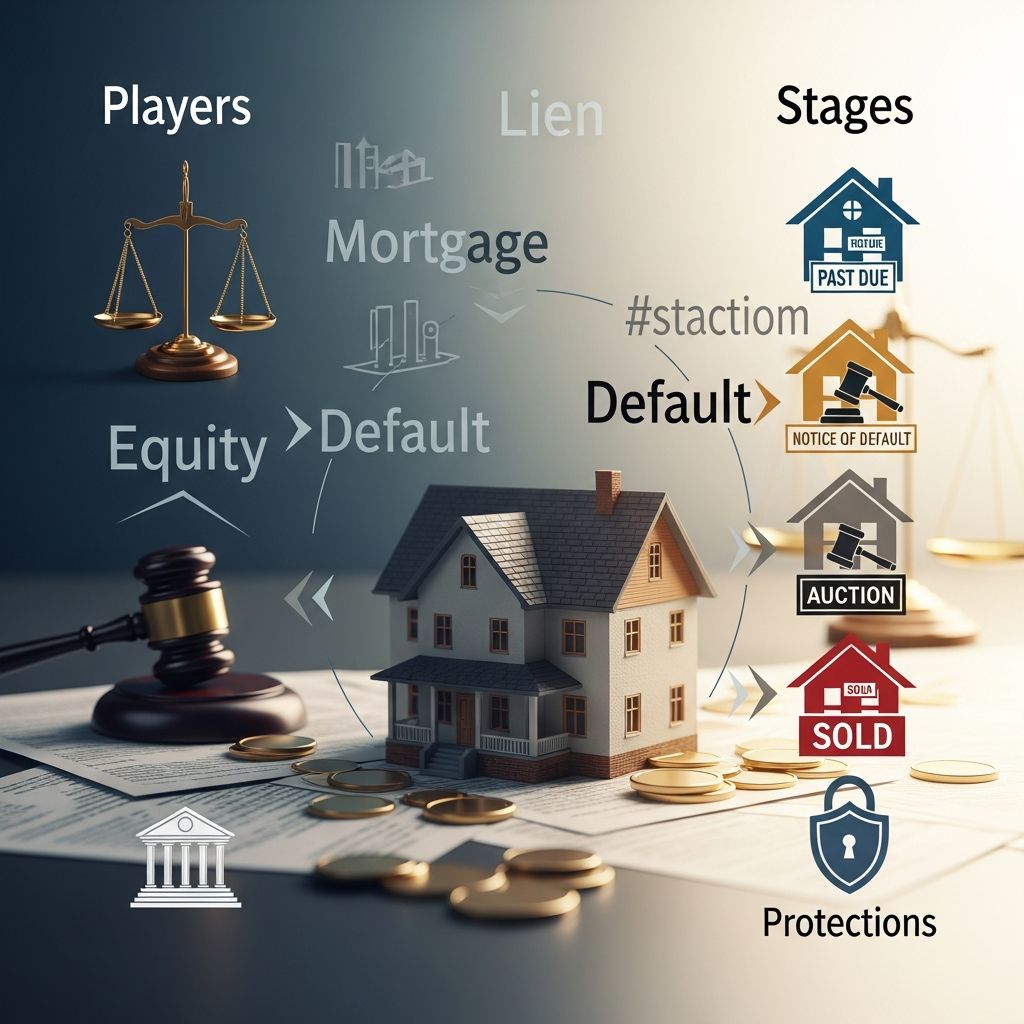
Foreclosure represents a lender’s legal mechanism to reclaim property when a borrower fails to meet mortgage obligations, ultimately leading to a forced sale to recover owed funds. Understanding its components empowers homeowners to respond effectively.
Core Terminology in Foreclosure Proceedings
Grasping the language of foreclosure is crucial for any homeowner navigating financial distress. Key terms include default, which occurs when payments are missed, typically after 30 days past due, triggering lender actions. A notice of default formally alerts the borrower of this breach, often posted on the property or mailed.
Other vital concepts encompass reinstatement, allowing cure by paying arrears before advanced stages, and redemption, the right to repurchase post-sale by settling the full judgment amount plus costs in some states. Equity of redemption provides a pre-sale window to reclaim ownership, varying by jurisdiction.
- Notice of Intention to Foreclose: Pre-litigation warning sent 30 days before court filings in judicial states.
- Writ of Execution: Court order authorizing sheriff-conducted auctions.
- Sheriff’s Sale: Public auction where the property sells to the highest bidder.
- Deed in Lieu of Foreclosure: Voluntary property surrender avoiding full process.
These terms form the backbone of proceedings, with variations by state law dictating their application.
Main Participants and Their Roles
Several entities drive the foreclosure machinery. The lender (mortgagee or beneficiary) initiates action upon default, seeking repayment through property seizure. In deed of trust states, a trustee manages nonjudicial sales, neutral between borrower (trustor) and lender.
Courts play pivotal roles in judicial processes: judges review complaints, enter judgments, and oversee sales via sheriffs.County sheriffs execute auctions, posting notices and transferring deeds. Borrowers, as defendants, must respond to summonses within strict deadlines, often 20-30 days.
| Party | Primary Role | Key Actions |
|---|---|---|
| Lender/Beneficiary | Initiates process | Files complaint, serves notices, bids at auction |
| Borrower/Trustor | Property owner | Receives notices, files defenses, seeks cures |
| Trustee (nonjudicial) | Neutral administrator | Handles notices, conducts sale |
| Sheriff/Court | Enforces judgment | Auctions property, issues writs |
| Junior Lienholders | Secondary claimants | Notified, may bid or object |
Homeowners should track all parties, as junior lienholders like second mortgages receive mandatory notices.
Judicial Foreclosure: The Court-Supervised Path
In judicial foreclosure states, lenders sue borrowers, requiring court validation of default claims. This borrower-friendly process allows defenses presentation.
Process unfolds as follows:
- Missed Payments and Pre-Foreclosure: Default after 90-120 days prompts notices.
- Complaint Filing: Lender submits detailed lawsuit 30+ days post-intent notice.
- Summons Service: Hand-delivered or mailed documents demand response; publication if unreachable.
- Answer Deadline: Borrowers file defenses or risk default judgment.
- Motion for Final Judgment: Lender seeks court order 14 days after notice, quantifying debt.
- Writ Issuance and Sale: Sheriff auctions property post-judgment.
Timelines span 4-12 months, with redemption rights post-sale in some areas (e.g., 3-12 months).
Nonjudicial Foreclosure: Streamlined Trustee-Led Process
Nonjudicial foreclosure, prevalent in states like California, bypasses courts via “power of sale” clauses in deeds of trust. Trustees follow statutory notices leading to trustee sales.
- Initiated post-default with recorded notice of default.
- Three-month pre-sale window for cure in many locales.
- Notice of sale published, posted, and mailed weeks prior.
- Auction to highest bidder, often the lender.
Faster (2-6 months), but offers fewer defense opportunities absent court oversight.
Detailed Timeline: From Default to Eviction
Foreclosure timelines vary, but a typical judicial sequence includes:
| Stage | Approximate Timing | Key Events |
|---|---|---|
| Default | Day 30+ | Missed payments; delinquency notice |
| Notice of Intent/Default | Day 90-120 | Formal warning; resolution attempts |
| Complaint/Summons | 4-8 months pre-sale | Lawsuit filed/served |
| Final Judgment | 10 days post-motion | Debt quantified; writ issued |
| Sheriff’s Sale | 2-5 months pre-eviction | Auction held; deed potential transfer |
| Redemption/Eviction | Post-sale (3-12 months) | Buyback option or forcible removal |
Nonjudicial paths compress to 90-180 days, emphasizing early intervention.
Robust Defenses and Relief Options for Homeowners
Challenging foreclosure demands timely, evidence-based responses. Common defenses include:
- Procedural Errors: Invalid service or notice timing violations halt progress.
- Loan Servicing Issues: Lender failures in payment application or dual-tracking (pursuing foreclosure during modification review).
- Standing Disputes: Prove lender lacks note ownership or holder-in-due-course status.
- Hardship Mitigation: Apply for forbearance, modification, or refinance pre-judgment.
Post-judgment appeals or motions to vacate defaults extend timelines. Mediation programs in select states facilitate settlements.
Alternatives like short sales or deed-in-lieu preserve credit better than full foreclosure.
Frequently Asked Questions (FAQs)
What triggers a foreclosure?
A series of missed mortgage payments, usually three or more, leading to default status and lender notices.
How long does the full process take?
Judicial: 6-24 months; nonjudicial: 3-6 months, depending on state laws and borrower responses.
Can I stop foreclosure after sheriff’s sale?
Yes, via redemption rights by paying judgment plus costs within statutory periods (e.g., 6-12 months).
What happens if I ignore summons?
Default judgment enters, accelerating sale without defense opportunity.
Does foreclosure affect my credit?
Severely: drops scores 100-150 points, lingering 7 years, but alternatives mitigate damage.
Proactive Strategies to Safeguard Your Home
Early contact with lenders unlocks options like payment plans or government programs (e.g., HAMP successors). Document all communications and consult housing counselors promptly. Maintain property during redemption to maximize value.
Foreclosure, while daunting, offers multiple off-ramps. Knowledge of terms, players, stages, and defenses equips homeowners for informed action.
References
- Foreclosure Timeline (The Foreclosure Process) — LSNJLAW. 2023. https://www.lsnjlaw.org/legal-topics/housing/home-ownership/foreclosure/pages/foreclosure-process-aspx
- How does foreclosure work? — Consumer Financial Protection Bureau. 2024-10-01. https://www.consumerfinance.gov/ask-cfpb/how-does-foreclosure-work-en-287/
- Foreclosure: How It Works And How To Avoid — Bankrate. 2025-05-15. https://www.bankrate.com/mortgages/what-is-a-foreclosure/
- An Overview of the Home Foreclosure Process — Federal Housing Finance Agency Office of Inspector General. 2022-06-30. https://www.fhfaoig.gov/Content/Files/SAR%20Home%20Foreclosure%20Process.pdf
- Foreclosure: What it means and how to avoid it — Rocket Mortgage. 2025-01-10. https://www.rocketmortgage.com/learn/foreclosure-definition
- Understanding Notice of Foreclosure, Process, and Sale Steps — Nolo. 2024. https://www.nolo.com/legal-encyclopedia/free-books/foreclosure-book/chapter9-3.html
- Guide to foreclosures — California Courts Self-Help. 2025. https://selfhelp.courts.ca.gov/foreclosures
- Stages of Foreclosure — Michigan State Housing Development Authority. 2024-11-20. https://www.michigan.gov/mshda/pathway-to-housing/stages-of-foreclosure
Similar Articles








Read full bio of medha deb




