
The Financial Frontiers of Democracy: Court Debt and Voting
Exploring the complex intersection of criminal justice debt, constitutional law, and access to the American ballot box.
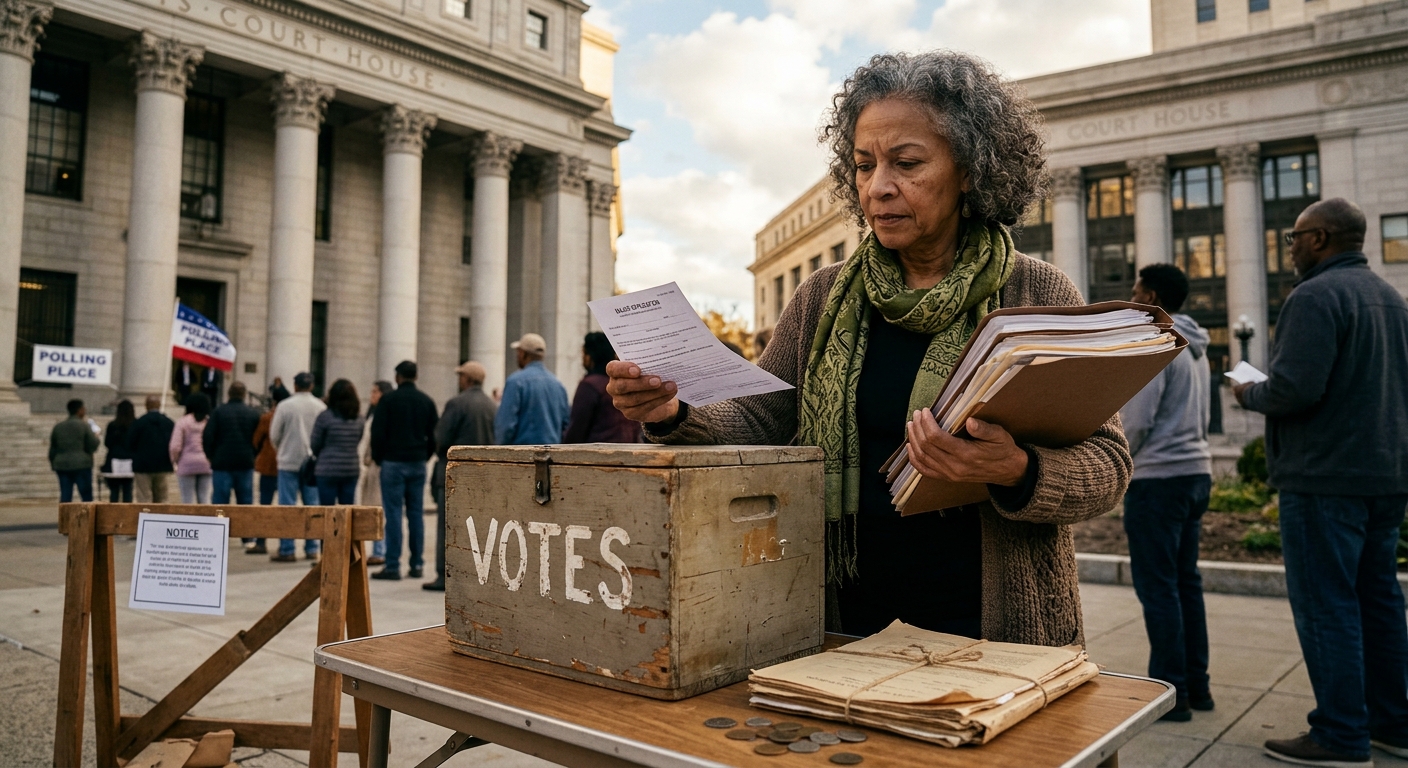
The bedrock of American civil society rests upon the principle of democratic participation, a concept fundamentally tied to the right to cast a ballot. However, the path to the ballot box is not uniformly paved for all citizens. Throughout the history of the United States, the definition of the electorate has been a subject of intense legislative, judicial, and societal conflict. Today, one of the most pressing civil rights issues centers on the intersection of the criminal justice system and electoral access, specifically regarding individuals who have completed sentences for felony convictions. The modern debate has shifted from blanket lifetime bans to a more complex, insidious barrier: the imposition of Legal Financial Obligations (LFOs) as a prerequisite for voter enfranchisement.
This financial frontier of democracy raises profound constitutional questions. When state legislatures mandate that returning citizens must pay all court-ordered fines, fees, and restitution before regaining their voting rights, they ignite fierce legal battles over wealth discrimination and the definition of a poll tax. By examining the historical context, the mechanics of modern legislative hurdles, and the sweeping judicial rulings that govern them, we can better understand the current landscape of voter suppression and enfranchisement in America.
The Historical Landscape of Voter Exclusion
To fully grasp the magnitude of modern debates surrounding felony disenfranchisement, one must first look at the historical precedents that established these exclusionary practices. The concept of stripping individuals of their civic rights following a criminal conviction—often referred to as “civil death”—has roots extending back to ancient European law. However, in the United States, the practice took on a distinctly targeted application following the Civil War and the Reconstruction era.
In the late 19th century, as newly freed Black Americans were granted the right to vote through the 15th Amendment, several states rapidly expanded their felony disenfranchisement laws. Lawmakers intentionally tailored these laws to disproportionately target offenses that they believed Black citizens were more likely to be convicted of, embedding a racial bias into the electoral framework that persists to this day. Over the decades, the era of mass incarceration dramatically multiplied the impact of these policies. According to The Sentencing Project’s comprehensive Locked Out 2024 report, an estimated 4 million Americans remain unable to vote due to a felony conviction, representing a staggering percentage of the voting-age population .
This systemic exclusion creates a crisis of representation. Entire communities, disproportionately populated by people of color and individuals from lower socioeconomic backgrounds, find themselves politically silenced. Without a voice in the democratic process, these populations lack the political leverage required to advocate for criminal justice reform, economic investment, and equitable social policies, thereby perpetuating a cycle of marginalization.
The Mechanics of Enfranchisement and Reversal
In recent years, a powerful grassroots movement has mobilized to dismantle these historical barriers. Advocacy groups, civil rights organizations, and bipartisan coalitions have successfully pushed for the restoration of voting rights through legislative action, executive orders, and direct citizen initiatives. A prominent example occurred in 2018 when voters in Florida overwhelmingly passed a constitutional amendment designed to automatically restore voting rights to individuals with prior felony convictions (excluding those convicted of murder or felony sexual offenses) upon the completion of their sentences.
This momentous victory was heralded as one of the most significant expansions of the voting franchise since the voting age was lowered to 18. However, the triumph was swiftly met with legislative counter-measures. Lawmakers introduced statutory frameworks to narrowly define what constituted the “completion” of a sentence. Through complex legislation, the definition was expanded beyond time served in prison and the completion of probation or parole to include the full payment of all legal financial obligations ordered by the sentencing court .
This legislative pivot effectively created two classes of returning citizens: those who possessed the financial means to buy back their constitutional rights, and those who remained indefinitely disenfranchised due to poverty. The implementation of these financial prerequisites shifted the focus of the voting rights battle from the ballot box directly to the federal courts.
Legal Financial Obligations (LFOs): The Modern Hurdle
To understand the barrier presented by LFOs, it is necessary to examine how the criminal justice system funds itself. Over the past few decades, local and state governments have increasingly relied on fines and fees levied against defendants to finance court operations, law enforcement agencies, and other municipal services. A comprehensive analysis by the Brennan Center for Justice details how these steep costs are routinely imposed on individuals who are already experiencing severe economic hardship .
LFOs can encompass a wide variety of charges, including public defender application fees, prosecution costs, electronic monitoring fees, and mandatory surcharges that have little to do with the actual crime committed. By the time an individual completes their prison sentence, they may owe tens of thousands of dollars in accumulated court debt. Because returning citizens face immense challenges in securing employment and housing due to their criminal records, paying off this debt is often an insurmountable task.
When the right to vote is conditioned upon the clearance of this debt, it transforms civic participation into a commodity. Critics argue that this system fundamentally breaks the social contract, as it ties fundamental constitutional rights to an individual’s bank account, punishing them not for their original crime, but for their ongoing poverty.
Constitutional Showdowns: Analyzing the Legal Precedents
The imposition of pay-to-vote systems has triggered landmark litigation, forcing the federal judiciary to weigh the authority of state legislatures against the protections enshrined in the U.S. Constitution. The legal arguments primarily revolve around two key constitutional provisions: the Equal Protection Clause of the 14th Amendment and the 24th Amendment’s prohibition on poll taxes.
- The 14th Amendment and Wealth Discrimination: Advocates for voting rights argue that conditioning the ballot on the payment of LFOs violates the Equal Protection Clause because it arbitrarily discriminates against indigent individuals. They rely on historical Supreme Court precedents which dictate that the state cannot limit fundamental rights based on a citizen’s ability to pay.
- The 24th Amendment and the Poll Tax: The 24th Amendment, ratified during the Civil Rights Movement, explicitly bans the use of a “poll tax or other tax” as a requirement to vote in federal elections. Civil rights litigators contend that court fees—especially those used to fund general government operations rather than strictly as punitive restitution—operate as an unconstitutional tax on the franchise.
These arguments culminated in highly publicized appellate court decisions. Notably, in the 11th Circuit Court of Appeals case Jones v. Governor of Florida, the deeply divided en banc court ruled in favor of the state’s authority to mandate the payment of LFOs . The majority opinion concluded that court-ordered debt is an intrinsic part of a criminal sentence rather than a “tax,” and ruled that states possess a rational basis for requiring full debt satisfaction before restoring civic rights. This ruling delivered a significant blow to voting rights advocates and firmly established a legal precedent allowing wealth-based prerequisites for returning citizens.
The Administrative Chilling Effect
Beyond the constitutional battles, the practical implementation of these financial prerequisites creates an administrative nightmare that effectively suppresses voter registration. One of the most glaring issues is the lack of centralized, accurate data regarding criminal justice debt. In many states, court records are hyper-localized, managed independently by county clerks using antiquated databases. This decentralization makes it nearly impossible for individuals to determine precisely how much they owe, or if they owe anything at all.
This administrative chaos is exacerbated by the threat of criminal prosecution. Returning citizens who mistakenly believe they have satisfied their financial obligations and attempt to register to vote can face severe felony charges for voter fraud. Recognizing this peril, advocacy groups have argued that these systems violate the National Voter Registration Act (NVRA), which requires states to clearly inform applicants of voter eligibility requirements . When the state itself cannot definitively tell a citizen whether they are eligible, the risk of imprisonment creates a profound “chilling effect.” Thousands of eligible voters choose to abstain from the democratic process entirely rather than risk accidental criminal liability.
State Approaches to Felony Disenfranchisement
The landscape of voting rights for individuals with felony convictions is a patchwork of wildly differing state laws. The table below provides a generalized overview of how different jurisdictions approach enfranchisement, highlighting the lack of a unified national standard.
| Disenfranchisement Model | Description of Electoral Access | Prevalence |
|---|---|---|
| Permanent Disenfranchisement | Individuals lose their voting rights permanently unless restored by an individual pardon or governor’s executive action. | A small minority of states retain this strict model. |
| Post-Sentence with LFO Requirements | Rights are restored only after the completion of prison, probation, parole, AND full payment of all court fines and fees. | Several states, particularly in the South and Midwest. |
| Post-Probation/Parole Restoration | Rights are restored automatically upon the completion of all terms of supervision, regardless of financial debt. | A significant portion of U.S. states follow this framework. |
| Post-Prison Restoration | Individuals regain the right to vote the moment they are released from incarceration, even while on probation or parole. | A growing number of reform-minded states. |
| Unrestricted Access | Citizens never lose their right to vote, even while actively incarcerated in a state correctional facility. | Only a very select few states (e.g., Maine, Vermont). |
Looking Toward the Future of Electoral Access
The fight over felony disenfranchisement and legal financial obligations is far from over. As litigation continues to wind its way through lower courts and potentially toward the Supreme Court, legislators and civil rights defenders remain locked in a struggle over the definition of democracy. For the millions of Americans living in the shadow of a past conviction, the stakes could not be higher. Their ability to reintegrate into society, to be recognized as full citizens, and to have a say in the laws that govern their lives hinges entirely on the resolution of these financial frontiers.
Ultimately, the imposition of court debt as a gateway to the ballot box forces society to confront an uncomfortable question: Is the right to vote a fundamental guarantee of citizenship, or is it a privilege reserved only for those who can afford the price of admission? Until a unified, equitable standard is established, the American electorate will remain fractured by the invisible boundaries of criminal justice debt.
Frequently Asked Questions
What are Legal Financial Obligations (LFOs)?
Legal Financial Obligations (LFOs) are fines, fees, court costs, and mandatory restitution imposed by a judge during criminal sentencing. These costs are often used to fund the operational budgets of local court systems and law enforcement agencies. Because they accumulate rapidly, they can create long-term financial burdens for returning citizens.
How do LFOs act as a barrier to voting?
In certain states, laws dictate that an individual’s criminal sentence is not considered “complete” until all associated LFOs are paid in full. Consequently, individuals who have served their prison time and completed parole cannot legally register to vote if they still owe money to the court, essentially tying the right to vote to personal wealth.
Does the 24th Amendment protect against pay-to-vote systems?
The 24th Amendment prohibits the denial of voting rights due to a failure to pay a “poll tax or other tax.” While civil rights advocates argue that mandatory court fees function exactly like a poll tax, some federal appellate courts have ruled that LFOs are punitive components of a criminal sentence, not taxes, and therefore do not violate the 24th Amendment.
Why is determining voter eligibility so difficult for returning citizens?
Many states lack a centralized, accurate database that tracks criminal justice debt. Court records are frequently managed at the county level and can be riddled with errors. As a result, it is incredibly difficult for an individual to find out exactly what they owe, leading to widespread confusion and a chilling effect on voter registration.
What is the National Voter Registration Act (NVRA) and how does it apply?
The National Voter Registration Act of 1993, often called the “Motor Voter Act,” requires state governments to make voter registration processes clear and accessible. Advocates argue that states violate the NVRA when they fail to provide clear information on their registration forms regarding the specific eligibility requirements for individuals with prior felony convictions.
References
- Locked Out 2024: Estimates of People Denied Voting Rights Due to a Felony Conviction — The Sentencing Project. 2024-10-10. https://www.sentencingproject.org/reports/locked-out-2024-estimates-of-people-denied-voting-rights/
- Senate Bill 7066 (2019) — The Florida Senate. 2019-06-28. https://www.flsenate.gov/Session/Bill/2019/7066
- The Steep Costs of Criminal Justice Fees and Fines — Brennan Center for Justice. 2019-11-21. https://www.brennancenter.org/our-work/research-reports/steep-costs-criminal-justice-fees-and-fines
- Jones v. Governor of Florida (No. 20-12003) — United States Court of Appeals for the Eleventh Circuit. 2020-09-11. https://media.ca11.uscourts.gov/opinions/pub/files/202012003.pdf
- Appeals court upholds Florida law restricting felon voting — The Associated Press (AP News). 2020-09-11. https://apnews.com/article/election-2020-florida-law-and-order-elections-courts-63d76e73cba394c86e08112dcf6b8f3d
Similar Articles








Read full bio of medha deb




