
Understanding Fair Credit Reporting Permissible Purposes
Learn when consumer reports may be furnished, used, or obtained under the Fair Credit Reporting Act and how those rules protect privacy.
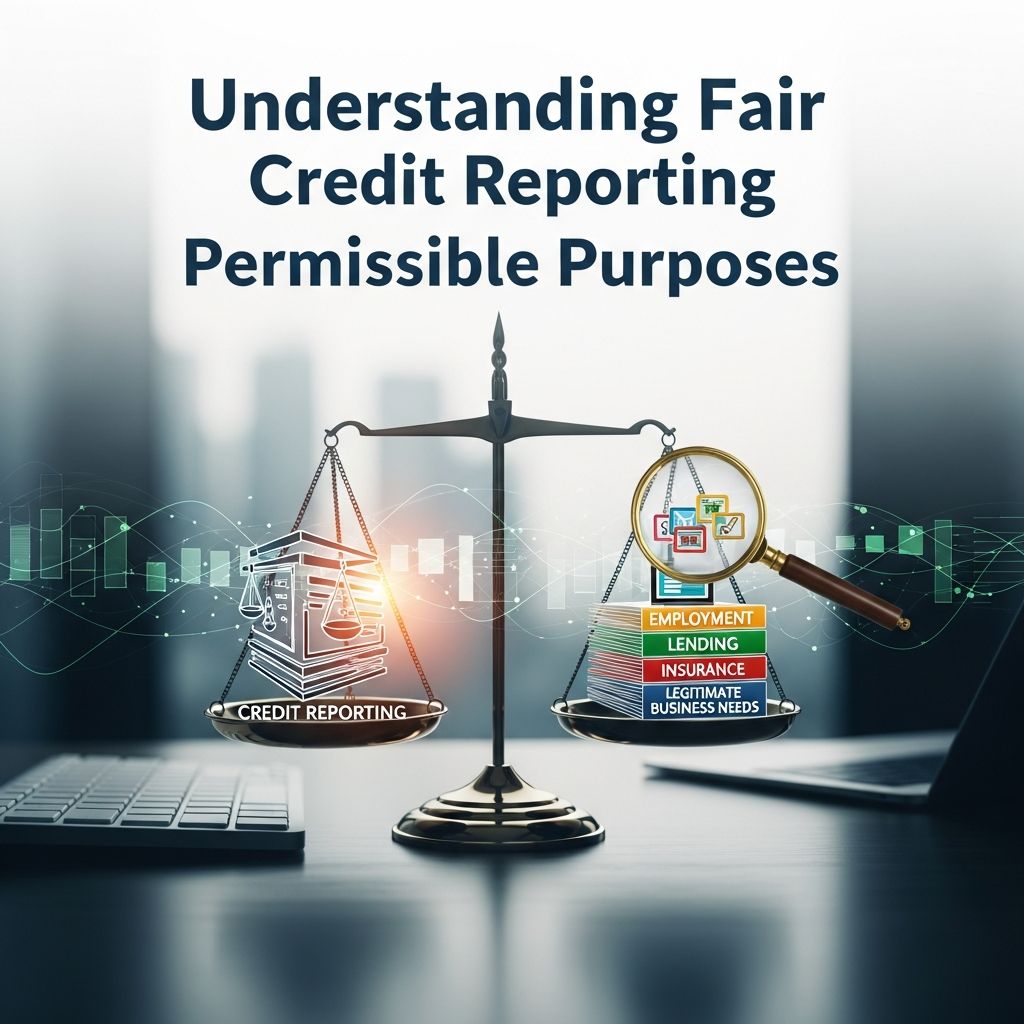
Consumer reports, often called credit reports, are at the center of many financial and employment decisions in the United States. Federal law strictly limits when these reports can be obtained, used, and shared, to protect the privacy and accuracy of consumer information. This article explains the concept of permissible purposes under the Fair Credit Reporting Act (FCRA), how recent regulatory interpretations clarify those purposes, and what obligations apply to both consumer reporting agencies and users of reports.
1. Legal Foundation: The FCRA and Section 604
The Fair Credit Reporting Act is a federal statute that governs how consumer reporting agencies collect, maintain, and share information about individuals. Among its core protections, the Act states that information in a consumer report cannot be provided to just anyone; instead, the requester must have a clearly defined legal reason to access the data.
These legal reasons are known as permissible purposes. Most of them are listed in Section 604 of the FCRA (codified at 15 U.S.C. § 1681b). This section sets out when a consumer reporting agency may furnish a report and when the request is unlawful.
1.1 What is a “consumer report”?
Although the statute contains a detailed definition, a consumer report generally means any communication of information by a consumer reporting agency that relates to a consumer’s creditworthiness, credit standing, credit capacity, character, reputation, personal characteristics, or mode of living, and that is used (or expected to be used) to make eligibility decisions regarding credit, insurance, employment, or similar purposes.
1.2 Why permissible purposes matter
- Privacy protection: Only those with a legally valid need can access consumer report information, helping to prevent misuse or unauthorized snooping.
- Data accuracy and control: Limiting access reduces the risk that reports will be obtained under false pretenses or used for unrelated purposes.
- Legal accountability: Consumer reporting agencies and users can face regulatory or legal consequences if they obtain or share reports without a permissible purpose.
2. Core Permissible Purposes under the FCRA
Section 604 identifies several primary situations where it is lawful to obtain and use a consumer report. The most widely used purposes appear in 15 U.S.C. § 1681b(a)(3).
| Permissible Purpose Category | Typical Use Case |
|---|---|
| Credit transactions | Evaluating a loan application, reviewing an existing account, or collecting a delinquent debt. |
| Employment purposes | Using a consumer report in hiring, promotion, or retention decisions, with additional procedural protections. |
| Insurance underwriting | Assessing risk when issuing or renewing insurance policies for individuals. |
| Licenses or government benefits | Determining eligibility for licenses or benefits when financial responsibility is relevant. |
| Investor, servicer, or insurer review | Evaluating credit or prepayment risk for an existing credit obligation. |
| Legitimate business need | Business transactions initiated by the consumer, or review of existing accounts for ongoing eligibility. |
| Written instructions from the consumer | Disclosures made at the consumer’s explicit direction, such as personal credit checks. |
2.1 Credit-related purposes
A consumer reporting agency may furnish a report when it has reason to believe the requester intends to use the information in connection with a credit transaction involving the consumer and involving either the extension of credit, review of an existing account, or collection of a debt. This authorization extends to post-consummation activities, such as evaluating whether a consumer still qualifies for existing credit or pursuing collection on a delinquent account.
2.2 Employment purposes
Employers may obtain consumer reports to evaluate applicants or employees, but additional rules apply. The report must be used for a bona fide employment purpose, and other federal and state employment laws may require disclosures, consent, and specific adverse action procedures.
2.3 Insurance underwriting
Insurers may request consumer reports when they need the information to underwrite insurance involving the consumer, such as setting premiums or deciding whether to issue coverage.
2.4 Government licenses and benefits
Government entities that grant licenses or benefits may use consumer reports when a law requires them to consider an applicant’s financial responsibility or status in making eligibility decisions.
2.5 Legitimate business needs
The FCRA permits consumer reports to be furnished when the requester has a legitimate business need in connection with a business transaction initiated by the consumer, or to review an existing account to determine whether the consumer continues to meet its terms. For example, institutions often rely on this provision when checking specialty reports for consumers opening deposit accounts.
3. The “Consumer-Specific” Nature of Permissible Purposes
Federal regulators have clarified that the permissible purposes listed in Section 604(a)(3) are consumer specific. This means that a consumer reporting agency must have reason to believe that all of the information it furnishes as part of a consumer report pertains to the particular consumer who is the subject of the request.
3.1 No “mixed” or unverified matches
Under this interpretation, a consumer reporting agency may not simply provide information that might relate to the requested consumer but also plausibly relates to other individuals. The report must be reasonably matched to the specific consumer for whom the permissible purpose exists.
- If a user requests a report on Jane Doe, the agency must not include information related to a different Jane Doe or an unrelated person whose data became linked through imprecise matching.
- Agencies must use procedures that reduce the risk of furnishing information about the wrong individual, such as robust identity-matching logic.
3.2 Implications for data accuracy and privacy
- Stronger identity matching: Agencies are expected to adopt reasonable procedures to ensure that they have a sound basis for believing all included data relates to the requested consumer.
- Reduced risk of harm: Preventing mixed files or misattributed information lowers the chance that consumers will be denied credit, employment, or insurance based on someone else’s history.
- Compliance controls: Agencies and users may need to review contracts, system design, and internal policies to ensure they do not rely on overly broad or ambiguous matches.
4. Duties of Consumer Reporting Agencies
Consumer reporting agencies must not furnish reports unless a valid permissible purpose under the FCRA exists. They also must implement reasonable procedures to assure maximum possible accuracy and to protect against unauthorized access or use.
4.1 Verifying the purpose of each request
- Agencies must have a reason to believe that the person requesting a consumer report intends to use it for a specific permissible purpose, such as a credit transaction or employment decision.
- Typically, this involves contractual certifications, due diligence on users, and monitoring for unusual request patterns.
- Agencies must decline or question requests that do not clearly fit any permissible purpose.
4.2 Matching information to the correct consumer
Because permissible purposes are consumer specific, agencies must design and maintain systems that reasonably ensure each furnished report contains information about the correct individual, and not about someone else with a similar identity profile.
4.3 Responding to disputes and errors
When consumers dispute the accuracy of information in their reports, consumer reporting agencies and furnishers of information must investigate and correct inaccuracies as needed. The improved accuracy that results from these duties supports the broader framework of permissible purposes by ensuring that only reliable data is used in consequential decisions.
5. Responsibilities of Users of Consumer Reports
Entities that obtain and use consumer reports—such as lenders, employers, insurers, and landlords—also have legal obligations when they access and rely on these reports.
5.1 Ensuring a lawful purpose
- Users must only request consumer reports when a clear permissible purpose exists under Section 604 or another applicable provision of the FCRA.
- They typically certify this purpose to the consumer reporting agency, often through contractual language and ongoing compliance attestations.
- Requesting a report without such a purpose can constitute a violation of federal law, and may subject the user to enforcement actions or private litigation.
5.2 Proper use and limitations
- Information obtained for one permissible purpose should not be reused for unrelated purposes without a separate legal basis.
- For employment uses, users may be required to obtain written consent and to follow adverse action procedures if they deny employment based on the report.
- For credit uses, if adverse action is taken (such as denying credit or offering materially less favorable terms), users must provide required notices, including the identity of the consumer reporting agency and the consumer’s right to dispute inaccuracies.
5.3 Safeguarding consumer information
Users must implement reasonable measures to secure consumer reports from unauthorized access, misuse, or improper disclosure. These data security obligations complement the permissible purpose framework by ensuring that even when reports are lawfully obtained, they are handled responsibly.
6. Special Topics: Prescreened Offers and Non–Consumer-Initiated Transactions
In some situations, consumer reports may be furnished in connection with credit or insurance transactions that the consumer did not initiate directly, such as prescreened offers of credit or insurance.
6.1 Prescreened credit and insurance offers
Section 604 provides specific rules for furnishing reports for prescreened offers. A consumer reporting agency may provide limited information to a creditor or insurer for such offers only under defined circumstances, including compliance with opt-out requirements and other restrictions.
6.2 Opt-out rights
Consumers generally have the right to opt out of having their information used for certain prescreened offers. These rights are designed to balance marketing practices with individual privacy and choice.
7. Compliance Considerations and Best Practices
Organizations that furnish, obtain, or use consumer reports should take a structured approach to FCRA compliance.
7.1 Governance and policy framework
- Adopt written policies that identify permissible purposes relevant to the organization’s activities and explain when reports may be requested.
- Include oversight responsibilities for compliance staff or legal counsel to periodically review practices against regulatory developments.
- Ensure contracts with consumer reporting agencies accurately reflect the organization’s intended uses and certifications.
7.2 Operational controls
- Build decision workflows that require documentation of the specific permissible purpose before a report request can be submitted.
- Establish user access controls and logging so that only appropriately authorized personnel may obtain or view consumer reports.
- Conduct periodic reviews of sample report requests to confirm that each was linked to a valid purpose and consumer-specific need.
7.3 Training and monitoring
- Train employees on the meaning of permissible purposes, including examples of prohibited uses (such as obtaining a report out of curiosity).
- Provide role-based training for staff involved in credit decisions, employment screening, underwriting, and collections.
- Monitor regulatory guidance and advisory opinions from federal agencies responsible for implementing the FCRA, and update internal practices accordingly.
8. Impact on Consumers
The permissible purpose framework is not merely a technical requirement for institutions; it has direct and significant effects on consumers.
8.1 Privacy and control over personal data
- Limits on when reports can be obtained reduce the risk that sensitive information is accessed without a legitimate need.
- Consumer-specific matching requirements help ensure that individuals are not judged based on another person’s history.
- Opt-out and disclosure rights give consumers more control over how their information is used in prescreened offers and other contexts.
8.2 Access, disputes, and corrections
Consumers have the right to obtain copies of their own consumer reports and to dispute inaccurate or incomplete information. These rights are essential to making the permissible purpose rules effective, because they help ensure that the data used in credit, employment, and insurance decisions is accurate and fairly attributed.
9. Frequently Asked Questions (FAQs)
Q1: Can any business check my credit report whenever it wants?
No. A business must have a permissible purpose under the FCRA—such as a credit transaction you initiated, employment purposes (with additional safeguards), insurance underwriting, or another legally recognized reason—before it can obtain your consumer report.
Q2: Is my consent always required for a consumer report?
Not always. The FCRA allows certain users, such as lenders or insurers, to obtain reports without separate written consent when a permissible purpose exists, for example in connection with a credit transaction you initiate. However, your consent is required for some uses, such as most employment-related checks and reports obtained based solely on your written instructions.
Q3: What happens if a company gets my report without a permissible purpose?
Obtaining a consumer report without a permissible purpose can violate federal law and may expose the company—and sometimes individuals—to enforcement actions or private lawsuits. Regulatory authorities can seek remedies and penalties, and consumers may have rights to pursue legal claims depending on the circumstances.
Q4: How do I know who has accessed my consumer report?
When you request a copy of your consumer report from a nationwide consumer reporting agency, it generally lists recent inquiries made in connection with credit, employment, or other purposes. Reviewing this information can help you identify potential unauthorized access or errors.
Q5: What should I do if I see inaccurate information on my report?
You should file a dispute with both the consumer reporting agency and, if applicable, the entity that furnished the information. They are required to investigate and, if they find the information is inaccurate or incomplete, to correct or delete it, which in turn improves the fairness and reliability of decisions made using your report.
References
- Fair Credit Reporting Act — Federal Trade Commission. 2021-03-10. https://www.ftc.gov/legal-library/browse/statutes/fair-credit-reporting-act
- Permissible purposes of consumer reports, 15 U.S.C. § 1681b — U.S. House of Representatives, Office of the Law Revision Counsel. 1999-10-01 (current codification with later amendments). https://uscode.house.gov/view.xhtml?req=granuleid:USC-prelim-title15-section1681b
- Federal Consumer Financial Protection Guide: Fair Credit Reporting Act (Regulation V) — National Credit Union Administration. 2023-05-01. https://ncua.gov/regulation-supervision/manuals-guides/federal-consumer-financial-protection-guide/compliance-management/lending-regulations/fair-credit-reporting-act-regulation-v
- Fair Credit Reporting; Permissible Purposes for Furnishing, Using, and Obtaining Consumer Reports (Advisory Opinion) — Consumer Financial Protection Bureau. 2022-07-12. https://www.federalregister.gov/documents/2022/07/12/2022-14823/fair-credit-reporting-permissible-purposes-for-furnishing-using-and-obtaining-consumer-reports
- Fair Credit Reporting Act (Regulation V) – Overview — National Credit Union Administration. 2022-09-30. https://ncua.gov/regulation-supervision/manuals-guides/federal-consumer-financial-protection-guide/compliance-management/lending-regulations/fair-credit-reporting-act-regulation-v
Similar Articles








Read full bio of Sneha Tete




