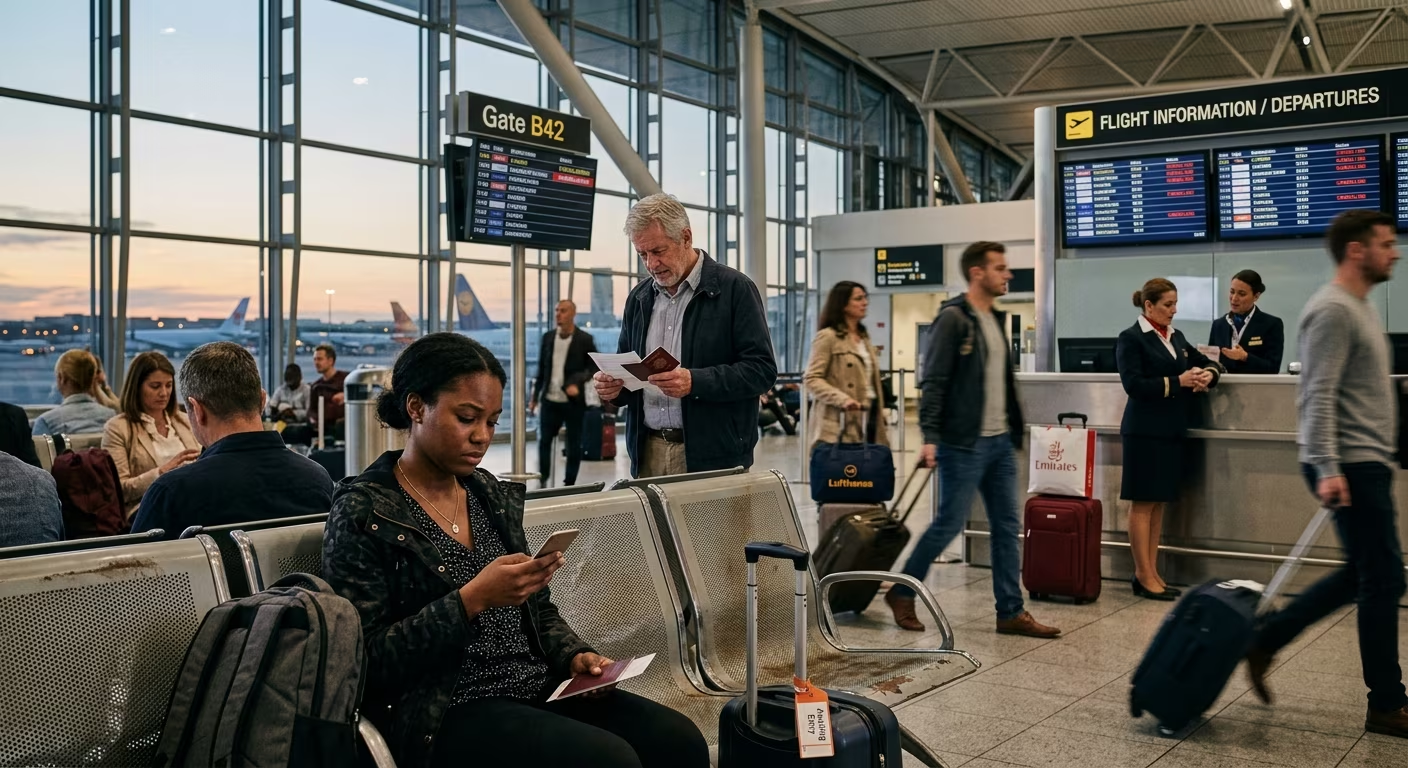
The tapestry of American immigration policy has historically been complex, balancing national security imperatives with a foundational ethos of welcoming those seeking refuge and opportunity. However, unilateral executive actions can profoundly disrupt this balance, creating shockwaves that resonate far beyond the tenure of any single administration. Among the most controversial measures in modern United States history was the series of executive travel restrictions initiated in January 2017. Widely criticized for targeting specific demographic and religious groups, these policies systematically dismantled the legal pathways for thousands of individuals, separating families and stunting professional opportunities.
While formal proclamations can be revoked with the stroke of a pen, the administrative, psychological, and institutional damage they inflict is rarely erased so easily. Years after their implementation and subsequent reversal, the architecture of these bans continues to cast a long shadow over the U.S. immigration system. Examining this legacy requires a deep dive into the legal mechanisms that enabled such sweeping restrictions, the bureaucratic inertia that complicates recovery, and the ongoing human toll borne by separated communities.
The Legal Architecture of Exclusion
To understand how a categorical restriction on entry was executed, one must look at the broad statutory authority delegated to the executive branch. The primary mechanism utilized was Section 212(f) of the Immigration and Nationality Act (INA). This statute grants the President the authority to suspend the entry of all aliens or any class of aliens into the United States if it is determined that their entry would be “detrimental to the interests of the United States.”
Historically, this provision was employed in highly targeted scenarios, such as preventing human rights abusers, specific rogue military dictators, or members of designated hostile regimes from crossing American borders. However, in 2017, the application of Section 212(f) underwent an unprecedented expansion. It was weaponized to suspend the entry of nearly all nationals from several predominantly Muslim-majority nations, and later expanded to include various African countries. The initial directive, Executive Order 13769, sparked immediate legal battles and nationwide protests.
Following legal challenges, the executive branch iterated on the policy, culminating in Proclamation 9645, which the Supreme Court ultimately upheld under a broad interpretation of presidential power. This legal precedent exposed a significant vulnerability in the U.S. immigration framework: the ability of the executive branch to enact sweeping, discriminatory bans with minimal congressional oversight or evidentiary requirements. The mere invocation of national security was deemed sufficient to bypass the standard vetting protocols and upend decades of established immigration precedent.
The Unrelenting Human Toll on Families and Communities
The most immediate and visceral impact of the travel restrictions was the forced separation of families. While the policies were debated in federal courts and political arenas, ordinary people were thrust into indefinite periods of waiting and uncertainty. The consequences of these separations extended far beyond mere inconvenience; they altered the trajectories of thousands of lives.
Missed Milestones and Health Crises
For individuals holding permanent residency or citizenship in the United States, the bans effectively meant that their overseas spouses, children, and parents were barred from joining them. This led to a cascade of heartbreaking realities:
- Fractured Marriages: Newlywed couples were forced to live on separate continents for years, unable to begin their lives together in the United States.
- Child Separation: Parents were separated from their young children, missing crucial developmental years and milestones.
- Medical Emergencies: Relatives of individuals undergoing severe medical treatments in the U.S. were denied entry, leaving vulnerable people without their primary support systems during life-threatening health crises.
- End-of-Life Goodbyes: Countless individuals were prevented from attending the funerals of their loved ones or providing comfort during a family member’s final days.
The Illusion of the Waiver Process
To survive legal scrutiny, the final iteration of the travel restrictions included a “waiver” provision, theoretically allowing consular officers to grant visas on a case-by-case basis if the applicant could prove undue hardship, no threat to national security, and that their entry was in the national interest. In practice, this waiver process was heavily criticized as a sham. Immigration advocates and legal experts documented that waivers were granted at an abysmal rate, often under 2 percent. The opacity of the process left applicants in a bureaucratic black hole, spending thousands of dollars on legal fees only to receive boilerplate rejections.
Academic, Institutional, and Economic Ramifications
Beyond the deeply personal tragedies of family separation, the categorical exclusion of foreign nationals dealt a severe blow to American institutions and the broader economy. The U.S. has long thrived on its ability to attract the brightest minds from across the globe, yet the travel restrictions sent a chilling message to the international community.
Stifling Innovation and Research
American universities and research institutions rely heavily on international scholars, post-doctoral researchers, and graduate students. The restrictions abruptly severed collaborations, forcing many talented individuals to seek opportunities in countries with more welcoming policies, such as Canada or the United Kingdom. Critical research in fields ranging from biotechnology to engineering suffered delays as vital team members were suddenly barred from re-entering the country after visiting their home nations. The perception of the United States as a hostile environment for international scholars continues to affect enrollment and recruitment efforts today.
The Impact on Healthcare
The U.S. healthcare system, which is acutely dependent on foreign-trained medical professionals, also felt the strain. Many doctors from the restricted nations who were slated to begin medical residencies—often in rural or underserved American communities—were denied entry. This exacerbated existing physician shortages and deprived vulnerable U.S. populations of essential medical care.
Bureaucratic Hangovers: Why Reversal Wasn’t Enough
On his first day in office in January 2021, President Joe Biden issued Proclamation 10141, effectively revoking the discriminatory travel bans. While this was celebrated as a monumental victory for civil rights and immigrant advocacy groups, the reality on the ground proved far more complicated. Revoking a policy does not automatically reverse the systemic damage it caused over four years.
The Phantom Backlog
When the bans were lifted, the State Department was ordered to reconsider applications that had been denied under the previous directives. However, individuals whose visas had been categorically refused were often required to restart the entire application process. This meant repaying exorbitant application fees, gathering new documentation, and re-entering the back of a line that had grown exponentially due to the compounding effects of the COVID-19 pandemic.
Institutional Muscle Memory
Bureaucracies often develop an institutional “muscle memory” that outlasts the policies themselves. Consular officers who were trained under an era of heightened, categorical suspicion did not seamlessly transition to a posture of welcoming facilitation. Immigration attorneys continue to report elevated rates of “administrative processing”—a vague security clearance phase that can delay a visa for months or years—for applicants from previously restricted nations. This lingering scrutiny suggests that the stigma attached to these nationalities was not erased by the executive revocation.
A Chronology of Executive Action and Reversal
To fully grasp the convoluted history of these policies, it is helpful to view their progression and the ultimate attempts at unwinding them.
| Executive Action | Date Implemented | Core Impact |
|---|---|---|
| Executive Order 13769 | January 2017 | Initial 90-day suspension of entry from 7 predominantly Muslim nations; chaotic implementation at airports. |
| Executive Order 13780 | March 2017 | Revised order removing Iraq from the list and temporarily halting the refugee resettlement program. |
| Proclamation 9645 | September 2017 | Indefinite travel restrictions with a nominal waiver process; upheld by the Supreme Court. |
| Proclamation 9983 | January 2020 | Expansion of the restrictions to include six additional countries, primarily in Africa. |
| Proclamation 10141 | January 2021 | Revocation of previous bans; directed the State Department to resume visa processing. |
The Push for Statutory Reform: The NO BAN Act
The traumatic legacy of the travel bans has catalyzed a movement to permanently curtail the executive branch’s ability to unilaterally exclude classes of people based on discriminatory criteria. The cornerstone of this legislative push is the National Origin-Based Antidiscrimination for Nonimmigrants (NO BAN) Act.
The NO BAN Act seeks to fundamentally reform Section 212(f) of the INA. Its provisions are designed to ensure that future administrations cannot bypass fundamental civil rights protections under the guise of unchecked national security claims. Key elements of the proposed legislation include:
- Expanding Non-Discrimination Protections: The Act explicitly prohibits discrimination based on religion in the issuance of immigrant and non-immigrant visas, closing a critical loophole that allowed the initial bans to target Muslim-majority countries.
- Evidence-Based Restrictions: It requires that any future travel suspensions be strictly tailored, temporary, and supported by credible, evidence-based findings of a specific threat to the United States.
- Mandatory Congressional Consultation: The legislation mandates that the executive branch consult with Congress and provide specific evidence before enacting widespread travel restrictions, restoring a vital check and balance to the immigration system.
Advocates argue that passing the NO BAN Act is not merely a symbolic repudiation of past policies, but a necessary statutory safeguard to protect the integrity of the U.S. immigration system from future abuses of power.
Frequently Asked Questions (FAQ)
Are the 2017 travel bans still in effect today?
No. The restrictive policies known colloquially as the travel bans or Muslim bans were officially revoked by President Biden on January 20, 2021, via Proclamation 10141. However, many applicants are still dealing with the processing backlogs caused by the years-long pause in visa issuance.
What is Section 212(f) of the INA?
Section 212(f) of the Immigration and Nationality Act gives the President the authority to suspend the entry of foreign nationals if it is deemed detrimental to U.S. interests. It was the primary legal justification used to implement the sweeping travel restrictions beginning in 2017.
Can a future president reinstate similar travel restrictions?
Under the current language of Section 212(f), a future president retains broad authority to restrict entry. This is why lawmakers and civil rights groups are advocating for the NO BAN Act, which would amend the law to require credible evidence and prevent discrimination based on religion or national origin.
Did the waiver process help families stay together during the ban?
In practice, the waiver process was highly ineffective. Data showed that a vast majority of waiver applications were denied, despite applicants demonstrating severe hardship and no security risk, leading critics to label the process a bureaucratic illusion.
Conclusion
The narrative of the executive travel restrictions is a profound testament to the fragility of immigrant rights in the face of expansive executive power. While the immediate directives have been dismantled, the enduring harms—fractured families, derailed careers, and deeply ingrained administrative backlogs—serve as a stark warning. True recovery requires more than just executive revocation; it demands an unwavering commitment to statutory reform. By implementing robust checks and balances, the United States can ensure that national security measures never again become a pretext for categorical discrimination, thereby reaffirming its core democratic principles.
References
- Executive Order 13769: Protecting the Nation From Foreign Terrorist Entry Into the United States — Federal Register. 2017-02-01. https://www.federalregister.gov/documents/2017/02/01/2017-02281/protecting-the-nation-from-foreign-terrorist-entry-into-the-united-states
- Proclamation 10141: Ending Discriminatory Bans on Entry to the United States — Federal Register. 2021-01-25. https://www.federalregister.gov/documents/2021/01/25/2021-01749/ending-discriminatory-bans-on-entry-to-the-united-states
- H.R. 2214 – NO BAN Act — Congress.gov. 2020-07-22. https://www.congress.gov/bill/116th-congress/house-bill/2214
- The NO BAN Act (HR 2214 | S 1123) — Brennan Center for Justice. 2019-05-08. https://www.brennancenter.org/our-work/research-reports/no-ban-act-hr-2214-s-1123