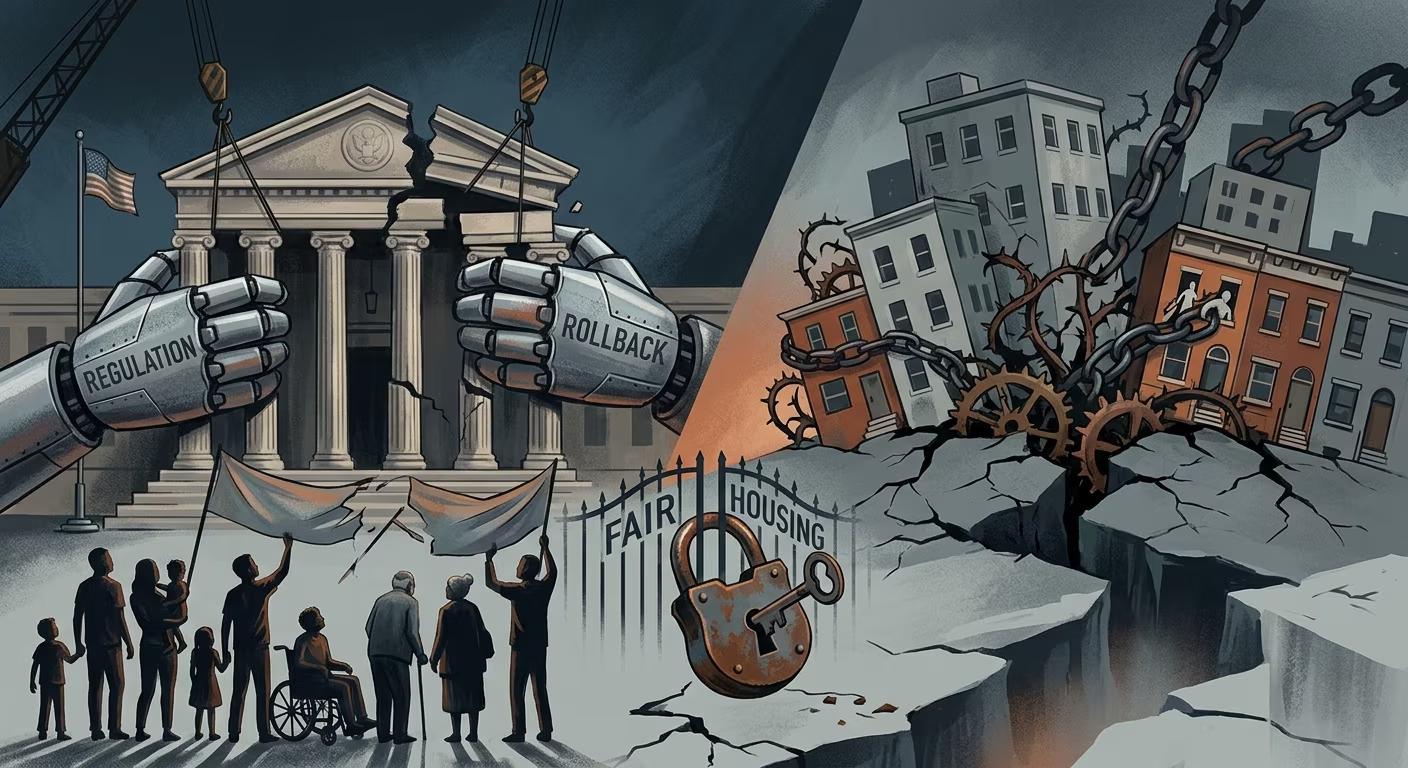
The Promise and Evolution of the Fair Housing Act
The enactment of the Fair Housing Act (FHA) in 1968 represented a watershed moment in the American civil rights movement. Passed in the tumultuous aftermath of the assassination of Dr. Martin Luther King Jr., the landmark legislation was explicitly designed to dismantle the entrenched systems of residential segregation that had long plagued the United States. For decades prior, overt discriminatory practicessuch as real estate agents explicitly refusing to sell homes to Black families, or landlords placing restrictive signs in apartment windowswere not only commonplace but legally tolerated. The FHA sought to eradicate these blatant injustices by making it unequivocally illegal to deny housing based on race, color, religion, sex, or national origin. Later congressional amendments expanded these vital protections to include disability and familial status, broadening the shield of federal protection.
However, as society and the legal landscape evolved, so too did the mechanisms of discrimination. While overt, vocalized bigotry became legally actionable and socially taboo, prejudice merely morphed into more sophisticated, covert forms. To combat these hidden barriers, civil rights advocates, government regulators, and legal scholars came to rely heavily on a critical legal doctrine known as the “disparate impact” standard. This standard recognizes that discrimination does not always announce itself with a slur; often, it is hidden within seemingly neutral policies that have a devastating, disproportionate effect on marginalized groups. Recently, however, severe regulatory maneuversspecifically those enacted by the Department of Housing and Urban Development (HUD) during the Trump administration in 2020threatened to irreparably undermine this critical civil rights tool, raising fierce alarms among fair housing advocates nationwide.
Understanding the Bedrock of Housing Equity: The Disparate Impact Standard
To fully comprehend the gravity of these regulatory rollbacks, one must first understand exactly what disparate impact entails. In fair housing law, there are two primary pathways to proving discrimination: “disparate treatment” and “disparate impact.” Disparate treatment involves intentional, deliberate discriminationfor example, a property manager outright refusing to rent to a prospective tenant explicitly because of their race or religion. In today’s modern landscape, proving this type of intentional animus is exceedingly difficult, as discriminatory actors rarely document their prejudices in writing or state them aloud.
Disparate impact, conversely, does not require a plaintiff to prove malicious intent. Instead, the doctrine focuses entirely on the statistical outcomes and real-world consequences of a policy or practice. If a housing provider, institutional lender, or local municipality implements a rule that is neutral on its face but statistically disadvantages a protected class without a valid, legally justifiable reason, that policy violates the FHA under the disparate impact doctrine.
Consider a local zoning board that passes a stringent ordinance prohibiting the construction of any multi-family apartment buildings within its jurisdiction, mandating only single-family homes on expansive, expensive lots. While the ordinance never explicitly mentions race or socioeconomic status, the practical, measurable outcome is the exclusion of lower-income familieswho are disproportionately people of colorfrom the community. Another common example involves landlords enforcing sweeping blanket bans on renting to anyone with a prior arrest record. Because systemic biases in the criminal justice system result in Black and Latino individuals being arrested at vastly disproportionate rates compared to their white counterparts, a blanket ban on arrest records serves as an effective proxy for racial discrimination, severely restricting housing options for minority applicants.
The fundamental validity of the disparate impact standard was decisively affirmed by the Supreme Court of the United States in the 2015 landmark case, Texas Department of Housing and Community Affairs v. Inclusive Communities Project, Inc. . In a deeply analytical 5-4 decision, the Court ruled that disparate impact claims are indeed cognizable under the Fair Housing Act, emphasizing that the doctrine is essential for uncovering “discriminatory intent that hides behind a screen of built-in laws” and dismantling invisible barriers to housing equity.
The Regulatory Rollback: Dismantling the 2013 Framework
For years, the application of disparate impact was guided by a clear, robust three-part burden-shifting framework formalized by HUD in 2013 . Under the 2013 rule, the legal process was straightforward, establishing a balanced playing field for both plaintiffs and defendants:
- Step 1: The plaintiff (the victim of discrimination) had to demonstrate that a specific policy caused a disproportionate, adverse impact on a protected class.
- Step 2: If the plaintiff was successful, the burden shifted to the defendant (the housing provider or lender) to prove that the policy was strictly necessary to achieve a substantial, legitimate, non-discriminatory interest.
- Step 3: Even if the defendant proved a legitimate business interest, the plaintiff could still prevail by showing that the defendant’s goal could be achieved through a less discriminatory alternative.
In the fall of 2020, under the Trump administration, HUD finalized a radical overhaul of this established standard, severely tipping the scales of justice in favor of corporate landlords, major banks, and massive insurance companies . The 2020 rule effectively dismantled the balanced 2013 framework, replacing it with a convoluted, heavily fortified, and nearly insurmountable pleading standard. Under these revised regulations, civil rights plaintiffs were forced to meet an extraordinarily high burden just to get their foot in the courthouse door.
Instead of simply demonstrating a statistical disparity, victims of discrimination were suddenly required to preemptively guess, analyze, and thoroughly debunk the defendant’s presumed business justifications before the legal discovery process even began. They had to decisively prove that the challenged policy was “arbitrary, artificial, and unnecessary,” a legal threshold so ambiguous and demanding that it threatened to result in the dismissal of legitimate civil rights claims before they could be thoroughly investigated by a court. By erecting these formidable procedural barriers, the 2020 rule functioned as an aggressive legal gatekeeper, systematically shielding housing providers from accountability and effectively neutralizing the disparate impact doctrine.
The Algorithm Loophole: Tech-Washing Housing Discrimination
Perhaps the most alarming and forward-looking aspect of the 2020 regulatory overhaul was the introduction of broad new “safe harbors” specifically designed for algorithmic decision-making. In the modern, digitized housing market, traditional human-led tenant screening and manual mortgage underwriting have been largely replaced by complex, automated algorithms. Landlords and financial institutions increasingly rely on third-party software that aggregates massive datasetsincluding credit scores, past eviction filings, criminal backgrounds, and even zip-code-level consumer behaviorto generate a rapid, simple “approve” or “deny” recommendation.
While proponents of these technologies frequently argue that machines are strictly objective and totally immune to human prejudice, the technological reality is starkly different. Algorithms are trained on historical data, and in the United States, historical data is deeply infected with the legacy of systemic racism, government-sponsored redlining, and unequal policing strategies . When an automated algorithm evaluates an applicant based on these inherently biased data points, it effectively codifies and automates historical discrimination. This phenomenon, often referred to as “tech-washing,” allows businesses to hide their discriminatory outcomes behind the impenetrable veneer of mathematics.
The 2020 HUD rule created a massive, highly protective loophole for this exact type of automated bias. It stipulated that if a housing provider used an algorithmic model produced by a recognized third party, or if the model had been theoretically “validated” by an ostensibly neutral entity, the housing provider would be completely shielded from disparate impact liability . This meant that if a proprietary tenant screening software systematically rejected Black applicants at twice the rate of white applicants, the landlord utilizing the software could simply point the finger at the third-party software vendor to permanently escape accountability. Furthermore, because these algorithms are tightly guarded as highly lucrative proprietary trade secrets, plaintiffs would have virtually no legal mechanism or discovery right to look under the hood and expose the discriminatory mechanics of the software.
Recent high-profile enforcement actions highlight the absolute critical need for robust algorithmic oversight. In 2022, the Department of Justice successfully secured a groundbreaking settlement with Meta (formerly Facebook) over severe allegations that its algorithmic advertising delivery systems subjected housing advertisements to disparate impact by systematically steering ads away from protected minority groups . If the broad algorithmic safe harbors of the 2020 HUD rule had remained the permanent law of the land, pursuing such high-impact, transformative cases against tech giants and automated screening platforms would be virtually impossible.
Comparing the Fair Housing Frameworks
To fully grasp the massive magnitude of the regulatory shift that was attempted, it is helpful to compare the stark differences between the established 2013 standards and the 2020 rollback attempt side-by-side:
| Legal Feature | 2013 Discriminatory Effects Rule | 2020 Proposed HUD Rollback Rule |
|---|---|---|
| Initial Burden of Proof | Plaintiff must show a policy causes a disparate impact on a protected class. | Plaintiff must preemptively debunk the defendant’s business justification before discovery. |
| Algorithmic Safe Harbors | None. Policies and algorithms are evaluated strictly on their discriminatory outcomes. | Broad immunity granted if using third-party, “validated” industry algorithms. |
| Less Discriminatory Alternatives | Plaintiff wins if they prove a less discriminatory alternative exists. | Severely limited; plaintiff must prove the alternative is equally profitable without imposing any burden. |
The Human Toll on Vulnerable Communities
The highly abstract legal arguments surrounding burden-shifting frameworks, pleading standards, and algorithmic safe harbors ultimately translate to profound, devastating real-world consequences for the most vulnerable members of society. When the disparate impact standard is weakened, marginalized communities are the ones left without a roof over their heads.
Women of color, for instance, are deeply and disproportionately impacted by aggressive “nuisance ordinances” enacted by local municipalities. These local laws often forcefully mandate that landlords evict tenants who call 911 a certain number of times within a specified period. Domestic violence survivorswho are frequently forced to call law enforcement simply for their own survivaloften find themselves facing immediate eviction under these facially neutral, zero-tolerance policies. Without a robust, functional disparate impact standard, successfully challenging these ordinances in court becomes an insurmountable uphill battle.
Similarly, individuals with physical and mental disabilities rely heavily on disparate impact claims to effectively challenge restrictive local zoning laws that block the establishment of vital group homes in safe residential neighborhoods. Families with young children depend entirely on the doctrine to combat arbitrary occupancy limits specifically designed to keep non-traditional, larger families out of certain apartment complexes. By attempting to raise the burden of proof to virtually impossible heights, regulatory rollbacks grant implicit, systemic permission for widespread exclusion to flourish unchecked.
The Ongoing Battle for Housing Equity
The aggressive fight over the disparate impact standard represents one of the defining civil rights battles of the 21st century. While subsequent administrations have moved to reverse the 2020 changes and reinstate the protective 2013 rule, the fierce political and legal tug-of-war highlights the extreme fragility of fair housing protections in the United States. Housing is the foundational bedrock upon which educational outcomes, health trajectories, and generational wealth are fundamentally built. Allowing discriminatory practices to hide behind complex, black-box algorithms or insurmountable legal pleading standards directly exacerbates the nation’s severe racial wealth gap and permanently perpetuates the vicious cycle of residential segregation.
Advocates, legal scholars, and civil rights organizations must remain perpetually vigilant, recognizing that as modern technology evolves, the underlying mechanisms of discrimination will only become more sophisticated and harder to detect. Protecting the disparate impact standard is not merely about preserving an obscure legal doctrine; it is fundamentally about honoring the unfulfilled, historic promise of the 1968 Fair Housing Act and ensuring that the door to safe, affordable opportunity remains wide open for all Americans.
Frequently Asked Questions
What exactly does the Fair Housing Act protect?
The Fair Housing Act is a foundational federal civil rights law passed in 1968 that strictly prohibits discrimination in the buying, selling, renting, or financing of housing. It explicitly outlaws discrimination based on race, color, national origin, religion, sex (which includes gender identity and sexual orientation), familial status (having children), and physical or mental disability.
What is the core difference between disparate impact and disparate treatment?
Disparate treatment refers to intentional, explicit discrimination, such as outright refusing to sell a home to someone specifically because of their religion. Disparate impact, on the other hand, refers to practices and policies that appear entirely neutral on their face but ultimately have a statistically disproportionate and highly negative effect on a protected group, all without a legally valid or necessary business justification.
How can a computer algorithm be discriminatory?
Algorithms are created by humans and trained heavily on historical datasets. If the historical data contains deep-seated biasessuch as minority populations having lower average credit scores due to decades of historical redlining, or experiencing higher arrest rates due to heavily systemic policing patternsthe algorithm will quickly learn these patterns and utilize them to systematically deny housing or loans, effectively automating and scaling prejudice.
Why did the 2020 HUD rule face such fierce opposition from civil rights groups?
Major civil rights organizations vehemently argued that the 2020 rule imposed an impossibly high burden of proof on victims of discrimination, unfairly requiring them to completely disprove a landlord’s business justification before a lawsuit could even proceed to the crucial discovery phase. Additionally, it created broad, unprecedented safe harbors that effectively immunized landlords and lenders who used biased, discriminatory third-party algorithms.
References
- Texas Department of Housing and Community Affairs v. Inclusive Communities Project, Inc. 576 U.S. 519 Supreme Court of the United States. 2015-06-25. https://supreme.justia.com/cases/federal/us/576/519/
- Implementation of the Fair Housing Act’s Discriminatory Effects Standard Department of Housing and Urban Development (HUD). 2013-02-15. https://www.federalregister.gov/documents/2013/02/15/2013-03375/implementation-of-the-fair-housing-acts-discriminatory-effects-standard
- HUD’s Implementation of the Fair Housing Act’s Disparate Impact Standard Department of Housing and Urban Development (HUD). 2020-09-24. https://www.federalregister.gov/documents/2020/09/24/2020-19887/huds-implementation-of-the-fair-housing-acts-disparate-impact-standard
- ARTIFICIAL INTOLERANCE: The Disparate Impact of AI in Housing Richmond Journal of Law and Technology. 2025-03-24. https://jolt.richmond.edu/
- Justice Department Secures Groundbreaking Settlement Agreement with Meta Platforms U.S. Department of Justice. 2022-06-21. https://www.justice.gov/opa/pr/justice-department-secures-groundbreaking-settlement-agreement-meta-platforms-formerly-known