
The Devastating Cycle: Debt-Based License Suspensions
How automatic license suspensions for unpaid traffic fines criminalize poverty.
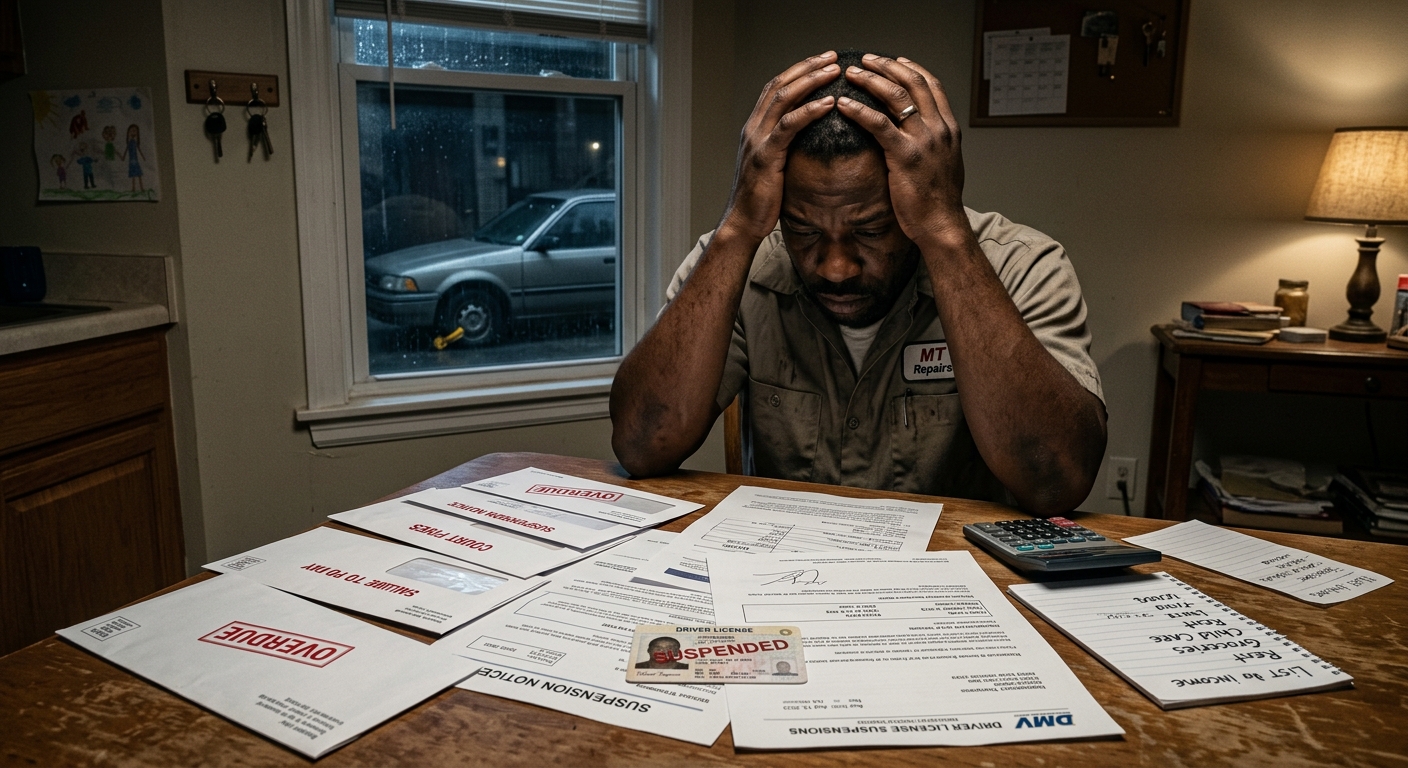
For the vast majority of Americans, possessing a valid driver’s license is not merely a legal credential; it is an essential passport to economic participation, community engagement, and family stability. In regions where sprawling geography and historically underfunded public transportation infrastructure make driving an absolute necessity rather than a luxury, losing the right to drive can be a catastrophic life event. Yet, across various parts of the United States, hundreds of thousands of individuals find themselves stripped of their driving privileges not because they are inherently dangerous behind the wheel, but simply because they lack the financial resources to pay a traffic fine.
This practice, widely known as debt-based driver’s license suspension, has come under intense legal and public scrutiny. Civil rights organizations argue that automatically revoking driving privileges for unpaid tickets creates a two-tiered system of justice: one where the wealthy can quickly resolve minor infractions with a simple payment, and another where low-income residents are pushed into a devastating downward spiral of debt, unemployment, and legal jeopardy.
How Unpaid Traffic Citations Ignite a Cycle of Poverty
The mechanics of the poverty trap created by license suspensions are insidious in their simplicity. The cycle typically begins when a driver is pulled over for a relatively minor traffic violation, such as a broken taillight, an expired registration tag, or driving slightly over the speed limit. The driver is subsequently issued a citation that carries a financial penalty, which often includes not just the base fine, but a myriad of additional court fees, administrative surcharges, and state assessments.
For a middle-class or wealthy individual, paying a $200 or $300 ticket is generally a minor inconvenience. However, for a low-wage worker, a single mother, or an elderly person living on a fixed income, an unexpected expense of this magnitude might represent a significant portion of their monthly budget, forcing an impossible choice between paying the court or paying for rent, utilities, and groceries. When the individual inevitably fails to pay the fine by the stipulated deadline, state agencies—such as the Department of Motor Vehicles (DMV)—frequently trigger an automatic suspension of their driver’s license.
Once the license is suspended, the cascading effects are immediate and severe. Without the legal ability to drive, individuals struggle to commute to work. If they lose their jobs due to an inability to travel, they lose the very income required to pay off the initial traffic debt. Furthermore, running basic errands, attending medical appointments, and transporting children to school become massive logistical hurdles. Out of sheer desperation, many individuals make the risky decision to continue driving with a suspended license. If they are caught, they face even steeper fines, potential vehicle impoundment, and even incarceration, thereby deepening their entanglement in the criminal justice system.
The Constitutional Question: Punishing Financial Inability
The core of the legal argument against automatic, wealth-based license suspensions rests on fundamental constitutional principles. Legal scholars and prominent civil rights advocates emphasize the protections afforded by the Fourteenth Amendment to the United States Constitution, which guarantees equal protection and due process under the law for all citizens. Suspending a person’s driver’s license simply because they cannot afford to pay a monetary penalty—without ever assessing their actual financial capacity—is viewed by many legal experts as a direct violation of these constitutional rights.
Historically, the United States Supreme Court has ruled that individuals cannot be punished solely for their poverty. In cases involving court fines and fees, judges are generally required to conduct a hearing to determine whether a person’s failure to pay is “willful” or if it is the result of genuine financial hardship. If a person is genuinely indigent, alternative methods of accountability, such as community service or adjusted payment plans, must be considered.
However, in states employing automatic suspension systems, these critical due process steps are frequently bypassed. Administrative agencies often enact suspensions automatically upon receiving notice of nonpayment from a local court, providing the individual with no meaningful opportunity to explain their financial constraints. Even worse, the mechanisms to appeal these suspensions are often barricaded behind exorbitant fees. For instance, individuals may be required to pay non-refundable filing fees to request an administrative hearing, alongside hefty reinstatement fees to eventually get their license back, making the appeals process entirely inaccessible to the very people who need it most.
Systemic Inequities and Disproportionate Impacts
It is impossible to analyze the impact of debt-based license suspensions without acknowledging the stark economic and racial disparities that define much of the American justice system. Because minority communities and historically marginalized groups disproportionately experience higher rates of poverty, they are systematically more vulnerable to the devastating consequences of these punitive traffic enforcement policies.
Furthermore, studies have consistently shown that police officers are statistically more likely to pull over Black and Hispanic drivers for minor infractions compared to their white counterparts. This higher frequency of traffic stops inevitably leads to a higher volume of citations issued to individuals in these communities. When combined with systemic wage gaps and lower rates of generational wealth, minority drivers find themselves at a vastly higher risk of facing unpaid fines and subsequent automatic license suspensions. The resulting loss of mobility restricts access to broader job markets, effectively geographically isolating low-income workers and reinforcing systemic inequality.
The Real-World Toll: Stories from the Ground
To truly comprehend the devastating societal impact of these policies, one must look beyond the abstract legal arguments and examine the lived experiences of those caught within the system. Consider the generalized plight of a working parent who relies on their vehicle to commute to a warehouse job located thirty miles from their home. A single unpaid speeding ticket, perhaps forgotten during a period of familial crisis, leads to an unnotified license suspension. Discovered only during a subsequent routine traffic stop, the parent is slapped with a “driving under suspension” charge.
Unable to legally drive to the warehouse, the parent loses their job. Without income, the initial fine of $250 balloons with late fees and reinstatement charges to well over $1,000. They cannot apply for better-paying jobs in neighboring counties because employers require a valid driver’s license as a condition of employment. They are forced to rely on unreliable, underfunded public transit to reach low-wage, part-time work near their home, effectively slashing their earning potential while their state-mandated debt continues to grow. For veterans, students, and essential workers, the loss of a license transforms from a punitive measure into a permanent economic barrier.
State Approaches to License Suspensions
The national landscape regarding traffic debt collection is highly fragmented. While some jurisdictions rigidly enforce automatic suspensions, a growing bipartisan coalition of states has recognized the counterproductive nature of this practice and enacted substantial reforms.
| Policy Approach | Description | Impact on Low-Income Drivers |
|---|---|---|
| Automatic Suspension | Licenses are suspended immediately upon failure to pay fines, with no hearing on the driver’s ability to pay. | Highly detrimental; directly causes job loss and traps drivers in cycles of debt. |
| Ability-to-Pay Hearings | Courts mandate a financial assessment before suspending a license. Fines may be reduced or waived for indigent drivers. | Moderate improvement; protects the poorest drivers but can involve bureaucratic hurdles. |
| Complete Decoupling | States eliminate license suspensions for unpaid debt entirely, reserving suspensions only for dangerous driving offenses (e.g., DUIs). | Highly beneficial; ensures economic participation is not restricted by traffic debt. |
A Nationwide Movement for Reform
Over the past decade, a powerful movement has emerged across the United States to decouple debt collection from driving privileges. Lawmakers from across the political spectrum are increasingly recognizing that suspending licenses for unpaid debt is a deeply inefficient method of coercing payment. After all, preventing a person from driving strips them of their primary means of generating the income necessary to pay the very debt the state is trying to collect.
States like California, Mississippi, Virginia, and Idaho have taken significant legislative steps to end wealth-based driver’s license suspensions. These reforms often involve clearing the backlog of existing debt-related suspensions, allowing hundreds of thousands of residents to regain their legal driving status and re-enter the workforce. Instead of relying on license revocation, progressive jurisdictions are implementing alternative compliance methods. These include sliding-scale fines based on an individual’s income, manageable monthly payment plans without interest, and community service options for those who are genuinely destitute.
The Road Ahead: Building an Equitable System
Creating a fair and equitable justice system requires a fundamental paradigm shift in how local and state governments approach traffic enforcement. The primary objective of the Department of Motor Vehicles and highway patrol agencies should be to ensure public safety on the roads, not to serve as highly aggressive debt collection agencies for municipal court systems. When a state restricts the mobility of its workforce, it harms its own economy by suppressing tax revenues, increasing reliance on social safety nets, and stifling economic growth.
Advocacy groups continue to file federal lawsuits challenging the constitutionality of automatic suspensions in states that refuse to reform their practices. The ultimate goal is to establish a nationwide legal precedent that firmly separates a citizen’s right to mobility from their socio-economic status. Until that happens, the fight for systemic equality requires continued public awareness, legislative pressure, and rigorous judicial oversight to ensure that no individual is driven into poverty simply because they could not afford to pay a ticket.
Frequently Asked Questions (FAQs)
What is a debt-based driver’s license suspension?
It is a policy where a state agency automatically suspends an individual’s driving privileges because they have failed to pay a court fine, traffic ticket, or associated administrative fees, rather than suspending the license for dangerous driving behavior.
Is it constitutional to suspend a license for unpaid fines?
Legal advocates argue that suspending a license without first assessing an individual’s ability to pay violates the Fourteenth Amendment’s Equal Protection and Due Process clauses. The argument is that the government cannot inflict harsh punishments strictly based on a person’s poverty or indigent status.
What are the alternatives to suspending a driver’s license?
States that have reformed their systems use alternatives such as establishing income-based payment plans, offering community service in lieu of monetary fines, or utilizing civil collection methods (like wage garnishment or tax intercepts) that do not inhibit a person’s ability to drive to work.
How does losing a driver’s license affect employment?
In many parts of the country without robust public transportation, a driver’s license is required to commute. Losing it often results in immediate job loss, prevents individuals from applying to better-paying jobs that require a commute, and severely limits their earning potential.
References
- Lawsuit Challenges South Carolina’s Wealth-Based Driver’s License Suspensions — American Civil Liberties Union (ACLU). 2019-10-31. https://www.aclu.org/press-releases/lawsuit-challenges-south-carolinas-wealth-based-drivers-license-suspensions
- SPLC and partners sue South Carolina DMV for suspending driver’s licenses of people who cannot afford traffic fines — Southern Poverty Law Center (SPLC). 2019-10-31. https://www.splcenter.org/news/2019/10/31/splc-and-partners-sue-south-carolina-dmv-suspending-drivers-licenses-people-who-cannot
- White et al. v. Shwedo et al. — Fines and Fees Justice Center. 2019-10-30. https://finesandfeesjusticecenter.org/articles/white-et-al-v-shwedo-et-al/
- Who Does America Want? Examining Systemic Poverty and the Law — Georgetown Immigration Law Journal (Georgetown University Law Center). 2020-05-27. https://www.law.georgetown.edu/immigration-law-journal/wp-content/uploads/sites/19/2021/04/Who-Does-America-Want.pdf
Similar Articles








Read full bio of Sneha Tete




