
Consolidated vs Combined Financial Statements: Key Differences
Understand the differences between consolidated and combined financial statements to choose the right reporting method for your business structure and stakeholders.
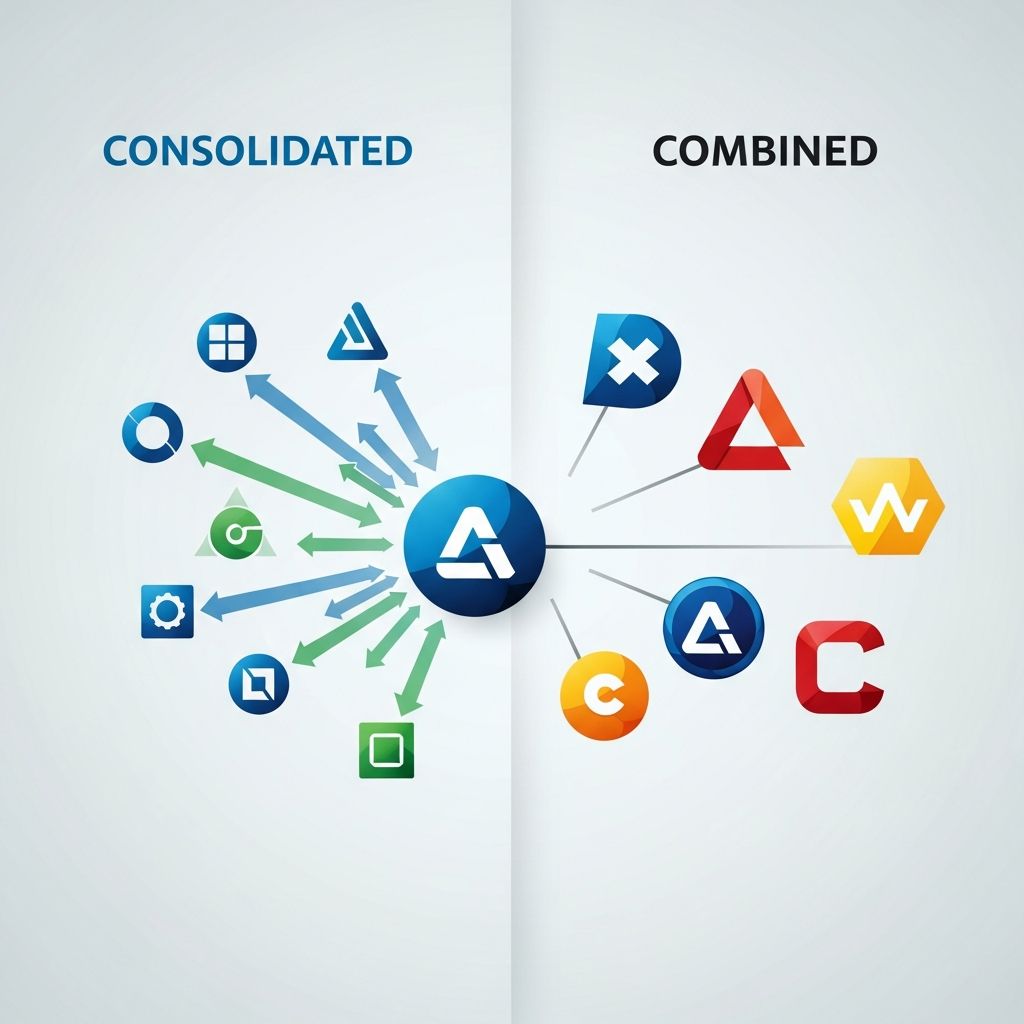
Financial statements are essential tools for portraying a company’s economic reality, but when multiple entities are involved, the choice between
consolidated
andcombined
presentations can significantly affect how stakeholders perceive performance and position. Consolidated statements treat a parent and its subsidiaries as a single economic unit, eliminating internal transactions, while combined statements aggregate separate entity results without such eliminations, preserving individual identities.Defining Consolidated Financial Statements
Consolidated financial statements integrate the financial data of a parent company and its controlled subsidiaries into one cohesive set of reports, including the balance sheet, income statement, and cash flow statement. This approach presents the group as a unified entity, providing a clear picture of its overall financial health to external users like investors and creditors.
The process requires eliminating all intercompany transactions—such as sales, loans, or transfers between group entities—to prevent double-counting and ensure the statements reflect only external activities. Under U.S. GAAP (ASC 810), consolidation is mandatory when a parent holds a controlling interest, typically more than 50% voting power or through other control mechanisms like contracts.
For instance, a multinational corporation like PepsiCo uses consolidated statements to report its global operations as one entity, disclosing any non-controlling interests in subsidiaries. This method highlights the group’s total assets, liabilities, revenues, and cash flows, making it ideal for assessing enterprise-wide viability.
Defining Combined Financial Statements
Combined financial statements gather the individual financial statements of multiple entities under common control into a single document, but each entity’s results remain distinct and unadjusted for intercompany activities. This format is particularly useful when no single parent-subsidiary relationship exists, such as in groups of businesses owned by the same individual or family.
Unlike consolidation, combined statements do not eliminate internal transactions, allowing users to evaluate each entity’s standalone performance alongside the group total. They are simpler to prepare since they involve merely compiling separate GAAP-compliant statements without complex elimination entries.
Common scenarios include real estate holdings or equipment leasing companies under common ownership, where stakeholders need visibility into each operation’s contributions without blending them into a fictional single entity.
Core Differences in Preparation and Presentation
The preparation of these statements diverges fundamentally in complexity and focus. Here’s a breakdown:
| Aspect | Consolidated Statements | Combined Statements |
|---|---|---|
| Control Structure | Parent with controlling interest (>50% voting or equivalent) | Entities under common control, no parent |
| Intercompany Eliminations | Full elimination of internal transactions | No eliminations; transactions preserved |
| Entity Presentation | Single economic entity | Separate entities side-by-side |
| Complexity | High (eliminations, non-controlling interests) | Low (simple aggregation) |
| GAAP Requirement | Mandatory for control (ASC 810) | Permitted for common control groups |
This table illustrates how consolidated statements demand rigorous adjustments for accuracy as a unified view, whereas combined ones prioritize transparency of individual results.
Impact on Key Financial Statements
Balance Sheet Implications
In consolidated balance sheets, intercompany receivables, payables, and investments are offset, resulting in a net external position. For example, if Subsidiary A owes Parent $1 million, both entries are removed. Combined balance sheets, however, display each entity’s assets and liabilities separately, enabling direct comparisons.
Income Statement Effects
Consolidation merges revenues and expenses, excluding internal sales to show true group profitability. Combined income statements list each entity’s net income distinctly, useful for performance benchmarking.
Cash Flow Statement Variations
Consolidated cash flows eliminate internal transfers, focusing on group liquidity from external sources. Combined versions retain entity-specific cash movements, aiding tax or lending analyses.
When to Choose Consolidated Statements
Opt for consolidation when a parent exerts control over subsidiaries, as required by GAAP for public filings, debt covenants, or investor reports. It’s suited for scenarios emphasizing total enterprise value, such as securing large loans or attracting equity investors who view the group holistically.
- Public companies filing with the SEC.
- Groups with variable interest entities (VIEs) where the parent is the primary beneficiary.
- Stakeholders needing a single metric for overall solvency.
Regulators presume consolidated statements are more meaningful than separate ones for controlled groups.
When to Choose Combined Statements
Combined statements shine when individual entity performance matters, like in common-control groups without a dominant parent. They’re preferred for internal management, targeted lending, or when misleading consolidations (e.g., treating siblings as parent-sub) could distort views.
- Family-owned businesses with multiple LLCs.
- Investors analyzing specific operations.
- Simpler compliance for private entities.
Accounting standards favor combined presentations for common control to avoid artificial hierarchies.
Practical Examples and Case Studies
Consider a tech holding company owning two startups. If it holds 60% of one, consolidation applies, blending results and noting the 40% minority interest. For two equally owned ventures under the same owner, combined statements allow separate evaluation of each startup’s viability.
In real estate, an investor with separate property LLCs uses combined statements to show rental income per property, avoiding consolidation that might misrepresent as a single entity.
Regulatory and Compliance Considerations
U.S. GAAP (ASC 810) mandates consolidation for control, with SEC rules reinforcing this for public entities. Combined statements, while not required, must still adhere to fair presentation standards. Auditors often recommend combined for non-controlled groups to enhance meaningfulness.
Tax authorities may request combined views for pass-through entities, differing from financial reporting needs.
Advantages and Limitations
Consolidated Advantages: Holistic view, regulatory compliance, investor appeal.
Limitations: Hides individual weaknesses, complex preparation.
Combined Advantages: Granular insights, ease of use, flexibility.
Limitations: No elimination of internal dealings, potentially less appealing for group-level assessments.
Frequently Asked Questions
What triggers the need for consolidated financial statements?
Control by a parent, such as over 50% ownership or primary beneficiary status in VIEs, per GAAP ASC 810.
Are intercompany transactions eliminated in combined statements?
No, they are retained to reflect each entity’s true activity, unlike in consolidation.
Can private companies use combined statements?
Yes, especially for common control groups without a parent, as it’s simpler and more informative.
Which is better for securing bank loans?
Depends on the lender: consolidated for group strength, combined for entity-specific collateral.
Do combined statements comply with SEC requirements?
Typically for non-public entities; public ones need consolidation where control exists.
Steps to Prepare These Statements
- Assess control and ownership structure.
- Gather individual GAAP-compliant statements.
- For consolidation: Perform eliminations and allocate non-controlling interests.
- Compile into a unified report with disclosures.
- Obtain audit review if required.
Tools like ERP software streamline this, but expert accountants ensure accuracy.
References
- A Guide to Combined vs Consolidated Financial Statements — Carson Thorn CPA. 2023. https://www.carsonthorncpa.com/news/how-are-consolidated-and-combined-financial-statements-different
- Consolidated vs Combined Financial Statements — Goldin Group CPAs. 2023. https://goldingroupcpas.com/consolidated-vs-combined-financial-statements/
- Consolidated vs. Combined Financial Statements: Unraveling the Mystery — Meaden & Moore. 2023. https://www.meadenmoore.com/blog/atc/consolidated-vs.-combined-financial-statements-unraveling-the-mystery
- Consolidated Financial Statements vs. Combined Financial Statements — LegalZoom. 2023. https://www.legalzoom.com/articles/consolidated-financial-statements-vs-combined-financial-statements-which-should-i-use-for
- Combined vs Consolidated Financial Statements — Embark. 2023. https://blog.embarkwithus.com/combined-vs-consolidated-financial-statements
- 210.3A — Consolidated and Combined Financial Statements — Deloitte DART (SEC Regulation S-X). 2024. https://dart.deloitte.com/USDART/home/accounting/sec/rules-regulations/210_reg_s-x_edit/210-3a-consolidated-combined-financial-statements
Similar Articles








Read full bio of medha deb




