
CFPB vs. Wells Fargo: What Student Loan Borrowers Must Know
How federal regulators penalized Wells Fargo for illegal student loan servicing practices and what it means for borrowers.
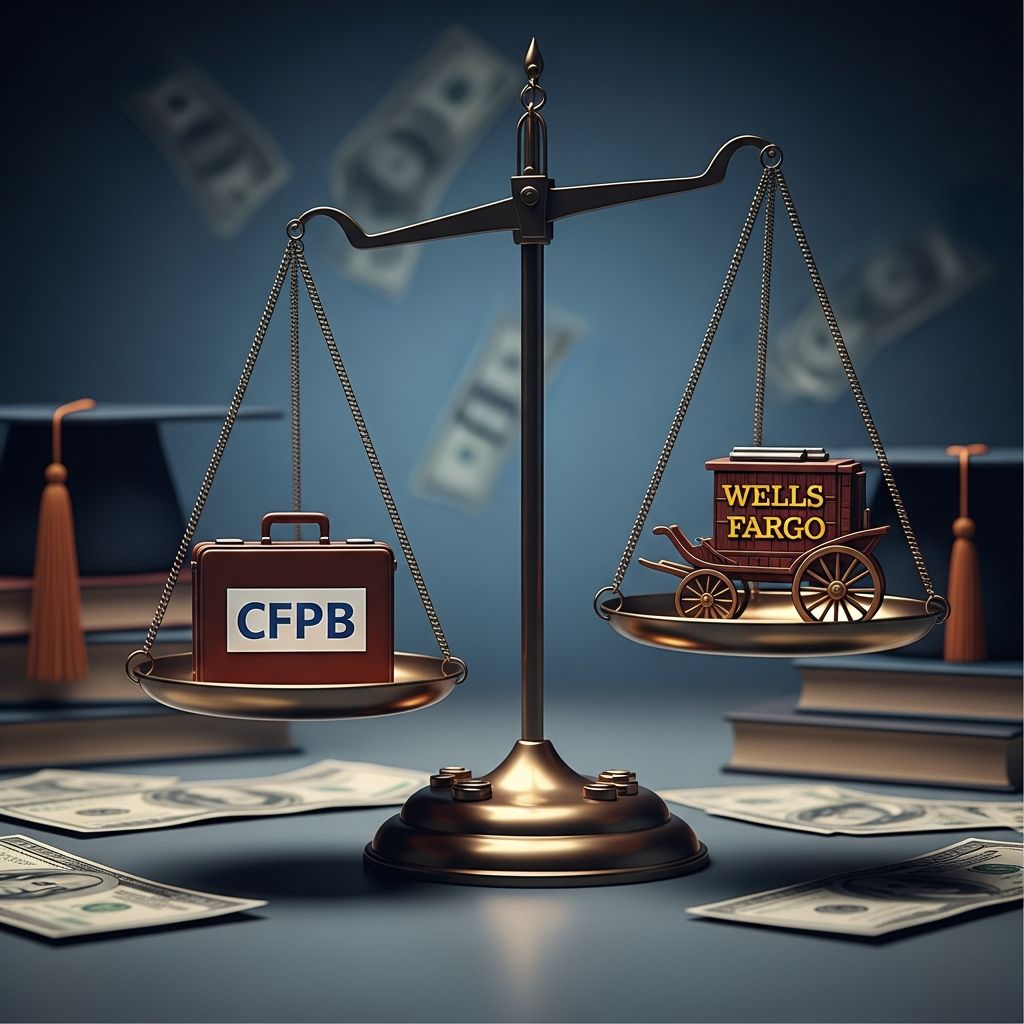
The Consumer Financial Protection Bureau (CFPB) brought a major enforcement action against Wells Fargo Bank, N.A. for illegal private student loan servicing practices that increased costs and unfairly penalized thousands of borrowers. This case offers a clear picture of what can go wrong in student loan servicing—and what rights borrowers have when it does.
This article explains the core problems the CFPB identified, the penalties imposed, and the key takeaways every student loan borrower should understand, whether or not they ever dealt with Wells Fargo.
Background: Why Regulators Targeted Wells Fargo
In 2016, the CFPB issued a public order against Wells Fargo related to its handling of private student loans, a segment of the market that typically lacks the flexible protections of federal student loans. According to the Bureau, Wells Fargo’s servicing practices violated:
- The Consumer Financial Protection Act (CFPA) ban on unfair and deceptive acts and practices.
- The Fair Credit Reporting Act (FCRA), which requires accurate and updated information to be provided to credit reporting companies.
The enforcement action focused on how the bank processed payments, charged fees, and reported information to credit bureaus—core functions that should help borrowers stay on track, but instead made their loans more expensive and damaged their credit.
Key Types of Misconduct Identified by the CFPB
The CFPB described multiple breakdowns across Wells Fargo’s private student loan servicing operations. Although each issue looks technical, together they significantly affected borrowers’ wallets and credit reports.
1. Payment Allocation That Increased Fees
Many borrowers had multiple loans under a single account, such as separate loans for each academic year. When a borrower made a payment that was less than the combined total due for all loans, Wells Fargo allocated that money in a way that maximized late fees instead of minimizing them.
The CFPB found that Wells Fargo:
- Split partial payments across all loans so that none of the loans were fully satisfied, rather than fully covering as many loans as possible.
- Failed to adequately disclose how payments were allocated and that borrowers could give specific instructions about how to apply payments.
This meant borrowers often paid more late fees than necessary, even when they were trying to pay as much as they could each month.
2. Misleading Information About Partial Payments
Another problem involved the way Wells Fargo described the impact of paying less than the “amount due” shown on billing statements. The CFPB found that Wells Fargo told borrowers that paying less than the full amount due in a billing cycle would not satisfy any obligation on their account.
In reality, when a borrower had multiple loans on one account, a partial payment could fully satisfy the monthly payment on at least one of those loans, helping avoid late fees or delinquency on that loan. By suggesting otherwise, the bank:
- Discouraged borrowers from making beneficial partial payments that could have helped them stay current on at least one loan.
- Increased the likelihood of delinquencies and fees on multiple loans instead of just one.
3. Illegal Late Fees on Timely Payments
The CFPB also concluded that Wells Fargo charged certain borrowers illegal late fees even when they met the bank’s own timing requirements. These practices included:
- Assessing late fees when borrowers made payments on the last day of a contractual grace period, even though such payments should have been treated as on time.
- Charging late fees where borrowers made multiple partial payments during a billing cycle that together equaled at least the amount due under the bank’s internal aggregation policies.
Because the late fees were tied to flawed processing rules and disclosures, not to truly late behavior, the CFPB characterized them as unfair under federal law.
4. Inaccurate and Uncorrected Credit Reporting
Loan servicers that furnish information to credit reporting companies must keep that information accurate and update it when errors are discovered. The CFPB found that Wells Fargo:
- Reported some borrowers as delinquent when, under the bank’s own payment aggregation policies, the borrowers had made sufficient payments to be considered current.
- Failed to update or correct prior negative information after payments were properly credited or combined.
These failures violated FCRA obligations and exposed borrowers to avoidable harm in the form of damaged credit histories and higher borrowing costs.
Legal Framework: The Laws Wells Fargo Violated
The enforcement order against Wells Fargo illustrates how general consumer protection laws apply to student loan servicing.
| Law or Rule | What It Requires | How Wells Fargo Violated It (CFPB Findings) |
|---|---|---|
| Consumer Financial Protection Act (CFPA) | Prohibits unfair, deceptive, or abusive acts or practices in consumer financial products. | Unfair and deceptive payment allocation, misleading partial payment disclosures, and improper late fees. |
| Fair Credit Reporting Act (FCRA) | Requires accurate furnishing of information and timely correction of errors to credit reporting companies. | Failure to update or correct negative credit information after aggregating payments; inaccurate delinquency reporting. |
Penalties and Relief Ordered by the CFPB
The CFPB’s order required Wells Fargo to provide financial relief to affected borrowers and to overhaul certain servicing practices.
Monetary Consequences
- Consumer refunds: Wells Fargo had to provide at least $410,000 in relief to borrowers, primarily to reimburse illegal late fees related to payment allocation and aggregation errors.
- Civil penalty: The bank also paid a $3.6 million civil money penalty to the CFPB’s Civil Penalty Fund.
Although modest compared with some later enforcement actions against the bank for other products, these penalties signaled that student loan servicing abuses would not be treated as minor technical violations.
Required Changes to Servicing Practices
Beyond financial penalties, the order required Wells Fargo to change how it handles private student loans:
- Payment allocation reforms: Partial payments must be applied in a way that satisfies the amounts due on as many loans as possible, unless a borrower provides different instructions.
- Clearer disclosures: Billing statements and related materials must explain how payments are applied and that consumers can direct how their payments should be allocated.
- Credit report corrections: Wells Fargo must remove or correct negative information about student loans that was inaccurately or incompletely furnished to consumer reporting companies.
The CFPB later terminated the 2016 consent order in 2022 after determining the bank had satisfied its obligations under that specific order, though Wells Fargo remained subject to other supervisory and enforcement actions.
Why This Case Matters Beyond Wells Fargo
Though focused on one company, the Wells Fargo action reflects broader patterns in student loan servicing that regulators and researchers have documented in recent years.
For borrowers, this case highlights several crucial themes:
- Servicers can significantly affect total loan cost. How payments are applied and how information is communicated can increase or decrease fees and interest.
- Errors often show up first as fees or credit problems. Unexpected late fees or sudden negative credit marks can signal underlying servicing issues that may violate consumer protection laws.
- Regulators can force corrections and refunds. When systemic issues are uncovered, agencies like the CFPB can require institutions to compensate consumers and change harmful practices.
Practical Guidance for Student Loan Borrowers
Whether you hold private or federal student loans, there are concrete steps you can take to protect yourself from similar servicing problems.
1. Understand Your Loan Portfolio
- List each loan separately, including interest rate, balance, type (federal vs. private), and servicer.
- Check whether you have multiple loans under one account number. This affects how partial payments may be allocated, as in the Wells Fargo case.
2. Control How Your Payments Are Applied
Many servicers allow borrowers to specify how payments should be allocated when they have multiple loans. To make the most of your money:
- Submit written or online instructions about which loan to pay first (for example, the loan with the highest interest rate).
- Confirm on subsequent statements that the servicer followed your instructions.
- Keep copies or screenshots of any directions you provide in case of disputes.
This practice helps you avoid the kind of automatic allocation that, in Wells Fargo’s case, increased late fees and costs for borrowers.
3. Monitor Statements for Inconsistent Fees
- Review each bill for late fees or unexpected charges, especially if you believe you paid on time.
- Compare the posting date of your payment with the due date and any grace period language.
- Call your servicer immediately if a fee appears incorrect and follow up in writing if the issue is not resolved.
If you repeatedly see unexplained or incorrectly assessed fees, that may indicate a systemic servicing problem similar to those uncovered in the Wells Fargo enforcement action.
4. Check Your Credit Reports Regularly
Because student loan information can affect your ability to borrow for cars, homes, or other needs, monitoring your credit history is essential.
- Obtain free credit reports from the major consumer reporting companies at least once a year.
- Look for student loans reported as late or in default when you believe you are current.
- Dispute any inaccurate information with both the credit reporting company and your loan servicer, providing documentation of payments.
In the Wells Fargo case, failures to update and correct information caused some borrowers to appear delinquent even after their payments were sufficient to meet the servicer’s internal rules.
5. Know How to Escalate Complaints
If you cannot resolve an issue directly with your servicer, you can escalate:
- File a written complaint and keep records of all correspondence.
- Submit a complaint to the CFPB, which tracks patterns and can take supervisory or enforcement actions when legal violations are found.
- Consider contacting state regulators or attorney general offices, which may also oversee student loan servicing and consumer protection.
Frequently Asked Questions (FAQs)
Q1: Does this case affect only Wells Fargo borrowers?
The CFPB’s specific order applied directly to Wells Fargo and the borrowers whose loans were serviced by the bank. However, the case highlights problems that can occur at any servicer, and it contributed to a broader regulatory conversation about student loan servicing standards across the industry.
Q2: What is the difference between federal and private student loan servicing problems?
Federal student loans are governed by extensive statutes and regulations that define repayment options, deferments, and forgiveness programs. Private student loans lack many of these built-in protections and depend more heavily on contract terms and general consumer protection laws like the CFPA and FCRA. As a result, enforcement actions—such as the one against Wells Fargo—play an important role in policing private student loan servicing abuses.
Q3: How do I know if my partial payments are being applied correctly?
Check your billing statements and account history after making partial payments. Ensure that at least some loans are listed as current when your total payments meet or exceed the amount due for those specific loans. If all loans still show as past due, even when you believe you have paid enough for at least one, contact your servicer and request a detailed explanation of its allocation method.
Q4: Can a servicer legally charge a late fee when I pay on the last day of a grace period?
If your loan agreement and disclosures state that you have a grace period and you pay within that period, a late fee tied to that payment may be inconsistent with the contract. In the Wells Fargo case, the CFPB viewed such late fees as illegal because borrowers paid by the final day of their grace period but were still treated as late. Always review your promissory note and billing statements to understand the exact rules.
Q5: What can I do if my servicer refuses to correct a clear error?
If internal customer service channels fail, consider sending a formal written dispute, including copies of statements and payment confirmations. You can then submit a complaint with supporting documentation to the CFPB, which forwards complaints to companies and tracks how they respond. Patterns of similar complaints can inform supervisory examinations and potential enforcement actions.
References
- CFPB Takes Action Against Wells Fargo for Illegal Student Loan Servicing Practices — Consumer Financial Protection Bureau. 2016-08-22. https://www.consumerfinance.gov/about-us/newsroom/cfpb-takes-action-against-wells-fargo-illegal-student-loan-servicing-practices/
- Wells Fargo Bank, N.A. (2016 Consent Order) — Consumer Financial Protection Bureau. 2016-08-22 (terminated 2022-12-20). https://www.consumerfinance.gov/enforcement/actions/wells-fargo-bank-na-2016/
- Consent Order, In the Matter of Wells Fargo Bank, N.A., File No. 2016-CFPB-0013 — Consumer Financial Protection Bureau (via Seattle City Clerk archive). 2016-08-22. https://clerk.seattle.gov/~cfpics/CF_314368i.pdf
- CFPB Fines Wells Fargo $3.6 Million for Illegal Student Loan Servicing Practices — National Association of Student Financial Aid Administrators (NASFAA). 2016-08-23. https://www.nasfaa.org/news-item/9627/CFPB_Fines_Wells_Fargo_3_6_Million_for_Illegal_Student_Loan_Servicing_Practices
- Wells Fargo Enters into Agreement with CFPB to Resolve Multiple Issues — Wells Fargo Newsroom. 2022-12-20. https://newsroom.wf.com/English/news-releases/news-release-details/2022/Wells-Fargo-Enters-into-Agreement-with-CFPB-to-Resolve-Multiple-Issues/default.aspx
- Wells Fargo Fined $3.7 Billion by Consumer Financial Protection Bureau — New York State Society of CPAs, The Trusted Professional. 2022-12-21. https://www.nysscpa.org/news/publications/the-trusted-professional/article/wells-fargo-fined-3.7-billion-by-consumer-financial-protection-bureau-122022
- Statement of Consumer Federation of America on the CFPB’s Landmark Enforcement Action Against Wells Fargo — Consumer Federation of America. 2016-09-13. https://consumerfed.org/testimonial/statement-of-consumer-federation-of-america-on-the-consumer-financial-protection-bureaus-landmark-enforcement-action-against-wells-fargo/
Similar Articles








Read full bio of medha deb




