
CFPB vs. Carrington Mortgage: What CARES Act Protections Really Mean for Homeowners
How a federal enforcement case against Carrington Mortgage highlights CARES Act rights and the risks of abusive mortgage servicing.
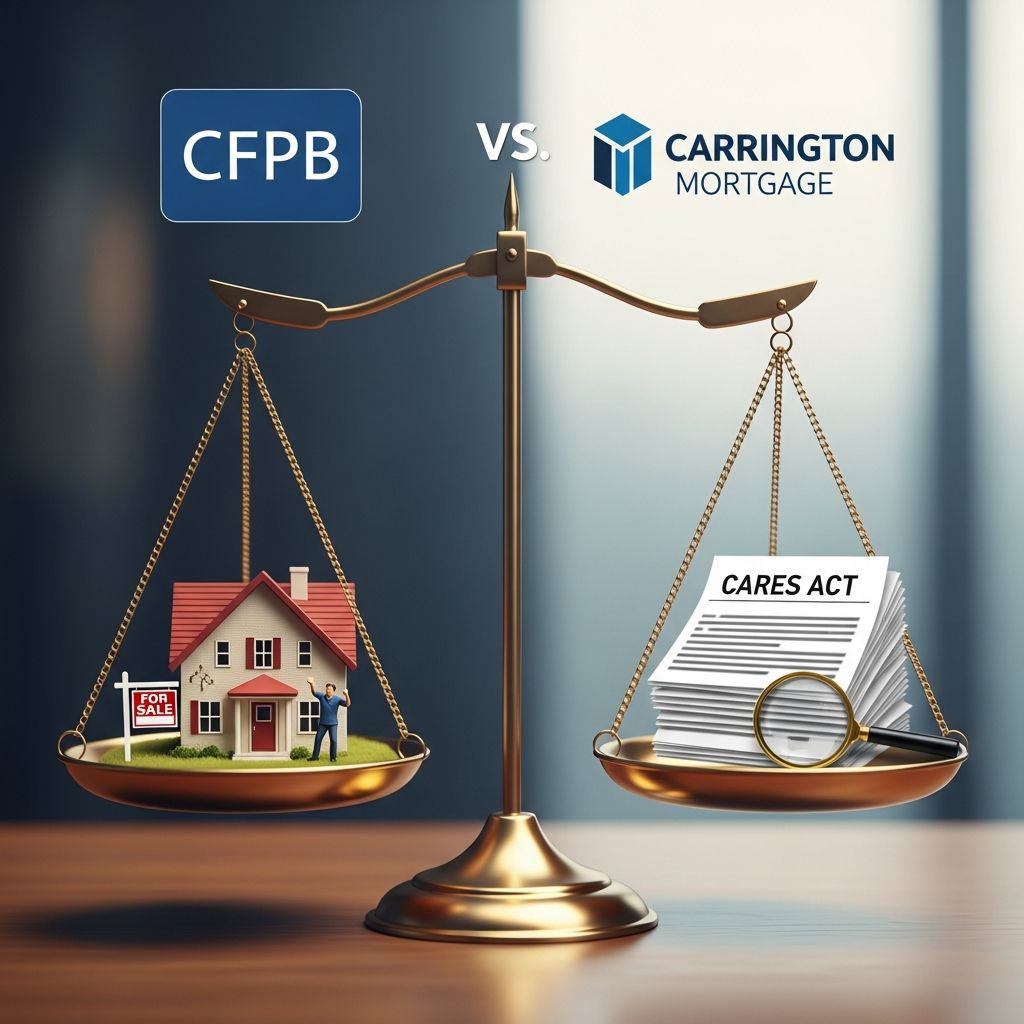
The federal government created extensive protections for homeowners with federally backed mortgages during the COVID-19 emergency. Those protections, embedded in the CARES Act and related guidance, were designed to give borrowers a clear path to temporary relief when they faced sudden income loss or medical expenses. Yet a major mortgage servicer, Carrington Mortgage Services, faced enforcement action by the Consumer Financial Protection Bureau (CFPB) for allegedly denying or undermining those protections and harming thousands of homeowners.
This article explains what happened in the Carrington case, what the CFPB found, how the consent order worked, and—most importantly—what practical lessons homeowners can draw about their rights, credit reporting, and dealing with mortgage servicers during and after a crisis.
Background: CARES Act Mortgage Relief in Plain Language
The Coronavirus Aid, Relief, and Economic Security (CARES) Act, enacted in March 2020, established special protections for borrowers with federally backed mortgage loans, including many loans owned or guaranteed by Fannie Mae, Freddie Mac, FHA, VA, or USDA.
Key protections for eligible borrowers included:
- Right to request forbearance: Borrowers experiencing a COVID-related hardship could obtain an initial forbearance of up to 180 days and request an extension of up to another 180 days, simply by affirming that they were affected by the pandemic.
- No extra documentation requirement: Servicers were not permitted to demand extensive proof such as pay stubs or medical bills. A borrower’s attestation of hardship was sufficient.
- No late fees during approved forbearance: When a borrower was in an approved COVID forbearance, the servicer was not allowed to charge late fees or treat payments as due during the forbearance period under relevant agency and investor guidelines.
- Credit reporting safeguards: Amendments to the Fair Credit Reporting Act (FCRA) under the CARES Act required that if a borrower was current before an accommodation and complied with it, the servicer had to continue reporting the account as current, rather than newly delinquent.
Federal agencies and government-sponsored enterprises (GSEs) then issued detailed guidance to servicers explaining how to implement forbearances, handle repayment options, and report to credit bureaus consistently with these new protections.
The Carrington Mortgage Case: What the CFPB Alleged
Carrington Mortgage Services is a nonbank servicer that operates nationwide and services a significant number of federally backed loans. The CFPB investigated Carrington’s handling of CARES Act forbearance requests and related credit reporting, and in November 2022 issued a consent order describing multiple violations of federal consumer protection laws.
According to the Bureau, Carrington’s conduct fell into three broad categories of harm:
- Misleading homeowners about their eligibility and rights under the CARES Act
- Charging or failing to promptly refund late fees that should not have been assessed
- Providing inaccurate and harmful credit information to major credit reporting companies
Key Findings at a Glance
| Issue | What the CFPB Found | Relevant Law |
|---|---|---|
| Forbearance representations | Borrowers were told they could not get the full 180 days of forbearance upon request, or that they were ineligible for forbearance at all, contrary to the CARES Act framework. | Consumer Financial Protection Act (CFPA) prohibition on deceptive practices |
| Late fees | Servicer assessed or failed to reverse late fees for borrowers who were entitled to forbearance protections. | Unfair or deceptive acts under the CFPA; violations of servicing guidance tied to CARES Act relief |
| Credit reporting | Furnished information to credit reporting agencies that was inconsistent with CARES Act amendments to FCRA, and failed to maintain adequate policies for accuracy and integrity. | FCRA (Section 623) and Regulation V requirements on accuracy and CARES Act reporting standards |
How Carrington’s Conduct Harmed Homeowners
The CFPB’s order and related reporting describe several ways borrowers were put at risk by Carrington’s actions during a period when families were relying heavily on federal protections.
1. Undermining Forbearance Rights
Under the CARES Act, an eligible borrower did not have to prove hardship through documents or extended explanations. A simple statement that they were experiencing a pandemic-related difficulty was enough. The Bureau found that Carrington misrepresented the law in ways such as:
- Implying that borrowers could not receive the full 180-day forbearance upon request
- Suggesting some borrowers could not receive forbearance at all even if their loans were covered
- Indicating that more detailed attestations were required than the law or agency guidelines demanded
These practices can cause borrowers to forgo protections they are legally entitled to, keep making unaffordable payments, or fall behind while believing they have no viable relief option.
2. Improper Late Fees and Servicing Charges
The CFPB found that Carrington charged late fees in situations where borrowers either:
- Should have been in a forbearance that suspended such fees, or
- Had obtained an accommodation that should have protected them from being treated as late for credit reporting and fee assessment purposes.
Improper late fees can snowball into larger arrears, trigger default-related processes earlier, and make it harder for borrowers to cure a delinquency. The consent order required Carrington to identify and refund late fees that had not already been returned to affected consumers.
3. Damaging Credit Reports in Violation of CARES Act Rules
The CARES Act amended FCRA to ensure that borrowers who entered into an accommodation—such as a forbearance or modified payment plan—would not see their credit reports worsen if they fulfilled the terms of that arrangement. The CFPB concluded that Carrington:
- Reported some accounts as more delinquent than they should have been under CARES Act rules
- Failed to update or correct information furnished to the major credit bureaus consistently with the law
- Lacked adequate written policies tailored to the new CARES Act reporting framework
Because credit reports influence access to future mortgages, credit cards, auto loans, and sometimes even employment or housing, inaccurate negative reporting during a national emergency can have long-term financial consequences for affected homeowners.
The Consent Order: Penalties and Required Reforms
To resolve the matter, Carrington entered into a consent order with the CFPB. In such an order, a company typically agrees to detailed remedial steps and civil penalties without formally admitting or denying every factual allegation.
Financial Penalty
- Civil money penalty: Carrington agreed to pay a $5.25 million civil penalty to the CFPB’s Civil Penalty Fund. This fund can be used to provide relief to consumers harmed by violations of federal consumer financial laws.
Consumer Redress and Remediation
Beyond the penalty, the company was required to make consumers whole as far as possible. Key obligations included:
- Late fee refunds: Conduct an audit to ensure that borrowers who were improperly charged late fees received full refunds where those had not already been provided.
- Review of credit reporting: Identify and correct credit reporting errors tied to CARES Act forbearances and accommodations by updating information furnished to credit reporting agencies in line with FCRA and Regulation V obligations.
Business Practice Changes
The CFPB also required structural changes designed to prevent recurrence. Among other steps, Carrington had to:
- Strengthen policies and procedures: Create and implement written policies specifying how staff must handle forbearance requests, disclosures to borrowers, and credit reporting for accounts in accommodation.
- Improve training: Train customer service and servicing staff on CARES Act requirements, agency guidelines, and FCRA reporting rules.
- Assess staffing and oversight: Review servicing operations to ensure they were adequately staffed and supervised to manage high volumes of borrower requests during crises.
Termination of the Order
In July 2025, the CFPB formally terminated the order after Carrington met certain obligations, including payment of the civil penalty and taking steps to identify and provide refunds to consumers who had not yet been reimbursed by the effective date of the order. Termination of an order does not mean the initial findings were incorrect; rather, it typically indicates that the company has completed the mandated corrective actions.
What This Case Teaches Homeowners About Their Rights
The Carrington matter is not only about one servicer’s conduct; it also illustrates how complex and high-stakes mortgage servicing becomes during emergencies. For borrowers, several lessons stand out.
Lesson 1: Know Whether Your Loan Is Federally Backed
Many CARES Act protections apply only to federally backed mortgages, which are owned or insured by entities such as:
- Fannie Mae or Freddie Mac
- Federal Housing Administration (FHA)
- U.S. Department of Veterans Affairs (VA)
- U.S. Department of Agriculture (USDA Rural Housing)
Borrowers can typically determine whether their loan is federally backed by contacting their servicer or using lookup tools provided by Fannie Mae and Freddie Mac. Understanding this status is critical because it shapes what relief is available during national emergencies.
Lesson 2: Verify What Your Servicer Tells You
Even reputable servicers can misinterpret fast-changing legal requirements. Borrowers should:
- Request written confirmations: Ask the servicer to confirm the terms of any forbearance or modification in writing, including the length of the relief and how missed payments will be handled afterward.
- Compare with official guidance: Consult official CFPB, HUD, VA, USDA, or GSE resources for current rules on forbearance, repayment options, and foreclosure protections.
- Keep a paper trail: Save call notes, letters, emails, and monthly statements as evidence in case of disputes about fees or status.
Lesson 3: Monitor for Improper Fees
Borrowers in an approved forbearance or accommodation should carefully review their statements to make sure they are not being assessed late fees that conflict with program rules. If a questionable fee appears:
- Contact the servicer promptly to dispute the charge
- Ask for a written explanation citing the applicable guidelines
- Escalate complaints to the CFPB or a state regulator if the issue is not resolved
Lesson 4: Check Your Credit Reports After Any Accommodation
Because CARES Act amendments to FCRA imposed specific reporting rules for loans in accommodation, borrowers who entered forbearance should review their credit files with the three nationwide credit reporting companies—Equifax, Experian, and TransUnion—to confirm that the account is reflected accurately.
- If you were current before an accommodation and complied with the arrangement, your report generally should not suddenly show you as delinquent.
- Federal law allows consumers to dispute inaccurate information directly with the credit reporting agency and the furnisher (servicer).
- The CFPB provides sample letters and guidance on how to submit effective credit reporting disputes.
Practical Checklist for Borrowers Seeking Forbearance
Although the formal COVID-19 national emergency has ended, similar relief programs may be used in future crises. The following checklist summarizes protective steps borrowers can take when requesting forbearance or other accommodations:
- Confirm loan type: Identify whether your mortgage is federally backed and which agency or GSE is involved.
- Ask specific questions: Inquire about the length of the forbearance, how interest will accrue, and what repayment options (lump sum, repayment plan, deferral, modification) are available afterward.
- Document hardship: Even if not required, make a note of how your income or expenses changed and the date you requested assistance.
- Get everything in writing: Keep copies of forbearance and modification agreements and verify they match what was discussed verbally.
- Review statements monthly: Watch for late fees, property inspection charges, or other fees that may not be permitted during relief.
- Check credit at least annually: After accommodations, obtain credit reports and look for unexpected delinquencies or status changes.
Frequently Asked Questions (FAQs)
Q1: What is a mortgage servicer, and how is it different from my lender?
A mortgage servicer is the company that sends your statements, collects your monthly payments, manages your escrow account, and handles customer service. It may or may not be the same company that originally made your loan. Servicers also report your payment history to credit bureaus and manage options like forbearance, repayment plans, and modifications.
Q2: Did the CARES Act automatically put mortgages into forbearance?
No. The CARES Act generally required borrowers with federally backed mortgages to request forbearance and to attest to a COVID-related hardship. Once they did so, servicers had to grant up to 180 days of forbearance upon request and extend it if the borrower asked for more time, subject to maximum caps, but there was no automatic pause for all loans.
Q3: Could a servicer demand proof of hardship before granting CARES Act forbearance?
Under the CARES Act structure and related agency guidance, servicers could not require extensive documentation of hardship. A borrower’s statement that they were experiencing a financial difficulty due to the pandemic was sufficient, and servicers were expected to rely on that attestation when granting forbearance.
Q4: How does the CFPB enforce rules against mortgage servicers?
The CFPB can investigate mortgage servicers and, when it finds violations of laws like the Consumer Financial Protection Act or FCRA, it can bring enforcement actions that result in consent orders, civil money penalties, restitution to consumers, and mandated reforms of business practices. These actions are part of the CFPB’s broader mandate to protect consumers in the financial marketplace.
Q5: What should I do if I think my servicer mishandled my forbearance or damaged my credit?
Consumers can take several steps:
- File a written complaint with the servicer detailing the issue and asking for correction
- Dispute any inaccurate credit information with the credit reporting agencies and the servicer furnishing the data
- Submit a complaint to the CFPB, which forwards complaints to companies for response and uses them to identify systemic problems
- Consult a housing counselor approved by the U.S. Department of Housing and Urban Development (HUD) for individualized assistance
References
- Carrington Mortgage Services, LLC – Consent Order — Consumer Financial Protection Bureau. 2022-11-17. https://www.consumerfinance.gov/enforcement/actions/carrington-mortgage-services-llc/
- CFPB Fines Carrington Mortgage $5.25M For Cheating Homeowners — National Mortgage Professional. 2022-11-18. https://nationalmortgageprofessional.com/news/cfpb-fines-carrington-mortgage-525m-cheating-homeowners
- Carrington Mortgage Services, LLC – Consent Order (PDF) — Consumer Financial Protection Bureau. 2022-11-17. https://files.consumerfinance.gov/f/documents/cfpb_carrington-mortgage-services-llc_consent-order_2022-11.pdf
- Federal Agency and Other Consumer Protection News (November 2022) — National Association of Attorneys General. 2022-11-30. https://www.naag.org/attorney-general-journal/federal-consumer-protection-news-nov-2022/
- The CARES Act: Implications for Consumers — Consumer Financial Protection Bureau (overview materials on COVID-19 mortgage protections). 2020-2022. https://www.consumerfinance.gov/coronavirus/mortgage-and-housing-assistance/
Similar Articles








Read full bio of Sneha Tete




