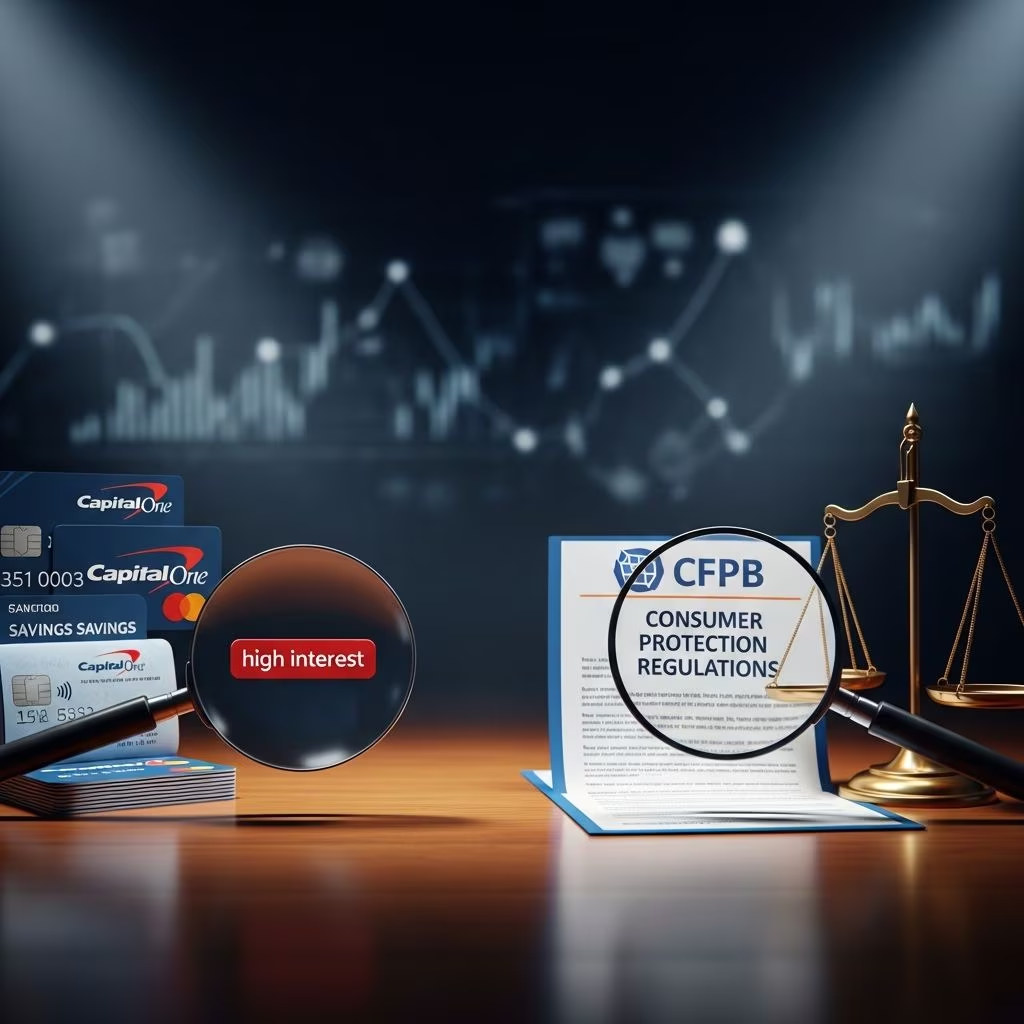
The Consumer Financial Protection Bureau (CFPB) has taken multiple actions over the years against large financial institutions for allegedly misleading consumers. One of the most significant and closely watched cases involves Capital One’s 360 Savings product and claims that millions of savers were deprived of substantial interest income because of deceptive and abusive practices.
This article explains what the CFPB alleged, how Capital One’s conduct affected customers, which laws were implicated, and what this case teaches ordinary consumers about evaluating “high-yield” savings products.
Background: Who Are the Key Players?
To understand the dispute, it helps to know the roles of the main institutions and the product at the center of the case.
Capital One and Its 360 Savings Product
Capital One, N.A. is a large national bank with hundreds of billions of dollars in assets and a major presence in credit cards, savings products, and consumer banking. The case focuses on Capital One’s flagship online savings account, marketed for years as “360 Savings.”
- 360 Savings was promoted as a “high interest” or “high-yield” savings account.
- Marketing materials touted the account as offering interest rates that were among the “top,” “best,” or “highest” in the nation, and higher than average savings or money market accounts.
- Later, Capital One introduced a separate, higher-yield account called “360 Performance Savings.”
The CFPB’s lawsuit centers on how Capital One described the 360 Savings account, how it set and changed interest rates, and how it transitioned to 360 Performance Savings while continuing to hold vast customer balances in the older account.
The CFPB’s Enforcement Authority
The Consumer Financial Protection Bureau is a U.S. federal agency created after the 2008 financial crisis to enforce federal consumer financial protection laws and to combat unfair, deceptive, or abusive acts and practices in consumer finance.
- Under the Consumer Financial Protection Act of 2010 (CFPA), the CFPB can bring enforcement actions in court against banks and non-bank financial companies.
- The Bureau also enforces the Truth in Savings Act and its implementing regulation, Regulation DD, which require clear and accurate disclosure of savings account terms, including interest rates.
In this case, the CFPB alleged violations of both the CFPA and the Truth in Savings Act tied to how Capital One described and administered its savings products.
What the CFPB Alleged Capital One Did Wrong
In its enforcement filings, the CFPB laid out a series of legal claims arguing that Capital One misled and took advantage of its 360 Savings customers.
1. Misrepresenting 360 Savings as a “High Interest” Account
The CFPB alleged that from 2013 to 2019, Capital One represented that 360 Savings offered a variable interest rate that was:
- Among the “highest,” “top,” or “best” in the country
- Significantly above the average savings or money market interest rate
- A strong way to earn substantially more interest than a typical savings account
According to the Bureau, these claims were deceptive under the CFPA because Capital One later held the 360 Savings rate far below levels implied by this marketing while market rates rose.
2. Freezing Interest Rates at a Low Level While Market Rates Rose
The CFPB alleged that from December 2020 through at least August 2024, Capital One kept the 360 Savings interest rate fixed at 0.30%, despite broad increases in interest rates across the economy.
During this time:
- Many banks increased yields on new and existing high-yield savings accounts as the Federal Reserve raised benchmark interest rates.
- Capital One’s 360 Savings customers allegedly continued to earn just 0.30%, a rate the CFPB said “falls far short” of what consumers had been led to expect based on earlier marketing describing 360 Savings as a high-yield product.
The Bureau estimated that this strategy cost millions of consumers more than $2 billion in foregone interest when compared with what they might have earned in Capital One’s newer high-yield account or comparable products.
3. Introducing 360 Performance Savings but Keeping 360 Savings Customers in the Dark
In 2019, Capital One stopped offering new 360 Savings accounts to fresh customers and launched a new product, 360 Performance Savings, marketed as a high-interest savings account.
The CFPB alleged that Capital One then:
- Did not automatically convert existing 360 Savings balances into the new 360 Performance Savings account, leaving many savers in the older, lower-yield product.
- Took steps to obscure from 360 Savings accountholders that the newer account was a separate product offering materially higher interest rates.
- Removed most references to 360 Savings from its public website and replaced them with information about 360 Performance Savings, without clearly explaining that 360 Savings still existed as a distinct, lower-yield account.
- Excluded 360 Savings customers from some marketing campaigns promoting 360 Performance Savings to other existing Capital One customers.
- Instructed employees not to proactively mention 360 Performance Savings to 360 Savings accountholders.
The Bureau argued that this conduct strengthened the misleading impression that 360 Savings was still the bank’s flagship high-yield savings account.
4. Violations of the CFPA and Truth in Savings Act
Based on the alleged conduct, the CFPB claimed that Capital One engaged in:
- Deceptive acts or practices under the CFPA, by misrepresenting 360 Savings interest rates and suggesting 360 Savings was the only or primary high-yield savings option.
- Abusive acts or practices under the CFPA, by taking unreasonable advantage of customers’ lack of understanding about the true risks, costs, and alternatives associated with the 360 Savings product.
- Violations of the Truth in Savings Act and Regulation DD, by misrepresenting interest rates and failing to provide accurate disclosure of the account’s yield and how it would be set over time.
The CFPB sought injunctive relief to prevent future violations, redress and restitution for affected consumers, and civil money penalties.
How Much Were Consumers Allegedly Harmed?
One of the most striking elements of the case is the CFPB’s estimate of the total harm.
- The CFPB alleged that Capital One’s practices caused customers to lose out on more than $2 billion in interest payments they otherwise could have earned.
- Advocacy organizations highlighted the scale of this loss and criticized later decisions by the CFPB to dismiss or not pursue parts of the enforcement action, noting that consumers might never receive those billions in potential reimbursements.
The size of the alleged shortfall underscores why seemingly small differences in interest rates can have major long-term impacts when applied to large balances over many years.
| Scenario (Illustrative) | Interest Rate | Approximate Outcome Over Time* |
|---|---|---|
| Customer in 360 Savings (fixed rate) | 0.30% | Slow balance growth; low interest earnings |
| Customer in higher-yield product | Significantly higher variable rate | Substantially more interest over the same period |
*Table is conceptual and based on CFPB allegations of relative rate differences; it does not reflect precise dollar amounts or specific rate paths.
Why This Case Matters for Consumer Protection
Beyond the immediate financial impact, the Capital One 360 Savings case has broader implications for how banks market savings products and how regulators police those marketing claims.
Marketing vs. Reality in “High-Yield” Accounts
Many banks promote online savings products as “high-yield” or “high-interest.” The CFPB’s allegations show how such claims can cross the line into deception if:
- Advertised phrases like “top rate” or “one of the nation’s best” are not supported by how rates are actually set over time.
- Banks freeze rates at relatively low levels while broader market rates increase.
- Customers are not clearly told when a newer, higher-yield version of a similar product becomes available.
Under the Truth in Savings Act, depository institutions must disclose key account terms accurately so that consumers can compare options on a fair and transparent basis.
Abusive Practices and Information Asymmetry
The CFPA’s prohibition on abusive practices is designed to address situations where firms exploit consumers’ lack of understanding of complex financial products or obscure crucial information.
In this case, the Bureau alleged that Capital One took unreasonable advantage of customers’ lack of awareness about:
- The existence of a nearly identical savings account offering much higher interest (360 Performance Savings).
- How the bank’s internal decisions to freeze rates would affect their long-term returns.
This focus on information asymmetry reflects a broader regulatory trend: banks are expected not only to avoid lies, but also to refrain from structuring products in ways that depend on customer confusion or inertia.
Practical Lessons for Consumers
Even though the Capital One case involves complex legal claims, it offers several concrete lessons for everyday savers.
1. Do Not Rely on Marketing Slogans Alone
- Treat phrases like “high interest,” “top rate,” or “best in the nation” as advertising, not as guarantees.
- Look for the actual annual percentage yield (APY) being offered today, and compare it with average rates using independent data sources such as Federal Deposit Insurance Corporation (FDIC) publications.
2. Regularly Check Your Rate
- Interest rates can change frequently; a product that was competitive several years ago may no longer be attractive.
- At least a few times a year, log in and confirm your current APY, especially if your bank initially promoted the account as “variable rate” or “high-yield.”
3. Ask About New Products and Conversions
- If your bank introduces a new savings product with similar features, ask whether your existing account can be converted or whether you can move funds without penalty.
- Be alert if older accounts are no longer prominently mentioned on the bank’s website; this could indicate that newer, potentially better options exist.
4. Understand Your Rights Under Federal Law
- The CFPA prohibits banks from engaging in unfair, deceptive, or abusive practices in connection with consumer financial products.
- The Truth in Savings Act and Regulation DD give you the right to clear disclosures of interest rates, fees, and other key terms for deposit accounts.
- If you believe your bank has misled you, you can submit a complaint to the CFPB, which maintains a public database of consumer complaints and responses.
Frequently Asked Questions (FAQs)
Q: What was the core issue in the CFPB’s case against Capital One?
A: The CFPB alleged that Capital One promoted its 360 Savings account as a high-interest product with one of the nation’s top rates, then kept the rate low and failed to clearly inform customers about a newer, higher-yield account, costing them more than $2 billion in foregone interest.
Q: Which laws did the CFPB claim Capital One violated?
A: The Bureau alleged violations of the Consumer Financial Protection Act’s bans on deceptive and abusive practices, as well as violations of the Truth in Savings Act and Regulation DD related to misrepresentations of interest rates and product terms.
Q: Did Capital One automatically move customers from 360 Savings to 360 Performance Savings?
A: According to the CFPB, Capital One did not convert 360 Savings balances into 360 Performance Savings, despite offering much higher rates on the newer product, and instead took steps that obscured the newer product from many existing 360 Savings accountholders.
Q: How much money did consumers allegedly lose?
A: The CFPB estimated that millions of customers collectively missed out on more than $2 billion in interest payments because their balances remained in lower-yield 360 Savings accounts instead of earning higher returns available on comparable products.
Q: What can I do if I think my savings account has been misrepresented?
A: Start by reviewing your account disclosures, current APY, and past statements. Compare your rate with alternatives at other institutions. If you suspect deceptive or abusive practices, you can file a complaint with the CFPB and consider moving your funds to a more transparent institution.
References
- Capital One, National Association, and Capital One Financial Corporation — Consumer Financial Protection Bureau. 2025-01-14. https://www.consumerfinance.gov/enforcement/actions/capital-one-national-association-and-capital-one-financial-corporation/
- CFPB Sues Capital One for Cheating Consumers Out of More Than $2 Billion in Interest Payments on Savings Accounts — Consumer Financial Protection Bureau. 2025-01-14. https://www.consumerfinance.gov/about-us/newsroom/cfpb-sues-capital-one-for-cheating-consumers-out-of-more-than-2-billion-in-interest-payments-on-savings-accounts/
- Enforcement Actions — Consumer Financial Protection Bureau. 2025-01-14 (page updated). https://www.consumerfinance.gov/enforcement/actions/
- CFPB drops enforcement lawsuit against Capital One for misleading customers about its low-interest savings accounts — Consumer Reports Advocacy. 2025-02-27. https://advocacy.consumerreports.org/press_release/cfpb-drops-enforcement-lawsuit-against-capital-one-for-misleading-customers-about-its-low-interest-savings-accounts/
- CFPB Fails to Pursue $2 Billion for Cheated Capital One Consumers — Consumer Federation of America. 2025-02-27. https://consumerfed.org/press_release/breaking-cfpb-fails-to-pursue-2-billion-for-cheated-capital-one-consumers/
- The CFPB’s First Enforcement Action — Capital One To Pay $210 Million — Atlas Consumer Law Center. 2012-07-27. https://www.atlaslawcenter.com/blog/cfpb-first-enforcement-action-capital-one-to-pay-210-million/