
Understanding Divorce Decrees and Certificates
Learn the difference between divorce decrees and divorce certificates and how to request official copies from government offices.
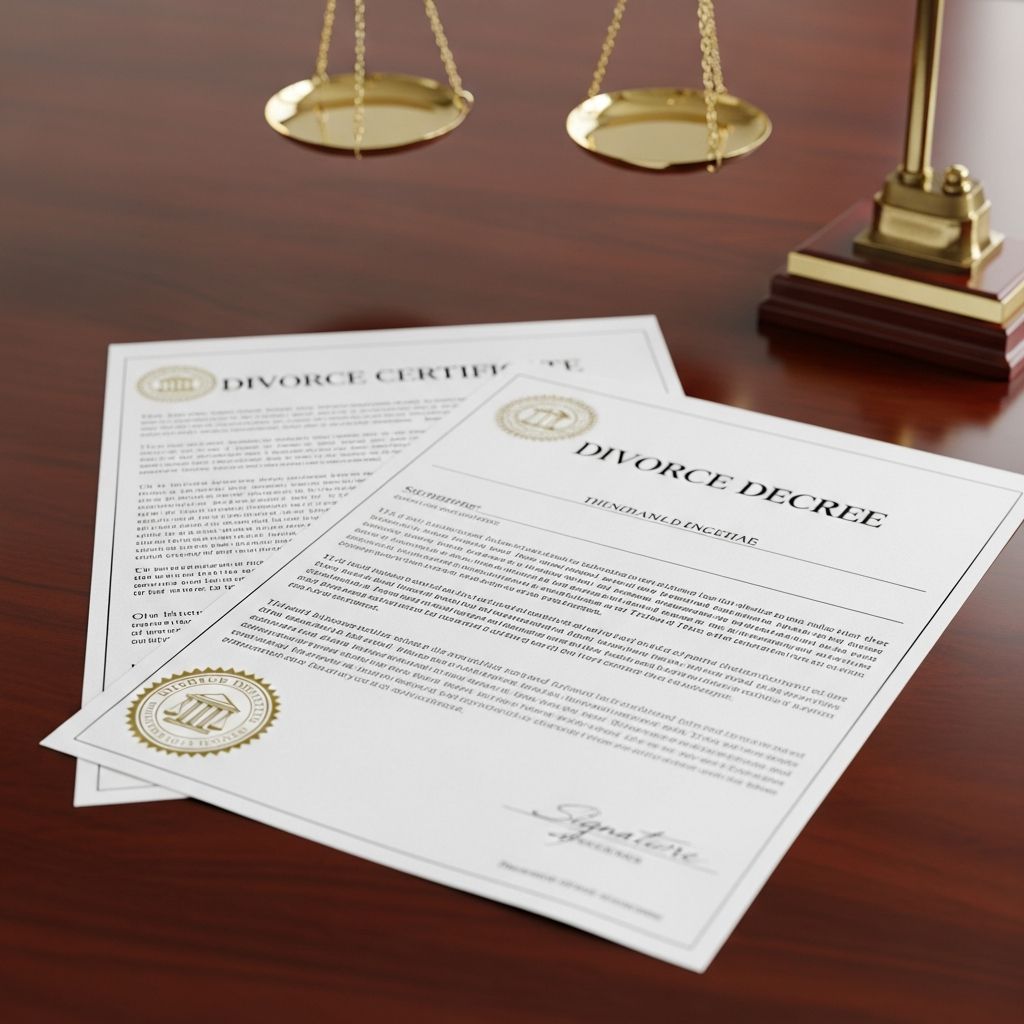
When a marriage legally ends, courts and vital records offices create official documents that prove and describe the divorce. Two terms you will often see are divorce decree and divorce certificate. Although they sound similar, they serve different purposes, come from different government offices, and are used in different situations.
This guide explains what each document is, how they compare, when you are likely to need them, and how to request copies in the United States.
1. Key Definitions: Decree vs. Certificate
Before you request records, it helps to understand the basic legal meaning of each document.
1.1 What is a divorce decree?
A divorce decree is a formal court order that legally ends a marriage and sets out the final terms of the divorce. It is issued by the court that handled your case and is typically signed by a judge.
In most states, a divorce decree will include:
- The names of both spouses and the case or docket number
- The date the marriage legally ended
- The judge’s name and the court that issued the order
- The legal grounds for divorce (where required by state law)
- Orders regarding division of marital property and debts
- Any spousal support (alimony or maintenance) obligations
- Custody, visitation, and child support terms, when applicable
- Any approved name change for a spouse
Because it contains detailed financial and personal information, the decree is usually treated as a sensitive document and is primarily used in legal, financial, or enforcement contexts.
1.2 What is a divorce certificate?
A divorce certificate is a shorter vital record that confirms a divorce occurred. In states that issue them, divorce certificates are maintained by a statewide vital records or health department office, similar to birth and death certificates.
A typical divorce certificate includes only basic facts:
- The full names of both former spouses
- The date the divorce became final
- The location and state of the divorce
- Possibly the court or case number, depending on the state
It does not list how your property was divided, how much support is owed, or details about custody or visitation.
2. How Divorce Decrees and Certificates Compare
The following table summarizes the major differences between these two documents.
| Feature | Divorce Decree | Divorce Certificate |
|---|---|---|
| Primary purpose | Official court order that ends a marriage and sets legal terms | Concise proof that a divorce took place |
| Issuing authority | Trial court that handled the divorce case | State or local vital records office, where available |
| Level of detail | Highly detailed; includes financial, custody, and property orders | Basic facts only; names, date, and place of divorce |
| Typical uses | Enforcing or modifying support, custody, and property orders; legal disputes | Proof for name changes, remarriage, or basic administrative purposes |
| Where to request | Clerk’s office of the court that issued the judgment | State vital records or health department office |
3. When You Need a Divorce Decree
Because the decree is the full text of the court’s decision, you will generally need it anytime a person or agency must know the specific terms of your divorce.
3.1 Common situations requiring a decree
- Enforcing child support or custody orders – Courts and child support agencies rely on the decree to see the exact payment schedule, custody arrangements, and visitation rights.
- Clarifying alimony or maintenance obligations – If there is a dispute about how much is owed or whether payments can stop, the decree is the controlling document.
- Resolving questions about property division – When selling or transferring a home, car, or retirement account, financial institutions often want to see the relevant decree language.
- Seeking post-divorce modifications – To change custody, adjust support, or correct errors, attorneys and courts use the existing decree as the starting point.
- Immigration or complex legal matters – Some immigration applications and court cases require full details of prior marriages and divorces.
3.2 Privacy considerations
Because a divorce decree can reveal income, assets, debts, and family information, you may not want to share it more widely than necessary. When a simple proof of divorce is enough, a certificate can be a better choice in states that issue them.
4. When You Need a Divorce Certificate
A divorce certificate is generally used when an organization only needs to verify that you are legally divorced, not how the divorce was structured.
4.1 Typical uses for a certificate
- Remarriage – Some states or foreign countries may ask for a divorce certificate when issuing a new marriage license to confirm you are free to marry.
- Updating identification documents – Agencies may accept a divorce certificate to update your name or marital status in their records.
- Employer or benefit administration – Human resources departments may request proof of divorce to update health plan coverage or beneficiary designations.
- General personal records – Some people prefer to keep a certificate instead of repeatedly handling a full decree with sensitive details.
4.2 Not all states issue certificates
Not every state creates a separate divorce certificate. Where divorce certificates are not available, a certified copy of the divorce decree often serves as the main document for proving that a divorce occurred.
5. How to Get a Copy of a Divorce Decree
Because a divorce decree is a court record, you request it from the court that finalized the divorce.
5.1 Find the correct court
To locate your decree, you generally need:
- The state and county where the divorce was granted
- The approximate year the divorce became final
- Names of both spouses (including former or maiden names)
- The case or docket number, if you know it (this speeds up the search)
Most divorces are handled in a trial-level court, such as a family court, circuit court, or superior court, depending on the state.
5.2 Request methods
Courts usually offer one or more of these options:
- In-person request – Visit the clerk’s office, fill out a request form, and pay a copy fee. This can be fastest if you live nearby.
- Mail request – Send a written request including names, dates, case number (if known), a return address, and payment. Some courts require a notarized signature.
- Online portal – Many courts now let you order certified or plain copies of divorce judgments through secure online systems for an additional fee.
5.3 Certified vs. plain copies
When you order your decree, the clerk’s office may offer:
- Plain copy – A regular photocopy or printout, often suitable for personal records.
- Certified copy – A copy with an official seal or stamp and a clerk’s certification that it matches the court’s record. Many agencies and other courts require certified copies for official uses.
5.4 Who can obtain a decree?
Access rules vary by state. In many jurisdictions, divorce decrees are public records, but some information may be redacted or sealed, especially in cases involving minors, domestic violence, or other sensitive issues. In those situations, only the parties, their lawyers, or people with a court order may see the full document.
6. How to Get a Copy of a Divorce Certificate
Divorce certificates, where available, are normally issued by a state’s vital records or health department.
6.1 Identify the vital records office
Each state designates a specific office to maintain vital records, which may include divorce certificates. Common names for this office include:
- Department of Health
- Office of Vital Statistics
- Bureau of Vital Records
State government websites typically list the address, phone number, and application instructions for obtaining divorce records.
6.2 Information you will need
To request a divorce certificate, you are usually asked to provide:
- Full legal names of both former spouses at the time of divorce
- Approximate date or year of the divorce
- City or county where the divorce was granted
- Your relationship to the parties and the purpose of the request
- Proof of identity, such as a government-issued photo ID
6.3 Eligibility and identification rules
Many states limit who can obtain a divorce certificate. Typical eligible requesters include:
- Either former spouse named on the record
- A legal representative of one of the spouses, with documentation
- In some cases, certain close family members
States often require a photocopy of a driver’s license, passport, or other acceptable identification to process a request.
6.4 Processing times and fees
Vital records offices charge a per-copy fee and sometimes additional fees for expedited processing or shipping. Processing times can range from a few business days to several weeks, especially for older records or busy offices.
7. Choosing the Right Document for Your Situation
When you are asked for “divorce papers,” it is important to clarify exactly which document is needed. In practice, many organizations use each document as follows:
- Use a divorce decree when:
- A court, lawyer, or government agency needs to see the detailed terms of child support, custody, or property division.
- You are trying to enforce or modify parts of your divorce order.
- A financial institution needs proof of how assets and debts were divided.
- Use a divorce certificate when:
- An agency or organization only needs proof that you are divorced.
- You are applying for a new marriage license and asked for evidence of a prior divorce.
- You want a simple document for your records that does not reveal personal financial information.
8. Practical Tips for Managing Divorce Records
Divorce records can affect many parts of life for years after the case ends. Careful record-keeping can prevent delays and confusion.
- Order multiple certified copies – Consider requesting more than one certified copy of your decree or certificate so you have extras when agencies require originals.
- Store documents securely – Keep paper copies in a safe place, such as a locked file or home safe, and consider keeping scanned copies in encrypted digital storage.
- Know your state’s terminology – Some states use different names, such as “judgment of divorce” or “final order,” for what is effectively a divorce decree.
- Update related records promptly – After a divorce, review and update beneficiary designations, insurance policies, and account ownership in line with the decree and your current wishes.
Frequently Asked Questions (FAQs)
Q1: Is a divorce decree the same as a divorce certificate?
No. A divorce decree is a detailed court order that ends the marriage and sets out legal terms, while a divorce certificate is a shorter vital record that simply confirms that a divorce occurred.
Q2: What if my state does not issue divorce certificates?
In states that do not create separate divorce certificates, a certified copy of your divorce decree usually serves as your main proof of divorce. You can request it from the court that finalized your case.
Q3: Can anyone look up my divorce decree?
Access rules vary by state. Many divorce decrees are part of public court records, but some details may be sealed or restricted, especially in cases involving children or safety concerns. Check with the court clerk in the county where your divorce was granted for specific rules.
Q4: How long after my divorce can I request copies?
In most states, you can request copies of your decree or certificate years or even decades later. Older records might be stored in archives, which can increase processing time, but they generally remain accessible through courts or vital records offices.
Q5: Do I need a lawyer to get my divorce decree or certificate?
You do not need a lawyer just to request copies of existing records. However, if you are trying to enforce or change the terms in your decree, consulting a family law attorney can help you understand your rights and the legal process.
References
- How to get a copy of a divorce decree or certificate — USA.gov. 2024-05-10. https://www.usa.gov/divorce-decree
- What Is a Divorce Decree? — Experian. 2023-08-21. https://www.experian.com/blogs/ask-experian/what-is-a-divorce-decree/
- Divorce Decree vs. Divorce Certificate — MetLife. 2023-11-03. https://www.metlife.com/stories/legal/divorce-decree/
- What is a Divorce Decree in New Jersey? — Jacobs Berger, LLC. 2022-06-15. https://jacobsberger.com/what-is-a-divorce-decree-new-jersey/
- What is a Divorce Decree? — Maryland People’s Law Library. 2022-09-01. https://www.peoples-law.org/what-divorce-decree
Similar Articles








Read full bio of medha deb


