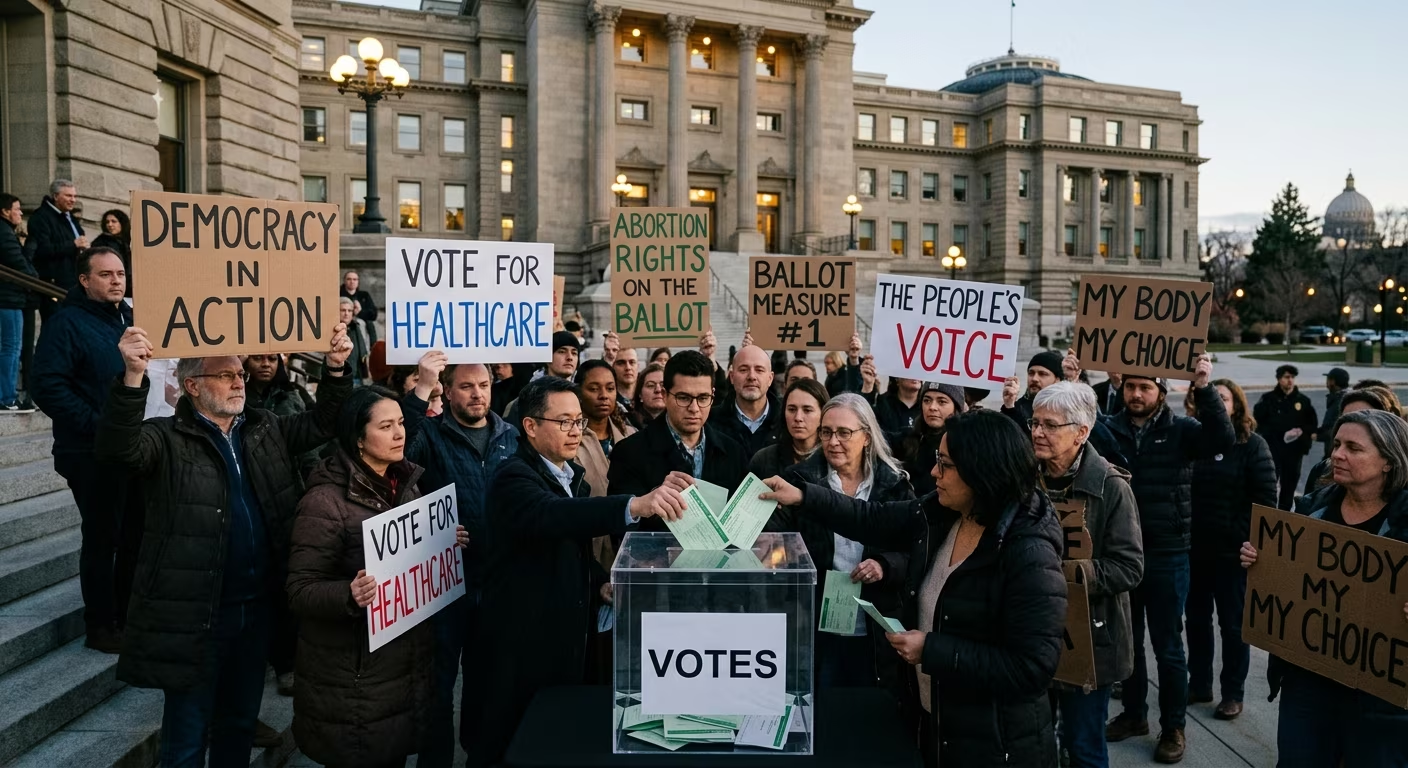
The New Frontier of Direct Democracy: Shaping Reproductive Healthcare at the Ballot Box
When the United States Supreme Court issued its landmark ruling in the summer of 2022, dismantling the federal protections that had stood for nearly half a century, the foundational fabric of American healthcare was instantly transformed. By returning the regulatory authority over reproductive rights to individual states, the federal standard was entirely erased. In the subsequent years, the most profound political consequence has not been merely legislative gridlock, but rather the explosive resurgence of direct democracy. Across the country, the fierce battle over bodily autonomy and medical privacy has moved out of federal courthouses and state capitols, landing directly on the voting ballot.
Citizens are now actively bypassing their elected representatives to vote on measures that either enshrine or severely restrict reproductive freedoms. This strategic pivot to ballot initiatives represents a historical realignment in how civil rights are secured in the modern era. Voters are no longer waiting for deeply polarized state legislatures to act; instead, they are taking the pen to their own state constitutions, setting binding precedents that will govern medical care for generations.
Understanding the Post-Roe Political Shift
The rapid shift from traditional legislative lobbying to citizen-initiated ballot measures is a calculated response to the structural realities of modern American politics. In many regions across the United States, heavily gerrymandered legislative maps have created a stark, enduring disconnect between the laws enacted by local politicians and the actual policy preferences of the broader electorate.
Public opinion polling consistently illustrates this deep divide. For instance, comprehensive demographic data gathered in early 2026 reveals that approximately 60% of U.S. adults believe reproductive healthcare, including abortion, should remain legal in all or most cases. Despite this clear majority support, numerous state legislatures have swiftly passed near-total bans or severe gestational restrictions. To bridge this glaring gap between public will and legislative action, advocacy coalitions have heavily invested in the ballot box.
Direct voting allows citizens to enact mandates that effectively override the ideological inclinations of state legislatures. This direct democracy strategy isolates a highly specific question about healthcare and personal privacy, divorcing it from the traditional partisan candidate races that are often bogged down by a myriad of other political issues. By doing so, these measures have proven highly effective at activating unlikely voters and forging unique coalitions that span the political spectrum, united by a shared resistance to government interference in private medical decisions.
The Mechanics of Ballot Initiatives and Constitutional Amendments
The intricate process of bringing a measure directly to voters is highly complex and varies dramatically from state to state. While the concept of direct democracy sounds straightforward, the legal and logistical hurdles designed to keep citizen initiatives off the ballot are immense. Generally, there are two primary instruments used in this legal arena: statutory initiatives and constitutional amendments.
- Statutory Initiatives: These measures seek to pass a standard state law. While they can successfully protect or restrict care in the short term, they carry a significant vulnerability. Because they hold the same legal weight as any other law, they can be amended, diluted, or entirely repealed by a hostile state legislature during the very next legislative session.
- Constitutional Amendments: These represent the absolute gold standard for long-term policy shifts and advocacy groups. Amending a state’s governing constitution creates a foundational legal right that cannot be easily overturned or ignored by lawmakers. It establishes a higher legal threshold that state supreme courts must use when evaluating future healthcare regulations.
Because of the enduring power of constitutional amendments, almost all major recent campaigns have focused exclusively on amending state constitutions to guarantee a fundamental right to “reproductive freedom.” However, qualifying an amendment for the ballot requires collecting hundreds of thousands of certified signatures across diverse geographic districts within a strict timeframe. This process requires not only massive grassroots mobilization but also sophisticated legal teams to navigate state review boards and challenge attempts by political opponents to rewrite ballot summary language in confusing or misleading ways.
State-by-State Outcomes: A Complex Patchwork of Policies
The widespread utilization of direct democracy has yielded a deeply fractured, balkanized national landscape. The outcomes of recent election cycles demonstrate both the sheer power and the stark limitations of relying on voter-led initiatives to secure healthcare rights.
During the pivotal 2024 elections, voters in several key states decisively backed reproductive rights. Measures in states like Arizona, Colorado, Maryland, Missouri, Montana, and New York successfully amended state constitutions to establish or protect abortion access. Arizona and Missouri were particularly significant battlegrounds; in those states, voters consciously opted to override existing, deeply restrictive state bans by explicitly enshrining healthcare protections through fetal viability.
However, the direct democracy strategy is not universally successful, and local political machinery often complicates outcomes. In the same election cycle, protective amendments in Florida and South Dakota failed to secure the necessary thresholds for passage. Florida’s failure was specifically tied to a state requirement demanding a 60% supermajority to pass any constitutional amendment—a high bar that fell just short despite majority support. Meanwhile, in Nebraska, the electorate faced competing ballot measures, ultimately affirming an existing state ban on procedures after the first trimester while simultaneously rejecting a broader protective measure.
Recent State Ballot Measure Outcomes (2024 Cycle)
| State | Type of Measure | Core Objective | Election Outcome |
|---|---|---|---|
| Arizona | Constitutional Amendment | Protect access up to fetal viability | Passed |
| Missouri | Constitutional Amendment | Overturn ban, establish reproductive rights | Passed |
| Florida | Constitutional Amendment | Protect rights (Subject to 60% threshold) | Failed |
| Nebraska | Constitutional Amendment | Enshrine existing 12-week ban | Passed |
| Colorado | Constitutional Amendment | Protect existing access and enable funding | Passed |
The Tangible Impact on Healthcare Access and Incidence
The direct voting strategy has profound, immediate implications for how and where medical care is administered across the United States. These ballot measures do not just exist in the realm of legal theory; they dictate the operational survival of medical facilities and the logistical burdens placed on patients.
Despite the implementation of severe legal bans in vast regions of the American South and Midwest, the overall national incidence of abortion has not decreased. Public health tracking in 2025 revealed that an estimated 1.12 million clinician-provided abortions took place across the United States. This sustained, and even slightly increased, volume is largely driven by rapid adaptations in healthcare delivery—specifically, the massive expansion of telehealth services. Interstate “shield laws” enacted in progressive states provide essential legal cover for healthcare providers who prescribe and mail medication to patients residing in restrictive jurisdictions.
Nevertheless, state-level ballot measures that successfully secure reproductive rights remain absolutely critical for the survival of brick-and-mortar clinics. Physical clinics have seen a slight overall decline nationwide, yet they remain vital infrastructure. They are essential for providing procedural care, managing complex medical conditions, serving marginalized communities lacking telehealth access, and offering comprehensive gynecological services. In states where ballot measures successfully override bans, local clinics are able to remain open and absorb the massive influx of patients who are forced into multi-state travel to receive standard, evidence-based medical care.
Beyond Abortion: Broad Implications for Privacy, IVF, and Contraception
While mainstream political discourse heavily centers on the specific procedure of abortion, the legal language drafted into these citizen-led constitutional amendments is intentionally much broader. Legal advocates deliberately utilize expansive terms such as “reproductive freedom” or “reproductive autonomy” because the judicial implications of dismantling federal privacy precedents extend far beyond a single medical intervention.
These comprehensive ballot measures are structurally designed to preemptively protect a wide spectrum of healthcare services. The rising legal ambiguity surrounding concepts of fetal personhood in several conservative states has actively threatened access to in vitro fertilization (IVF), routine hormonal contraception, and standard medical interventions necessary for miscarriage management. By explicitly protecting a citizen’s fundamental right to make decisions regarding their own reproductive life, these constitutional amendments act as a powerful legal shield.
They safeguard fertility treatments from sudden shutdowns, protect the distribution and use of intrauterine devices (IUDs), and ensure that emergency room doctors can provide life-saving obstetric care without fear of criminal prosecution. The ultimate focus of these campaigns is to foster a holistic approach to medical privacy, ensuring that patients, in consultation with their licensed physicians, can make critical health decisions free from arbitrary government overreach.
The Role of Grassroots Mobilization and Financial Investment
The recurring success of these state-level ballot initiatives is inextricably linked to monumental grassroots organizing and staggering financial investment. Executing a successful statewide constitutional amendment campaign is a multi-million dollar endeavor that requires years of advanced planning.
The initial signature-gathering phase is notoriously grueling. Campaigns often must rely on a mix of highly motivated local volunteers and paid professional canvassers to traverse the state, ensuring that signatures are collected from specific geographical districts to satisfy complex state requirements. Once an initiative officially qualifies for the ballot, the campaign must rapidly pivot to massive public education, combatting misinformation, and executing expansive advertising efforts. This requires significant funding for television broadcasts, targeted digital advertising, and comprehensive mailer campaigns.
In direct response to the overwhelming success of reproductive rights measures, opposition coalitions have aggressively attempted to change the fundamental rules of direct democracy itself. Rather than merely fighting the campaigns on their policy merits, some political factions have introduced legislative measures designed to raise the threshold for passing constitutional amendments from a simple 50% majority to a 60% supermajority. These strategic counter-tactics underscore the immense threat that direct democracy poses to entrenched legislative majorities.
Looking Ahead: The 2026 Landscape and Beyond
As the nation looks toward the 2026 midterm elections, the intense reliance on citizen ballot measures shows no signs of waning. Several states are actively gearing up for highly consequential votes that will further define the national healthcare map.
States with unique legislative processes face ongoing battles. Nevada, for instance, legally requires citizen-led constitutional amendments to be passed in two consecutive general elections. Consequently, voters there will head back to the polls in 2026 to finalize the protections they initially approved in 2024. Simultaneously, well-funded advocacy groups in states like Virginia are organizing massive campaigns to place comprehensive reproductive rights amendments on their upcoming ballots, aiming to secure protections before political winds shift.
The continued, heavy use of direct democracy will undoubtedly test the endurance, financial resources, and enthusiasm of grassroots organizations and everyday voters. While some political analysts ponder whether voter fatigue will eventually set in after multiple cycles of high-stakes referendums, the deeply personal and immediate nature of reproductive healthcare suggests otherwise. As long as the United States lacks uniform, federal protections for medical privacy and bodily autonomy, the state ballot will forcefully remain the primary battleground for securing these essential civil rights.
Frequently Asked Questions (FAQs)
What is the fundamental difference between a statutory initiative and a constitutional amendment?
A statutory initiative proposes a standard law that, while legally binding, can typically be altered, weakened, or completely repealed by the state legislature during standard sessions. A constitutional amendment changes the foundational governing document of the state. This makes the newly established right vastly more difficult for hostile lawmakers to overturn, requiring another public vote to remove it.
Why are ballot measures suddenly being used so frequently for reproductive healthcare?
Following the dismantling of federal protections, regulatory power was handed back to the states. Because many state legislatures are politically polarized—often due to heavily gerrymandered voting districts—they frequently pass policies that do not reflect the majority opinion of their constituents. Advocates use ballot measures to bypass these lawmakers, allowing citizens to vote directly on their healthcare access.
Do these ballot measures only protect abortion access?
No. The vast majority of protective ballot measures are carefully drafted to safeguard broader “reproductive freedom” or “reproductive autonomy.” This intentional legal phrasing ensures the protection of a wide array of vital medical care, including access to contraception, fertility treatments like IVF, and necessary interventions for miscarriage management.
How do strict out-of-state bans affect states that have successfully passed protective measures?
States that successfully secure reproductive rights through their constitution often become vital “safe havens” in their geographic region. Consequently, their local medical infrastructure—particularly physical brick-and-mortar clinics—frequently experiences a massive surge in demand as thousands of patients are forced to travel across state lines to receive legal, safe medical care.
What are shield laws and why are they important in this context?
Shield laws are proactive, state-level legal frameworks designed to protect local healthcare providers from civil litigation, criminal prosecution, or license revocation initiated by states with severe bans. These laws are an essential component of modern healthcare, particularly for protecting clinicians who utilize telehealth to prescribe and mail necessary medications to patients trapped in restrictive jurisdictions.
References
- What’s Next for State Abortion Ballot Initiatives? — KFF. 2024-12-18. https://www.kff.org/womens-health-policy/issue-brief/whats-next-for-state-abortion-ballot-initiatives/
- Guttmacher Releases Full-Year 2025 Abortion Incidence and Travel Data — Guttmacher Institute. 2026-03-24. https://www.guttmacher.org/news-release/2026/guttmacher-releases-full-year-2025-abortion-incidence-and-travel-data
- Public Opinion on Abortion — Pew Research Center. 2026-03-12. https://www.pewresearch.org/religion/fact-sheet/public-opinion-on-abortion/
- Abortion on the 2026 Ballot: The Evolving Landscape of State Abortion Initiatives — KFF. 2026-03-17. https://www.kff.org/womens-health-policy/issue-brief/abortion-on-the-2026-ballot-the-evolving-landscape-of-state-abortion-initiatives/