
The Shield of the Free Press: A Civil Rights Legal Legacy
Exploring how a 1964 Supreme Court defamation case revolutionized journalism.
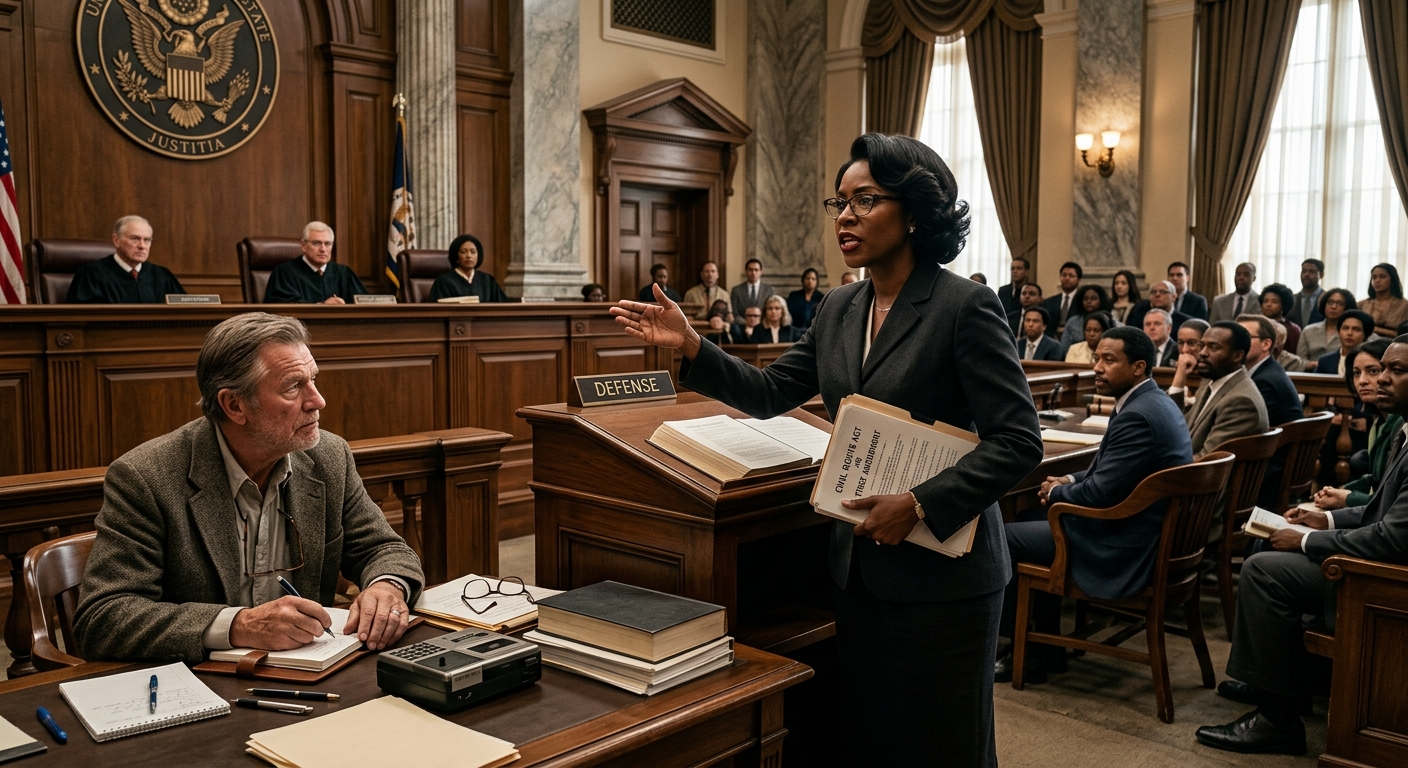
The modern landscape of American journalism, characterized by its rigorous scrutiny of public officials and robust institutional accountability, is not a byproduct of historical accident. It rests upon a foundational legal bedrock established over six decades ago. Before 1964, the press operated under a pervasive shadow of existential financial ruin. State defamation laws were notoriously stringent, holding publishers strictly liable for any factual inaccuracies, no matter how minor or unintentional. In this chilling environment, a single misstep could bankrupt a newspaper. This precarious reality came to a head during one of the most turbulent and consequential periods in American history: the Civil Rights Movement.
The landmark United States Supreme Court decision in New York Times Co. v. Sullivan (1964) fundamentally altered the trajectory of both the First Amendment and civil rights. It established the formidable “actual malice” standard, forever changing how public officials could sue for defamation. By demanding that public officials prove a publisher knew a statement was false or acted with reckless disregard for its truth, the Court erected a vital constitutional shield for the press. This ruling was not merely a procedural adjustment to tort law; it was a profound declaration that vibrant, uninhibited public debate is essential to the health of a democracy. In doing so, it empowered journalists to aggressively cover the civil rights struggles in the American South, fundamentally shaping public consciousness and accelerating the push for racial equality.
The Precarious State of Press Freedom Before 1964
To truly appreciate the magnitude of the Sullivan decision, one must first understand the severe legal peril that defined journalistic endeavors prior to the mid-20th century. Defamation, traditionally governed by disparate state common laws, heavily favored the plaintiff. Under the strict liability doctrines prevalent at the time, a plaintiff merely needed to prove that a published statement was defamatory and that it explicitly referred to them.
The burden of proof then violently shifted to the publisher to prove the absolute, unvarnished truth of the statement. If a newspaper published a deeply researched investigative piece comprising thousands of words and got one peripheral detail wrong—a date, a specific location, or a minor procedural detail—the subject of the article could secure a devastating financial judgment. Furthermore, many states allowed for “presumed damages,” meaning the plaintiff did not even have to prove they suffered actual financial harm; the jury could simply invent a monetary figure based on assumed reputational injury.
This oppressive legal framework created a palpable “chilling effect.” Newspaper editors and television producers, acutely aware of the financial devastation a libel suit could unleash, frequently opted for self-censorship. When deciding whether to publish a controversial expose on local corruption or police brutality, the risk often outweighed the journalistic reward. The common law of defamation effectively functioned as an invisible gag order, prioritizing the pristine reputations of powerful individuals over the public’s right to be informed. This dynamic was particularly potent in the Jim Crow South, where local officials commanded immense power and courts were deeply entrenched in the prevailing social order.
The Catalyst: A Controversial Advertisement
The genesis of the Sullivan case was not a deeply researched investigative report, but rather a full-page editorial advertisement. On March 29, 1960, the New York Times published an ad titled “Heed Their Rising Voices.” Placed by a coalition of civil rights leaders, including prominent actors, writers, and influential figures like Eleanor Roosevelt, the advertisement sought to raise funds for the legal defense of Dr. Martin Luther King Jr., who was facing perjury charges in Alabama, and to support student activists peacefully protesting racial segregation.
The text of the advertisement passionately decried the “unprecedented wave of terror” unleashed against nonviolent civil rights demonstrators in the South. However, the passionately written copy contained several minor factual inaccuracies. It incorrectly stated that students who sang “My Country, ‘Tis of Thee” on the State Capitol steps were expelled for that specific action (they were actually expelled for a sit-in at a courthouse grill). It slightly overstated the number of times Dr. King had been arrested. It also mischaracterized the police response, falsely claiming that the Montgomery police had “ringed” the Alabama State College campus and padlocked the dining hall to starve the students into submission. While the broader narrative of systemic oppression and brutal police tactics was undeniably true, these specific granular details were factually flawed.
Weaponizing Libel Law to Silence Dissent
These minor discrepancies provided the perfect ammunition for those desperate to suppress national coverage of the civil rights struggle. L.B. Sullivan, the Public Affairs Commissioner of Montgomery, Alabama, whose purview included the supervision of the police department, seized the opportunity. Although Sullivan was not explicitly named anywhere in the advertisement, he argued that the critical references to “police” and “Southern violators” inherently reflected upon his official leadership and defamed his character.
Sullivan filed a libel lawsuit in an Alabama state court against the New York Times and four Black Alabama ministers—Ralph Abernathy, Fred Shuttlesworth, Joseph Lowery, and S.S. Seay Sr.—whose names appeared as endorsers of the ad. Under Alabama’s strict liability defamation laws, the trial was heavily stacked against the defendants. The local all-white jury awarded Sullivan $500,000 in damages—a staggering, unprecedented sum at the time that represented a significant portion of the newspaper’s annual revenue.
But Sullivan was not an isolated case. His lawsuit was part of a coordinated, strategic campaign by Southern officials to weaponize defamation law against the Northern press. Following Sullivan’s victory, a barrage of similar lawsuits flooded in. Soon, the New York Times was facing nearly $3 million in pending libel claims in Alabama alone. CBS News and other major outlets faced similar threats. The objective was transparent: bankrupt the national media or terrify them into abandoning their coverage of the South. Without national reporters illuminating the atrocities of segregation and the violent suppression of peaceful protests, the Civil Rights Movement risked being plunged into darkness, isolated and silenced.
The Supreme Court Intervenes: Forging the “Actual Malice” Standard
Facing ruinous judgments that threatened to end its national circulation, the New York Times appealed the case to the United States Supreme Court. The stakes were monumental. If the Court upheld the Alabama verdict, it would effectively grant local officials a nationwide veto over press coverage. In a unanimous 9-0 decision delivered on March 9, 1964, the Supreme Court reversed the Alabama judgment, handing down a ruling that would forever alter the landscape of American constitutional law.
Justice Brennan and the Need for “Breathing Space”
Writing for the Court, Justice William J. Brennan Jr. recognized the insidious nature of the libel suits emanating from the South. He understood that these lawsuits were not genuinely about repairing damaged reputations; they were punitive tools designed to enforce a localized orthodoxy and crush dissent. Brennan articulated a profound defense of the First Amendment, declaring that the United States has a “profound national commitment to the principle that debate on public issues should be uninhibited, robust, and wide-open.”
Brennan famously noted that in the heat of rigorous public debate, factual errors are inevitable. If journalists are required to guarantee the absolute truth of every single utterance or face catastrophic financial ruin, they will inevitably steer wide of the controversy. This self-censorship, Brennan reasoned, dampens the vigor and limits the variety of public debate. To survive and fulfill its constitutional role, freedom of expression requires “breathing space.”
What Exactly Is “Actual Malice”?
To provide this necessary breathing space, the Court fundamentally rewrote the rules of defamation for public officials. The ruling held that the First Amendment protects the publication of all statements—even false ones—about the conduct of public officials, unless the statement was made with “actual malice.”
The term “actual malice” is often misunderstood by the public. In the context of defamation law, it does not mean ill will, spite, or a malicious intent to harm. Instead, it is a specific legal standard with a high threshold. To prove actual malice, a public official must demonstrate by “clear and convincing evidence” (a much higher bar than the standard “preponderance of evidence” used in most civil trials) that the publisher acted with one of two mental states:
- Knowledge of Falsity: The publisher knew the statement was a complete lie before publishing it.
- Reckless Disregard for the Truth: The publisher entertained serious doubts about the truth of the statement but published it anyway, willfully ignoring obvious reasons to verify the facts.
By shifting the burden of proof to the plaintiff and establishing a rigorous standard of fault, the Court neutralized the weaponized libel suits that threatened to destroy the press.
The Inseparable Bond Between First Amendment Rights and the Civil Rights Movement
The immediate aftermath of the Sullivan decision was nothing short of a rescue mission for the Civil Rights Movement. With the oppressive threat of multi-million dollar libel judgments lifted, journalists were reinvigorated. Reporters from national newspapers, wire services, and television networks descended upon the South with renewed determination and legal security.
Because the press had the “breathing space” to report on controversial, rapidly unfolding events without paralyzing fear of minor factual errors, the American public was exposed to the unvarnished realities of the struggle. The nation witnessed the brutal use of police dogs and fire hoses against children in Birmingham. They saw the vicious beatings of peaceful marchers on the Edmund Pettus Bridge in Selma. This relentless, courageous journalism forced the conscience of a nation to confront the realities of institutionalized racism, galvanizing public support that directly culminated in the passage of the landmark Civil Rights Act of 1964 and the Voting Rights Act of 1965. In this sense, the fight for a free press and the fight for racial equality were inextricably symbiotic; neither could fully succeed without the other.
The Evolution of Defamation Law
The jurisprudence stemming from this historic ruling continued to evolve in the subsequent decades. The Supreme Court recognized that the rationale for protecting speech about public officials applied equally to other powerful individuals who shape societal outcomes. In subsequent rulings, the Court extended the actual malice standard to “public figures”—individuals who thrust themselves into the forefront of public controversies to influence their resolution, or those who achieve pervasive fame or notoriety.
This transformation shifted the entire philosophical framework of defamation law in the United States:
| Aspect of Libel Law | Pre-1964 (Strict Liability) | Post-1964 (Actual Malice Standard) |
|---|---|---|
| Burden of Proof | Defendant (Publisher) had to prove absolute truth. | Plaintiff (Public Official) must prove the statement is false. |
| Level of Fault Required | Strict liability. Innocent mistakes were actionable. | Actual Malice (Knowledge of falsity or reckless disregard). |
| Standard of Evidence | Preponderance of the evidence. | Clear and convincing evidence. |
Modern Challenges: Is the Actual Malice Standard Under Threat?
More than 60 years later, the protections established by Sullivan remain the bedrock of modern investigative journalism, but they are increasingly finding themselves under unprecedented scrutiny. In recent years, a growing chorus of political figures and even some legal scholars have called for a reexamination of the actual malice standard.
Critics argue that the media landscape has fundamentally transformed since 1964. In the era of the internet, social media algorithms, and hyper-partisan echo chambers, misinformation and defamatory content can spread globally in milliseconds. Some argue that the Sullivan standard makes it nearly impossible for individuals whose reputations are unjustly destroyed by bad-faith actors to seek recourse. Prominent judicial figures have penned dissenting opinions suggesting that the standard may be ill-suited for the digital age, noting that it provides a shield for coordinated disinformation campaigns rather than honest journalistic mistakes.
Furthermore, the rise of Strategic Lawsuits Against Public Participation (SLAPP) highlights the ongoing tension. While the actual malice standard makes it incredibly difficult for a public figure to ultimately win a libel suit on the merits, wealthy individuals can still file frivolous lawsuits to bleed journalists, freelancers, and smaller publications dry through exorbitant legal defense fees and drawn-out discovery processes.
However, press freedom advocates adamantly defend the precedent. They warn that lowering the bar for defamation would instantly resurrect the chilling effect of the pre-1964 era. In a profoundly polarized political climate, the threat of ruinous litigation could easily be weaponized by powerful politicians to bankrupt news organizations and silence critical investigative reporting. The “breathing space” championed is arguably more vital now than ever, ensuring that those in power cannot litigate their critics into submission.
Frequently Asked Questions (FAQ)
What is defamation?
Defamation is a broad legal term encompassing any false statement communicated to a third party that harms the reputation of an individual or organization. If the defamatory statement is written or published in a tangible medium, it is known as “libel.” If it is spoken orally, it is called “slander.”
What is the exact definition of “actual malice”?
In U.S. defamation law, actual malice does not mean the publisher hated the subject or intended to harm them out of spite. It means the publisher published a statement either knowing it was completely false, or acting with reckless disregard for the truth (meaning they had serious doubts about its accuracy but published it anyway without basic verification).
Who qualifies as a “public figure” today?
Courts generally recognize two types of public figures. “All-purpose” public figures are individuals with pervasive fame and influence, such as prominent celebrities or national politicians. “Limited-purpose” public figures are private citizens who voluntarily thrust themselves into a specific public controversy to influence its outcome. Both must prove actual malice in a defamation suit.
Did this ruling legalize publishing lies?
No. Defamation is still highly actionable. The standard merely raised the evidentiary bar for public officials and public figures to successfully sue for it. It ensures that honest mistakes made during rigorous reporting do not result in financial ruin, while still allowing individuals to seek substantial damages if they can prove a publisher knowingly or recklessly lied about them.
How did this specific case help the Civil Rights Movement?
Segregationist leaders in the South utilized massive libel lawsuits to financially terrorize Northern news outlets into abandoning their coverage of the South. By establishing the actual malice standard, the Supreme Court nullified these weaponized lawsuits, allowing journalists to freely report on racial injustices, which ultimately catalyzed national support for landmark civil rights legislation.
Conclusion
The enduring legacy of New York Times Co. v. Sullivan extends far beyond the confines of tort law or legal academia. It remains a definitive cornerstone of American democracy. By recognizing that the press cannot function as a vital societal watchdog if it is shackled by the constant fear of paralyzing litigation over minor errors, the Supreme Court safeguarded the mechanisms of public accountability. The decision ensured that the horrific realities of segregation were broadcast to the nation, proving that the struggle for civil rights and the mandate of a free, uninhibited press are inextricably linked. As new technological, cultural, and political challenges emerge, the principles enshrined in that 1964 courtroom remain an indispensable defense against those who would prefer the comfort of silence over the necessary friction of truth.
References
- New York Times Co. v. Sullivan, 376 U.S. 254 (1964) — Library of Congress. 1964-03-09. https://tile.loc.gov/storage-services/service/ll/usrep/usrep376/usrep376254/usrep376254.pdf
- Herbert v. Lando, 441 U.S. 153 (1979) — Library of Congress. 1979-04-18. https://tile.loc.gov/storage-services/service/ll/usrep/usrep441/usrep441153/usrep441153.pdf
- New York Times v. Sullivan at 50: Despite Criticism, the Actual Malice Standard Still Provides “Breathing Space” for Communications in the Public Interest — DePaul Law Review. 2014. https://via.library.depaul.edu/law-review/vol64/iss1/2/
- Civil Rights Act of 1964 — National Archives. 1964-07-02. https://www.archives.gov/milestone-documents/civil-rights-act
Similar Articles








Read full bio of medha deb


