
The Shadow of the Alien Enemies Act: Historical Injustice and Modern Implications
Understanding the 1798 wartime statute, its dark history of mass incarceration, and its dangerous modern revival.
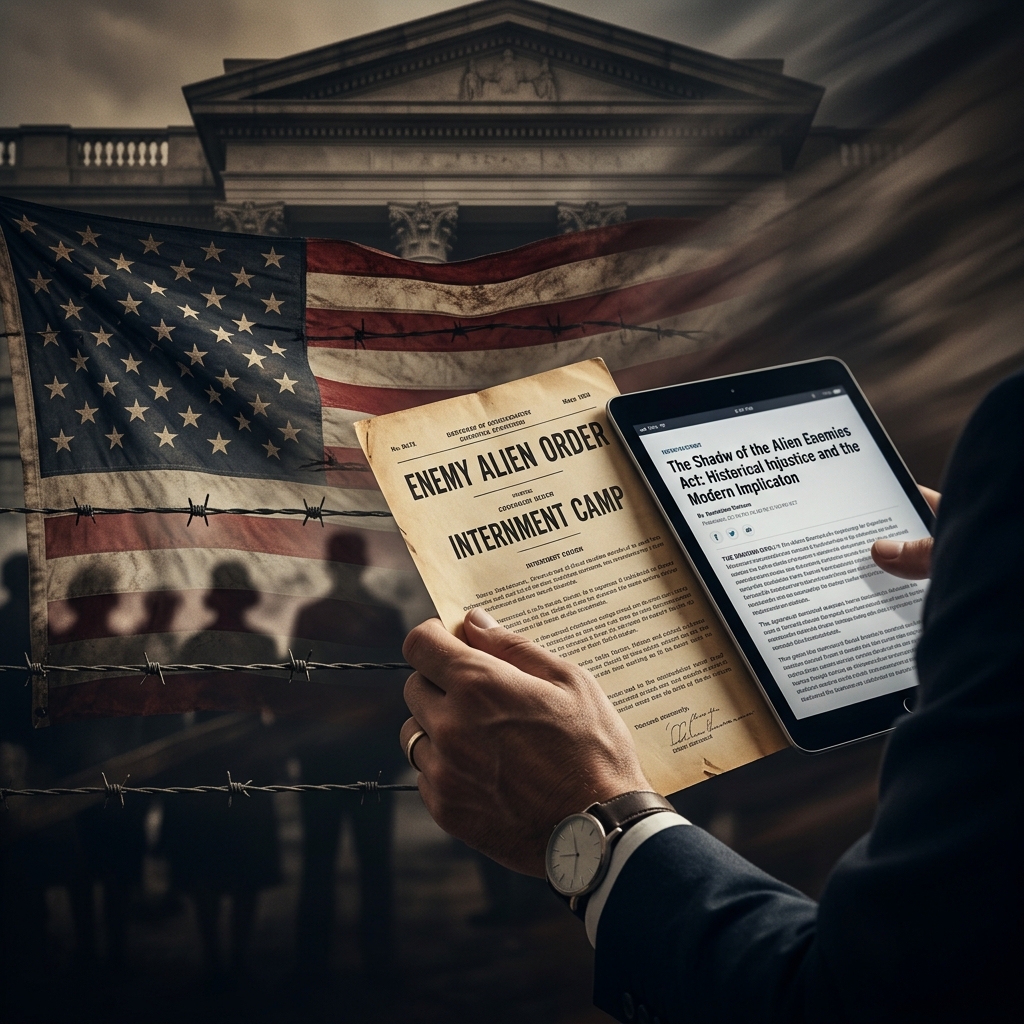
In the vast and complex landscape of United States law, few statutes are as archaic, controversial, and enduring as the Alien Enemies Act of 1798. Originally enacted during the infancy of the American republic, this legislation was designed to grant the executive branch sweeping powers during times of declared war. Over two centuries later, this law remains actively on the books, serving as a chilling reminder of how wartime panic can systematically dismantle civil liberties and bypass due process.
As modern political discourse increasingly turns toward hardline immigration policies and mass deportation strategies, the Alien Enemies Act has been exhumed from legal obscurity. Understanding its mechanics, its devastating historical applications, and the constitutional threats it poses today is essential for safeguarding democratic principles against the overreach of executive authority.
Legislative Origins: The Birth of a Wartime Power
To grasp the dangerous breadth of the Alien Enemies Act, one must examine the paranoid political climate in which it was forged. In 1798, the United States was locked in the “Quasi-War,” an undeclared naval conflict with France. Driven by xenophobia and the fear of foreign espionage, the Federalist-controlled Congress, under President John Adams, passed four distinct pieces of legislation collectively known as the Alien and Sedition Acts .
These laws were inherently political, designed in part to suppress the political opposition of the Democratic-Republicans, who were favored by many recent immigrants. While three of these acts—including the infamous Sedition Act, which criminalized criticism of the government—eventually expired or were repealed due to their blatant infringements on constitutional rights, the Alien Enemies Act survived . It was viewed strictly as an emergency military measure, which shielded it from the immediate political backlash that destroyed its companion laws. It provided the President of the United States with the unilateral authority to apprehend, restrain, secure, and remove foreign nationals of a hostile country during a declared war or an invasion.
Mechanics of the 1798 Statute
The text of the Alien Enemies Act is remarkably broad. It authorizes the targeting of “all natives, citizens, denizens, or subjects of the hostile nation or government” who are at least fourteen years old and have not become naturalized citizens . The inclusion of the word “natives” is particularly insidious. It dictates that even if a person renounced their former citizenship and fled their home country to escape a hostile regime, the United States government could still target them based merely on their geographic place of birth. It effectively conflates biological ancestry and geographical origin with political loyalty.
The trigger mechanism for this extreme executive power requires either a congressionally declared war or an “invasion or predatory incursion” by a foreign nation or government . Once activated, the statute effectively strips targeted noncitizens of standard constitutional protections, eliminating the need for individualized hearings, evidence of wrongdoing, or traditional due process. It operates entirely on guilt by association, an alarming deviation from the individualized justice that underpins the American legal system.
The World War II Application and Mass Incarceration
The most devastating implementation of the Alien Enemies Act occurred during the Second World War . Immediately following the Imperial Japanese attack on Pearl Harbor on December 7, 1941, President Franklin D. Roosevelt invoked the statute to issue Presidential Proclamations 2525, 2526, and 2527 . These proclamations officially branded noncitizen immigrants from Japan, Germany, and Italy as “enemy aliens.”
Within hours of the attack, the Federal Bureau of Investigation launched a coordinated dragnet, arresting prominent immigrant community leaders, Buddhist priests, Japanese language teachers, martial arts instructors, and newspaper editors . These individuals were apprehended without warrants or formal criminal charges. Families were left completely unaware of their loved ones’ whereabouts for weeks or months. Furthermore, the proclamations required these “enemy aliens” to surrender items like shortwave radios, cameras, and firearms, effectively stripping them of communication and self-defense capabilities under the guise of national security.
Beyond Military Necessity: The Human Toll
The human cost of this blanket policy was catastrophic. By targeting individuals based purely on their heritage, the federal government tore families apart and destroyed thriving communities. Because federal laws at the time explicitly barred Asian immigrants from ever becoming naturalized U.S. citizens, the entire first generation of Japanese immigrants (known as the Issei) remained legally vulnerable to the Alien Enemies Act .
This 1798 statute provided the necessary legal and psychological scaffolding that normalized the viewing of an entire ethnic group as inherently suspicious. It smoothed the political path for the broader, catastrophic incarceration authorized shortly thereafter by Executive Order 9066, which led to the imprisonment of over 120,000 people of Japanese descent—the majority of whom were American citizens by birth. It wasn’t until the Civil Liberties Act of 1988 that the U.S. government formally apologized for this profound injustice, acknowledging that the internment was fueled by racial prejudice, wartime hysteria, and a massive failure of political leadership.
Constitutional Critiques and Legal Vulnerabilities
Legal scholars and civil rights advocates have long criticized the Alien Enemies Act as a glaring loophole in the United States Constitution’s guarantee of due process . Standard immigration law requires that individuals facing deportation be granted a hearing before an immigration judge. This process allows them to present evidence, apply for asylum, or contest the government’s claims of deportability.
The Alien Enemies Act bypasses this judicial oversight entirely. By classifying individuals not as civilians entitled to legal protections, but as extensions of a hostile foreign power, the executive branch can execute summary detentions and mass deportations. This subverts the concept of Habeas Corpus. Under normal circumstances, any person detained by the government has the right to challenge the legality of their detention in court. However, courts during wartime have historically invoked the “political question doctrine,” refusing to second-guess the executive branch’s military determinations. When the judiciary steps back, the executive branch operates without the crucial checks and balances designed by the Constitution’s framers, creating a legal black hole where civil rights vanish without a trace.
Contemporary Rhetoric: A New Threat of Weaponization
Despite its dark legacy, the Alien Enemies Act has not been relegated to the history books. In recent political discourse, there has been an alarming resurgence of proposals to invoke this 18th-century law to execute mass deportations today. Politicians seeking to bypass a sluggish, heavily backlogged immigration court system have sought creative, albeit legally dubious, methods to expedite expulsions.
Some hardline political strategists have proposed labeling the influx of undocumented migrants or the illicit smuggling operations of transnational cartels as an “invasion” of the United States. By framing organized crime or mass migration as a military incursion, proponents argue that the President could activate the Alien Enemies Act. This maneuver would theoretically transform immigration enforcement from a civil, judicial process into a militarized, executive-mandated expulsion program, allowing authorities to immediately deport suspected gang members or undocumented immigrants without a trial or hearing.
Why the “Invasion” Clause Faces Legal Scrutiny
The attempt to repurpose the Alien Enemies Act for modern border enforcement faces immense legal and historical hurdles. The statutory language of 1798 explicitly requires an invasion or predatory incursion “by any foreign nation or government” . At the time the Constitution and the Alien Enemies Act were drafted, “invasion” universally meant an armed incursion by the uniformed military forces of a recognized foreign sovereign state.
Transnational cartels and street gangs, regardless of their violence, operational scale, or economic power, are non-state actors. They do not represent a sovereign foreign government, nor do they constitute a traditional military force. Legal experts argue that stretching the definition of “invasion” to encompass drug trafficking or unlawful migration is a gross misinterpretation of the law’s original intent. Furthermore, attempting to use the Act against nationals of countries with which the United States maintains formal diplomatic relations—and is not actively at war—completely subverts the statutory requirement of a “hostile nation.” Employing a wartime emergency statute to circumvent domestic due process sets a perilous precedent that could rapidly erode the constitutional rights of millions of lawful residents.
Standard Deportation vs. The Alien Enemies Act
Understanding the severity of this archaic law requires comparing its mechanisms to standard, contemporary immigration proceedings.
| Feature | Standard Immigration Law (INA) | Alien Enemies Act of 1798 |
|---|---|---|
| Due Process | Right to a formal hearing before an immigration judge. | No hearing required; authorizes summary executive action. |
| Targeting Basis | Individual immigration status, visa overstays, or criminal conduct. | Ancestry, nationality, or birthplace (guilt by association). |
| Judicial Review | Subject to extensive appeals processes and federal court review. | Historically minimal to non-existent judicial oversight. |
| Triggering Condition | Active at all times under domestic civil law. | Requires a congressionally declared war or an invasion by a foreign nation. |
Preventing Historical Repetition: The Call for Repeal
The continued existence of the Alien Enemies Act poses an unacceptable risk to American civil liberties. As long as the statute remains codified in federal law, the threat of arbitrary detention and summary deportation looms over immigrant communities like a dormant volcano. Advocacy groups and progressive lawmakers have periodically introduced legislation, such as the Neighbors Not Enemies Act, aimed at formally and finally repealing the 1798 statute in its entirety .
Proponents of repeal argue that modern national security challenges can be effectively and comprehensively managed through contemporary counterterrorism and criminal laws—none of which require suspending the fundamental constitutional right to due process. Retaining a law that explicitly authorizes systemic discrimination based on national origin contradicts the core, hard-won principles of modern democratic justice. Erasing it from the books is viewed as a necessary step to ensure that the wartime hysteria of the past cannot be weaponized against vulnerable populations in the future.
Frequently Asked Questions
- What exactly is the Alien Enemies Act of 1798?
It is a wartime law passed during the administration of President John Adams. It grants the U.S. President the unilateral power to detain, relocate, or deport noncitizens hailing from a hostile nation without a trial or standard due process, provided there is a declared war or an invasion . - How was the Act utilized during World War II?
Following the attack on Pearl Harbor, President Franklin D. Roosevelt invoked the Act to designate Japanese, German, and Italian immigrants as “enemy aliens.” This designation led to widespread surveillance, the confiscation of personal property, and facilitated the mass incarceration of these populations in internment camps . - Does the Alien Enemies Act apply to U.S. citizens?
By its strict textual definition, the law only applies to “natives, citizens, denizens, or subjects” of a hostile nation who are not naturalized U.S. citizens . However, historically, its aggressive enforcement heavily impacted mixed-status families, often separating noncitizen parents from their U.S. citizen children. - Can the President legally use this law during peacetime?
The statute explicitly requires a declared war or an “invasion” by a foreign government. Attempts to use it during peacetime by redefining issues like cartel activity or border migration as a military “invasion” are highly controversial, legally unsound, and face severe constitutional challenges in federal courts . - Why hasn’t the law been repealed yet?
While the other three laws comprising the Alien and Sedition Acts expired or were quickly repealed, the Alien Enemies Act was left intact because it was viewed strictly as an emergency military tool . Legislative efforts to repeal it, citing its historical abuse and modern threats, are ongoing but have yet to pass both chambers of Congress.
References
- Alien and Sedition Acts (1798) — National Archives. 2023-07-27. https://www.archives.gov/milestone-documents/alien-and-sedition-acts
- The Alien Enemies Act, Explained — Brennan Center for Justice. 2024-10-09. https://www.brennancenter.org/our-work/research-reports/alien-enemies-act-explained
- Alien Enemies Act of 1798 — Densho Encyclopedia. 2026-05-20. https://encyclopedia.densho.org/Alien_Enemies_Act_of_1798/
- Neighbors Not Enemies Act — Japanese American Citizens League (JACL). https://jacl.org/neighbors-not-enemies-act
- Law of Crystal City — Harris County Robert W. Hainsworth Law Library. https://www.harriscountylawlibrary.org/law-of-crystal-city
Similar Articles








Read full bio of Sneha Tete


