
Timeline For Legal Name Changes: 2-6 Month Process Guide
Understand the complete timeline and steps for legally changing your name, from filing to updating all records nationwide.
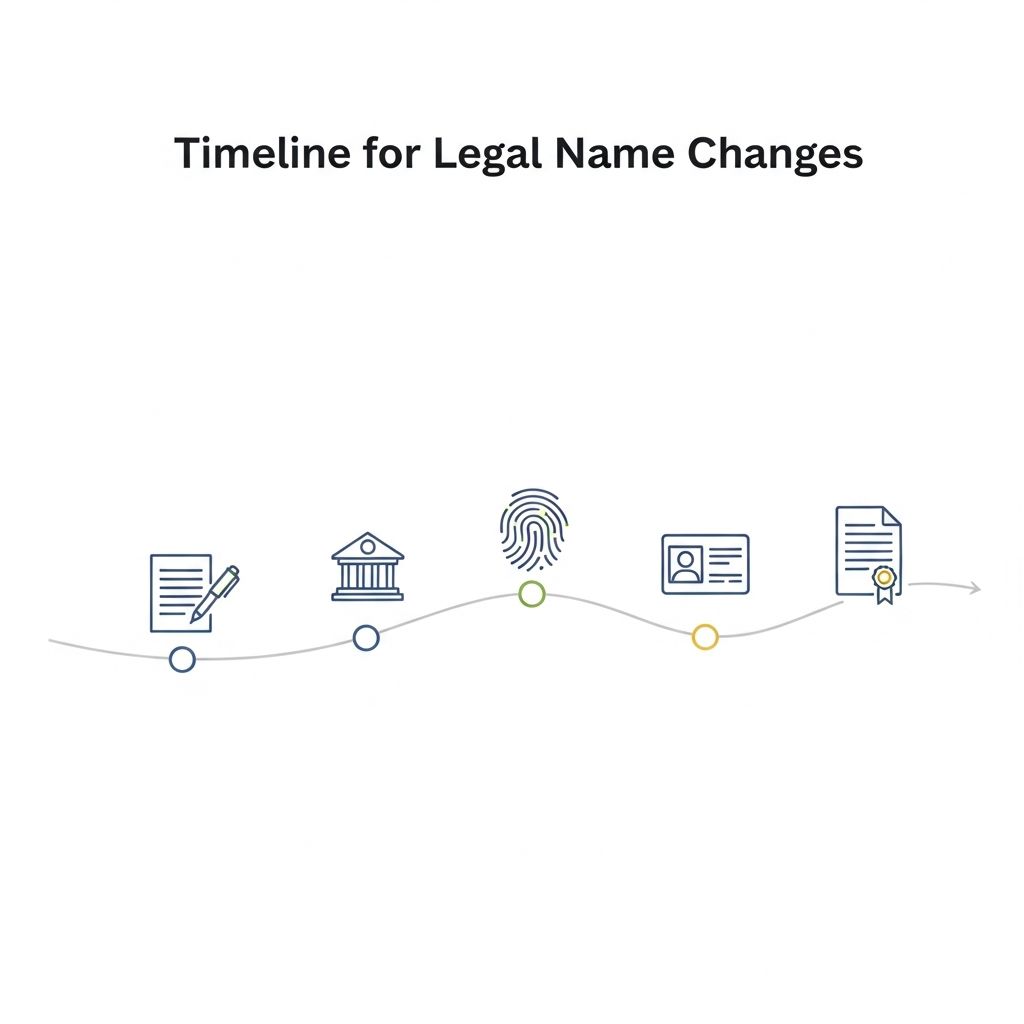
Legally altering your name involves a structured court process that typically spans 2 to 6 months, depending on your location, case complexity, and court schedules. This guide outlines every phase, from initial filing to final document updates, helping you plan effectively.
Reasons Individuals Seek Name Modifications
People pursue name changes for diverse personal, familial, or identity-related motivations. Marriage or divorce often prompts informal shifts, but formal court approval is needed for unique surnames, gender alignment, or post-adoption adjustments. Personal preference, escaping negative associations, or cultural integration also drive petitions. Courts scrutinize requests to prevent fraud, requiring petitioners to demonstrate legitimate intent without criminal evasion.
- Marriage/Divorce: Spouses may adopt partner’s name or create hybrids, but court orders are essential for non-standard changes.
- Gender Transition: Aligning legal name with identity, often exempt from public notice in progressive states.
- Adoption/Guardianship: Minors receive new family names with parental consent.
- Personal Reasons: Simplifying pronunciation or honoring heritage.
Core Steps in the Adult Name Change Procedure
The process commences with paperwork submission to your local superior or circuit court. Expect fees of $400-$500, waivable for low-income filers. Key forms include petitions detailing current and proposed names, personal history, and supporting affidavits.
| Step | Description | Typical Duration |
|---|---|---|
| 1. Form Preparation | Gather ID, background info; complete petition (e.g., NC-100 in CA). | 1-2 weeks |
| 2. Court Filing | Submit originals + copies; pay fee or request waiver. | 1 day |
| 3. Hearing Scheduling | Court assigns date; publish notice if required. | 4-8 weeks |
| 4. Publication | Advertise in local paper for 4-6 weeks (waived for safety/gender cases). | 1 month |
| 5. Court Hearing | Appear, present evidence; judge approves/denies. | 1 day (2-3 months post-filing) |
| 6. Decree Issuance | Receive certified court order (NC-130). | 1-2 weeks |
In California, the full cycle from filing to decree often concludes in 2-3 months, assuming no objections.
Navigating Publication and Notice Requirements
Most jurisdictions mandate public notification via newspaper to invite objections, ensuring transparency. This step, costing $50-$200, runs for 4 consecutive weeks in a general circulation paper’s legal section. Exceptions apply for victims of domestic violence, gender changes, or minors.
- Print petition excerpts weekly.
- File proof of publication with court pre-hearing.
- Some states allow online alternatives or waivers via affidavit.
Failure to publish invalidates the petition, delaying proceedings. Post-publication, any objector (e.g., creditor) must file opposition timely.
Court Hearings: What to Anticipate
Hearings last 10-30 minutes. Arrive early with multiple decree copies, photo ID, fingerprints (if required), and criminal clearance. Explain your rationale succinctly; judges probe for fraudulent motives like debt dodging. Uncontested cases approve swiftly; contested ones extend timelines.
Virtual options emerged post-pandemic in many courts, reducing travel. If approved, sign the decree on-site or collect later. Certified copies ($20-$40 each) prove the change for agencies.
Special Considerations for Minor Name Changes
Altering a child’s name demands both parents’ consent or judicial override. File joint petitions if agreeing; solo filers serve the other parent legally. Courts prioritize child welfare, often requiring impact assessments.
- Complete child-specific forms (e.g., NC-110).
- Publish notice (parental consent may waive).
- Attend hearing; judge interviews minors over 12-14 in some areas.
- Obtain decree for birth certificate updates.
Post-divorce stepparent adoptions streamline via family court. Total time: 2-4 months. Contested cases escalate to custody disputes, prolonging resolution.
Updating Official Documents After Approval
The decree triggers a cascade of notifications. Prioritize IDs for verification chains. Processing varies: driver’s licenses (1-4 weeks), passports (6-8 weeks expedited).
| Document/Entity | Update Method | Timeline |
|---|---|---|
| Social Security Card | Mail SSA-5 form + decree. | 2-4 weeks |
| Driver’s License/ID | DMV visit with decree. | 1-2 weeks |
| Passport | Submit DS-5504/DS-82 + decree. | 4-6 weeks routine |
| Birth Certificate | State vital records office. | 4-8 weeks |
| Bank/Finance | Branch visit with decree + ID. | Immediate |
| Voter Registration | Online/state form. | 1 week |
Employers update payroll/HR instantly. Professional licenses (e.g., medical) require state board filings, potentially months.
Factors Influencing Overall Duration
Court backlogs in populous areas like California or New York stretch waits to 4-6 months. Rural courts process faster. Peak seasons (post-holidays) delay scheduling. Objections or incomplete forms reset clocks. Proactive filers with fee waivers and e-filing shave weeks.
- Expedited Paths: Uncontested adult changes sans publication (gender cases).
- Delays: Criminal history reviews, holidays, pandemics.
Costs Associated with the Process
Beyond filing ($435-$450 CA), budget $100-$300 publication, $50 fingerprints, $100+ certified copies. Attorney fees ($500-$2000) optional but wise for complexities. Waivers cover courts; nonprofits aid pro se filers.
State Variations in Procedures
While nationwide basics align, details diverge. California emphasizes publication; Texas allows marriage-based changes sans court. New York mandates background checks. Always consult local clerk or self-help portal.
Frequently Asked Questions
Can I change my name without court approval?
Only via marriage/divorce certificates; other changes require petitions.
How soon after decree can I use the new name?
Immediately for informal use; update IDs first for official purposes.
Do I need a lawyer for name change?
Not mandatory; self-help suffices for simple cases.
What if the other parent objects to child’s name change?
Court decides based on child’s best interest; mediation encouraged.
Can felons change names?
Yes, post-sentence, absent fraud intent.
Potential Pitfalls and Pro Tips
Avoid generic names or trademarks. Dual citizenship complicates passports. Notify IRS for tax filings. Track all updates systematically. Legal aid societies offer free clinics.
References
- Start the name change process – California Courts | Self Help Guide — California Courts Self Help. 2023. https://selfhelp.courts.ca.gov/name-change/name-adult/fill-forms
- How to Legally Change Your Name: A Complete Guide — LegalZoom. 2023. https://www.legalzoom.com/articles/the-complete-guide-to-legally-changing-your-name
- How to change your name and what government agencies to notify — USA.gov. 2025-02-01. https://www.usa.gov/name-change
- Name Change for Adults | Superior Court of California — Orange County Superior Court. 2023. https://www.occourts.org/self-help/name-change/name-change-adults
- Change your name in California – California Courts | Self Help Guide — California Courts Self Help. 2023. https://selfhelp.courts.ca.gov/name-change
- Change child’s name both parents – California Courts | Self Help Guide — California Courts Self Help. 2023. https://selfhelp.courts.ca.gov/name-change/name-child
- Name Change | Superior Court of California | County of Orange — Orange County Superior Court. 2023. https://www.occourts.org/self-help/name-change
Similar Articles








Read full bio of Sneha Tete


