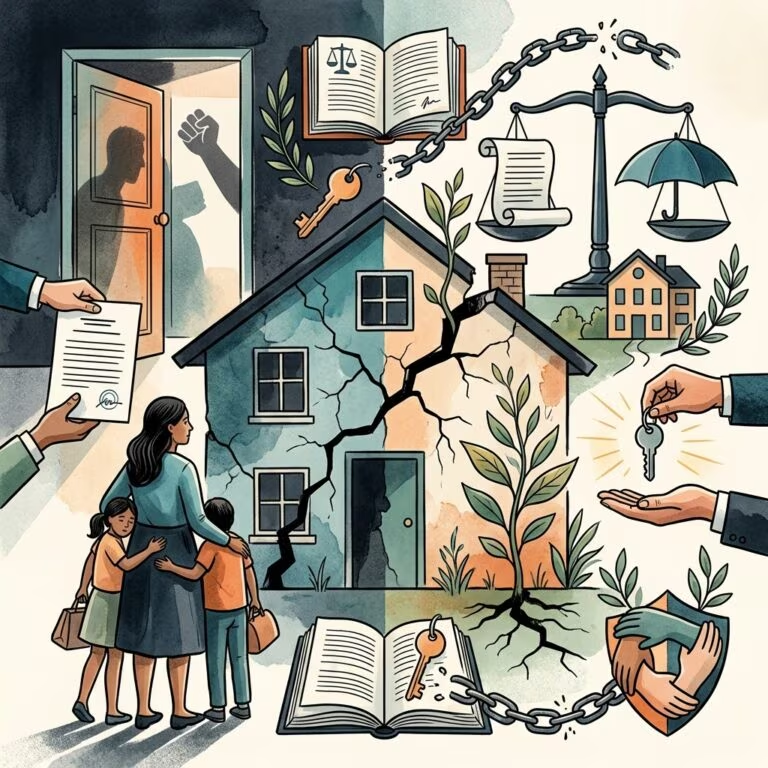
For decades, the cornerstone of child rights advocacy in the United States has been the courtroom. When child welfare systems fail to protect the vulnerable youth entrusted to their care, advocates have historically turned to class-action litigation to force systemic compliance and hold state agencies accountable. However, a profound paradigm shift is currently underway within the sector. Leading advocacy organizations are increasingly recognizing that while litigation is a powerful tool for halting immediate harm, sustainable, long-term transformation requires proactive legislative change. This realization has sparked a strategic pivot toward robust, systemic policy advocacy.
At the heart of this transition is the emergence of dedicated policy divisions within child advocacy organizations, often spearheaded by a Director of Policy. These specialized departments are tasked with moving the battleground from the judge’s bench to the legislative floor. By drafting comprehensive legislation, building cross-sector coalitions, and centering the voices of those with lived experience, these policy advocates are addressing the root causes of systemic failures—such as racial disproportionality, the criminalization of poverty, and the trauma of unnecessary family separation. This article explores the vital evolution of child welfare advocacy and the critical priorities driving modern systemic reform.
The Evolution of Child Advocacy: Beyond the Courtroom
The history of child welfare reform is deeply intertwined with high-stakes litigation. Class-action lawsuits have successfully exposed egregious conditions in foster care, leading to federal consent decrees that mandate specific improvements in state agencies. These legal battles have undeniably saved lives by enforcing basic safety standards, capping caseworker loads, and ensuring access to necessary medical and mental health services for children in state custody.
Yet, litigation is inherently reactive. A lawsuit is typically filed only after a system has already collapsed and children have already suffered significant harm. Furthermore, consent decrees—while legally binding—often take decades to fully implement, and they are frequently contested by state governments facing budget constraints. Once court oversight ends, agencies can sometimes backslide into old, dysfunctional habits if the underlying statutory framework remains unchanged.
Recognizing these limitations, the child welfare advocacy sector is evolving. Organizations are investing heavily in policy advocacy as a complementary strategy to litigation. Rather than waiting for a system to break the law, policy advocates work to change the law itself. By engaging directly with lawmakers, agency directors, and community leaders, child rights defenders can engineer statutory frameworks that prioritize family preservation and preventative support over surveillance and family separation.
Defining the Role: What Does a Policy Director in Child Welfare Do?
The establishment of a dedicated policy director role represents a maturation of a child advocacy organization’s strategy. A policy director serves as the architect of an organization’s legislative agenda, bridging the gap between legal theory, on-the-ground reality, and political viability. Their work is multifaceted and requires a deep understanding of administrative law, federal funding streams (such as Title IV-E), and community organizing.
Key responsibilities of a policy division in child welfare include:
- Legislative Drafting and Analysis: Reviewing proposed state and federal legislation to determine its impact on vulnerable children and families, and drafting original bills that promote systemic equity.
- Strategic Advocacy and Lobbying: Educating lawmakers and public officials about the realities of the foster care system, presenting data-driven arguments to secure essential funding for preventative services.
- Coalition Building: Partnering with other civil rights organizations, community-based support groups, and healthcare providers to create a unified front for systemic reform.
- Administrative Advocacy: Working directly with state child welfare agencies to reform internal rules, training protocols, and operational guidelines without the need for formal legislation.
- Centering Lived Experience: Ensuring that the voices of foster youth, parents who have navigated the system, and kinship caregivers are at the forefront of policy discussions and decision-making processes.
Litigation vs. Policy Advocacy: A Synergistic Approach
It is important to note that policy advocacy does not replace litigation; rather, the two strategies work synergistically. Litigation provides the “stick”—the threat of court-ordered mandates—while policy advocacy offers the “carrot”—the collaborative blueprint for how to build a better system. The most effective child rights organizations utilize both tools simultaneously to achieve comprehensive reform.
| Dimension | Class-Action Litigation | Systemic Policy Advocacy |
|---|---|---|
| Primary Focus | Reactive; addressing existing constitutional violations and harm. | Proactive; changing laws and structures to prevent harm from occurring. |
| Mechanism of Change | Judicial rulings, settlement agreements, and consent decrees. | Legislative bills, statutory amendments, and administrative rule changes. |
| Timeline | Often extremely lengthy (years or decades) for resolution and monitoring. | Variable; can be rapid during a legislative session or require multi-year campaigns. |
| Scope of Impact | Typically limited to the specific state or county agency being sued. | Can reshape funding streams and laws on a statewide or national level. |
Key Priorities for Systemic Policy Reform
As child advocacy organizations expand their policy footprints, their agendas are increasingly focused on dismantling the structural inequities embedded within the child protection system. The modern policy agenda is driven by the understanding that the child welfare system, as currently constructed, often inflicts trauma rather than healing it. Several core priorities dominate the current policy landscape.
1. Eradicating Racial and Ethnic Disproportionality
One of the most pressing issues in child welfare today is the profound racial disproportionality that exists at every decision point in the system. Data from the Administration for Children and Families (ACF) consistently reveals that Black and Native American children are investigated, removed from their homes, and placed in foster care at rates vastly disproportionate to their representation in the general population. These disparities are not indicative of higher rates of abuse within these communities, but rather reflect systemic biases, historical inequalities, and the over-surveillance of marginalized neighborhoods.
Policy advocates are aggressively pushing for legislative changes to address this disproportionality. This includes advocating for “blind removal” processes—where the race and demographic details of a family are redacted when an agency decides whether to remove a child—and fighting to strengthen and uphold the Indian Child Welfare Act (ICWA). Furthermore, policy directors work to implement culturally responsive training mandates and demand strict data reporting requirements to hold agencies accountable for racially disparate outcomes.
2. Redefining Neglect vs. Poverty
A staggering majority of children who enter the foster care system are not removed due to physical or sexual abuse, but rather due to “neglect.” However, in the United States, the legal definition of neglect is frequently conflated with the symptoms of poverty. Families are routinely separated because they lack access to stable housing, adequate food, or affordable childcare. Punishing families for being poor by separating parents from their children causes irreparable psychological trauma.
A central pillar of modern policy advocacy is the push to uncouple poverty from neglect. Policy divisions are championing legislation that redefines actionable neglect, ensuring that a lack of financial resources cannot be the sole basis for a child’s removal. Furthermore, advocates are pushing for a shift toward a “mandatory supporting” framework rather than “mandatory reporting.” This involves redirecting state and federal funds away from foster care placements and toward concrete economic supports for families in crisis, such as rent assistance, food subsidies, and direct cash transfers.
3. Reforming Congregate Care and Prioritizing Kinship
Historically, a significant portion of foster youth—particularly older adolescents and those with behavioral health needs—have been placed in institutional settings such as group homes and residential treatment centers. Extensive research has demonstrated that congregate care settings often exacerbate trauma, lead to poorer educational outcomes, and increase the likelihood of involvement with the juvenile justice system.
Policy advocates have been instrumental in driving the implementation of the federal Family First Prevention Services Act, which restricts federal funding for congregate care and redirects those funds toward preventative services and family-based placements. On a state level, policy teams advocate for increased financial stipends and support services for kinship caregivers (grandparents, aunts, uncles), recognizing that children fare significantly better when placed with family members rather than strangers or in institutional settings.
4. Supporting Youth Aging Out of Care
Every year, approximately 18,500 youth age out of the foster care system without a permanent family connection. These young adults face daunting statistical odds, experiencing disproportionately high rates of homelessness, incarceration, early parenthood, and unemployment. The transition to adulthood is perilous for youth who lack a familial safety net.
Policy divisions dedicate substantial resources to drafting transition-age youth policies. This includes advocating for the extension of foster care benefits up to age 21 across all states, guaranteeing free college tuition for care leavers, and ensuring automatic enrollment in Medicaid up to age 26. Furthermore, policy experts are fighting for guaranteed housing vouchers and specialized transitional living programs that provide life-skills training and financial literacy education.
Building Coalitions and Centering Lived Experiences
A defining characteristic of modern systemic policy advocacy is its collaborative nature. The era of lawyers and lobbyists drafting legislation in isolation is fading. Today, effective policy change requires the active participation of the communities most impacted by the child welfare system. Policy directors prioritize the formation of broad-based coalitions that include civil rights groups, public health professionals, and grassroots community organizers.
Most importantly, systemic policy advocacy must center “lived experience.” Foster youth alumni and parents who have successfully navigated the child protection system possess unparalleled expertise regarding the system’s flaws and potential solutions. Advocacy organizations are increasingly establishing advisory boards composed of former foster youth and impacted parents to review legislative proposals and testify before legislative committees. By amplifying these voices, policy advocates ensure that proposed reforms are grounded in reality and genuinely responsive to the needs of families.
The Future of Child Rights Legislation
As child welfare advocacy continues to evolve, the integration of robust policy divisions will be critical to achieving lasting systemic change. While litigation will remain an essential safeguard against egregious agency misconduct, proactive policy advocacy holds the key to reimagining the system entirely. By shifting the focus from reactive punishment to proactive family support, policy advocates are working to build a future where the child welfare system genuinely functions as a source of healing and stabilization.
The transition toward systemic policy advocacy represents a beacon of hope for millions of vulnerable children and families. With dedicated policy leadership driving the agenda, the child rights movement is better equipped than ever to dismantle discriminatory structures, end the criminalization of poverty, and ensure that every child has the opportunity to grow up in a safe, loving, and permanent home.
Frequently Asked Questions (FAQs)
What is the difference between child welfare litigation and policy advocacy?
Litigation involves taking legal action (suing) state agencies in a court of law to correct specific, ongoing constitutional violations or failures within the foster care system. Policy advocacy involves working with lawmakers and government officials to proactively change laws, statutes, and funding mechanisms to prevent harm and improve the system on a broader, systemic level.
Why are racial disparities so prevalent in the foster care system?
Racial disparities in child welfare stem from a combination of historical inequities, systemic biases within reporting and assessment protocols, and the disproportionate surveillance of low-income communities of color by mandated reporters. Policy advocates are fighting to implement blind removals and culturally responsive training to mitigate these systemic biases.
What does it mean to “conflate poverty with neglect”?
In many jurisdictions, the legal definition of neglect is broad enough that a family’s inability to afford adequate housing, food, or childcare is penalized as child neglect. Advocates argue that removing a child because the family is poor traumatizes the child; instead, the state should provide economic support to help the family meet their basic needs.
How does the Family First Prevention Services Act relate to policy advocacy?
The Family First Prevention Services Act is a landmark piece of federal legislation that allows states to use federal Title IV-E funds for preventative services (like mental health and substance abuse treatment) to keep children with their families, rather than solely funding foster care placements. Policy advocates were critical in shaping this law and continue to work on its effective implementation at the state level.
References
- Data and Statistics: AFCARS — Administration for Children and Families (ACF), U.S. Department of Health and Human Services. 2025-05-01. https://www.acf.hhs.gov/cb/data-research/afcars
- Accountability in the Courtroom: Review of Child Welfare Litigation and Required Reforms — Bipartisan Policy Center. 2025-12-11. https://bipartisanpolicy.org/report/child-welfare-litigation/
- Data – California Department of Social Services — California Department of Social Services, Research and Data Insights Branch / CCWIP. 2024-01-01. https://www.cdss.ca.gov/inforesources/data