
The Unresolved Crisis: How the Supreme Court Left Emergency Abortion Care in Limbo
Analyzing the Supreme Court's procedural sidestep on EMTALA and Idaho's abortion ban.
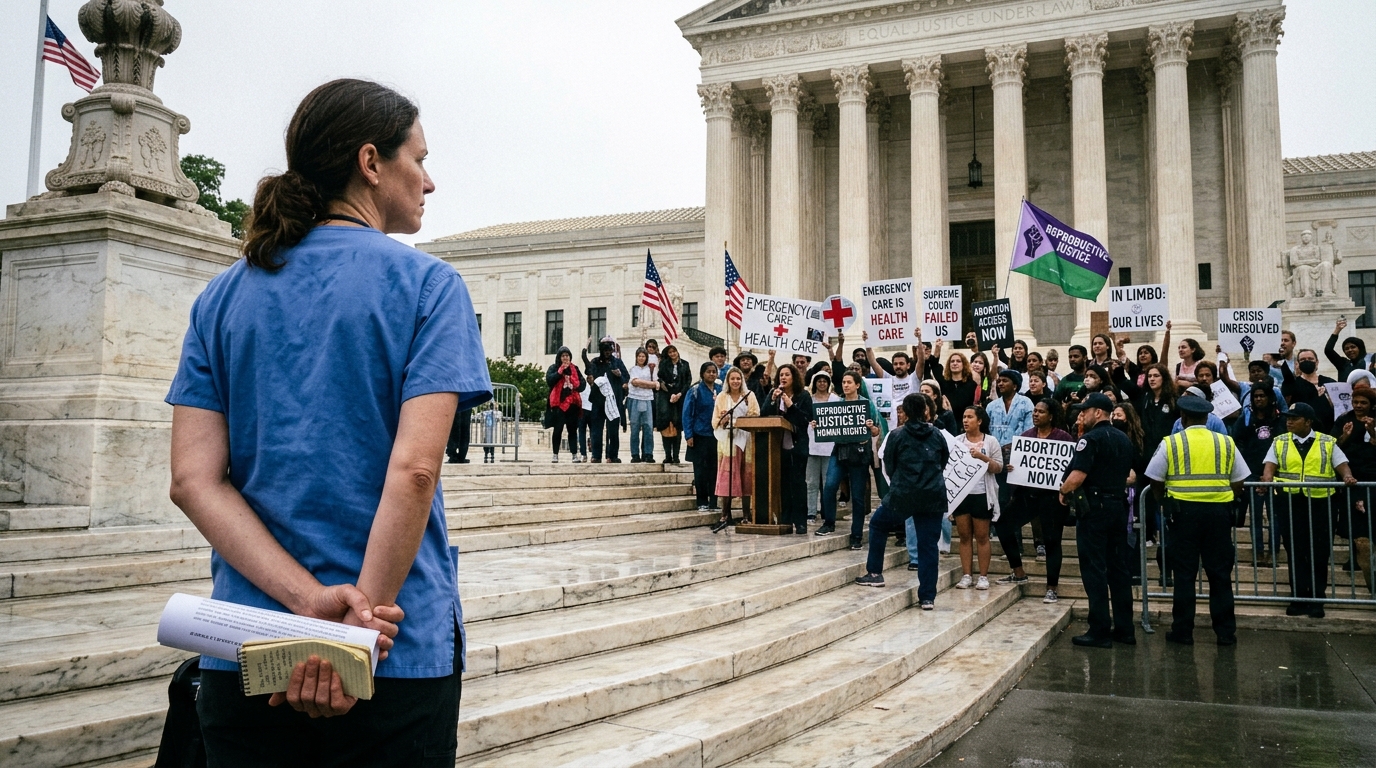
The Supreme Court’s Anti-Climactic Action on Reproductive Healthcare
In a highly anticipated legal showdown that ultimately resulted in a procedural anti-climax, the United States Supreme Court issued its ruling on Moyle v. United States (consolidated with Idaho v. United States) in late June 2024. The case struck at the very heart of post-Roe America, asking a fundamental and urgent question: When state laws enact near-total bans on abortion, does a federal statute mandating emergency medical care override those bans to protect the life and health of a pregnant patient? Rather than providing a definitive answer to this constitutional clash, the Court opted for a procedural maneuver, dismissing the case as “improvidently granted.”
While this decision temporarily restored vital healthcare protections for pregnant individuals in Idaho by reinstating a lower court’s injunction, it failed to establish a nationwide precedent. The justices sidestepped the core legal questions, leaving the intersection of emergency medicine and state-level abortion restrictions in a precarious state of legal limbo. For healthcare providers and patients alike, the lack of a definitive national ruling ensures that the chaos surrounding emergency obstetric care will continue to unfold in federal appellate courts across the country.
The Federal Baseline: Understanding EMTALA
To comprehend the gravity of this legal conflict, it is essential to understand the foundation of the federal law at the center of the dispute. Enacted by Congress in 1986, the Emergency Medical Treatment and Labor Act (EMTALA) was designed as a crucial federal safety net. Its primary goal was to prevent a discriminatory practice known as “patient dumping.” Historically, some medical facilities would turn away uninsured, indigent, or vulnerable patients, or transfer them to public hospitals without stabilizing them first, often with catastrophic or fatal consequences for the patient.
EMTALA mandates that any hospital receiving Medicare funding—which encompasses the vast majority of hospital infrastructure in the United States—must adhere to strict protocols when an individual seeks emergency care. The statute requires hospitals to provide an appropriate medical screening examination to any individual who presents at the emergency department. If an “emergency medical condition” is identified, the hospital is federally obligated to provide stabilizing treatment within its capabilities before the patient can be discharged or transferred.
Crucially, federal regulations define an emergency medical condition as one that manifests itself by acute symptoms of sufficient severity such that the absence of immediate medical attention could reasonably be expected to result in:
- Placing the individual’s overall health in serious jeopardy.
- Serious impairment to bodily functions.
- Serious dysfunction of any bodily organ or part.
For pregnant patients experiencing severe and sudden complications—such as preterm premature rupture of membranes (PPROM), severe preeclampsia, massive hemorrhaging, or uncontrollable sepsis—the standard medical intervention required to stabilize the patient, prevent organ failure, and preserve future fertility is, in many instances, a pregnancy termination. Under the Biden administration’s interpretation, if an abortion is the necessary stabilizing treatment for an emergency medical condition, EMTALA requires the hospital to provide it.
The Collision Course: State Sovereignty vs. Federal Supremacy
Following the Supreme Court’s landmark 2022 decision in Dobbs v. Jackson Women’s Health Organization, which eliminated the federal constitutional right to an abortion, several conservative states swiftly enacted sweeping bans on the procedure. Idaho implemented one of the most restrictive laws in the nation, known as the Defense of Life Act. This statute criminalized abortion providers, making the procedure a felony punishable by severe prison sentences and the revocation of medical licenses.
Idaho’s law offered only a narrow affirmative defense: a physician could attempt to avoid conviction by proving the abortion was strictly necessary to prevent the death of the pregnant woman. The stark contrast between Idaho’s law and federal regulations created an immediate, intractable conflict for emergency room personnel. Idaho’s ban permitted medical intervention only when a patient was actively dying. EMTALA, conversely, requires medical intervention much earlier in the timeline of an emergency—when a patient’s health is in “serious jeopardy,” even if death is not yet imminent.
In response to this severe legislative clash, the federal government sued the state of Idaho. The Department of Justice argued under the Supremacy Clause of the U.S. Constitution (Article VI, Paragraph 2) that federal law preempts conflicting state law. They asserted that because hospitals are bound by EMTALA to stabilize patients facing severe health risks, they must provide abortions when medically necessary, regardless of state-level criminal prohibitions. A federal district court originally agreed, issuing a preliminary injunction that blocked Idaho from enforcing its ban in EMTALA-covered emergencies. However, state officials appealed, and the Supreme Court initially stayed (paused) the lower court’s ruling, allowing the total ban to take effect while agreeing to hear the case on an expedited basis.
The Supreme Court’s Procedural Sidestep
When the Supreme Court finally released its per curiam decision in the summer of 2024, it did not resolve the profound constitutional questions it had agreed to review. Instead, the Court vacated its previous stay and dismissed the writ of certiorari as “improvidently granted” (a maneuver commonly referred to in legal circles as a DIG). In practical terms, this means a majority of the justices decided, after hearing oral arguments and reviewing briefs, that they should not have accepted the case at such an early stage in the appellate process.
By dismissing the case, the Supreme Court effectively returned the litigation to the U.S. Court of Appeals for the Ninth Circuit for further proceedings on the merits. As a direct consequence of vacating the stay, the district court’s original preliminary injunction immediately went back into effect. This procedural reset meant that emergency room physicians in Idaho could once again legally perform abortions when medically necessary to stabilize a patient’s health, shielding them from the immediate threat of state prosecution.
However, the lack of a definitive ruling on the merits frustrated legal scholars, healthcare advocates, and politicians across the ideological spectrum. As Justice Elena Kagan vividly noted in her concurring opinion, the on-the-ground reality during the months the Supreme Court’s stay was in effect was devastating. Without the protection of EMTALA, Idaho’s largest emergency services provider was forced to airlift pregnant women out of the state roughly every other week to receive stabilizing care in neighboring jurisdictions. Meanwhile, conservative dissenting justices, including Justice Samuel Alito, sharply criticized the majority for avoiding the core issue. Alito argued that the Court was merely “ducking” a critical legal controversy regarding state sovereignty and fetal rights that it would inevitably have to confront.
The Chilling Effect on Emergency Medicine
The Supreme Court’s refusal to issue a definitive national ruling leaves healthcare providers in a sustained state of anxiety, ethical distress, and operational confusion. Emergency medicine is inherently characterized by rapid triage and split-second decision-making in high-stakes environments. When physicians are forced to pause critical care to consult hospital legal counsel to interpret conflicting state and federal laws before treating a hemorrhaging patient, the resulting delay can lead to irreversible physical harm.
In states with stringent criminal bans akin to Idaho’s, doctors face a harrowing, no-win dilemma. They must choose whether to comply with EMTALA’s federal mandate to stabilize a patient’s health—thereby risking state-level felony charges and imprisonment—or to comply with the state ban by delaying care until the patient’s condition deteriorates to the point of imminent death, thereby violating federal law and their fundamental medical oath to do no harm.
This ongoing legal tightrope has severely destabilized the maternal healthcare workforce nationwide. Growing bodies of evidence indicate a stark reluctance among medical students, residents, and established obstetricians to train or practice in states where their ability to provide standard, evidence-based emergency care is criminalized. The resulting medical brain drain further degrades the overall infrastructure of maternal health, endangering not only those seeking abortion care but all individuals who may encounter unexpected and severe pregnancy complications.
A Deeply Fractured Healthcare Landscape
Because the Supreme Court’s non-decision in Moyle v. United States failed to settle the preemption question, access to emergency reproductive care remains deeply fractured across state lines. While the Ninth Circuit deliberates on the specific contours of the Idaho case, similar, contradictory legal battles are unfolding in other federal jurisdictions.
Most notably, in Texas, state officials launched a preemptive lawsuit challenging the Biden administration’s authority to enforce EMTALA guidance that conflicts with Texas’s own near-total abortion ban. In that parallel case, the conservative-leaning U.S. Court of Appeals for the Fifth Circuit ruled against the federal government, concluding that EMTALA does not mandate abortion care and does not preempt Texas law. This has created a stark “circuit split”—a situation where different federal appellate courts interpret the exact same federal law in fundamentally contradictory ways.
This state-by-state patchwork creates an unequal and dangerous healthcare landscape. A pregnant patient experiencing a catastrophic placental abruption or severe intrauterine infection in a state with protective injunctions may receive immediate, life-saving care. Yet, a patient experiencing the exact same medical crisis just a few miles away across a state border may be denied care until their vital organs begin to fail, or they may be forced to endure a costly and medically risky transport to a neighboring jurisdiction. Because of the existing circuit split, legal experts widely agree that the Supreme Court will eventually be forced to take up the EMTALA issue once again to provide national uniformity.
Conclusion: A Crisis Deferred
The Supreme Court’s dismissal of Moyle v. United States is not the conclusion of this historic legal battle; it is merely a postponement. While the immediate reinstatement of the injunction in Idaho provided critical, life-saving relief to pregnant patients and necessary legal cover for medical providers within that specific state’s borders, the overarching constitutional tension between the federal government’s healthcare mandates and state-level abortion bans remains fundamentally unresolved.
Until the highest court provides unequivocal clarity on the scope of the Emergency Medical Treatment and Labor Act, emergency room doctors will continue to operate under the heavy shadow of criminalization. Furthermore, pregnant patients will continue to navigate a fractured, unpredictable healthcare system where their fundamental right to receive standard, life-saving medical care depends entirely on their geographic location and the prevailing political winds of their state legislature.
Frequently Asked Questions
What is the core legal conflict in Moyle v. United States?
The case revolves around a direct conflict between a federal healthcare statute (EMTALA), which requires Medicare-funded hospitals to provide stabilizing emergency medical care (which can medically necessitate an abortion), and Idaho’s Defense of Life Act, a state law that criminalizes abortions unless the patient’s life is explicitly and imminently in danger.
What does it mean when the Supreme Court dismisses a case as “improvidently granted”?
Often referred to as a “DIG,” this procedural move means the Supreme Court has decided in hindsight that it should not have taken up the case for review at its current stage. The Court dismisses the appeal without issuing a ruling on the underlying legal questions, thereby sending the case back to the lower appellate courts for further litigation.
Are emergency abortions currently legal in Idaho?
Yes, for the time being. As a result of the Supreme Court’s June 2024 procedural dismissal, a previous lower court preliminary injunction was reinstated. This injunction temporarily prevents Idaho from enforcing its criminal abortion ban in specific, severe medical emergencies where EMTALA requires stabilizing care, allowing physicians to perform necessary procedures while the case proceeds through the Ninth Circuit.
How does this Supreme Court decision impact states other than Idaho?
Because the Supreme Court deliberately avoided issuing a ruling on the merits of the federal preemption argument, the decision does not establish a national legal precedent. Consequently, the conflict remains unresolved nationwide. Medical providers in other states with strict abortion bans remain vulnerable to conflicting federal directives and state criminal laws, leading to disparate standards of emergency care across the country.
What exactly is the EMTALA law?
The Emergency Medical Treatment and Labor Act (EMTALA) is a federal law enacted in 1986 to prevent “patient dumping.” It legally requires any hospital that receives Medicare funding to provide a comprehensive medical screening exam and stabilizing treatment to anyone who presents at an emergency room with a severe medical condition, regardless of their insurance status, ability to pay, or conflicting state regulations.
References
- 23-726 Moyle v. United States (06/27/2024) — Supreme Court of the United States. 2024-06-27. https://www.supremecourt.gov/opinions/23pdf/23-726_6j37.pdf
- Emergency Medical Treatment & Labor Act (EMTALA) — Centers for Medicare & Medicaid Services (CMS). 2026-03-10. https://www.cms.gov/medicare/regulations-guidance/legislation/emergency-medical-treatment-labor-act
- Emergency Abortion Care to Preserve the Health of Pregnant People: SCOTUS, EMTALA, and Beyond — KFF. 2024-06-27. https://www.kff.org/womens-health-policy/issue-brief/emergency-abortion-care-to-preserve-the-health-of-pregnant-people-scotus-emtala-and-beyond/
- Moyle v. United States — Oyez. 2024-06-27. https://www.oyez.org/cases/2023/23-726
Similar Articles








Read full bio of medha deb


