
Strategic Legal Partnerships: Driving Child Welfare Reform in the Southeast
How high-powered corporate law firms are teaming up with nonprofit watchdogs to demand systemic reform and protect vulnerable children in state care.
The Imperative for Systemic Change in the Southeast
Across the United States, the child welfare system operates as a vital safety net, designed to protect minors who have experienced abuse or neglect. However, in many regions—particularly in the Southeast—state-managed child protective services and foster care systems are experiencing unprecedented strain. Chronic underfunding, high caseworker turnover, and a lack of appropriate housing placements have left tens of thousands of children in precarious situations. According to data from the Administration for Children and Families, hundreds of thousands of children engage with the foster care system annually, often facing long-term psychological and educational hurdles as a result of institutional instability.
The Southern United States features unique demographic and economic challenges, including rapid population growth paired with localized areas of deep, generational poverty. These factors contribute to a high volume of child welfare caseloads that overburden state agencies. When a state takes custody of a child, it assumes a constitutional obligation under the Fourteenth Amendment to protect that child from further harm and provide for their basic needs. Unfortunately, bureaucratic inefficiencies frequently result in the violation of these fundamental rights. Children are sometimes housed in unregulated motels, forced to sleep in administrative offices, or separated from their siblings due to a sheer lack of available, licensed foster homes.
Addressing these systemic failures requires more than incremental policy tweaks; it demands rigorous oversight and legal accountability. Because children in state custody cannot vote, lobby, or financially support political campaigns, they are effectively voiceless in the legislative process. This structural vulnerability necessitates the intervention of external legal watchdogs who can use the federal court system to compel states to fulfill their constitutional duties to vulnerable youth.
The Strategic Role of Nonprofit Legal Watchdogs
Nonprofit child advocacy organizations and legal watchdogs serve as the primary mechanism for enforcing the rights of children in state care. These groups are uniquely equipped to investigate systemic abuses, aggregate data, and file complex class-action lawsuits against state agencies. Their primary goal is not to win financial damages, but to secure federal consent decrees—legally binding agreements that require states to overhaul their child welfare operations under the supervision of court-appointed independent monitors.
These organizations focus on the most severe and widespread failures within child protective systems. Their investigations often reveal harrowing patterns: children being heavily over-medicated with psychotropic drugs without proper psychiatric oversight, youth being moved across dozens of different temporary homes in a single year, and older teenagers being abruptly discharged from state care straight into homelessness. By documenting these patterns, watchdogs translate the silent suffering of marginalized youth into actionable legal claims.
However, litigating against state governments is an immensely resource-intensive endeavor. State agencies are backed by taxpayer-funded legal departments and can afford to drag out litigation for years through procedural delays and endless appeals. For a nonprofit watchdog relying on donor funding and grants, taking a massive institutional reform case to trial can drain operational budgets entirely. This stark resource disparity is where the corporate legal sector becomes an indispensable ally.
Bridging the Resource Gap with Corporate Legal Partnerships
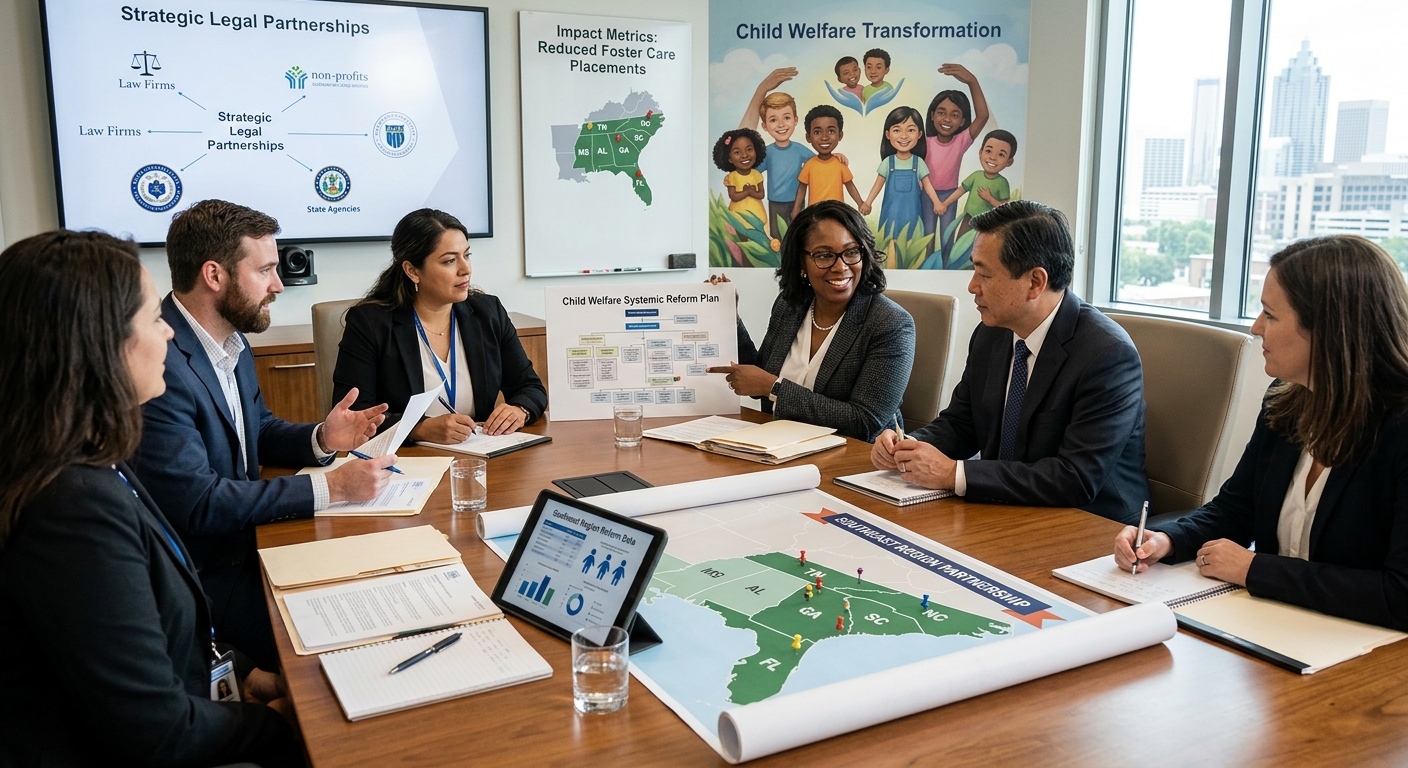
To level the playing field against well-funded state bureaucracies, nonprofit watchdogs increasingly rely on strategic partnerships with high-powered private law firms. In the Southeast, major litigation firms have begun integrating child welfare advocacy into their core operations, transforming traditional pro bono work into highly integrated, multi-year alliances.
Unlike standard pro bono arrangements—where an individual attorney might take on a single, isolated custody or immigration case—these institutional partnerships are comprehensive. A corporate law firm brings an arsenal of resources to the table. Beyond simply dedicating thousands of billable hours from senior partners and junior associates, these firms often provide physical infrastructure. It is not uncommon for a major firm to grant the nonprofit rent-free office space within their commercial real estate footprint, significantly reducing the advocacy group’s overhead costs.
Furthermore, corporate firms offer extensive administrative and paralegal support. Class-action lawsuits involve millions of pages of discovery, including heavily redacted medical files, caseworker logs, and internal state communications. Large firms possess the advanced legal technology, e-discovery software, and administrative staffing required to process this overwhelming volume of evidence. By absorbing these logistical burdens, private law firms free up the watchdog’s specialized civil rights attorneys to focus strictly on legal strategy and trial preparation.
Litigation as a Tool for Institutional Reform
The ultimate objective of these legal partnerships is to secure structural, permanent change through the federal courts. When a federal judge rules that a state’s foster care system violates the constitutional rights of its wards, the resulting court orders dictate sweeping operational changes. These lawsuits are not quick fixes; they are decade-long commitments that redefine how child welfare agencies function.
For example, in prominent foster care litigation originating in states like Texas and Florida, federal judges have mandated the implementation of strict caseload limits for social workers. When caseworkers are forced to manage upwards of 30 or 40 children at once, meaningful supervision becomes mathematically impossible. Court orders forced through watchdog litigation cap these numbers, ensuring that state employees actually have the time to visit their assigned foster homes, assess the children’s well-being, and catch signs of abuse before tragedies occur.
Another major outcome of this litigation is the enforced creation of specialized placements. State agencies are frequently mandated to increase funding to recruit and retain therapeutic foster homes capable of caring for children with severe emotional or physical trauma. Moreover, court orders often establish permanent, independent oversight bodies. These external monitors report directly to the federal judge, issuing semi-annual assessments on the state’s compliance with the reform mandates. If the state fails to meet its benchmarks, the plaintiffs’ legal team—backed by their corporate law firm partners—can file motions for contempt, forcing the state to comply.
Key Focus Areas in Child Welfare Advocacy
While every state’s foster care system has unique deficiencies, watchdog litigation across the Southeast tends to focus on several distinct, widespread battlegrounds. The table below outlines the primary areas where legal partnerships apply pressure to enact reform.
| Legal Focus Area | Systemic Failure Description | Desired Legal Outcome |
|---|---|---|
| Placement Stability | Children are moved between temporary homes, shelters, and offices 10 to 30 times a year, destroying educational continuity and psychological safety. | Court mandates requiring the state to develop sufficient licensed foster homes and prohibiting the use of administrative offices for overnight stays. |
| Sibling Connections | Due to a lack of multi-bed homes, biological siblings are routinely separated upon entering state care, compounding their trauma. | Enforceable policies ensuring siblings are placed together, or at minimum, provided with guaranteed, regular visitation rights. |
| Medical Oversight | Over-prescription of heavy psychotropic medications to control behavior, often without the approval of a board-certified child psychiatrist. | Implementation of rigorous secondary-review protocols for any psychotropic drug prescriptions administered to children in state custody. |
| Aging Out Transitions | Older teenagers are released from the system at age 18 with no housing, no employment, and no life skills, feeding the “foster care to homelessness” pipeline. | Creation of robust transitional housing programs, extended foster care options, and mandatory life-skills training prior to system discharge. |
The Reciprocal Benefits for Corporate Law Firms
While the primary beneficiaries of these partnerships are the vulnerable children, corporate law firms also derive substantial internal benefits from engaging in child welfare litigation. First and foremost is the fulfillment of ethical obligations. The American Bar Association strongly encourages practicing attorneys to contribute at least 50 hours of pro bono legal services annually. Partnering with a recognized watchdog allows a firm to efficiently channel its associates’ pro bono hours into high-impact, meaningful cases.
Additionally, these partnerships serve as an invaluable training ground for young attorneys. In modern corporate law, junior associates rarely see the inside of a courtroom; their early years are often dominated by document review and contract drafting. By co-counseling on a federal civil rights class action, these young lawyers gain crucial hands-on experience. They learn how to take depositions from state officials, draft complex federal motions, and present arguments before federal judges. This real-world litigation experience accelerates their professional development while serving a profound public good.
Beyond skill development, deep involvement in social justice initiatives acts as a powerful recruitment and retention tool. Top law school graduates are increasingly seeking employers who demonstrate a genuine commitment to corporate social responsibility. A firm that heavily invests its resources into protecting abused children projects a culture of empathy and ethical leadership, allowing it to attract the industry’s brightest talent.
Looking Ahead: The Future of Advocacy in Child Welfare
The landscape of child welfare is gradually shifting from a reactive model to a proactive one. Legal experts and policy advocates are increasingly focusing on prevention—providing legal aid and social services to struggling families to prevent the initial removal of children from their homes. Legal aid lawyers can stabilize households by fighting unlawful evictions, securing domestic violence protective orders, and resolving public benefit disputes, thereby eliminating the poverty-related stressors that often trigger child protective investigations.
For children who are already in the system, however, the need for fierce legal representation remains absolute. The Southeast has seen remarkable progress spurred by federal litigation, but maintaining that progress requires constant vigilance. As long as state agencies face budget shortfalls and bureaucratic stagnation, the alliance between nonprofit civil rights watchdogs and private corporate law firms will remain the most effective weapon in the fight to guarantee every child a safe, permanent, and loving home.
Frequently Asked Questions (FAQ)
Why is federal litigation necessary to fix state child welfare systems?
Children in foster care lack political power, and state agencies are often bound by tight legislative budgets that prevent necessary reforms. Federal litigation bypasses political gridlock by using the U.S. Constitution (specifically the Fourteenth Amendment) to force states to protect the children in their custody. When a federal judge issues a consent decree, the state is legally compelled to fund and implement systemic improvements, regardless of local political resistance.
What is the “foster care to homelessness pipeline”?
This term refers to the tragic trajectory of many older foster youth who “age out” of the system at 18 without being adopted or reunited with their families. Because the state often fails to provide adequate transitional housing, life-skills training, or higher education support, a disproportionately high percentage of these young adults experience homelessness, incarceration, or severe poverty shortly after leaving state care.
How do corporate law firms assist beyond providing free attorneys?
While supplying free (pro bono) legal counsel is critical, major law firms also provide massive logistical support. This includes granting nonprofit advocacy groups free office space, paying for expensive litigation costs (like expert witness fees and deposition transcripts), and using their advanced e-discovery software to process millions of pages of state records. This operational backing allows nonprofits to take on deep-pocketed government agencies.
Why is keeping siblings together in foster care so difficult?
Systemic shortages of licensed foster homes are the primary cause of sibling separation. Many available foster homes only have the physical space or licensing capacity to take in one child at a time. When a large sibling group enters the system, overwhelmed caseworkers are often forced to split them up across multiple homes or facilities simply to ensure they have a roof over their heads, severely compounding the emotional trauma of being removed from their parents.
References
- Child Maltreatment 2023 — Administration for Children and Families (HHS). 2024. https://www.acf.hhs.gov/cb/data-research/child-maltreatment
- An Economic Look at Child Protection Policies of the Foster Care System — Bureau of Labor Statistics / NBER. 2022-11-15. https://www.bls.gov/opub/mlr/2022/beyond-bls/an-economic-look-at-child-protection-policies-of-the-foster-care-system.htm
- DFPS – Foster Care Litigation — Texas Department of Family and Protective Services. 2019. https://www.dfps.texas.gov/Child_Protection/Foster_Care/Litigation.asp
- Legal Aid and Pro Bono Programs Can Keep Children Out of Foster Care — American Bar Association. 2023-05-02. https://www.americanbar.org/groups/litigation/committees/childrens-rights/articles/2023/spring2023-legal-aid-and-pro-bono-programs-can-keep-children-out-of-foster-care/
- Constitutional Catch-22: The Unvindicated Rights of Foster Children — Stanford Law School. 2025. https://law.stanford.edu/publications/constitutional-catch-22-the-unvindicated-rights-of-foster-children/
Similar Articles








Read full bio of medha deb


