
Crafting a Will in South Dakota: Essential Guide
Learn how to create a legally binding will in South Dakota, from basic rules to advanced strategies for protecting your legacy.
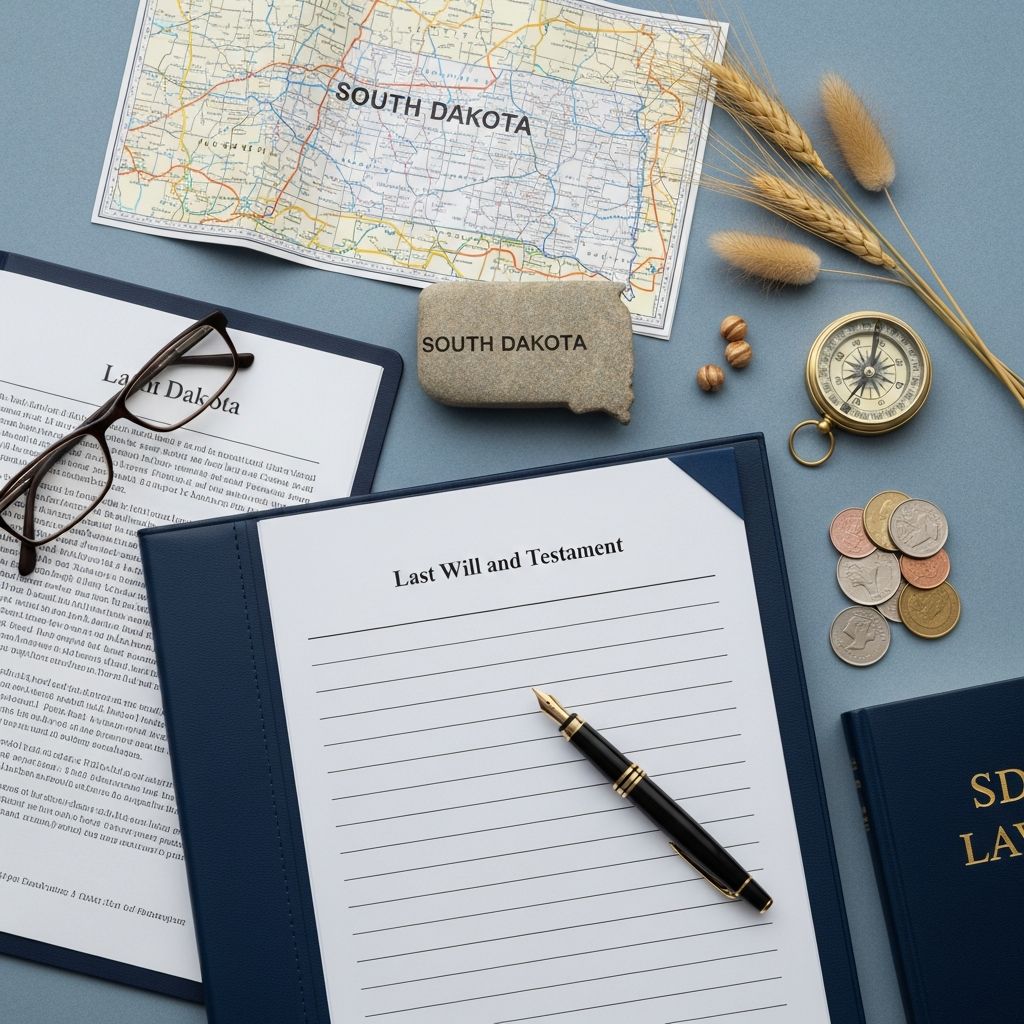
Establishing a last will and testament in South Dakota provides a clear path for distributing your assets after death, preventing intestate succession where state laws dictate outcomes. This document empowers you to designate beneficiaries, appoint executors, and outline final wishes, ensuring your legacy aligns with personal intentions.
Core Legal Standards for Validity
To qualify as enforceable under South Dakota law, a will demands specific criteria rooted in the Uniform Probate Code, Title 29A. The creator, known as the testator, must reach 18 years of age and demonstrate sound mental capacity, free from legal incompetence declarations.
The document requires a written format—typed or printed—though rare exceptions allow oral declarations in extreme situations. Physical signature by the testator is mandatory; if incapacity prevents this, a directed proxy may sign under supervision.
Witness involvement is pivotal: two disinterested individuals must observe the signing and add their signatures in the testator’s presence. While interested witnesses do not automatically void the will, selecting neutral parties minimizes disputes.
- Age threshold: Minimum 18 years.
- Mental state: Capable of understanding asset scope, beneficiaries, and implications.
- Format: Permanent writing preferred over verbal.
- Signatures: Testator plus two witnesses.
Special Provisions: Holographic Wills
South Dakota uniquely accommodates holographic wills, entirely handwritten and dated by the testator, bypassing witness requirements. This provision suits emergencies, like during travel or illness, where formalities prove challenging. The entire content, including signature, must reflect the testator’s hand to authenticate intent.
Courts scrutinize these rigorously for clarity and completeness, often requiring probate validation. Despite flexibility, formal witnessed wills reduce litigation risks, as holographic versions may spark authenticity challenges.
Self-Proving Affidavits for Efficiency
Enhance probate smoothness with a self-proving affidavit, where testator and witnesses notarize statements affirming execution voluntariness and capacity. Attached or integrated, this eliminates courtroom witness testimony, streamlining validation.
Ideal for uncontested estates, it cuts administrative delays and costs. South Dakota statutes explicitly endorse this under Section 29A-2-505, promoting judicial efficiency.
Appointing Key Roles: Executors and Guardians
Designate a reliable executor to manage probate, pay debts, file taxes, and distribute assets. Select someone organized, trustworthy, and ideally local to navigate South Dakota courts. Name alternates to cover unavailability.
For parents, specify guardians for minor children, prioritizing their welfare. Courts honor these absent compelling reasons, averting disputes. Include property management instructions for minors until adulthood.
| Role | Responsibilities | Best Practices |
|---|---|---|
| Executor | Asset inventory, debt settlement, distribution | Choose capable, impartial kin or professional |
| Guardian | Child care, decisions until 18 | Prioritize stability, discuss with nominees |
| Backup Options | Succession if primary unavailable | List 1-2 alternates explicitly |
Handling Specific Assets and Beneficiaries
Detail distributions: real estate, vehicles, bank accounts, investments, and personal items. Use percentages or specific bequests for precision. Address digital assets like online accounts, increasingly vital in modern estates.
Jointly owned property with rights of survivorship bypasses the will, transferring directly. Name beneficiaries on life insurance and retirement accounts similarly, as these supersede will directives.
- Real property: Deeds to heirs.
- Financial accounts: POD/TOD designations complement will.
- Personal effects: Lists for heirlooms.
- Charitable gifts: Specify organizations.
Updating Your Will: Timing and Methods
Life events necessitate reviews: every 3-5 years, or post-marriage, divorce, births, deaths, or asset shifts. Marriage does not revoke a prior will, but omissions grant spouses intestate shares.
Avoid marginal notations; instead, execute a codicil—a formal amendment witnessed identically—or draft a new will revoking priors. Destroy outdated versions to prevent confusion.
Probate Process Overview in South Dakota
Post-death, the executor files the will with the circuit court in the decedent’s county. Informal probate suits uncontested cases; formal applies to disputes. Creditors get notice, assets inventory, taxes settle, then distribution occurs.
Simplified for small estates under thresholds, avoiding full administration. Trusts can sidestep probate entirely for privacy and speed.
Online Templates vs. Professional Assistance
Online tools and software offer accessible starting points, legally viable if meeting statutory elements. However, they risk oversights in complex scenarios like blended families or businesses.
Attorneys tailor documents, incorporating tax strategies and contingencies. Initial consultations often prove cost-effective versus post-execution fixes.
Complementary Estate Tools
Beyond wills, living wills direct end-of-life care, withholding treatments under specified conditions. Distinct from healthcare powers of attorney delegating decisions.
Durable powers handle finances during incapacity. Trusts manage assets pre-death, evading probate. Integrate these for holistic planning.
Frequently Asked Questions
Can I use an online template for my South Dakota will?
Yes, provided it includes writing, your signature, and two witnesses; however, professional review ensures compliance and completeness.
What is a holographic will in South Dakota?
A fully handwritten, dated, and signed document by you, valid without witnesses, ideal for urgent situations.
Does marriage invalidate my existing will?
No, but your spouse gains rights to a share if unprovided for, prompting review.
How often should I update my will?
Every 3-5 years or after major life changes like births, deaths, or divorces.
Do witnesses need to be disinterested?
Preferred but not required; interested signatures do not void the will.
What happens without a will in South Dakota?
Intestate laws distribute assets: spouse and children first, then broader kin.
References
- If I Make a Will with an Online Template, Is it Legal? — Super Lawyers. 2025-06-10. https://www.superlawyers.com/resources/wills/south-dakota/if-i-make-a-will-with-an-online-template-is-it-legal/
- Basic Requirements for a Last Will and Testament in South Dakota — LawInfo. N/A. https://www.lawinfo.com/resources/wills/south-dakota/
- Wills & Trusts — South Dakota Consumer Protection (sd.gov). N/A. https://consumer.sd.gov/fastfacts/wills.aspx
- Codified Law 29A-3 — South Dakota Legislature. N/A. https://sdlegislature.gov/Statutes/29A-3
- End of Life Documents You Should Have in Place — SDSU Extension. N/A. https://extension.sdstate.edu/end-life-documents-you-should-have-place
Similar Articles








Read full bio of Sneha Tete


