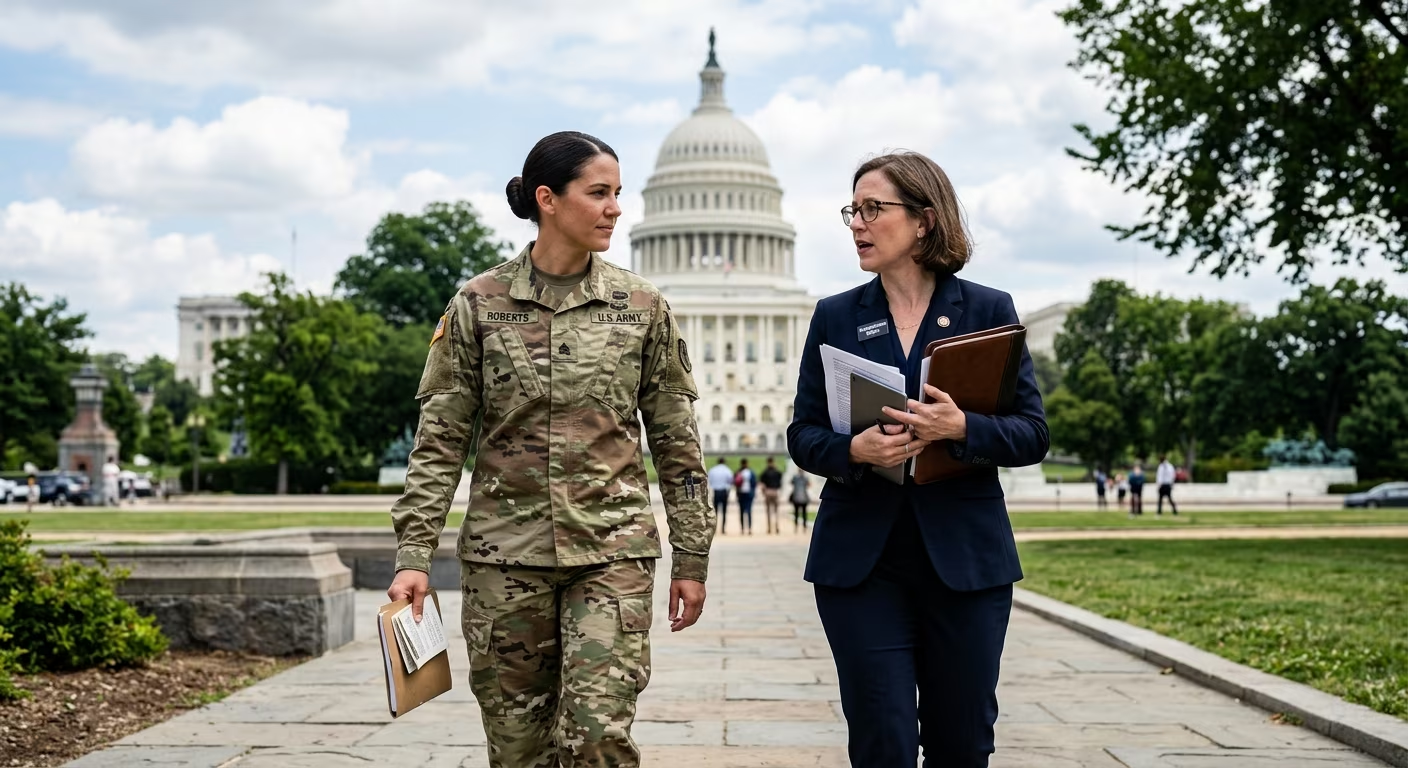
The Paradox of Service: Defending Freedoms While Fighting for Basic Autonomy
Women make up a critical, rapidly growing percentage of the United States Armed Forces, volunteering to put their lives on the line to safeguard the nation’s constitutional freedoms. However, a glaring contradiction exists within this noble pursuit: active-duty service women frequently face substantial hurdles when attempting to exercise their own fundamental reproductive rights. For decades, the intersection of military policy, federal funding constraints, and political battles has uniquely disadvantaged women in uniform, limiting their healthcare choices in ways civilian women rarely experience.
This complex web of restrictions dictates whether, when, and how a service member can access abortion, contraception, and assisted reproductive technologies. Understanding this dynamic requires an in-depth analysis of federal law, the operational realities of deployment, and the evolving policies of the Department of Defense (DoD). While civil rights advocates and lawmakers battle for parity, the women who defend the country continue to navigate a convoluted healthcare system where their bodily autonomy is heavily regulated by statutory bans.
The armed forces rely entirely on the dedication, physical readiness, and mental resilience of all their members. When service women are denied comprehensive healthcare, it not only impacts their personal lives and financial stability but also degrades overall unit readiness. This intersection of civil liberties and military policy creates a unique battlefield—one where the fight is not against a foreign adversary, but against domestic laws that strip away bodily autonomy. The struggle for reproductive freedom in the military is not solely a medical issue; it is fundamentally intertwined with readiness, equity, and the broader fight for gender equality within the armed services.
Navigating Federal Restrictions: The TRICARE and MTF Limitations
The foundation of reproductive healthcare for military personnel and their dependents is TRICARE, the military’s designated health insurance program. However, federal law imposes draconian limitations on what TRICARE can actually cover, largely stemming from decades-old legislative riders that strictly regulate the use of federal funds for abortion services.
The Statutory Bans on Abortion Care
Under current federal statutes, TRICARE is expressly prohibited from covering abortion procedures except under extreme and highly specific circumstances. A service member, veteran, or dependent is only eligible for covered abortion care if the pregnancy is the direct result of an act of rape or incest, or if the life of the pregnant person is in imminent danger should the pregnancy be carried to term. For any situation outside of these incredibly narrow parameters, the government categorically refuses financial support, leaving the service member to fend for themselves.
But the restrictions go even further than denying funding. Federal law also strictly prohibits Military Treatment Facilities (MTFs) from performing non-covered abortions. Astonishingly, this ban applies even if a service member offers to pay for the procedure entirely out of pocket with their own private funds. Consequently, military women stationed at domestic bases must seek off-base civilian providers, a process that is increasingly complicated, expensive, and sometimes impossible depending on restrictive state laws.
The Post-Dobbs Era: A Seismic Shift in Military Health Policy
The landscape of reproductive rights shifted violently following the Supreme Court’s 2022 decision that dismantled federal abortion protections. Because military installations are dispersed across the United States, hundreds of thousands of service members suddenly found themselves stationed in states that immediately enacted severe, uncompromising abortion bans. Unlike civilians who might choose where they live based on local laws and healthcare access, military personnel are assigned to their duty stations by command, leaving them effectively trapped in restrictive jurisdictions without a choice.
The Department of Defense 2022 Memorandum
Recognizing the acute crisis this posed to military readiness, retention, and morale, Secretary of Defense Lloyd J. Austin III issued a pivotal memorandum in October 2022 titled “Ensuring Access to Reproductive Health Care.” This sweeping policy was a deliberate maneuver designed to insulate service members from the immediate fallout of state-level health restrictions.
The directive established vital administrative workarounds to support active-duty troops:
- Administrative Absence: Commanders were authorized to grant up to 21 days of non-chargeable leave (known as administrative absence) for service members who need to travel across state lines to access non-covered reproductive health care.
- Travel and Transportation Allowances: The DoD formally authorized financial allowances to cover the cost of travel when timely access to non-covered services is unavailable within the local area of a service member’s permanent duty station.
- Extended Pregnancy Notification: To protect medical privacy and give personnel ample time to make private medical decisions, the DoD extended the timeline for notifying a commander of a pregnancy to 20 weeks, barring specific occupational health hazards.
While these measures provided a highly necessary lifeline to those in uniform, they are ultimately administrative policy band-aids on a deep statutory wound. Because they are not codified into law by Congress, these administrative policies can be altered or outright rescinded by future presidential administrations, leaving the underlying fragility of military reproductive rights entirely intact.
Broader Reproductive Health: Beyond Abortion
The fight for reproductive autonomy in the military extends well beyond abortion access. Service members also face unique, compounding challenges regarding family planning, contraception, and fertility treatments. Frequent deployments, harsh training environments, and prolonged separations complicate the basic logistics of starting or growing a family.
Assisted Reproductive Technology (ART) and IVF
Infertility is a significant and growing issue within the active-duty and veteran communities, sometimes directly resulting from service-connected injuries, exposure to hazards, or the intense physical stress of military life. Historically, the military’s coverage of Assisted Reproductive Technology (ART), such as In Vitro Fertilization (IVF), has been heavily restricted, exceptionally expensive, and difficult to navigate.
Recently, the Department of Defense has taken incremental steps to expand access. In 2024, policies were amended to allow severely ill or injured active-duty service members to access extended ART benefits regardless of their marital status, and to utilize donor gametes at their own expense. Despite these crucial advancements, standard IVF for service members without a qualifying, documented service-connected injury remains a completely non-covered benefit under TRICARE. This forces many military families to pay tens of thousands of dollars out of pocket just to start a family.
Contraceptive access, while generally covered by TRICARE, can also face logistical hurdles during long-term deployments or training exercises in remote environments. Ensuring that service women have consistent, uninterrupted access to their preferred birth control methods is a critical component of medical readiness that advocacy groups continually monitor and push the Department of Defense to improve.
| Healthcare Service | TRICARE Coverage Status | DoD Policy & Allowances |
|---|---|---|
| Abortion Care | Covered ONLY for rape, incest, or life endangerment of the mother. | Administrative absence and travel allowances permitted for out-of-state non-covered procedures. |
| In Vitro Fertilization (IVF) | Not covered for the general military population. | Extended benefits available ONLY for severely ill/injured service members. |
| Contraception | Fully covered (prescription required for some methods). | Walk-in contraceptive clinics increasingly available at most major military hospitals. |
The Advocacy Frontline: Fighting for Equality in Uniform
The push to dismantle these restrictive health policies has been fiercely championed by various civil rights organizations and military advocacy groups. Their core argument is straightforward yet profound: women cannot achieve true equality within the armed forces if they are explicitly denied fundamental control over their own bodies.
Ending the Combat Exclusion Policy
The trajectory of women’s rights in the military saw a monumental, historic victory in 2013 when the Pentagon officially rescinded the ground combat exclusion policy. For decades prior, women were formally barred from serving in combat arms units—a restriction that not only severely limited their career advancement and promotion potential but was also used to justify treating them as a secondary class of soldiers. Advocates fiercely litigated and lobbied against this exclusion, successfully proving that physical ability, tactical brilliance, and patriotism are not gendered traits.
However, as civil rights defenders rightly point out, allowing women to fight on the front lines, sustain injuries, and lead combat units while simultaneously denying them basic reproductive healthcare at military hospitals creates an untenable double standard that advocates continue to fight today.
Pushing Congress for Lasting Legislative Change
True, permanent security for military women’s reproductive health requires definitive congressional action. Advocates consistently lobby for the absolute repeal of the statutory bans that govern military facilities and dictate TRICARE funding. Legislative proposals aim to ensure that any person receiving their health insurance through the federal government—including military personnel—has access to comprehensive reproductive care, completely free from the ideological riders that have plagued defense authorization bills since the late 1970s.
Addressing the Unique Challenges of Overseas Deployment
While navigating domestic bans is inherently difficult, women stationed overseas face an entirely different magnitude of logistical nightmares. The federal ban on privately funded abortions at military hospitals abroad puts deployed service members in highly perilous situations.
If an active-duty woman becomes pregnant while deployed to a country with strict abortion laws, or where local medical infrastructure is subpar, she is placed in a staggering predicament. She cannot use the secure, highly-regulated, U.S.-standard military hospital on her base for this specific care. Instead, she must navigate foreign medical systems, potential language barriers, and questionable safety standards, all while trying to maintain operational secrecy and manage her grueling military duties.
If she chooses to return to the United States for the procedure, she faces extensive, exhausting travel times and immense out-of-pocket costs, further delaying highly time-sensitive medical care. The overseas restriction perfectly highlights the punitive nature of these federal bans, essentially abandoning service women when they are at their most isolated and vulnerable.
The Path Forward: What Needs to Change?
Ensuring that service members have unfettered access to reproductive healthcare is not merely a political talking point; it is an absolute imperative for maintaining military readiness and operational excellence. A force that is stressed, financially burdened, or unable to access basic medical care is a severely compromised force. To achieve lasting equity and support the troops effectively, several systemic changes must occur:
- Repeal Statutory Bans: Congress must eliminate the overarching federal laws prohibiting TRICARE coverage and MTF provision of abortion care, treating service members with the exact same medical standard as civilians residing in progressive states.
- Codify Travel Allowances: The DoD’s travel and administrative absence policies must be codified into permanent, unshakeable law to prevent future political administrations from easily revoking these crucial protections.
- Expand ART Coverage: Broaden TRICARE’s coverage of fertility treatments to fully support the family planning goals of all service members, removing the strict requirement for a specific service-connected injury to receive basic IVF support.
- Enhance Privacy Protocols: Strengthen military-specific privacy guidelines to ensure that sensitive reproductive health decisions remain strictly confidential between a service member and their medical provider, completely shielded from command overreach.
Frequently Asked Questions (FAQs)
What does TRICARE cover when it comes to abortion services?
By strict federal law, TRICARE only covers abortion services if the pregnancy is the direct result of rape or incest, or if the life of the pregnant individual is severely at risk. All other scenarios are entirely excluded from TRICARE coverage.
Are military members allowed to travel out of state for reproductive care?
Yes. Under a 2022 Department of Defense policy update, service members can legally request an administrative absence of up to 21 days to travel for non-covered reproductive care, such as abortion or IVF, without using their standard accrued leave. The DoD also provides travel and transportation allowances if the care is not available locally.
Can service members pay out of pocket for reproductive care at military hospitals?
No. Federal statute explicitly prohibits Military Treatment Facilities (MTFs) from providing abortion care—even if the service member offers to pay for the procedure entirely out of their own private funds—unless the pregnancy stems from rape, incest, or threatens the mother’s life.
How do state-level abortion bans impact active-duty service women?
Because military service members do not get to choose their duty stations, many are forcefully relocated to live in states with severe reproductive healthcare restrictions. This forces them to travel long distances, incur significant financial expenses, and coordinate complex absences with their command structure just to receive standard medical care.
Does the military provide coverage for In Vitro Fertilization (IVF)?
TRICARE standard policies do not cover IVF for the general military population. However, the DoD offers extended Assisted Reproductive Technology (ART) benefits specifically for active-duty service members who have suffered a severely qualifying illness or injury that impacts their fertility.
References
- Memorandum: Ensuring Access to Reproductive Health Care — U.S. Department of Defense. 2022-10-20. https://www.defense.gov/News/Releases/Release/Article/3194165/dod-announces-efforts-to-ensure-access-to-reproductive-health-care/
- Abortions Policy Overview — TRICARE. 2024-03-28. https://tricare.mil/CoveredServices/IsItCovered/Abortions
- DOD Amends Assisted Reproductive Services Policy for Seriously, Severely Ill or Injured Active Duty Service Members — U.S. Department of Defense. 2024-03-11. https://www.defense.gov/News/News-Stories/Article/Article/3703501/