
Why Punishing Parents for School Absenteeism Fails Students
Punitive truancy laws harm vulnerable families instead of solving absenteeism.
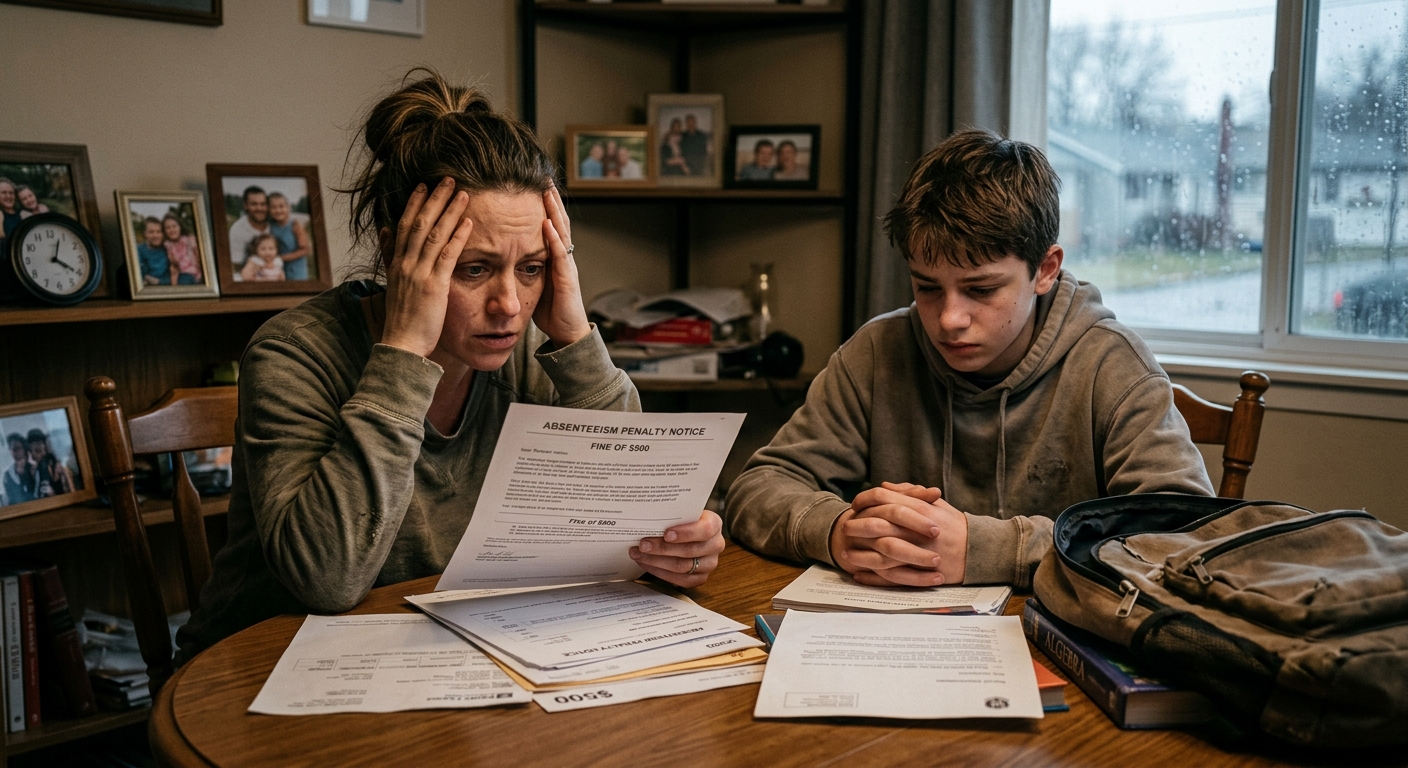
Across the United States, school districts are grappling with a persistent, escalating crisis: chronic absenteeism. According to the U.S. Department of Education, millions of students—affecting nearly a quarter of the K-12 population—are chronically absent, a figure that nearly doubled between 2018 and 2022. Faced with these alarming statistics and the corresponding decline in high school graduation rates, some policymakers and local jurisdictions have resorted to a heavy-handed, legacy approach: punishing the parents.
In many states, strict truancy laws dictate that a child’s unexcused absences can result in court summons, exorbitant financial fines, and, in severe cases, actual jail time for parents and guardians. However, this strategy of criminalizing absenteeism relies on a fundamentally flawed premise. It assumes that students miss school primarily because their parents simply do not care or are intentionally neglecting their educational responsibilities.
The reality is far more complex, deeply rooted in systemic inequities, poverty, and community-wide resource deficits. Punishing families who are already navigating acute economic and social hardships does not magically transport children to the classroom. Instead, it drives a wedge between the school system and the community, pushing vulnerable students further toward the margins. To authentically improve school attendance and boost graduation rates, the educational sector must pivot away from punitive judicial mandates and embrace holistic, supportive frameworks that address the actual barriers keeping students at home.
Deconstructing the Root Causes of Missing School
To solve the absenteeism puzzle, one must look beyond the empty desk and understand the systemic barriers at play. The Institute of Education Sciences (IES) and numerous educational researchers have consistently demonstrated that chronic absenteeism—generally defined as missing 10 percent or more of the academic year—derives from interconnected societal and structural factors. Rarely do these factors include a parent’s willful sabotage of their child’s future.
- Economic and Housing Instability: Families living below the poverty line frequently face housing insecurity. A family facing eviction or transitioning between temporary shelters will naturally struggle to establish a consistent morning routine for school.
- Transportation Barriers: When school bus routes are reduced due to district budget constraints, parents without reliable personal vehicles or access to affordable public transit find themselves physically unable to get their children to school on time.
- Physical and Mental Health: Chronic physical illnesses, such as asthma, are more prevalent in lower-income communities due to environmental factors, leading to frequent sick days. Additionally, the post-pandemic era has seen a surge in adolescent mental health crises, leading to school avoidance behaviors.
- School Climate and Safety: Bullying and exclusionary school climates further exacerbate attendance issues. If a child feels unsafe, marginalized, or targeted within the school walls, their attendance will naturally plummet.
Blaming parents for these systemic failures is an exercise in misdirection. When chronically absent students and their families are viewed through a deficit lens—labeled as “problematic” or “negligent”—schools miss critical opportunities to provide appropriate support for legitimate barriers entirely outside the family’s control.
The Fallacy and Harm of Punitive Truancy Policies
Despite extensive data pointing toward the systemic causes of absenteeism, the American legal and educational systems have a long history of intertwining truancy with the criminal justice system. The concept of compulsory school attendance was originally designed to ensure every child received an equitable education, but the enforcement mechanisms have morphed into a vehicle for criminalizing poverty.
In several jurisdictions, the law permits school districts to refer parents to truancy court after a surprisingly low number of unexcused absences. The financial penalties can be staggering. Parents can face fines ranging from small daily fees to hundreds of dollars per day of missed school, plus administrative court costs. For a family already struggling to pay rent, afford groceries, or keep the electricity on, a massive truancy fine is a catastrophic financial blow. It forces parents into an impossible position: pay the municipal fine and skip rent, or ignore the fine and face the threat of legal escalation.
The threat of incarceration is not an empty one. There are documented cases across the country where parents—disproportionately single mothers and people of color—have been incarcerated for failing to pay truancy fines or adequately supervise their truant teenagers. The tragic irony is palpable: incarcerating a primary caregiver or drowning them in debt destabilizes the household even further, making it substantially less likely that the child will successfully attend school and graduate.
Furthermore, involving the justice system introduces families to a cycle of court dates, probation officers, and legal fees. In worst-case scenarios, this can result in family separation, with children being placed in foster care or juvenile detention centers merely over missed school days. These retributive responses to truancy not only fail to address the root causes but actively magnify them, reinforcing an adversarial relationship between the educational system and the community.
Comparing Approaches: Systemic Realities vs. Punitive Fallacies
To understand why a shift in policy is necessary, it is helpful to compare the punitive assumptions of truancy laws against the reality of evidence-based interventions.
| Common Assumption (Punitive Model) | Systemic Reality (Supportive Model) | Effective Institutional Response |
|---|---|---|
| Absences are due to parental apathy. | Absences are driven by poverty, illness, or transportation issues. | Provide basic needs support, bus passes, and telehealth access. |
| Fines will motivate parents to force attendance. | Fines drain essential household resources, worsening the crisis. | Implement restorative justice and social worker interventions. |
| Court involvement scares students straight. | Court involvement creates trauma and increases dropout rates. | Establish community school models with wraparound services. |
Shifting Paradigms: From Courtrooms to Community Schools
If punitive measures are detrimental, what is the alternative? The answer lies in transforming schools into hubs of community support. The “community schools” model has emerged as a highly effective, evidence-based strategy for combating chronic absenteeism and improving graduation rates. Rather than pushing families out into the court system, community schools pull families in by providing wraparound services directly on campus.
According to federal educational initiatives focusing on Full-Service Community Schools, this model integrates academics with health and social services, youth and community development, and robust family engagement. A community school might partner with local non-profits, health care providers, and businesses to offer on-site medical and dental clinics, mental health counseling, food pantries, and even laundry facilities.
Research examining wraparound services indicates that these resources are crucial for academic success, particularly for lower-income students, because they mitigate the external economic pressures that hinder learning. When a school can provide an asthma inhaler to a student, offer a housing legal clinic for parents, or supply a public transit pass, they directly dismantle the physical barriers to attendance. By meeting the physiological and safety needs of the student body, community schools foster an environment where students can actually focus on their academic coursework and progress toward graduation.
Effective, Evidence-Based Interventions for Policymakers
Beyond adopting the comprehensive community school model, districts can implement several targeted, asset-based interventions to improve attendance without resorting to punitive laws:
- Asset-Based Family Communication: Instead of sending intimidating legal summons as a first point of contact, schools should leverage proactive, positive communication. Studies have found that utilizing automated, supportive text messages to parents regarding their child’s attendance can significantly reduce absenteeism. These messages focus on the value of the student’s presence and offer assistance, rather than threatening legal action.
- Restorative Justice and Counseling: Zero-tolerance discipline policies often lead to out-of-school suspensions, literally forcing students to be absent. Transitioning to restorative justice practices keeps students in the building, repairs harm, and addresses behavioral issues through counseling rather than exclusion.
- Early Warning Systems: By tracking attendance data closely and intervening at the first signs of chronic absence, schools can deploy social workers or school counselors to perform wellness checks. These checks aim to assess the family’s basic needs—such as providing winter coats, alarm clocks, or help navigating city bus routes—rather than issuing municipal citations.
Frequently Asked Questions (FAQs)
What qualifies as chronic absenteeism?
While definitions can vary slightly by state, chronic absenteeism is widely defined by educational authorities as a student missing 10 percent or more of the academic school year for any reason, including excused and unexcused absences. In a standard 180-day school year, this equates to missing 18 or more days.
Can parents actually face jail time for a child’s truancy?
Yes, in several states, strict compulsory education and truancy laws allow local justice systems to impose severe penalties on parents. If a parent is unable to pay compounding truancy fines, or if a judge determines they are failing to compel their child’s attendance, they can be held in contempt of court and sentenced to short-term incarceration.
What are wraparound services?
Wraparound services are comprehensive, non-academic supports provided to students and their families, often directly within the school building. These services are designed to address out-of-school barriers to learning and can include mental health counseling, medical and dental care, food assistance, housing support, and transportation aid.
Why don’t financial fines improve school attendance?
Financial fines exacerbate the root causes of absenteeism. Because chronic absenteeism is heavily correlated with poverty, fining a low-income family drains the very resources they need to secure reliable housing, healthcare, and transportation. Instead of motivating attendance, fines create financial emergencies that further destabilize the household.
Conclusion: Fostering Support Over Punishment
Ending the high school dropout crisis requires a fundamental paradigm shift in how society views absenteeism. Treating missing school as a criminal offense committed by negligent parents is not only factually incorrect but actively destructive to vulnerable communities. Chronic absenteeism is an urgent warning sign of systemic failure, poverty, and unmet basic needs.
By dismantling punitive truancy laws and reinvesting those resources into community schools, wraparound services, and restorative justice practices, districts can create educational environments where all students have the opportunity to thrive. It is time to stop fining and jailing parents for the societal failures that surround them, and instead, start providing the tangible support that families need to ensure their children can safely and consistently arrive in the classroom.
References
- Chronic Absenteeism — U.S. Department of Education. 2025-01-01. https://www.ed.gov/teaching-and-administration/supporting-students/chronic-absenteeism
- Using asset-based framing to guide decisionmaking about chronic absenteeism — Institute of Education Sciences (IES). 2025-11-30. https://ies.ed.gov/ncee/edlabs/regions/midwest/blogs/asset-based-framing-chronic-absenteeism.aspx
- Beyond Academic Assistance: Key Findings on Wraparound Services at Community Colleges — Federal Reserve Bank of Richmond. 2026-04-09. https://www.richmondfed.org/publications/community_development/community_scope/2026/04_09_wraparound_services
- Parents’ Guide to Truancy — Office of Justice Programs. 2024-01-01. https://www.ojp.gov/pdffiles1/ojjdp/223985.pdf
Similar Articles








Read full bio of medha deb


