
Civil Rights Advocates Challenge Minnesota’s Child Welfare System Over Racial Disparities
A landmark civil rights complaint alleges that Minnesota's child protection agencies discriminatorily target Black families, prompting calls for federal intervention.
Introduction
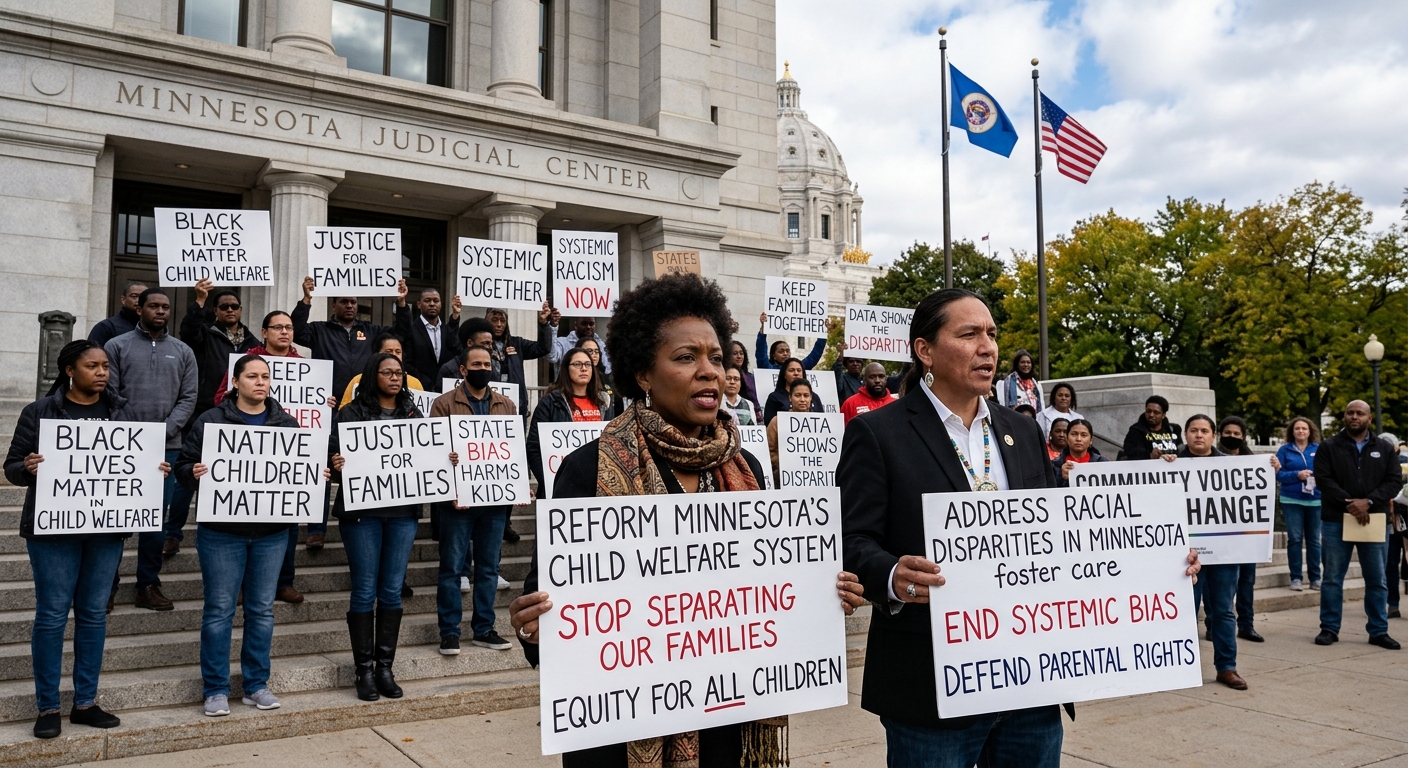
For decades, child welfare systems across the United States have operated under the mandate of protecting vulnerable youth from abuse and neglect. However, a growing coalition of legal advocates, civil rights organizations, and impacted communities are fundamentally questioning the operational realities of these agencies. Critics argue that what is ostensibly a protective apparatus often functions as a punitive system of family policing that disproportionately targets, surveils, and separates families of color.
This ongoing national scrutiny has recently culminated in a profound legal challenge in the Midwest. In March 2024, the Minneapolis branch of the NAACP, working alongside the national legal advocacy group Children’s Rights, initiated a landmark administrative action. The organizations submitted a formal civil rights complaint against the State of Minnesota, alleging that its state and county-level child welfare agencies engage in pervasive and systemic racial discrimination. The filing asserts that state practices have relentlessly targeted Black families, resulting in devastating rates of family separation that cannot be explained or justified by underlying rates of actual child maltreatment. This case represents a novel, highly strategic approach to child welfare reform, moving beyond local courtrooms and leveraging the full weight of federal civil rights law to demand sweeping, systemic accountability.
The Federal Civil Rights Complaint Explained
Unlike traditional state-level tort claims or localized class-action lawsuits, the legal maneuver executed by the NAACP and Children’s Rights takes a distinctively federal route. The formal complaint was submitted directly to the United States Department of Health and Human Services Office for Civil Rights (HHS/OCR). By bypassing state courts, the advocates are invoking Title VI of the Civil Rights Act of 1964. This foundational civil rights legislation explicitly prohibits discrimination on the basis of race, color, or national origin in any program or activity that receives federal financial assistance.
The crux of the advocates’ argument is that Minnesota’s child protection agencies—specifically focusing on the state’s two most populous regions, Hennepin County and Ramsey County—rely heavily on federal funding to operate. If these agencies deploy those funds in a manner that yields a disparate and discriminatory impact on Black families, they are in direct violation of Title VI. The complainants are demanding that the HHS/OCR immediately open an exhaustive investigation into Minnesota’s foster system. The ultimate goal is to force the state into strict compliance with federal civil rights laws, fundamentally altering how social workers, mandatory reporters, and family courts interact with marginalized communities.
Decoding the Disparities: A Look at the Data
The allegations of racial discrimination are not rooted merely in anecdotal grievances; they are heavily substantiated by striking statistical disparities. Data extracted from state records reveals a stark overrepresentation of Black children at every phase of the child welfare process, from the initial hotline report to the final termination of parental rights.
According to demographic research, while Black children comprise a relatively small minority of the overall youth population in Minnesota, they represent an oversized demographic within the child protection system. In recent data sets, Black youth accounted for approximately 11% of the state’s total child population, yet they made up roughly 17% of the children subjected to completed welfare assessments and investigations. The disparities are even more pronounced at the county level.
| Demographic Metric (Recent Averages) | Black Children | White Children |
|---|---|---|
| Percentage of Total Minnesota Child Population | ~11% | ~74% |
| Representation in Completed Assessments/Investigations | ~17% | ~49% |
| Hennepin County Child Welfare Reports (Since 2019) | >53% | <35% |
Crucially, the data points to a disturbing qualitative reality regarding why these families are investigated. In Hennepin County, nearly 70% of the reports involving Black children were not precipitated by allegations of physical or sexual abuse. Instead, the vast majority of these interventions were categorized under broader, more subjective definitions of “neglect.” Advocates argue that this statistical reality proves the system is not primarily rescuing children from violent homes, but rather penalizing families for the manifestations of systemic poverty.
Furthermore, the disparities recorded in Minnesota reflect a broader, federally acknowledged crisis. In 2021, the U.S. Administration for Children and Families publicly acknowledged that Black children and other marginalized groups are disproportionately represented in the system, identifying “structural racism” as a primary driver. By highlighting these federal admissions, advocates strengthen their case against Minnesota, proving the issues are deeply systemic rather than isolated incidents.
The Mechanics of Systemic Bias in Child Protection
To understand how such stark statistical anomalies occur, it is necessary to examine the daily mechanics of the child welfare system. Disproportionality is rarely the result of overt, intentional racism by individual caseworkers. Rather, it is the byproduct of structural biases baked into the very policies and tools the state utilizes.
The complaint highlights several specific drivers of discrimination within Minnesota’s system:
- Mandatory Reporting Biases: The child welfare process almost always begins with a call from a mandatory reporter, such as a teacher, therapist, or medical professional. Implicit biases often influence these professionals, making them more likely to report a Black family for a perceived infraction than a white family in identical circumstances.
- Conflating Poverty with Neglect: The legal definition of “neglect” is notoriously broad across state lines. Symptoms of systemic economic deprivation—such as food insecurity, a lack of adequate winter clothing, or temporary housing instability—are frequently interpreted by state agents as parental unfitness rather than a clear need for community social support.
- Discriminatory Risk Assessment Tools: Social workers rely on standardized “safety and risk assessment” algorithms to determine if a child should be removed from the home. These tools frequently weigh factors like past interactions with the system, reliance on public assistance, or neighborhood demographics. Because Black families are historically over-policed, these algorithms create a negative feedback loop, mathematically penalizing them for systemic, generational disadvantages.
These interconnected mechanisms create a formidable dragnet that disproportionately subjects Black parents to intense state surveillance and their children to the profound trauma of out-of-home placements.
The Title VI Strategy: Weaponizing Federal Accountability
The decision to utilize Title VI of the Civil Rights Act is a strategic masterstroke by the NAACP and Children’s Rights. Historically, child welfare agencies have been shielded from broad civil rights litigation through claims of state sovereignty, qualified immunity for social workers, and the intensely private nature of family court proceedings. By shifting the battlefield to the federal administrative level, advocates bypass many of these traditional judicial barriers.
Title VI acts as a powerful lever because it targets the financial lifeblood of state agencies. The federal government funnels billions of dollars into state foster care systems annually to assist with housing, administrative costs, and intervention programs. If the HHS/OCR determines that Minnesota is utilizing these federal grants to administer a program with an unjustified disparate racial impact, the state risks severe sanctions, including the withholding of critical federal funds. This financial threat is often the only catalyst potent enough to force recalcitrant state bureaucracies to dismantle discriminatory practices and implement genuine, systemic reforms.
The Human Toll and Pathways to Legislative Reform
Beyond the legal maneuvers and demographic statistics lies the profound human cost of family separation. Decades of psychological and sociological research confirm that forcibly removing a child from their home inflicts severe, lasting trauma on both the youth and their parents. Children placed in the foster care system often experience disrupted educational trajectories, higher rates of mental health crises, and an increased likelihood of future involvement with the juvenile justice system. For Black children, who are statistically the least likely to find permanent placements and often languish in state care the longest, the outcomes are particularly dire.
Recognizing this crisis, grassroots organizers and lawmakers in Minnesota have pushed for legislative remedies alongside the legal battles in federal bureaus. Initiatives like the proposed African American Family Preservation Act aim to radically restructure the state’s approach to child welfare. The legislation seeks to prohibit the state from removing children without concrete evidence of egregious harm, effectively raising the legal threshold for family separation. Furthermore, it prioritizes preventative measures—such as direct financial aid, housing assistance, and mental health resources—over punitive out-of-home placements. By shifting the paradigm from “child rescue” to “family support,” advocates hope to break the generational cycle of state intervention that has disproportionately fractured Black communities across the Midwest.
Frequently Asked Questions (FAQs)
What is Title VI of the Civil Rights Act of 1964?
Title VI is a landmark federal law that prohibits discrimination on the basis of race, color, or national origin in any program, agency, or activity that receives federal financial assistance. In the context of child welfare, it ensures that state agencies cannot use federal tax dollars to fund racially biased practices or programs with discriminatory impacts.
Why did the NAACP and Children’s Rights target Minnesota?
Advocates targeted Minnesota, particularly Hennepin and Ramsey counties, because state data revealed severe, historic, and ongoing racial disparities in child welfare investigations and removals. Minnesota’s rates of family separation significantly outpace national averages, disproportionately impacting Black residents.
What is the difference between child abuse and child neglect?
Child abuse typically involves deliberate physical, emotional, or sexual harm inflicted upon a youth. Child neglect, however, is generally defined as the failure to provide basic needs, such as adequate food, shelter, or supervision. Critics argue that child welfare systems frequently confuse poverty-driven neglect with intentional harm, unfairly penalizing low-income parents.
What are the potential outcomes of the HHS/OCR complaint?
If the federal Office for Civil Rights opens an investigation and finds the state in violation of Title VI, it can mandate a strict corrective action plan. This plan would force Minnesota to change its policies, retrain staff, and eliminate biased risk assessment tools. Failure to comply could theoretically result in the termination of federal funding for the state’s child welfare programs.
Conclusion: A Potential Blueprint for Nationwide Reform
The civil rights complaint filed by the NAACP and Children’s Rights against the State of Minnesota represents far more than a localized administrative dispute; it is a critical stress test for the future of child welfare in the United States. By reframing excessive family surveillance and unwarranted child removals as fundamental violations of the Civil Rights Act, advocates are charting a new legal pathway to dismantle structural racism. If the federal government forces Minnesota to overhaul its child protection apparatus under the threat of losing federal funds, it will set a monumental precedent. Child welfare agencies nationwide will be put on notice: the era of weaponizing the guise of child protection to discriminate against marginalized families is coming to an end. The ultimate success of this endeavor could fundamentally redefine the meaning of child welfare, transitioning it from a system of punitive policing to an institution of genuine, equitable family support.
References
- NAACP, Children’s Rights Submit Civil Rights Complaint Against Minnesota’s Child Welfare System, Alleging Racial Discrimination — NAACP. 2024-03-04. https://naacp.org/articles/naacp-childrens-rights-submit-civil-rights-complaint-against-minnesotas-child-welfare
- Title VI of the Civil Rights Act of 1964 — U.S. Department of Justice. 2024-04-25. https://www.justice.gov/crt/fcs/TitleVI
- Child Welfare Practice to Address Racial Disproportionality and Disparity — Child Welfare Information Gateway (U.S. Department of Health & Human Services). 2021-11-01. https://www.childwelfare.gov/resources/child-welfare-practice-address-racial-disproportionality-and-disparity/
- Minnesota’s Child Maltreatment Report Data Overview — Minnesota Department of Human Services. 2022-01-01. https://mn.gov/dhs/
Similar Articles








Read full bio of medha deb


