
Child Welfare and Immigration: The Minnesota Detainment Case
Examining the controversial detainment of a 5-year-old and its national impact.
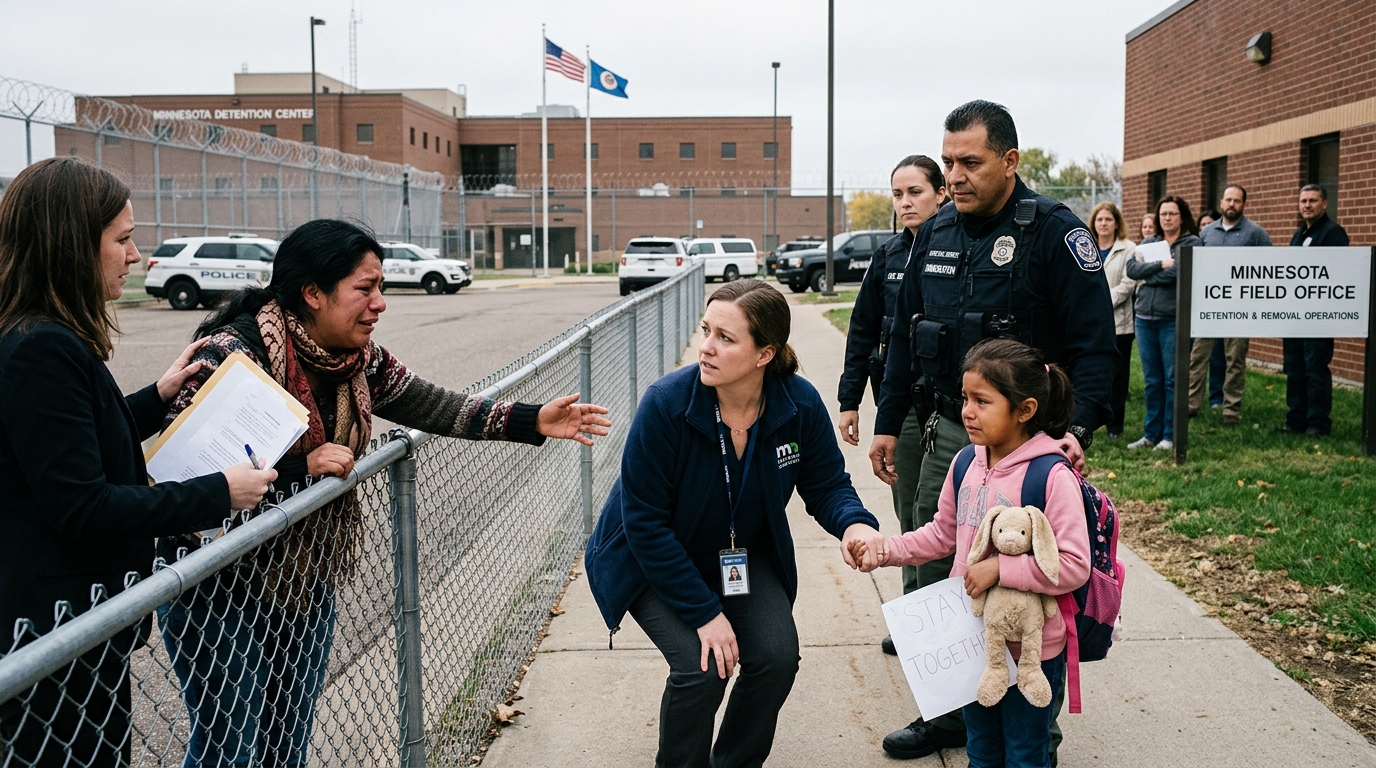
The Intersection of Immigration Enforcement and Child Welfare: Analyzing the Minnesota Detainment Case
Immigration enforcement tactics have long been a subject of intense national debate, but recent events in Minnesota have sharply intensified the scrutiny surrounding the intersection of border security and child welfare. In early 2026, the apprehension of a five-year-old boy by federal immigration officers outside his home prompted immediate outrage from educators, civil rights advocates, and the broader community. The case has raised critical questions regarding operational protocols, the concept of “sensitive locations,” and the psychological well-being of young children caught in the crosshairs of federal policy. This article dissects the details of the Minnesota detainment, examines the competing narratives surrounding the controversial operation, and explores the broader developmental and legal ramifications for migrant families.
Anatomy of the Minnesota Apprehension
The incident unfolded in Columbia Heights, a suburb of Minneapolis, Minnesota. A five-year-old boy, Liam Conejo Ramos, had just arrived home from preschool when agents from U.S. Immigration and Customs Enforcement (ICE) initiated an enforcement operation . The family, who had migrated from Ecuador and had an active asylum case, found themselves suddenly intercepted in their own driveway.
According to legal representation for the family, they were not under any current deportation order that necessitated immediate removal . Yet, the operation resulted in both the child and his father being detained and swiftly transported to an ICE detention facility in Dilley, Texas . The rapid escalation from a routine afternoon drop-off to a federal holding center sent shockwaves through the local school district, marking Liam as the fourth student from the suburb to be detained by immigration officers in a matter of weeks .
The “Bait” Allegation and Competing Narratives
The specifics of the apprehension quickly became a flashpoint due to polarized accounts of what transpired in the driveway. Zena Stenvik, the Superintendent of Columbia Heights Public Schools, organized a press conference where she levied severe accusations against the federal agents. According to Stenvik, officers instructed the terrified five-year-old to walk up to his house and knock on the front door to check if his mother or other individuals were inside . She categorized this action as essentially utilizing a preschooler as “bait” to draw out potential undocumented targets.
The Department of Homeland Security (DHS) vehemently denied this characterization. Tricia McLaughlin, a spokesperson for the agency, stated that ICE was strictly targeting the child’s father, Adrian Alexander Conejo Arias, who they claimed was in the country illegally. According to the official federal narrative, the father abandoned his son and fled the scene on foot when approached by officers. DHS asserted that one agent remained with the young boy strictly for his physical safety while other officers pursued and apprehended the father . The agency dismissed the “bait” allegations as completely fabricated, arguing their presence beside the child was an emergency protective measure rather than an investigative tactic.
Judicial Intervention: Deportation Quotas on Trial
The legal fallout from the detainment reached a critical juncture when the case was brought before a federal court. U.S. District Judge Fred Biery, presiding in San Antonio, Texas, intervened forcefully. On January 31, 2026, he issued a ruling that halted the immediate removal of the child and his father, mandating their release from the Texas family detention center .
Judge Biery’s ruling was highly critical of the administration’s enforcement strategies. He noted that the situation had its origins in what he described as “ill-conceived and incompetently-implemented” efforts to satisfy daily deportation quotas, asserting that the government was prioritizing numerical targets even when it meant “traumatizing children” . The judicial reprimand underscored a growing legal skepticism toward aggressive enforcement maneuvers that inadvertently entangle minors who possess no criminal record or violent history.
The Psychological Toll on Immigrant Children
Beyond the immediate legal battles, the detainment of minors triggers profound public health concerns. Mental health professionals and childhood development experts caution that aggressive immigration enforcement acts as a catalyst for severe psychological distress . For young children, the threat or reality of sudden family separation disrupts fundamental emotional attachments and cognitive development.
According to a 2025 study led by Dr. Lisa Fortuna at the University of California, Riverside, the trauma stemming from aggressive enforcement tactics is not isolated to the detained individuals . U.S.-born and migrant children in mixed-status households frequently experience heightened anxiety, hypervigilance, and symptoms of post-traumatic stress disorder (PTSD) . This “intergenerational trauma” manifests in poor academic performance, emotional withdrawal, and an ingrained mistrust of public institutions .
When a child is taken from a familiar environment—such as returning from preschool—the physiological stress response can alter brain architecture. The Society for Research in Child Development (SRCD) classifies such experiences as Adverse Childhood Experiences (ACEs), which carry long-term consequences for physical and socioeconomic well-being . The Minnesota incident perfectly encapsulates the chaotic unpredictability that developmental psychologists warn against.
Policy Implications: The Shifting Landscape of “Sensitive Locations”
The apprehension also brings to the forefront the debated DHS policy regarding “sensitive locations” or “protected areas.” Historically, agencies like ICE and Customs and Border Protection (CBP) operated under guidelines that discouraged enforcement actions at schools, hospitals, places of worship, and known school bus stops, unless exigent circumstances existed .
In 2021, the Biden administration expanded these guidelines to ensure that children could access education and basic services without the looming threat of ICE presence. However, early 2025 saw the rescission of these robust protections, granting federal agents more latitude to operate near these traditionally protected community spaces .
While the driveway of a private residence is not inherently a school zone, the timing of the enforcement—immediately following a preschool drop-off—has blurred the operational lines. Educational leaders argue that intercepting families during school transit effectively nullifies the safety guarantee of the educational environment. When families fear that the route to school is compromised, attendance drops, and the educational mandate of local districts is severely undermined.
Broader Community Repercussions and Educator Roles
The ripple effects of the Minnesota case were immediately felt throughout the community. Fearing similar driveway interceptions, many migrant families opted to keep their children home from school. This self-imposed isolation further marginalizes vulnerable populations, cutting them off from essential nutritional, educational, and social support systems provided by local districts.
Educators and school administrators have increasingly found themselves acting as frontline advocates. Superintendents like Zena Stenvik are navigating uncharted territory, balancing their legal obligations to ensure equal educational access for all children—as mandated by the Supreme Court decision in Plyler v. Doe—against the realities of federal enforcement operations. Schools are now frequently tasked with developing rapid-response protocols, verifying legal warrants, and providing emergency emotional counseling for peers traumatized by the sudden absence of their classmates.
Timeline of Events: The Minnesota Detainment
To understand the rapid escalation of this case, consider the chronological progression of events:
| Date | Event Description | Key Developments |
|---|---|---|
| Late 2024 | Family Arrival | The family arrives in the U.S. from Ecuador and initiates an active asylum claim. |
| January 20, 2026 | The Apprehension | ICE agents intercept the father and 5-year-old son outside their Minnesota home following preschool. Both are detained. |
| January 21, 2026 | Community Backlash | The school superintendent publicly accuses ICE of using the child as “bait.” DHS fiercely denies the claim. |
| January 31, 2026 | Judicial Ruling | U.S. District Judge Fred Biery orders the release of the boy and his father, criticizing arbitrary deportation quotas. |
Navigating the Future of Child Welfare and Immigration
The detention of Liam Conejo Ramos represents more than an isolated law enforcement operation; it serves as a litmus test for the ethical boundaries of federal immigration policies. As communities grapple with the fallout, the call for clear, humane directives that prioritize child welfare over numerical enforcement quotas grows louder. Until a cohesive policy framework shields the youngest and most vulnerable from the collateral damage of border security measures, educators and developmental experts warn that the psychological scars on a generation of migrant children will continue to deepen.
Frequently Asked Questions (FAQs)
Can federal immigration agents legally detain a minor?
Yes, under certain circumstances, federal agents can detain minors if they are undocumented or if their parent or guardian is apprehended during an operation. However, strict protocols dictate the transfer of unaccompanied minors to the Office of Refugee Resettlement (ORR) or family detention centers, and prolonged detention of children is heavily restricted by judicial precedents such as the Flores Settlement Agreement.
Are schools considered off-limits for immigration enforcement?
Historically, under the “sensitive locations” policy, schools, hospitals, and churches were generally avoided for routine enforcement actions unless there was an immediate threat or high-level supervisory approval . While recent administrative changes have altered the strictness of these protections, public pressure and internal guidelines still heavily discourage operations directly on school grounds.
What was the “bait” allegation in the Minnesota case?
A local school superintendent claimed that ICE agents instructed a terrified 5-year-old boy to knock on the door of his home to draw out potential targets, effectively using him as a decoy. DHS categorically denied this, stating the father fled and left the child behind, prompting agents to stay with the boy strictly for his own physical safety.
How did the federal court respond to the Minnesota case?
A U.S. District Court judge forcefully intervened, ordering the release of the father and son from a Texas detention center. The judge strongly criticized the administration’s reliance on daily deportation quotas, asserting that such practices lead to the unnecessary traumatization of young children .
What are the psychological impacts of immigration enforcement on young children?
Research indicates that exposure to immigration raids, detentions, or the constant fear of family separation leads to severe anxiety, toxic stress, and PTSD in children. This can result in delayed cognitive development, poor academic outcomes, and long-term behavioral health challenges .
References
- Federal agents detain 5-year-old boy in Minnesota immigration raid — The Associated Press. 2026-01-22. https://apnews.com/
- Judge orders release of 5-year-old Liam Conejo Ramos and his father from ICE detention — PBS News. 2026-01-31. https://www.pbs.org/
- Child mental health crisis tied to immigration enforcement — UC Riverside News. 2025-08-08. https://news.ucr.edu/
- Deportation Threatens the Psychological, Physical, and Socioeconomic Well-being of Children and Families — Society for Research in Child Development. 2025-01-01. https://www.srcd.org/
- DHS Protected Areas FAQs — U.S. Customs and Border Protection. 2025-03-14. https://www.cbp.gov/
Similar Articles








Read full bio of medha deb


