
Iowa Probate Alternatives: 6 Practical Options To Avoid Probate
Discover efficient ways to bypass traditional probate in Iowa, saving time, money, and stress for your loved ones.
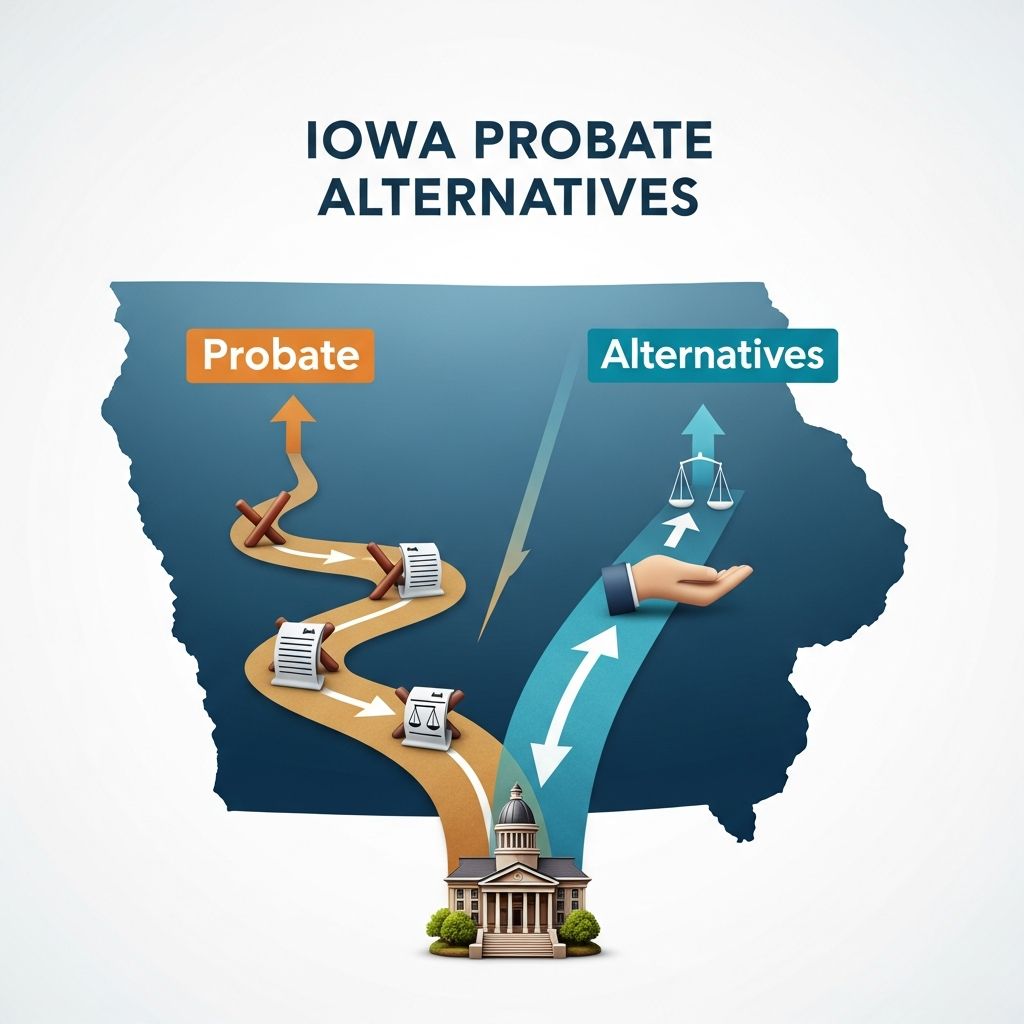
Navigating the death of a loved one involves many challenges, but handling their estate doesn’t have to mean a prolonged court battle. In Iowa, traditional probate can take over a year and incur significant fees, yet several
probate shortcuts
exist to expedite asset transfer. These methods allow heirs to access property quickly while ensuring legal validity.Understanding Iowa’s Probate Landscape
Probate in Iowa is a court-supervised procedure governed by
Chapter 633 of the Iowa Code
, validating wills, paying debts, and distributing assets. It applies mainly to solely owned assets like real estate or bank accounts without beneficiaries. However, not all estates require full probate; many can use simplified paths if assets stay below certain limits or are structured to bypass court oversight.Full probate suits complex estates with disputes or large values, involving executor appointment, asset inventory, creditor notices, and court approvals. Timelines often span 12-18 months due to a four-month creditor claim period, with costs including court fees (0.2% of estate value over $200,000) and attorney rates around $300/hour. For simpler cases, alternatives reduce this burden dramatically.
Small Estate Affidavit: The Quickest Path for Modest Estates
Iowa’s
small estate affidavit
under Iowa Code Chapter 635 offers a non-judicial shortcut for estates valued at$200,000 or less
in probate assets, excluding non-probate items like joint accounts or life insurance. This process skips formal court filings, enabling heirs to claim property via a sworn statement after 30 days from death.- Eligibility Criteria: Total probate assets (real estate, vehicles, solo accounts) ≤ $200,000; no real property over homestead exemptions unless waived.
- Steps to File: Heir waits 30 days, prepares affidavit listing assets/debts, signs before notary, delivers to asset holders (e.g., banks).
- Benefits: Avoids executor fees, court costs; completes in weeks vs. months.
This method suits straightforward estates without disputes. Banks and title offices accept the affidavit as proof of authority, transferring titles swiftly.
Non-Probate Asset Transfers: Automatic Bypass Options
The simplest avoidance strategy structures assets to pass outside probate automatically. These
non-probate transfers
activate upon death without court involvement.| Method | Description | Iowa Availability | Key Limitation |
|---|---|---|---|
| Joint Tenancy with Right of Survivorship | Co-owned property transfers to survivor(s) | Yes, for real estate, accounts | Potential gift tax if not spouses |
| Payable on Death (POD)/Transfer on Death (TOD) | Designated beneficiary receives account funds | Yes, for bank/investment accounts | Not for real estate/vehicles |
| Beneficiary Designations | Life insurance, retirement accounts pass directly | Yes, standard | Must update after life changes |
| Living Trusts | Assets in revocable trust avoid probate | Yes, fully supported | Requires funding during life |
Joint tenancy works well for spouses owning a home, as Iowa recognizes tenancy by the entirety for married couples. POD accounts let sole owners name heirs, preventing probate for liquid assets. Note: Iowa lacks transfer-on-death deeds for real estate or vehicles, so titling solely demands probate or trusts.
Revocable Living Trusts: Comprehensive Probate Avoidance
A
revocable living trust
centralizes control, allowing the grantor to manage assets while alive and designating successors for seamless transfer post-death. Unlike wills, trust assets bypass probate entirely.- Creation: Draft trust document naming trustee (often self) and beneficiaries.
- Funding: Retitle assets (deeds, accounts) into trust name.
- Operation: Manage as before; upon death, successor trustee distributes per terms.
Trusts handle real estate effectively in Iowa, where TOD deeds aren’t available. They also manage incapacity without conservatorship. Drawbacks include setup costs ($1,000-$3,000) and diligent funding. Ideal for estates over $200,000 or privacy concerns, as probate filings are public.
Other Simplified Probate Procedures
Beyond affidavits, Iowa provides
unsupervised administration
for estates where heirs agree, minimizing court oversight. The personal representative handles inventory, pays debts, and distributes with final court approval only.For intestate estates (no will), heirs follow Iowa’s priority order: spouse first, then children/parents. Publication notices alert creditors within four months, after which unchallenged claims bar.
Costs and Timelines: Full Probate vs. Shortcuts
| Process | Timeline | Costs | Best For |
|---|---|---|---|
| Full Probate | 12-18+ months | 0.2% court fee + attorney (up to 2x estate value) | Complex/disputed estates |
| Small Estate Affidavit | 30+ days | Minimal (notary fees) | ≤$200K simple estates |
| Non-Probate Transfers | Immediate | Setup only | All asset types |
| Living Trust | Immediate post-death | Initial setup $1K+ | Large/privacy-focused |
Full probate’s creditor period drives delays; shortcuts eliminate this for qualifying cases. Costs soar with litigation, but planning ahead caps expenses.
Planning Ahead: Proactive Estate Strategies
To leverage shortcuts, review assets now: Add POD to accounts, fund trusts, use joint titling judiciously. Update beneficiaries post-life events. Consult Iowa estate attorneys for personalized plans, as DIY errors risk invalid transfers. Iowa Legal Aid offers free guidance for low-income residents.
Wills remain vital for naming guardians or specific bequests, even with non-probate assets. Combine strategies for robust coverage.
Frequently Asked Questions (FAQs)
What qualifies as a small estate in Iowa?
Estates with $200,000 or less in probate assets, excluding joint property or beneficiary-designated accounts.
Does Iowa allow transfer-on-death for real estate?
No, real estate solely owned requires probate or trust; joint tenancy is an alternative.
How long do creditors have to claim against an Iowa estate?
Four months after notice publication.
Can I avoid probate entirely in Iowa?
Yes, via trusts, joint ownership, and designations for all assets.
Is an attorney required for Iowa probate?
Recommended and often necessary for full probate; small estates can be DIY.
Implementing these Iowa probate alternatives honors your legacy efficiently, sparing heirs stress. Professional advice tailors strategies to your situation.
References
- Understanding Probate Proceedings: A Guide for Iowa Residents — Laird Law Firm. 2024. https://lairdlawfirm.com/understanding-probate-proceedings-a-guide-for-iowa-residents/
- Managing the Probate Process in Iowa: A Comprehensive Guide — Checketts Law. 2024. https://checkettslaw.com/managing-the-probate-process-in-iowa-a-comprehensive-guide/
- The Iowa Probate Process Explained — O’Flaherty Law. 2024. https://www.oflaherty-law.com/learn-about-law/the-iowa-probate-process-explained
- An Overview of the Probate Process — Center for Agricultural Law and Taxation, Iowa State University. 2024. https://www.calt.iastate.edu/article/overview-probate-process
- Probate | Scott County, Iowa — Scott County Iowa Government (.gov). 2025. https://www.scottcountyiowa.gov/courts/probate
- Preserving Your Legacy: Estate Administration and Probate in Iowa — Pearson Bollman Law. 2024. https://pearsonbollmanlaw.com/preserving-your-legacy-estate-administration-and-probate-in-iowa/
Similar Articles








Read full bio of medha deb


