
Immigrant Rights and Reproductive Freedom at the High Court
How the Supreme Court shapes immigrant rights and bodily autonomy.
Introduction
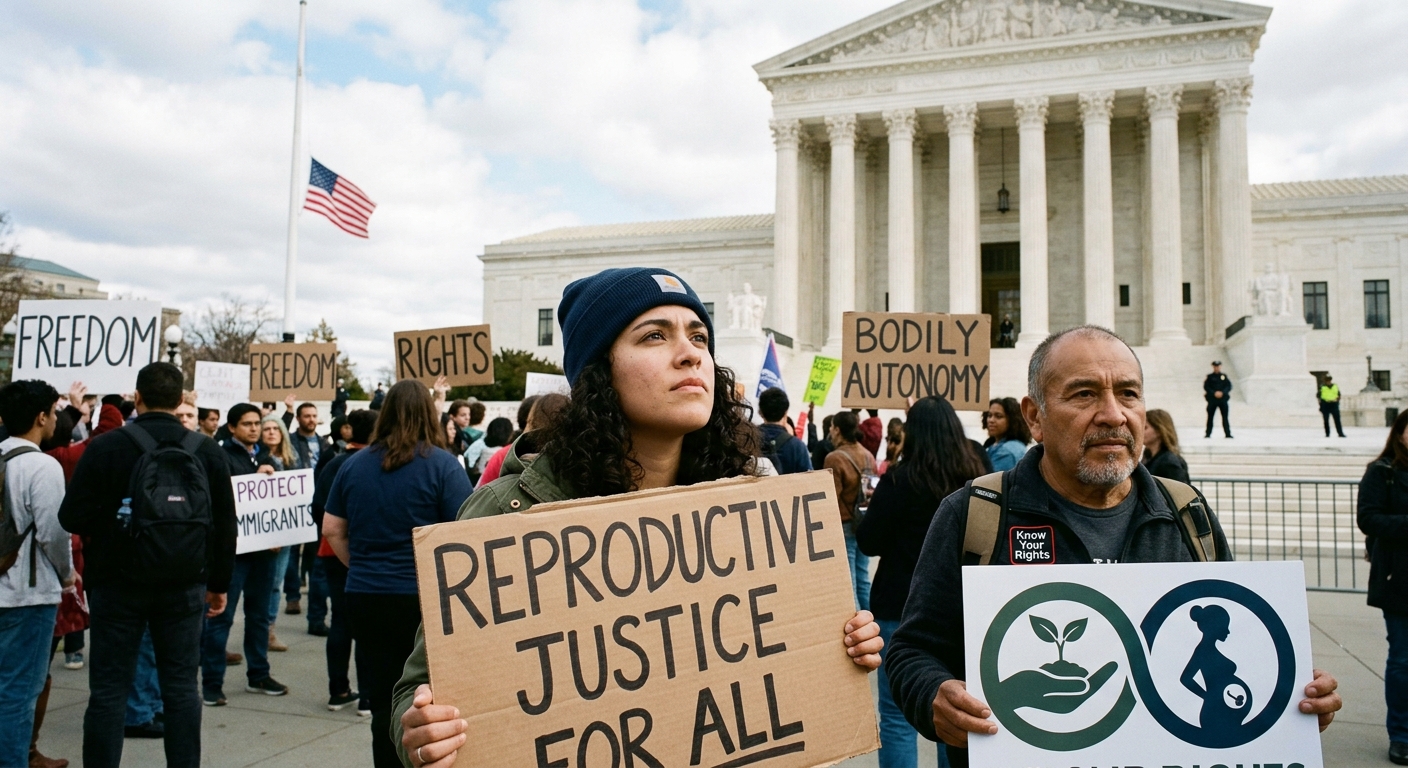
The Supreme Court of the United States stands as the ultimate theater where the nation’s most profound and consequential civil liberties disputes are adjudicated. Among the most deeply contested areas of constitutional law are the fundamental rights of immigrants and the baseline guarantees of reproductive freedom. Historically viewed by some as entirely separate legal arenas, these two domains frequently and powerfully intersect, revealing a shared vulnerability among marginalized populations subject to shifting judicial philosophies. When the high court deliberates on these pressing matters, the resulting jurisprudence dictates the limits of bodily autonomy, the scope of federal executive power, and the basic procedural protections afforded to those seeking refuge within American borders.
The dual crises facing immigrants 94specifically asylum seekers subjected to fast-tracked removal processes 94and individuals seeking essential reproductive healthcare highlight a broader ideological battle. This conflict revolves around who is ultimately entitled to constitutional protections and due process in the modern era. As federal policies oscillate between expanding protections and severely restricting them, the courts act as the final backstop. By examining the trajectory of Supreme Court decisions, we can better understand how the chipping away of one civil liberty often serves as a precursor to the dismantling of another.
The Erosion of Judicial Review in Immigration
At the heart of the American legal system is the Great Writ of habeas corpus 94a centuries-old legal principle originally inherited from English common law. It was explicitly designed to protect individuals from arbitrary and unlawful detention by requiring the government to justify a person’s imprisonment before a neutral judge. In the context of immigration, this principle has been heavily and aggressively litigated, especially concerning the federal government’s use of expedited removal processes. Expedited removal, established by the Illegal Immigration Reform and Immigrant Responsibility Act (IIRIRA) of 1996, allows frontline immigration officers to deport certain undocumented immigrants swiftly, completely bypassing a formal hearing before an immigration judge.
The Supreme Court’s landmark ruling in Department of Homeland Security v. Thuraissigiam served as a critical inflection point for immigrant rights and the fundamental concept of due process. The case involved Vijayakumar Thuraissigiam, a Sri Lankan national and asylum seeker who fled targeted political persecution and was apprehended just twenty-five yards after crossing the southern U.S. border. After an administrative asylum officer determined he did not present a “credible fear” of persecution 94the initial threshold required to pause expedited removal 94Thuraissigiam faced immediate, fast-tracked deportation. Civil liberties advocates argued that he possessed a baseline constitutional right to have a federal court review the legality of his deportation through a writ of habeas corpus.
However, the Supreme Court ruled that limiting judicial review in expedited removal proceedings does not violate the Suspension Clause of the Constitution. The majority decision fundamentally curtailed the ability of asylum seekers to challenge administrative deportation orders in federal court. By granting immense, unchecked discretionary power to frontline immigration officers, the ruling raised severe alarm among human rights advocates.
Without the critical safety net of judicial review, the risk of mistakenly deporting individuals back to countries where they face extreme violence, torture, or death increases exponentially. This erosion of due process signifies a broader judicial trend in which the constitutional rights of non-citizens are systematically restricted. When the administrative state is granted the ultimate authority to determine a person’s fate without judicial oversight, some of the most vulnerable populations in the world are left without adequate legal recourse.
The Proliferation of TRAP Laws and the Battle for Bodily Autonomy
Parallel to the gradual dismantling of procedural protections for immigrants is an aggressive legislative push to restrict, and ultimately eliminate, reproductive freedom. Over the past decade, opponents of abortion access have heavily utilized Targeted Regulation of Abortion Providers (TRAP) laws. These state-level mandates impose onerous, highly specific, and medically unnecessary requirements on abortion clinics and practitioners under the guise of protecting patient safety . In reality, TRAP laws are strategically designed to force clinics to close, thereby severely restricting the public’s access to constitutionally protected reproductive healthcare.
A major battle over TRAP laws culminated in the Supreme Court case June Medical Services L.L.C. v. Russo . The fierce legal dispute centered on a highly restrictive Louisiana law that required doctors who perform abortions to hold active admitting privileges at a hospital located within 30 miles of their clinic. The legislation was nearly word-for-word identical to a Texas law previously struck down by the Supreme Court in the landmark Whole Woman 99s Health v. Hellerstedt decision. In that prior case, the Court recognized that the admitting privileges requirement provided virtually no medical benefit and imposed an “undue burden” on individuals seeking abortion care.
Despite overwhelming medical consensus from organizations like the American Medical Association 94which emphasized that abortion is a highly safe procedure and that admitting privileges do not improve patient outcomes 94proponents of the Louisiana law argued it was a necessary safety protocol. In June Medical Services, the Supreme Court narrowly struck down the Louisiana law, adhering to the precedent set in Whole Woman’s Health.
However, the fractured nature of the ruling, with varying concurring opinions, signaled profound vulnerability for reproductive rights. When TRAP laws succeed, even temporarily, the resulting clinic closures create vast healthcare deserts. For individuals living in these affected regions, obtaining an abortion means traveling hundreds of miles, securing time off work, and finding alternative childcare. These immense logistical and financial burdens fall disproportionately on low-income individuals, people of color, and immigrant communities who already face systemic inequities.
Intersecting Vulnerabilities: When Immigrants Need Healthcare
The convergence of these two distinct civil liberties issues is most acutely and painfully felt by undocumented immigrants and asylum seekers who require reproductive healthcare. The structural barriers imposed by both stringent immigration enforcement and restrictive healthcare laws create a unique, overlapping matrix of oppression for this demographic. According to extensive research by the Guttmacher Institute, immigrants living in the United States face significant federal restrictions on their ability to obtain comprehensive, affordable health insurance coverage . Consequently, immigrant women 94including those lawfully present 94are significantly less likely to utilize sexual and reproductive health services compared to their U.S.-born counterparts.
For undocumented individuals living in southern border states 94where reproductive healthcare restrictions are ironically often the most severe 94the sheer physical act of traveling to an abortion clinic can be perilous. Interior border checkpoints operated by U.S. Customs and Border Protection (CBP) essentially trap undocumented individuals within specific, highly monitored geographic zones. If a local community clinic is forced to shutter its doors due to restrictive TRAP laws, an undocumented pregnant person cannot simply travel to a neighboring state or a major metropolitan area for care without risking apprehension, prolonged detention, and deportation.
Furthermore, the plight of unaccompanied migrant minors in federal custody serves as a stark illustration of these intersecting issues. In recent years, high-profile federal legal battles have erupted when government agencies have attempted to actively block detained immigrant teenagers from accessing necessary abortion care. In these disturbing instances, the government essentially weaponizes a minor 99s precarious immigration status and physical confinement to enforce ideological restrictions on bodily autonomy. The combination of intense language barriers, crippling fear of deportation, severe lack of medical insurance, and shrinking clinic availability ensures that immigrant women are among those most severely impacted by the continuous rollback of fundamental reproductive freedoms.
Religious Exemptions and Employer-Dictated Access
Adding yet another complex layer to the fight for reproductive freedom is the steady expansion of religious exemptions in the provision of healthcare. The legal landscape has witnessed numerous high-stakes challenges regarding employer-sponsored health insurance, specifically concerning the Affordable Care Act’s mandate that employer plans cover preventative contraception. Recent Supreme Court dockets have entertained arguments that employers with religious or moral objections should be legally permitted to opt out of providing contraceptive coverage to their workforce entirely.
When private employers are granted the sweeping authority to impose their personal religious beliefs on their employees’ standard healthcare plans, low-wage workers 94many of whom are hard-working immigrants 94suffer the most devastating consequences. Contraception is an undeniably fundamental component of preventative healthcare, and out-of-pocket costs can be prohibitively expensive for families living paycheck to paycheck. Denying comprehensive insurance coverage for birth control forcibly strips individuals of their agency to plan their families, manage chronic health conditions, and dictate their own economic futures. For immigrant workers who already face immense systemic hurdles in navigating the complexities of the U.S. healthcare system, the outright denial of basic contraceptive coverage by a corporate employer is yet another mechanism of structural disenfranchisement.
The Broader Implications for Civil Rights
The overlapping trajectories of immigrant rights and reproductive freedom at the Supreme Court highlight a pivotal and deeply concerning moment in modern American jurisprudence. Both areas of constitutional law are heavily dependent on stare decisis


Read full bio of Sneha Tete




