
How Minor Traffic Tickets Criminalize Poverty in America
Exploring the devastating cycle of court fines, fees, and license suspensions.
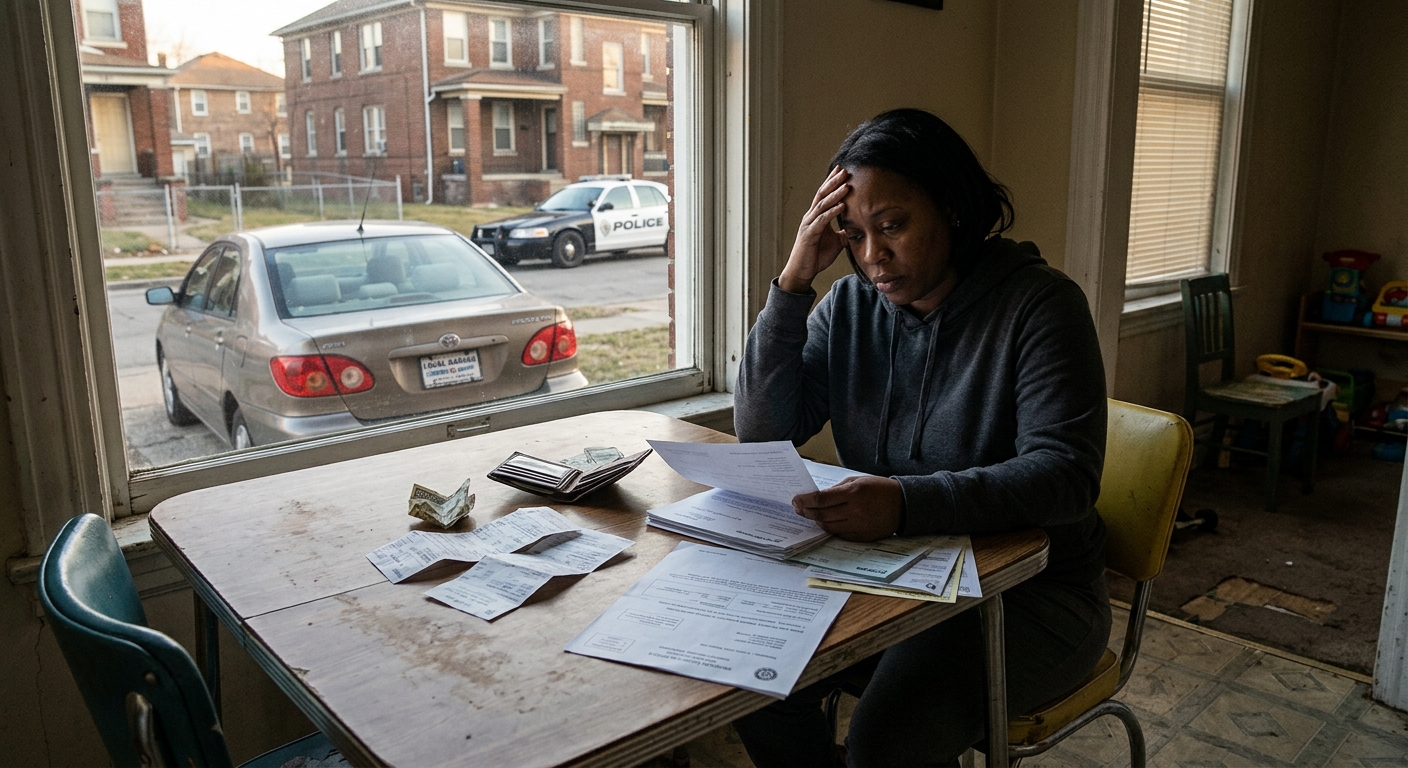
The Hidden Crisis: How a Simple Traffic Stop Can Spiral into Ruin
For millions of Americans, the sudden flash of red and blue police lights in the rearview mirror induces a profound sense of panic. While a traffic stop is universally stressful, the long-term consequences of that encounter depend entirely on the driver’s socioeconomic status. For a wealthy individual, a citation for a broken taillight, an expired registration tag, or minor speeding is an inconvenience—a temporary annoyance resolved with a quick online payment. However, for a person living paycheck to paycheck, that exact same piece of paper can serve as the catalyst for an economic and legal catastrophe.
Across the United States, the criminal justice system has increasingly relied on financial penalties to fund its operations. This shift has inadvertently created a two-tiered system of justice, one where the weight of a penalty is determined not by the severity of the offense, but by the size of the offender’s bank account. When local municipalities enforce aggressive ticketing strategies and attach exorbitant surcharges to basic fines, they effectively criminalize poverty. What begins as a minor civil infraction can rapidly metastasize into thousands of dollars in debt, the loss of driving privileges, job termination, and even physical incarceration. This is not a glitch in the system; in many jurisdictions, it is the system functioning exactly as designed to generate revenue.
Understanding this hidden crisis requires peeling back the layers of our municipal court infrastructure to examine how routine traffic enforcement has evolved into a highly regressive taxation mechanism. It demands a critical look at how we punish minor infractions and whether the punishment truly fits the crime when the collateral damage destroys a family’s financial stability.
The Debt Trap: Understanding the Architecture of Fines and Fees
To grasp how a minor ticket balloons into an insurmountable debt, one must understand the critical legal distinction between “fines” and “fees.” A fine is officially intended as a punitive measure—a financial deterrent designed to discourage individuals from violating traffic laws. A fee, on the other hand, is essentially a hidden tax. Fees, assessments, and surcharges are administrative costs tacked onto the base fine to generate revenue for government operations. These operations are often completely unrelated to the traffic offense itself.
Consider a hypothetical but statistically common scenario: A driver receives a citation for an expired vehicle registration. The statutory base fine might be a seemingly manageable $50. However, once the ticket is processed, a myriad of hidden costs are applied. The driver might face a $40 court processing fee, a $25 technology upgrade fee for the municipal courthouse, a $30 state mandated surcharge for a driver education fund, and a $15 fee to support local emergency medical services. Before the individual has even had a chance to contest the ticket, their $50 fine has exploded into a $160 financial burden.
For a significant portion of the American populace, an unexpected $160 expense is a crisis. When a defendant inevitably misses the initial payment deadline because they must choose between paying the court or paying their utility bill, late penalties are aggressively applied. Collection agency surcharges, which can legally add an additional 30 percent to the total debt, are often outsourced to private, for-profit companies. Within a matter of months, the initial $50 infraction can snowball into $500 or more. Because the justice system rarely assesses a defendant’s actual ability to pay before levying these penalties, the system operates under the false assumption that non-payment is an act of defiance, rather than a symptom of destitution.
The Mobility Paradox: The Devastating Impact of License Suspensions
When an individual cannot afford to pay their accumulating court debt, the state requires a mechanism to force compliance. Historically, the most common enforcement tool utilized by courts across the country is the suspension of the individual’s driver’s license. It is crucial to note that these specific suspensions are not enacted because the individual is a dangerous, reckless, or impaired driver; they are enacted solely as a debt collection tactic.
This practice creates a devastating paradox. In the vast majority of the United States, reliable public transportation is practically nonexistent. A car is an absolute prerequisite for participating in the modern economy. Driving is required to commute to a workplace, drop children off at school, attend medical appointments, and purchase groceries. When the state suspends a driver’s license for unpaid fines, they are effectively stripping the individual of their primary mechanism for generating the income necessary to pay off the very debt that caused the suspension in the first place.
Faced with the impossible choice between losing their livelihood or breaking the law, millions of Americans choose to drive with a suspended license. If they are pulled over again—perhaps for another minor infraction—the situation escalates from a civil debt issue to a criminal misdemeanor. The charge of “Driving While License Suspended” (DWLS) carries massive new fines, mandatory court appearances, and potential jail time. The individual’s vehicle may be impounded, leading to daily storage fees that far exceed the value of the car. The loss of mobility inevitably leads to job loss, plunging the individual deeper into poverty and ensuring that the original municipal debt will never be satisfied.
The Vicious Cycle: From Civil Infraction to Criminal Warrants
The United States formally abolished debtors’ prisons under federal law in the mid-19th century. In theory, no American can be jailed simply because they are too poor to pay a debt. In practice, however, the modern municipal court system has engineered legal loopholes that bypass this constitutional protection, creating a functional equivalent of the debtors’ prison for traffic offenses.
When a low-income driver misses a court date or a scheduled payment for their traffic ticket, the judge will typically issue a “failure to appear” or “failure to comply” bench warrant. From a strict legal standpoint, the individual is not being arrested for their poverty; they are being arrested for defying a court order. This semantic distinction offers little comfort to the single mother sitting in a county jail cell because she could not afford a $200 traffic surcharge.
Once a warrant is active, the individual lives in a state of perpetual fear. A routine encounter with law enforcement—even if they are the victim of a crime reporting an incident—can result in an immediate arrest. Incarceration, even for a few days, can trigger a catastrophic chain reaction. The individual loses wages, may be fired for missing shifts without notice, and can face eviction if the lost income results in a missed rent payment. Upon release, the court assesses yet another round of fees: warrant fees, jail booking fees, and public defender application fees. The system traps the individual in a perpetual cycle of punishment, extracting wealth they do not possess while offering no viable off-ramp.
Disproportionate Burden: The Demographics of the Debt Trap
The punitive burden of fines and fees does not fall equally across the American demographic landscape. The criminalization of poverty through traffic citations is deeply intertwined with systemic inequality, disproportionately devastating low-income communities and communities of color.
- Over-Policing and Targeted Enforcement: Minority neighborhoods often face higher concentrations of police presence. This increased surveillance naturally results in a higher volume of traffic stops for minor, non-moving violations. A broken taillight that might result in a verbal warning in an affluent suburb frequently results in a costly citation in a marginalized neighborhood.
- Wealth Extraction to Fund Local Governments: Some municipalities rely heavily on fines and fees to balance their civic budgets. In jurisdictions where property tax revenues are low, local governments use law enforcement as a decentralized tax collection agency. The burden of funding local government operations is forcibly shifted onto the backs of the poorest residents who lack the political capital to fight back.
- Compounding Generational Poverty: When millions of dollars are extracted from a low-income community to pay municipal fines, that capital is removed from the local economy. It cannot be used to pay for housing, support local businesses, or fund higher education, thereby entrenching generational poverty and stalling upward mobility.
Pathways to Reform: Dismantling the Systemic Criminalization of Poverty
The sheer scale of the harm caused by excessive traffic fines has sparked a bipartisan reform movement aimed at decoupling poverty from punishment. Legal advocates, economists, and civil rights organizations are pushing for structural changes to ensure the justice system is focused on public safety rather than revenue generation.
A primary target of legislative reform is the elimination of debt-based driver’s license suspensions. Several states have recently passed legislation recognizing that suspending driving privileges for unpaid court debt is both cruel and economically counterproductive. By restoring licenses, states allow individuals to remain in the workforce, thereby increasing the likelihood that they can eventually pay their legal obligations.
Furthermore, courts are increasingly being urged to implement mandatory “ability-to-pay” hearings. Before levying fines or assessing administrative fees, judges must evaluate a defendant’s financial reality. If an individual is found to be indigent, courts can offer alternatives such as proportional community service or debt forgiveness. In 2023, the U.S. Department of Justice issued explicit guidance emphasizing that courts must not impose adverse consequences for failure to pay without first conducting a meaningful assessment of a person’s financial capability.
Another innovative solution gaining traction is the “Day Fine” model, widely used in European nations. Under this system, the financial penalty for a traffic violation is mathematically scaled to the offender’s daily income. A speeding ticket thus carries the same proportional sting for a millionaire as it does for a minimum-wage worker, ensuring equitable punishment without causing financial ruin.
Frequently Asked Questions (FAQs)
What is the difference between a court fine and a fee?
A fine is a financial punishment intended to deter specific illegal behavior, such as speeding. Fees, surcharges, and assessments are additional administrative costs added to the ticket to raise revenue for government operations, such as court maintenance or emergency services.
Can I go to jail simply for an unpaid traffic ticket?
Technically, you cannot be jailed solely for owing debt. However, if you fail to pay a ticket and subsequently miss a required court appearance, a judge can issue a “failure to appear” or “contempt of court” bench warrant. This warrant will lead to your arrest and potential incarceration.
What is a debt-based driver’s license suspension?
This occurs when a state suspends your driving privileges not because you are a dangerous driver, but solely to coerce you into paying outstanding court fines and fees. It is a debt collection tactic that makes it exponentially harder for an individual to maintain employment.
What is an ability-to-pay hearing?
An ability-to-pay hearing is a judicial process where a judge reviews an individual’s income, living expenses, and financial hardships to determine if they can reasonably afford to pay a fine. If they cannot, the judge may waive the fees or offer an alternative, such as community service.
References
- Justice Department Issues Dear Colleague Letter to Courts Regarding Fines and Fees for Youth and Adults — U.S. Department of Justice. 2023-04-20. https://www.justice.gov/opa/pr/justice-department-issues-dear-colleague-letter-courts-regarding-fines-and-fees-youth-and
- Resource Guide: Reforming the Assessment and Enforcement of Fines and Fees — Office of Justice Programs, U.S. Department of Justice. 2023-01-01. https://bja.ojp.gov/sites/g/files/xycvty186/files/Publications/finesandfeesguide.pdf
- The Criminalization of Poverty in Tennessee — Vera Institute of Justice. 2023-08-01. https://www.vera.org/publications/the-criminalization-of-poverty-in-tennessee
- Preventing the criminalization of poverty through driver’s license suspension — Michigan League for Public Policy. 2020-09-16. https://mlpp.org/preventing-the-criminalization-of-poverty-through-drivers-license-suspension/
Similar Articles








Read full bio of Sneha Tete


