
Crafting a Valid Will in Hawaii: Essential Guide
Master the legal steps to create a binding will in Hawaii, ensuring your legacy is protected under state law.
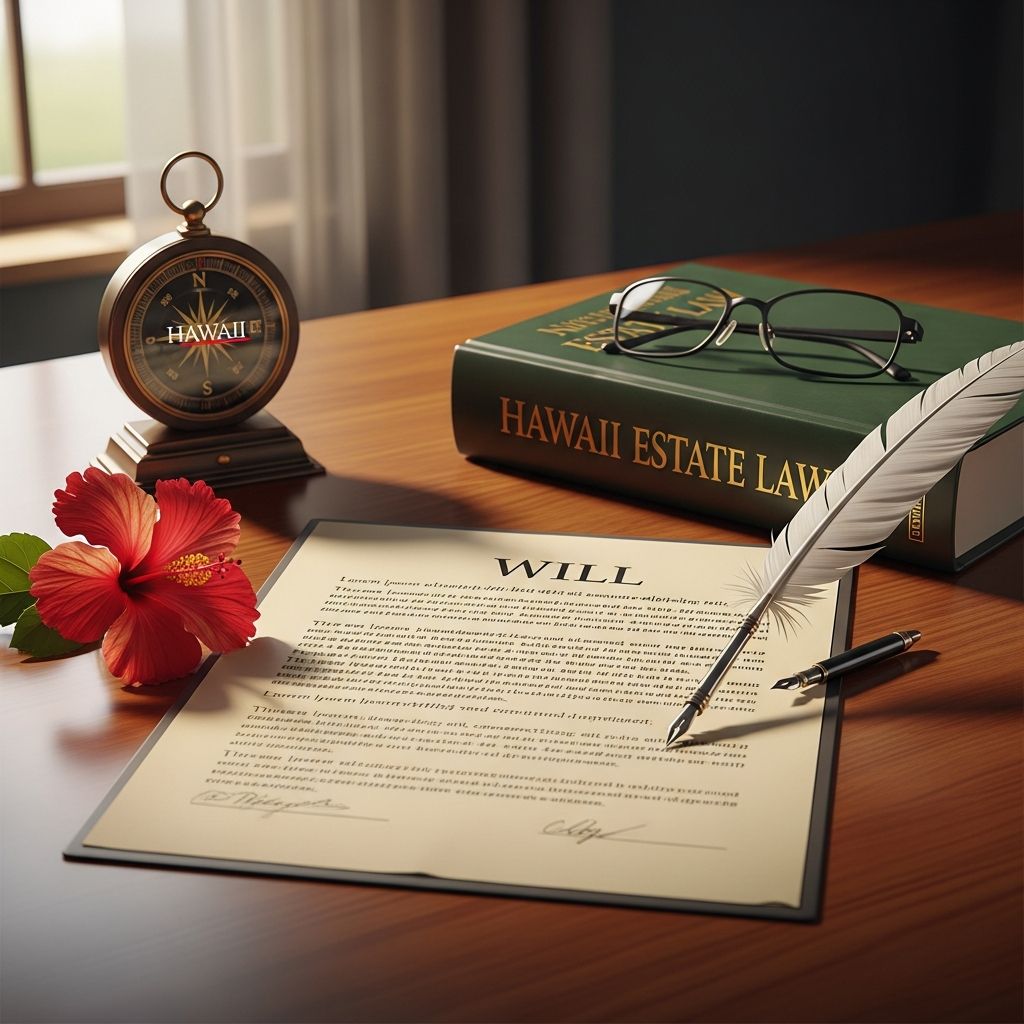
In Hawaii, establishing a last will and testament is a critical step in estate planning to direct how your assets are distributed after death. This document allows you to specify beneficiaries, appoint an executor, and name guardians for dependents, overriding default intestate laws that might not align with your intentions.
Core Legal Requirements for a Hawaii Will
To qualify as valid under Hawaii law, a will must meet specific criteria outlined in the Hawaii Revised Statutes. The individual creating the will, known as the testator, must be at least 18 years old and possess sound mental capacity, meaning they understand the nature of their assets, relationships, and the document’s implications.
The will must be in written form—electronic or oral wills are not recognized except in rare circumstances. It requires the testator’s signature or that of another person acting in their presence and at their direction. Additionally, at least two witnesses must sign the document shortly after observing the signing or the testator’s acknowledgment of it.
- Age Threshold: Testator must be 18+ years.
- Mental Competency: Clear understanding of actions and consequences.
- Written Format: No video or audio substitutes.
- Signature: Testator’s own or proxy under supervision.
- Witnesses: Minimum two, signing promptly after attestation.
Understanding Holographic Wills in the Islands
Hawaii permits holographic wills as an exception to standard witnessing rules. These are entirely handwritten and signed by the testator, with no witnesses required, provided the signature and key provisions are in their handwriting. Courts may use external evidence to confirm intent, even if parts are typed.
This option suits emergencies but risks challenges due to handwriting disputes or incomplete details. For reliability, formal witnessed wills are preferable, especially for complex estates involving real property or businesses.
Appointing Key Roles: Executors and Guardians
A primary advantage of a will is naming a
personal representative
(executor) to manage probate, collect assets, pay debts, and distribute inheritances. Select someone trustworthy, organized, and ideally local to Hawaii to handle court filings efficiently.For parents, designating a
guardian
for minor children is vital. This nominates who raises them if both parents pass, subject to court approval prioritizing the child’s welfare. Include alternates to cover unavailability.| Role | Responsibilities | Selection Tips |
|---|---|---|
| Executor | Probate oversight, asset management, debt settlement | Choose reliable family, friend, or professional; compensate via will |
| Guardian | Care for minors’ upbringing and needs | Prioritize family alignment, stability; discuss consent beforehand |
Probate Process in Hawaii: What to Anticipate
Upon death, the will enters probate in the circuit court of the decedent’s residence. This supervised process validates the will, inventories assets, notifies creditors, and authorizes distributions. Hawaii’s probate is formal but can be streamlined for small estates under $100,000 via affidavit procedures.
Probate records become public, potentially exposing family finances. Duration varies from months to years based on estate size and disputes. Historical records from 1847 show probate files detailing heirs, inventories, and guardianships, often in English and Hawaiian.
Strategies to Bypass Probate Altogether
To avoid probate’s costs, publicity, and delays, integrate tools like revocable living trusts. Transfer assets into the trust during life; it bypasses probate upon death, with a successor trustee handling distributions privately.
Other methods include joint tenancy with right of survivorship, payable-on-death bank accounts, and beneficiary designations on retirement plans or life insurance. Update these post-will execution to prevent conflicts.
Probate vs. Trust Comparison
| Aspect | Probate | Living Trust |
|---|---|---|
| Privacy | Public record | Private |
| Time | 6-18+ months | Weeks |
| Cost | 3-7% of estate | Upfront setup, lower long-term |
| Court Oversight | Required | None |
Special Considerations for Blended Families and Pets
Hawaii’s laws presume equal spousal shares, but wills can customize for stepchildren or partners. Explicitly disinherit if needed to avoid partial intestate claims. For pets, designate caregivers and create pet trusts funding their care—Hawaii recognizes these.
Digital assets like online accounts require specific instructions, as standard wills may not cover passwords or virtual property.
Updating Your Will: Life Changes Demand Revisions
Review your will after major events: marriage, divorce, births, deaths, or asset shifts. Hawaii requires full re-execution or codicil (amendment) with same formalities. Destroy outdated versions to prevent confusion.
DIY Options vs. Professional Assistance
Online platforms offer customizable Hawaii-compliant templates, legal without attorneys if properly executed. However, for intricate estates—businesses, out-of-state property, tax minimization—consult an attorney to avert invalidation risks.
Affordable aid exists via legal clinics for low-income residents, emphasizing written signatures and witnessing.
Frequently Asked Questions About Hawaii Wills
Can I make a will without a lawyer in Hawaii?
Yes, as long as it complies with statutory requirements for writing, signature, and witnesses. Holographic wills offer a lawyer-free alternative.
What happens if I die without a will in Hawaii?
Intestate succession applies: spouse and children inherit first; distant relatives follow. Non-relatives get nothing.
Is a handwritten will legal in Hawaii?
Yes, if the material parts and signature are in your handwriting, even without witnesses.
How many witnesses are needed for a Hawaii will?
At least two, who sign after seeing you sign or acknowledge the will.
Does a will avoid all taxes in Hawaii?
No, federal estate taxes may apply over $13.61 million (2024 threshold); Hawaii has no state estate tax.
Can I include real estate in my will?
Yes, specify property clearly; out-of-state land may require ancillary probate.
Steps to Execute Your Will Properly
- Gather asset details and beneficiary lists.
- Draft using software or attorney.
- Sign in front of two disinterested witnesses (non-beneficiaries).
- Store securely; inform executor of location.
- Review every 3-5 years or after life events.
By following these guidelines, Hawaii residents secure their legacies effectively. Proactive planning minimizes disputes, honors wishes, and supports loved ones seamlessly.
References
- Hawaii Revised Statutes § 560:2-502 (2024) – Execution; witnessed wills; holographic wills — Hawaii State Legislature. 2024. https://law.justia.com/codes/hawaii/title-30a/chapter-560/section-560-2-502/
- Wills and Trusts Honolulu, the Big Island, Oahu, and Maui — Sterling & Tucker. Accessed 2026. https://www.sterlingandtucker.com/services/wills-and-trusts/
- Is there a way to prepare a will if you are unable to afford an estate planning attorney? — Native Hawaiian Legal Corporation. Accessed 2026. https://nativehawaiianlegalcorp.org/is-there-a-way-to-prepare-a-will-if-you-are-unable-to-afford-an-estate-planning-attorney/
- Probates/Wills – Department of Accounting and General Services — State of Hawaii. Accessed 2026. https://ags.hawaii.gov/archives/about-us/genealogy-research-guide/probateswills/
- 2026 Trust and Will review: Pros, cons, and alternatives — FreeWill. 2026. https://www.freewill.com/learn/trust-and-will-review
Similar Articles








Read full bio of Sneha Tete


