
Delaware Divorce Filing: 8-Step Guide To File Efficiently
Complete resource for navigating Delaware divorce: residency rules, filing steps, costs, and legal options for a smooth process.
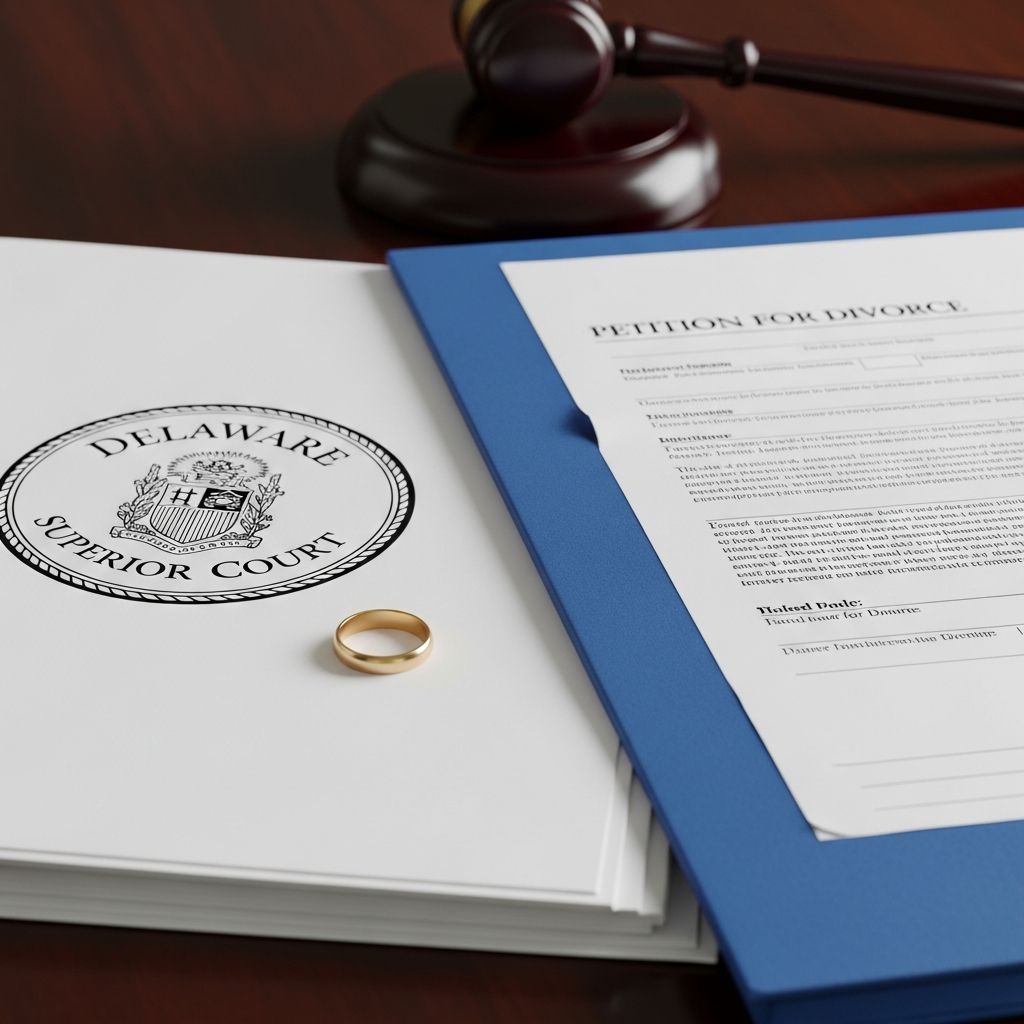
Ending a marriage in Delaware involves specific legal steps governed by Family Court rules. This guide details eligibility criteria, procedural requirements, financial considerations, and strategies for efficient resolution, drawing from state statutes and court practices.
Establishing Eligibility for Divorce Proceedings
Delaware mandates that at least one spouse maintains residency in the state for six consecutive months before initiating divorce actions. This applies equally to military personnel stationed within Delaware borders for the same period. The purpose is to affirm the court’s jurisdiction over the marital dissolution.
Residency proof typically includes documents like a Delaware driver’s license, voter registration, or utility statements tied to a local address. For civil unions solemnized in Delaware, filing remains possible even if neither party currently resides in the state, provided their home jurisdiction does not recognize dissolution of such unions.
Understanding Separation Requirements
A core prerequisite is a six-month separation period, during which spouses must live apart without sharing a bedroom or engaging in sexual relations. Importantly, physical relocation is not required; cohabitation under separate sleeping arrangements suffices.
Any reconciliation attempt resets the clock unless the couple avoids intimacy and shared bedding for at least 30 days prior to the final hearing. This flexibility accommodates practical realities while upholding the irretrievable breakdown standard.
Available Grounds for Marital Dissolution
Delaware primarily recognizes no-fault divorce, where the marriage is deemed irretrievably broken. This is proven through voluntary separation, spouse misconduct, mental illness, or incompatibility, each requiring the six-month separation except in direct misconduct cases.
- Voluntary Separation: Mutual agreement to live apart for six months.
- Misconduct-Induced Separation: Acts like adultery, desertion, abuse (physical/verbal), substance addiction, criminal imprisonment over one year, or willful neglect of marital duties bypass the wait if substantiated.
- Mental Illness Separation: Proven incapacity rendering cohabitation untenable.
- Incompatibility: Irreconcilable differences without blame, post six months apart.
Fault grounds demand evidentiary support, potentially lengthening proceedings but eliminating separation delays.
Comprehensive Step-by-Step Filing Process
Initiating divorce requires precision in documentation and court submission. Here’s the structured pathway:
- Prepare Essential Documents: Secure an original or certified marriage certificate.
- Complete Core Forms: Petition for Divorce/Annulment (Form 442), Confidential Information Sheet (Form 240), and Vital Statistics Form (441 or 441SS).
- Submit to Appropriate Court: File in the Family Court county of residence for either spouse.
- Effectuate Service: Deliver copies to the other spouse via sheriff, process server, or certified mail.
- Monitor Response Window: Spouse has 20 days to contest; silence deems it uncontested.
- Engage in Disclosure: Exchange financial affidavits, asset details, and parenting plans if applicable.
- Participate in Hearings: Uncontested matters may finalize without appearance; contested require scheduling.
- Await Decree: Judicial approval issues the final order dissolving the marriage.
Couples accelerating financial disclosures see 40% quicker resolutions per filing data analysis.
Financial Implications and Court Fees
Costs vary by case complexity. Basic filing stands at $165, but anticipate additional expenses for service ($50+), mediation, or attorney representation pushing totals from $300 for simple uncontested to $20,000+ for litigated disputes involving property division or custody battles.
| Cost Category | Estimated Range | Notes |
|---|---|---|
| Filing Fee | $165 | Non-waivable unless indigency proven |
| Service of Process | $50–$100 | Sheriff or private server |
| Attorney Fees (Uncontested) | $300–$2,000 | Flat rate common |
| Contested Full Case | $5,000–$20,000+ | Includes discovery, hearings |
| Mediation | $200–$500/session | Optional for agreement |
Fee waivers are available for low-income filers via court application.
Uncontested vs. Contested Divorce Timelines
Uncontested divorces, with mutual agreement on all terms, resolve in 6–8 months post-filing, often without hearings. Contested cases, marked by disputes over alimony, assets, or children, extend to 12+ months, involving discovery, motions, and trials.
Prompt cooperation minimizes delays; mediation services aid in bridging gaps efficiently.
Navigating Child Custody and Support
Delaware prioritizes the child’s best interests in custody determinations, considering factors like parental fitness, home environment, and sibling bonds. Joint custody is favored absent contraindications.
Support calculations follow state guidelines based on income shares, typically 20–30% of net income allocated per child, adjustable for overnights and special needs.
Property Division and Spousal Maintenance
Delaware adheres to equitable distribution, dividing marital property fairly but not equally. Courts weigh marriage length, contributions, earning capacities, and conduct impacting finances.
Alimony (spousal support) may be temporary or permanent, guided by need and ability to pay, with fault potentially influencing awards in misconduct filings.
Strategic Considerations for Efficient Resolution
Opt for uncontested paths by pre-negotiating terms via mediation. Self-representation suits simple no-minor-children cases, but professionals advise on complexities. Military families benefit from specialized court accommodations.
Post-decree modifications for substantial changes in circumstances ensure ongoing adaptability.
Frequently Asked Questions
Can I file for divorce in Delaware without living apart?
Yes, if residing in the same home but separate bedrooms without intimacy for six months.
How long does an uncontested Delaware divorce take?
Typically 6–8 months from filing to decree.
What if my spouse won’t respond to the petition?
Proceed as uncontested after 20 days; seek default judgment.
Does adultery speed up the process?
Fault grounds like adultery waive separation wait if proven.
Are there forms for free online?
Yes, Delaware Courts website provides downloadable packets.
Final Thoughts on Delaware Divorce
Armed with residency confirmation, proper grounds, and procedural knowledge, Delaware divorces can proceed methodically. Consult Family Court resources or counsel for tailored guidance amid evolving personal circumstances.
References
- Delaware Divorce Filing Guide: Requirements, Process & Costs — Civilly.io. 2025. https://civilly.io/blog/delaware-divorce-filing-guide
- What are the grounds to file for divorce in Delaware? — WomensLaw.org. Accessed 2026. https://www.womenslaw.org/laws/de/divorce/basic-info/what-are-grounds-file-divorce-delaware
- Divorce/Annulment – Family Court – Delaware Courts — courts.delaware.gov. Accessed 2026. https://courts.delaware.gov/family/divorce/
- Delaware Divorce Lawyers — Abram, Gulab & Hutchison. Accessed 2026. https://agh.law/family-law/divorce/
- Delaware Divorce Laws – What Your Need to Know! — LawInfo.com. Accessed 2026. https://www.lawinfo.com/resources/divorce/delaware/
Similar Articles








Read full bio of Sneha Tete


