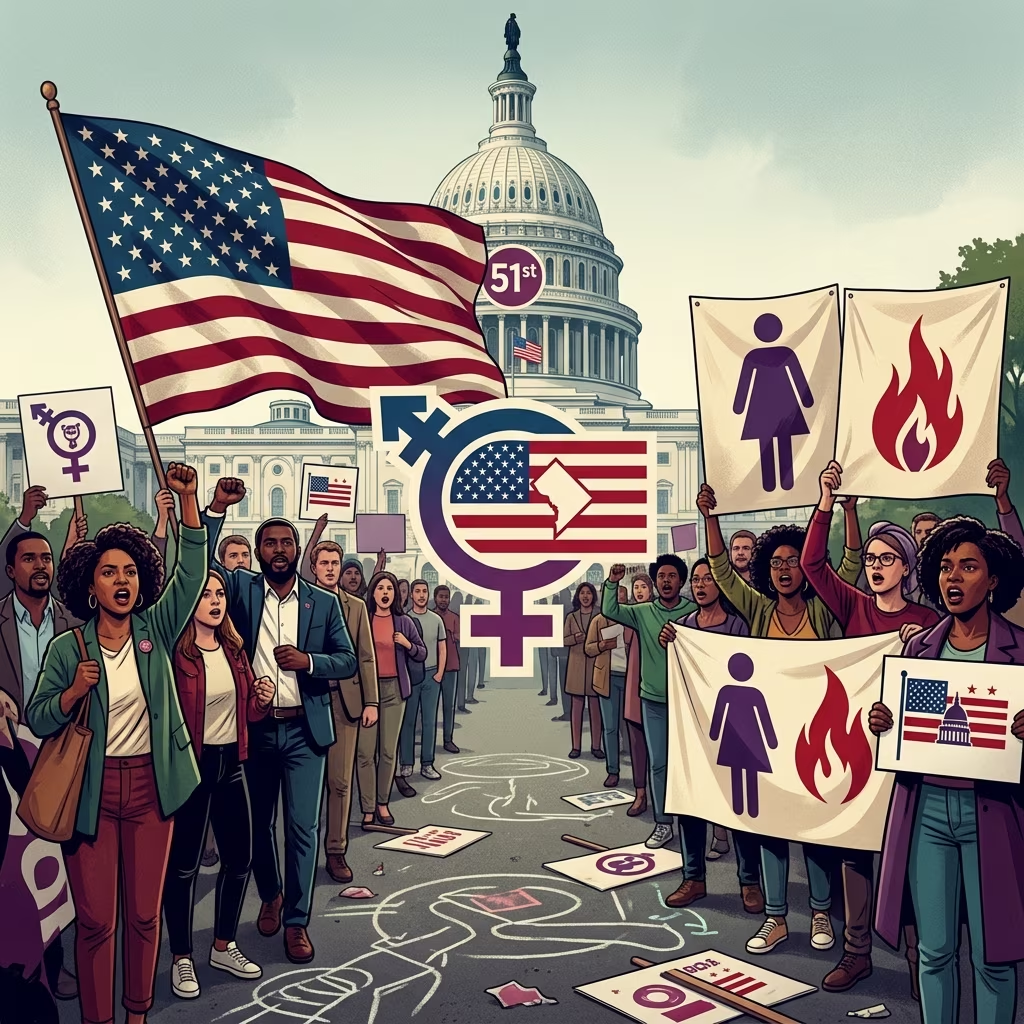
The cornerstone of American democracy is the principle that citizens have a voice in the halls of power. For millions of Americans, the ability to vote for federal representatives ensures their local concerns, deeply held values, and health care needs are fiercely defended in Congress. Meeting with a member of Congress who champions your rights—particularly on vital issues such as reproductive freedom and bodily autonomy—is a profound reminder of how representative democracy is supposed to function. It empowers constituents to hold their government accountable and push for legislative priorities that benefit their communities. Yet, this fundamental democratic experience is entirely denied to the nearly 700,000 residents of Washington, D.C.
Despite paying federal taxes, serving on juries, and fighting in the military, residents of the nation’s capital are uniquely disenfranchised. They have no voting representation in the United States Senate or the House of Representatives. Worse still, because Washington, D.C. is not a state, its local legislative decisions are routinely subjected to the whims of federal politicians. This undemocratic arrangement goes far beyond symbolic disenfranchisement; it has severe, tangible impacts on the health, safety, and economic security of D.C. residents. One of the most glaring examples of this congressional overreach is the systematic dismantling of local reproductive health care access through targeted federal budget riders.
The Anatomy of Taxation Without Representation
The historical origins of Washington, D.C.’s lack of statehood trace back to Article I of the U.S. Constitution, which granted Congress “exclusive legislation” over the federal district. However, the Framers failed to establish a mechanism for the political representation of the people who would eventually live there. Consequently, the capital operates under a deeply flawed system where the federal government wields unparalleled authority over municipal affairs.
While the Home Rule Act of 1973 allowed D.C. to elect a local mayor and city council, this autonomy remains largely an illusion. Congress retains the ultimate authority to review, modify, or completely overturn laws passed by the D.C. Council. Any piece of local legislation must endure a congressional review period, during which federal lawmakers—who do not live in D.C. and are inherently not accountable to its voters—can block the law. Additionally, without representation, the residents of D.C. are entirely reliant on the goodwill of lawmakers from other states, many of whom possess vastly different political priorities and values than the local population.
This dynamic essentially renders Washington, D.C. a testing ground for restrictive federal policies, especially those championed by politicians who wish to impose their ideological agendas on a populace that cannot vote them out of office. Legislative efforts such as the Washington, D.C. Admission Act (H.R. 51) seek to rectify this historical injustice by granting the capital statehood, thereby ensuring its residents equal footing with the rest of the nation. Until such measures are enacted, D.C. remains incredibly vulnerable to extreme legislative interference that undermines local autonomy.
Federal Meddling: Understanding the Dornan Amendment
One of the most devastating examples of congressional interference in D.C.’s local governance is the implementation of the Dornan Amendment. While the federally mandated Hyde Amendment prohibits the use of federal taxpayer dollars for abortion services (with narrow exceptions for life endangerment, rape, or incest), individual states possess the sovereign right to use their own locally raised tax revenues to cover these critical health services. Currently, numerous states opt to allocate their own state funds to ensure Medicaid enrollees have comprehensive access to abortion care.
Washington, D.C., however, is explicitly barred from making this same choice for its residents. First enacted in the late 1980s, the Dornan Amendment is a controversial budget rider attached by Congress to D.C.’s annual appropriations bill. It strictly forbids the District from using its *own* locally collected tax dollars to fund abortion services for its low-income residents. This creates a uniquely punitive framework that targets the capital.
The amendment treats D.C. differently than any other jurisdiction in the country, punishing its residents simply because they live within the boundaries of a federal district. Furthermore, the D.C. Council and the overwhelming majority of its residents strongly support robust reproductive rights. The Dornan Amendment represents a direct subversion of the local democratic will, forced upon the city by external forces. Lawmakers who face strict opposition to abortion bans in their home states often use D.C. budget riders to score political points with their national base, fully aware that D.C. residents have no congressional representation to fight back and hold them accountable at the ballot box.
The Disproportionate Impact on Low-Income and Marginalized Communities
The intersection of federal disenfranchisement and reproductive restrictions creates an ongoing public health crisis for Washington, D.C.’s most vulnerable populations. Restrictions on Medicaid funding for abortions do not eliminate the community’s need for reproductive care; instead, they drastically alter who can safely and easily access it. When local funds cannot be used to bridge the gap left by federal bans, the financial burden falls squarely on those least able to afford it.
Out-of-pocket costs for abortion care, coupled with potential travel expenses, childcare demands, and lost wages from taking time off work, create insurmountable barriers for many. Consider the following impacts of localized abortion funding restrictions:
- Deepening Economic Hardship: Studies consistently show that individuals who are denied abortion care due to financial or geographical barriers are significantly more likely to fall into deep poverty. They face higher rates of eviction, bankruptcy, and long-term financial instability compared to those who receive the care they need.
- Maternal Health Risks: Low-income individuals, particularly women of color, already face disproportionately high maternal mortality and morbidity rates. Restricting access to comprehensive reproductive healthcare forces many to carry high-risk pregnancies to term against their will, further endangering their physical and mental health.
- Racial Inequity: Because systemic racism has historically tied wealth to race in the United States, Medicaid-eligible populations are disproportionately made up of people of color. The Dornan Amendment is therefore not just a reproductive rights issue; it is a glaring issue of racial justice and economic equity.
Federal lawmakers who repeatedly vote to maintain the Dornan Amendment are actively perpetuating health disparities in the nation’s capital. Academic research, such as studies published in peer-reviewed journals, has demonstrated that Medicaid abortion funding restrictions lead directly to a reduction in access to necessary reproductive care, placing the heaviest and most unjust burden on low-income adults.
A Tale of Two Systems: States vs. The District
To fully grasp the fundamental unfairness of the federal oversight of Washington, D.C., one must compare the rights afforded to standard states versus the harsh restrictions placed on the nation’s capital. The following table highlights the profound disparities in reproductive and legislative autonomy that D.C. residents endure.
| Democratic & Legislative Rights | The 50 U.S. States | Washington, D.C. |
|---|---|---|
| Voting Representation in Congress | Yes (2 Senators, proportional House Reps) | No (0 Senators, 1 Non-voting Delegate) |
| Control over Local Tax Revenue | Full autonomy over state-raised funds | Subject to Congressional approval and riders |
| Ability to Fund Medicaid Abortions | Yes (Multiple states currently use local funds) | No (Blocked by the federal Dornan Amendment) |
| Protection from Federal Veto of Local Laws | Protected by the Tenth Amendment | Congress can veto or rewrite any D.C. law |
This stark contrast clearly illustrates why reproductive justice organizations continuously argue that bodily autonomy cannot be fully realized in a society without accompanying political autonomy. Rights mean very little if the government can arbitrarily suspend them without democratic recourse.
Reproductive Justice Requires Democratic Autonomy
The fight for reproductive freedom is inextricably linked to the fight for democratic representation. Advocates argue that you cannot legitimately protect a person’s right to make private medical decisions while simultaneously accepting a system that strips entire geographic populations of their right to self-governance. These two forms of autonomy go hand in hand.
For decades, the residents of Washington, D.C. have organized grassroots movements, launched regional abortion funds, and established community health networks to support those marginalized by federal overreach. Organizations operating on the ground work tirelessly to provide the financial assistance that the local government is legally prohibited from offering its own citizens. However, philanthropy, volunteerism, and mutual aid cannot replace sound public policy and equitable, institutionalized health care access.
The ongoing denial of statehood allows anti-choice members of Congress to use the capital as a playground for authoritarian policies. By overriding the D.C. Council, these politicians force their moral and religious frameworks onto a progressive, diverse city. True reproductive justice will only be achieved in the nation’s capital when its citizens are granted the fundamental American right to govern themselves without federal vetoes.
What Constituents Nationwide Can Do to Help
Because D.C. residents cannot vote for federal lawmakers who will protect their rights, the responsibility falls heavily on voters in the other 50 states to act as vocal allies. The power of collective, nationwide action is the only mechanism that can force a change in the status quo. The next time you meet with your elected representative, attend a town hall, or participate in a lobby day to advocate for reproductive rights, you must also raise your voice for the disenfranchised citizens of Washington, D.C. Here are actionable steps allies can take:
- Demand Support for D.C. Statehood: Contact your Senators and Representatives and demand they cosponsor and vote for statehood legislation like the Washington, D.C. Admission Act. Remind them that American democracy is incomplete as long as the capital’s residents are sidelined.
- Advocate for Clean Budgets: Urge your federal lawmakers to pass federal appropriations bills free of ideological riders. Specifically, demand the removal of the Dornan Amendment so D.C. can finally spend its own local tax dollars according to the will of its voters.
- Support Local Abortion Funds: While the legislative battles wage on in Congress, donate to regional funds that directly assist D.C. residents and those traveling to the capital for care. Financial solidarity is a crucial component of the reproductive justice movement.
- Elevate the Conversation: Use your personal platform to educate others about the intersection of voting rights and health care access. Many Americans are entirely unaware that Congress actively blocks D.C. from funding reproductive care for low-income citizens.
Frequently Asked Questions (FAQs)
Why doesn’t Washington, D.C. have congressional representation?
The U.S. Constitution designated a maximum ten-mile-square federal district to serve as the seat of government, explicitly granting Congress exclusive legislative jurisdiction over it. The Framers did not outline a congressional voting process for the district’s future residents, leading to centuries of political disenfranchisement. Although the 23rd Amendment, ratified in 1961, allowed D.C. to vote in presidential elections, it still lacks voting members in both the House of Representatives and the Senate.
What is the difference between the Hyde and Dornan Amendments?
The Hyde Amendment is a federal provision that prohibits the use of federal taxpayer dollars (specifically federal Medicaid funds) for abortion services across the entire country, except in cases of rape, incest, or life endangerment. The Dornan Amendment, on the other hand, is a specific legislative rider attached exclusively to Washington, D.C.’s budget. It goes a step further by preventing the District from using its own locally raised tax revenue to fund abortion care for Medicaid enrollees, a restriction not placed on any of the 50 states.
How can D.C. achieve statehood?
D.C. statehood can be achieved through regular federal legislative action, meaning it does not necessarily require a constitutional amendment. It requires a majority vote in both the House of Representatives and the Senate, followed by the President’s signature. Proposed legislation, such as H.R. 51, would shrink the federal district to encompass only core government buildings and monuments, while admitting the surrounding populated residential areas as a new, independent state.
Does overturning Roe v. Wade affect the Dornan Amendment?
While the Supreme Court’s overturning of Roe v. Wade allowed individual states to ban abortion outright, abortion currently remains legal in Washington, D.C. thanks to local health care laws. However, the Dornan Amendment has been in place for decades prior to the recent Supreme Court decision, and it continuously acts as an economic barrier to abortion access for low-income residents regardless of the procedure’s overarching legal status in the city.
Conclusion
The dual denial of reproductive freedom and democratic representation in Washington, D.C. is a glaring stain on the American promise of equality. When federal politicians repeatedly weaponize their congressional authority to strip a municipality of its right to provide vital healthcare to low-income residents, they deeply undermine the very essence of liberty. Ensuring that everyone has the right to bodily autonomy means ensuring that everyone has a voice in the halls of power to defend those rights. It is past time for the rest of the nation to stand in unyielding solidarity with the people of Washington, D.C., demanding an immediate end to the Dornan Amendment and the rapid passage of full statehood. Only then will the residents of the capital truly be represented by the government that resides in their own backyard.
References
- DC Statehood, Explained — Brennan Center for Justice. 2022-03-18. https://www.brennancenter.org/our-work/research-reports/dc-statehood-explained
- The Hyde Amendment and Coverage for Abortion Services Under Medicaid in the Post-Roe Era — KFF. 2024-03-14. https://www.kff.org/womens-health-policy/issue-brief/the-hyde-amendment-and-coverage-for-abortion-services/
- The Fight for D.C. Statehood — Congresswoman Eleanor Holmes Norton, House.gov. https://norton.house.gov/issues/dc-statehood
- The effect of Medicaid abortion funding restrictions on abortions, pregnancies and births — P B Levine, A B Trainor, D J Zimmerman, PubMed (DOI: 10.1016/s0167-6296(96)00495-x). 1996-10-01. https://pubmed.ncbi.nlm.nih.gov/10164043/