
Child Welfare Reform: The Urgent Civil Rights Battle
Legal organizations are fighting systemic racism in the foster care system.
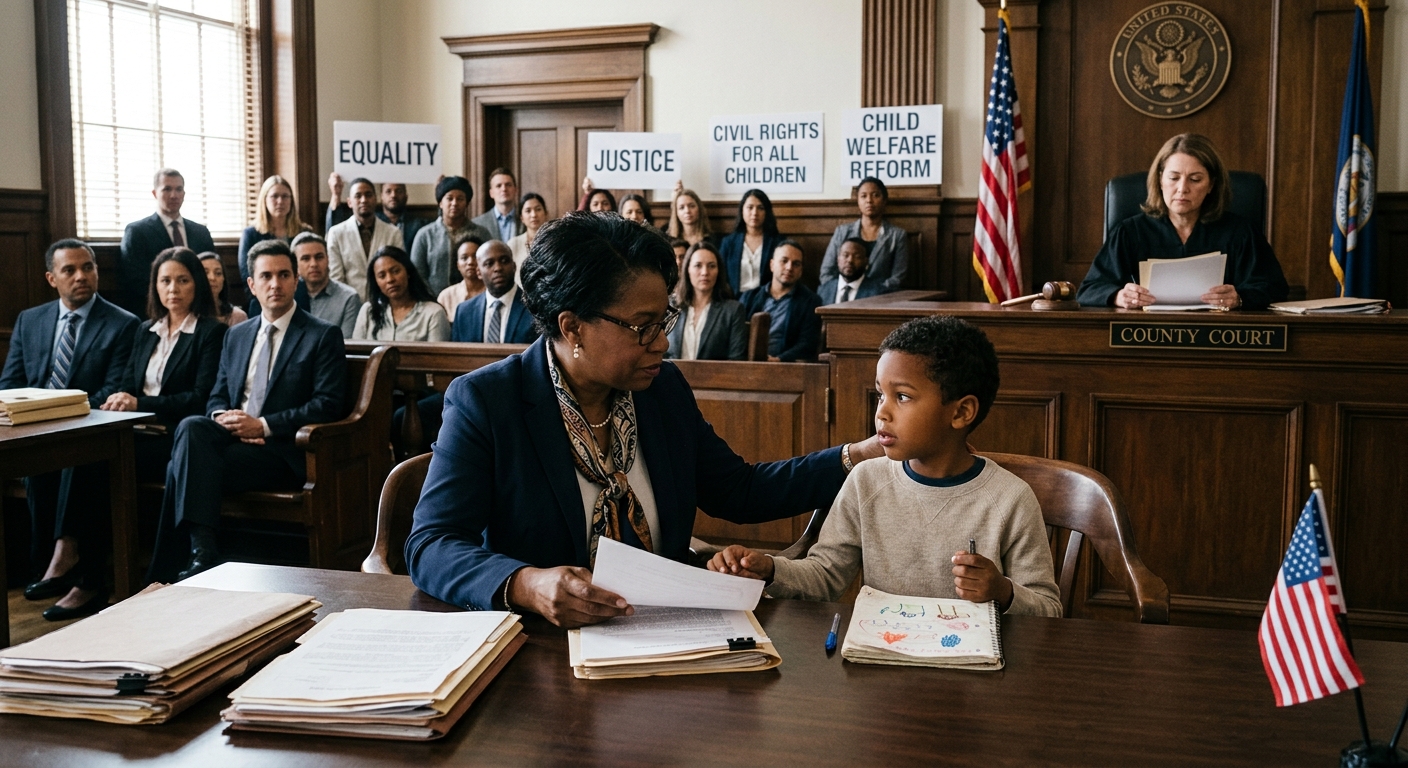
When Americans reflect on historical and contemporary civil rights milestones, the collective consciousness naturally gravitates toward voting accessibility, criminal justice reform, housing equality, and educational parity. However, quietly operating in the background of these monumental struggles is another profound systemic issue that directly impacts the fundamental liberties of millions of citizens. A rapidly growing consensus among top legal advocates, policy experts, and human rights organizations highlights that the American child welfare system—often characterized by advocates as the “family policing system”—represents one of the most pressing, yet drastically underreported, civil rights crises of the modern era.
For decades, prominent litigation groups approached the foster care system with a specific mandate: ensuring that children who were removed from their homes were kept safe in state custody. Lawsuits were traditionally aimed at improving the physical conditions of foster facilities, reducing caseworker ratios, and mandating better healthcare for youth in state care. Today, however, an ideological and legal revolution is underway. The vanguard of child welfare litigation is shifting its focus toward a much more fundamental question: Why are so many children, predominantly from marginalized and minority communities, being forcibly separated from their families in the first place?
Redefining Child Welfare as a System of Surveillance
To understand the pivot in legal strategy, one must examine how the child welfare system currently operates in many jurisdictions across the United States. Historically framed as a benevolent social safety net designed to rescue abused and neglected children, the system has increasingly drawn criticism for functioning as an expansive surveillance apparatus. This apparatus disproportionately targets Black, Indigenous, and low-income families, monitoring their parenting through a punitive lens rather than a supportive one.
Advocates argue that the vast majority of child welfare interventions are not responses to malicious physical or sexual abuse. Instead, the overwhelming majority of cases involve “neglect,” a broadly defined legal category that frequently conflates poor parenting with the unavoidable consequences of systemic poverty. A lack of stable housing, food insecurity, untreated maternal mental health issues, or an inability to afford reliable childcare are routinely criminalized and labeled as parental failures. Instead of providing the financial and social resources necessary to alleviate these conditions, state agencies frequently default to the most extreme and traumatic intervention available: family separation.
This operational model has profound civil rights implications. The constitutional right to family integrity—the right of parents to raise their children and children to remain with their families—is considered a fundamental liberty under the Fourteenth Amendment. Yet, in practice, this right is heavily compromised for marginalized families who lack the economic resources to defend themselves against state intervention.
The Disproportionate Impact on Marginalized Communities
The statistics surrounding child welfare investigations reveal stark racial disparities that mirror those found in the adult criminal justice system. Across numerous states, Black and Indigenous children are reported to child protective services, investigated, and ultimately removed from their homes at rates that far exceed their representation in the general population.
- Heightened Scrutiny: Implicit biases often influence mandated reporters—such as teachers, medical professionals, and social workers—leading to higher reporting rates for families of color even when behavioral indicators are identical to those of white families.
- Investigation Disparities: Once a report is filed, cases involving Black and Indigenous families are statistically more likely to be “screened in” for a full investigation.
- Placement Discrepancies: Following an investigation, children of color are less likely to be provided with in-home supportive services and more likely to be placed into out-of-home foster care.
These systemic inequities are not merely historical artifacts; they are active, ongoing crises that deprive millions of children of their cultural heritage, community connections, and family bonds, prompting civil rights lawyers to intervene aggressively.
The Legislative Catalyst: The Shadow of ASFA
Any comprehensive analysis of the child welfare system’s civil rights issues must address the profound impact of federal legislation, most notably the Adoption and Safe Families Act (ASFA) of 1997. Originally passed with the intention of preventing children from languishing indefinitely in foster care, ASFA established aggressive timelines for permanent placement. The most controversial provision of ASFA is the “15 of 22” rule, which generally requires state agencies to file a petition to terminate parental rights if a child has been in foster care for 15 out of the most recent 22 months.
While the stated goal of “permanency” sounds beneficial, the arbitrary timeline acts as a devastating mechanism for families struggling with complex, systemic barriers. Securing affordable housing, completing court-mandated addiction rehabilitation programs, or overcoming periods of incarceration often takes significantly longer than 15 months. Consequently, ASFA has led to the mass termination of parental rights—often referred to by legal scholars as the “civil death penalty” for families. Litigation groups are increasingly challenging the constitutionality and discriminatory application of these accelerated timelines, arguing that they punish families for circumstances born of poverty and systemic inequality rather than a lack of love or parental fitness.
The New Legal Frontier: Title VI and Federal Intervention
In response to these entrenched systemic failures, civil rights litigation groups are deploying novel legal theories to force structural change. Rather than solely relying on state tort claims or challenging individual case adjudications, advocates are elevating their fight to the federal civil rights arena. The central weapon in this new legal strategy is Title VI of the Civil Rights Act of 1964.
Title VI strictly prohibits discrimination on the basis of race, color, or national origin in any program or activity that receives federal financial assistance. Because state child welfare agencies rely heavily on federal funding—particularly through Title IV-E and Title IV-B of the Social Security Act—they are legally bound by Title VI provisions. Legal groups are actively compiling extensive statistical data to demonstrate that state child welfare practices have an undeniable, discriminatory disparate impact on Black and minority families. By filing complaints with the U.S. Department of Health and Human Services’ Office for Civil Rights (HHS-OCR), advocates bypass localized administrative hurdles and leverage the threat of federal funding revocation to compel immediate, state-wide reforms.
A Groundbreaking Precedent in Minnesota
The theoretical framework of utilizing civil rights law to combat child welfare disparities transitioned into concrete action in early 2024. In a historic move, the Minneapolis branch of the NAACP, partnering with prominent national child welfare legal advocates, submitted a groundbreaking formal complaint to the HHS-OCR against the State of Minnesota. The complaint specifically targeted the family policing practices in Hennepin and Ramsey counties, two of the state’s most populous regions.
The core allegation was straightforward yet profound: the state’s child welfare system had weaponized federal dollars to discriminatorily surveil, investigate, and separate Black families. Utilizing comprehensive data, the complaint highlighted that despite decades of internal agency task forces and pledges for equity, the overrepresentation of Black children in the state’s foster system remained stagnant or worsened. Black children were removed from their homes at a degree of disproportionality that heavily outpaced both state and national averages. This formal civil rights complaint is widely viewed as a watershed moment, signaling a definitive end to the era where child welfare agencies operated without rigorous federal civil rights scrutiny.
Moving Toward Family Preservation: A Paradigm Shift
To rectify these deeply ingrained civil rights violations, litigation and advocacy are pushing for a fundamental paradigm shift away from punitive protection toward holistic family preservation. The table below outlines the critical differences between the legacy approach to child welfare and the modern, civil rights-based framework.
| System Characteristic | Legacy Child Welfare Approach | Civil Rights & Preservation Approach |
|---|---|---|
| Primary Focus | Child rescue and rapid removal. | Family stabilization and in-home support. |
| View of Poverty | Often conflated with parental neglect. | Recognized as a structural deficit requiring financial aid. |
| Intervention Method | Punitive mandates, surveillance, and family separation. | Voluntary, community-based services without coercion. |
| Permanency Goals | Strict adherence to ASFA timelines and swift adoption. | Repeal of arbitrary timelines; prioritizing biological reunification or kinship care. |
Essential Strategies for Meaningful Reform
To dismantle the discriminatory architecture of the current system, legal scholars and civil rights activists advocate for several critical policy and legislative overhauls:
- Ending Anonymous Reporting: Anonymous abuse hotlines are frequently weaponized in domestic disputes or driven by implicit racial bias. Requiring mandated reporters to provide identifiable information increases accountability.
- Implementing Blind Removal Decisions: Removing demographic data (such as race and neighborhood) from the initial assessment committees that decide whether to remove a child has been shown to significantly reduce racial disparities.
- Providing High-Quality Legal Counsel: Ensuring that parents facing child welfare investigations have immediate access to specialized, multidisciplinary legal representation prior to a child’s removal, protecting their due process rights.
- Direct Financial Investment: Redirecting federal and state funds away from the foster care administrative bureaucracy and directly into the hands of struggling families to secure housing, food, and medical care.
Frequently Asked Questions (FAQs)
What is the “family policing system”?
The term “family policing system” is increasingly used by civil rights advocates and scholars to describe the child welfare and foster care systems. It highlights how these agencies often function similarly to law enforcement—utilizing surveillance, coercive investigations, and the punitive separation of families, rather than providing the necessary social and economic support to keep families safely intact.
How does poverty intersect with child neglect laws?
In many jurisdictions, the legal definition of “neglect” is broad and ambiguous, frequently criminalizing the symptoms of poverty. When a parent cannot afford safe housing, consistent utilities, or reliable childcare, state agencies often classify these economic hardships as neglectful parenting. Civil rights groups argue that poverty is an economic failure of the state, not a moral failing of the parent, and should be met with financial assistance rather than child removal.
Why is the Adoption and Safe Families Act (ASFA) considered controversial?
ASFA mandates that states file to terminate parental rights if a child is in foster care for 15 of the last 22 months. Critics argue this arbitrary timeline is a draconian measure that fails to account for the realities of systemic poverty, the slow pace of securing subsidized housing, and extensive waitlists for rehabilitation programs, disproportionately tearing apart minority families permanently.
How does Title VI of the Civil Rights Act apply to foster care?
Title VI prohibits entities receiving federal funding from engaging in practices that have a discriminatory impact based on race, color, or national origin. Because state child welfare departments rely on federal money, civil rights groups can file complaints if data shows their policies disproportionately harm and separate minority families.
Conclusion
The framing of child welfare as a vital civil rights issue is not merely a rhetorical shift; it is an essential legal evolution. For generations, the systemic dismantling of marginalized families has been shielded from rigorous scrutiny under the protective guise of child safety. By holding state systems accountable to the highest standards of constitutional law and federal civil rights mandates, litigation groups are demanding a profound structural reckoning. The ultimate goal is no longer just to build a slightly better foster care system, but to cultivate a society where the fundamental right to family integrity is fiercely protected, and where systemic poverty is met with enduring support rather than devastating punishment.
References
- Title VI of the Civil Rights Act of 1964 — U.S. Department of Justice. 2024-04-24. https://www.justice.gov/crt/fcs/TitleVI
- Child Welfare Practice to Address Racial Disproportionality and Disparity — U.S. Department of Health and Human Services, Children’s Bureau. 2021-01-01. https://www.childwelfare.gov/resources/child-welfare-practice-address-racial-disproportionality-and-disparity/
- NAACP, Children’s Rights Submit Civil Rights Complaint Against Minnesota’s Child Welfare System — NAACP. 2024-03-04. https://naacp.org/articles/naacp-childrens-rights-submit-civil-rights-complaint-against-minnesotas-child-welfare
- Disproportionality & Disparity in Child Welfare Dashboard — Washington State Department of Children, Youth, and Families (DCYF). 2024-01-01. https://www.dcyf.wa.gov/practice/practice-improvement/disproportionality
- GAO-07-816: African American Children In Foster Care — U.S. Government Accountability Office (GAO). 2007-07-11. https://www.gao.gov/products/gao-07-816 (Though published in 2007, this GAO report remains a foundational, universally cited benchmark in understanding structural disparities in foster care.)
Similar Articles








Read full bio of Sneha Tete


