
Censored Canvas: State Abortion Laws vs. Campus Art
How state healthcare laws collide with campus First Amendment rights.
Introduction: The Intersection of Art, Policy, and Free Speech
Art has long served as a vital mirror, reflecting the most contentious and profound issues of its era. Throughout history, public galleries and educational exhibits have provided essential safe havens for dialogue, challenging the status quo, and processing collective societal shifts. However, a modern conflict is rapidly unfolding across the United States, positioning raw artistic expression directly against newly minted state legislative mandates. In the wake of shifting reproductive rights landscapes following the overturn of Roe v. Wade, several states have enacted sweeping laws that not only restrict medical procedures but also attempt to stringently regulate how the topic of reproductive healthcare is discussed, taught, and depicted in publicly funded arenas.
This collision of restrictive policy and constitutional rights has turned public university campuses—traditionally heralded as the ultimate bastions of free thought and academic freedom—into heavily monitored ideological battlegrounds. The preemptive removal of reproductive health-themed artwork from a public college gallery in Idaho serves as a stark, precedent-setting example of this tension. It raises urgent, unavoidable questions about the acceptable limits of government reach and the durability of the First Amendment within higher education. When state funding becomes conditional on ideological silence, the fundamental purpose of the university is placed in immediate jeopardy.
The No Public Funds for Abortion Act Explained
To fully understand the foundation of this administrative censorship, one must examine the specific legislation that triggered the panic: Idaho’s No Public Funds for Abortion Act (NPFAA). Enacted by the Idaho State Legislature in 2021, the law was originally presented as a financial safeguard designed to prevent state taxpayer money from subsidizing abortion providers or medical facilities. However, the statutory language extends far beyond surgical or pharmaceutical interventions. The NPFAA explicitly prohibits any public entity, including state-funded universities and colleges, from using public funds to promote, counsel in favor of, or refer for abortion.
Violations of the act are not treated lightly; they carry severe penalties, including potential felony charges for individual employees, massive fines, and the catastrophic risk of funding cuts for the offending institution. The crux of the constitutional controversy lies in the deliberate ambiguity of the word promote. For medical professionals, the line between objective counseling and active promoting is already fraught. But for educators, gallery curators, and invited artists operating within state-funded institutions, this vague terminology acts as an invisible legislative tripwire.
How does a university administration accurately distinguish between an objective, academic discussion of reproductive rights and the illegal promotion of those rights? If a university-funded art exhibit displays a piece that normalizes or humanizes the personal experience of receiving reproductive healthcare, does that inherently constitute a violation of state law? Legal scholars and free speech advocates argue that this lack of clarity is not an accidental byproduct of the legislation. Rather, it is a deliberate feature designed to compel broad compliance through intimidation, forcing risk-averse institutions to over-correct and silence potentially lawful speech simply to ensure they remain safely insulated from state prosecution.
The Flashpoint at Lewis-Clark State College
The theoretical fears surrounding the NPFAA materialized into a highly publicized, tangible incident of administrative censorship in March 2023 at Lewis-Clark State College, a public undergraduate institution located in Lewiston, Idaho. The college’s Center for Arts & History was in the final stages of preparing a new, thought-provoking exhibition titled Unconditional Care: Listening to people’s health needs. The exhibit, meticulously curated to explore diverse perspectives on medical care, chronic illness, and bodily autonomy, featured works from several nationally recognized contemporary artists.
Among the selected pieces were multi-media installations, including profound video and audio recordings that documented real individuals sharing their deeply personal stories about navigating the complex healthcare system to obtain reproductive services. Another planned piece featured traditional craft mediums, such as intricate cross-stitch, creatively utilized to depict pharmaceutical treatments, accompanied by objective clinical statistics regarding their usage, safety, and efficacy. These compelling works were not designed to serve as political propaganda or literal advertisements; rather, they were intended to reflect the diverse lived realities of patients and foster critical, empathetic conversations about healthcare access.
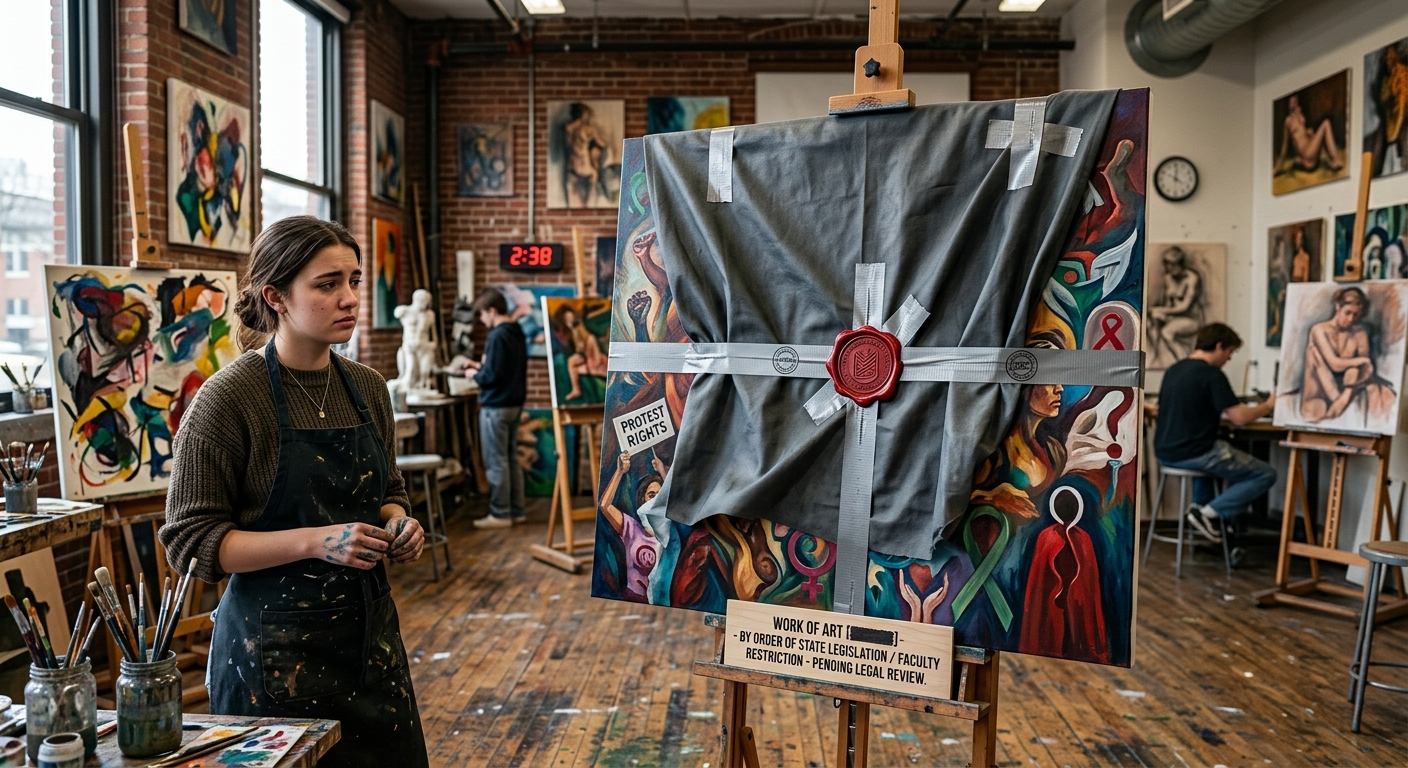
However, mere days before the exhibition’s scheduled opening reception, the administration at Lewis-Clark State College intervened drastically. Citing a recent, highly cautious legal review and the looming existential threat of the NPFAA, college officials explicitly ordered the removal of several artworks directly addressing the topic of abortion. The administration concluded that displaying these specific pieces within a publicly funded gallery could be legally construed by aggressive state prosecutors as using state resources to promote abortion. When the artists and the exhibit’s curator proposed reasonable compromises—such as covering the controversial art with a curtain accompanied by a neutral sign explaining the legal rationale for its censorship—the college swiftly rejected the alternatives. The gallery space was left conspicuously empty, transforming an exhibit intended to be about health, empathy, and care into a glaring, undeniable monument to institutional censorship.
The Chilling Effect on Academic and Artistic Freedom
The preemptive removal of art at Lewis-Clark State College perfectly illustrates a dangerous legal phenomenon known as the chilling effect. This occurs when individuals or institutions voluntarily restrict their own lawful expression out of a profound fear of penalization under a vague, overly broad, or aggressively enforced law. In the context of higher education, this chilling effect is fundamentally devastating to the core mission of the university. Public colleges and universities have been historically recognized by the United States Supreme Court as vibrant marketplaces of ideas, where intellectual exploration, debate, and controversial discourse must be aggressively protected from political orthodoxy.
When an educational administration acts as an extension of the state’s censorship apparatus, it betrays the foundational principles of academic freedom. The ramifications of this fear-based compliance extend far beyond the walls of the visual arts gallery. If an institution is willing to ban a cross-stitched artwork or a documentary-style video simply to avoid running afoul of the NPFAA, what happens inside the traditional classroom? Across the state, educators have reported significantly altering their syllabi, purposefully avoiding specific historical or sociological topics, and actively self-censoring classroom discussions regarding reproductive health out of sheer terror that a student complaint could lead to immediate criminal prosecution and job loss.
This pervasive environment of fear and surveillance fundamentally degrades the overall quality of higher education. Students are unfairly deprived of the critical opportunity to engage with complex, controversial, and timely subjects, while faculty members are systematically stripped of their pedagogical autonomy. The art gallery, much like the university lecture hall, is inherently a space meant for challenging preconceptions and expanding worldviews. When the state dictates precisely what can and cannot be displayed on the walls of a public gallery, it drastically alters the intellectual landscape of the entire campus, replacing robust, authentic debate with sanitized, state-approved messaging that serves political interests rather than educational goals.
Legal Pushback: Defending the First Amendment
Unsurprisingly, the blatant censorship at Lewis-Clark State College did not go unchallenged by the public or the legal community. The incident drew immediate, widespread condemnation from civil liberties advocates across the nation, triggering a fierce legal and public relations pushback. Prominent organizations dedicated to protecting constitutional rights rapidly mobilized to defend the censored artists’ First Amendment rights. Furthermore, free speech watchdogs issued stark, comprehensive warnings about the deeply unconstitutional nature of the college’s actions, emphasizing the dangerous precedent it set for public institutions nationwide.
The core legal argument against the college’s administrative decision is firmly anchored in the crucial constitutional distinction between official government speech and private speech occurring within a designated public forum. While the NPFAA dictates how state funds can be utilized for operations, civil rights attorneys argue that when a public university hosts a curated art exhibit, it is actively creating a forum for private expression, not adopting or endorsing the specific message of every individual artwork displayed. By selectively removing the art based entirely on its subject matter, the college engaged in textbook unconstitutional viewpoint discrimination.
Furthermore, advocates emphasize that factually documenting a medical reality or sharing an individual’s personal narrative does not legally or logically equate to promoting a medical procedure. This specific gallery dispute has quickly become part of a much broader, systemic pushback against the NPFAA and similar legislative efforts. This includes sweeping federal lawsuits filed by courageous university professors and faculty unions seeking to block the ongoing enforcement of the law, arguing passionately that it unconstitutionally criminalizes vital academic speech and eviscerates the First Amendment rights of educators.
Comparing Speech Frameworks on Campus
Understanding the tension requires looking at the competing frameworks governing public universities today. The table below highlights the stark contrast between traditional academic freedom and the new restrictions imposed by state laws.
| Concept | Core Principle | Impact on University Speech |
|---|---|---|
| Academic Freedom (First Amendment) | Protects the rights of educators, students, and artists to explore ideas without government interference. | Encourages open debate, controversial exhibits, and comprehensive academic inquiry without fear of reprisal. |
| State Funding Restrictions (e.g., NPFAA) | Prohibits the use of taxpayer funds to support, promote, or counsel in favor of specific restricted activities. | Creates a chilling effect, leading to administrative self-censorship and the rapid removal of relevant educational materials. |
Broader Implications for Higher Education
The conflict at Lewis-Clark State College is not merely an isolated, unfortunate anomaly; it is a blaring bellwether for the tumultuous future of higher education in heavily regulated states. As state legislatures become increasingly polarized and aggressive in their policymaking, there is a rapidly growing, undeniable trend of utilizing the power of the public purse to dictate strict ideological conformity on state-funded campuses. Today, the legislative target is reproductive health and abortion; tomorrow, the restricted topics could easily expand to include climate change research, gender studies, or historically accurate narratives regarding race and systemic inequality.
If the legal precedent is firmly established that arbitrary state funding restrictions can seamlessly override constitutional protections for free speech and academic inquiry, the very concept of the American public university is in severe jeopardy. University administrators increasingly find themselves trapped between a rock and a hard place: they must choose between upholding the First Amendment—thereby risking devastating legal prosecution and financial ruin from angry state lawmakers—or complying with restrictive, politically motivated mandates, thereby sacrificing the institution’s fundamental academic integrity and ultimately failing their student body.
Conclusion: The Resilience of Artistic Voices
Ultimately, the heavy-handed attempt to silence the urgent conversation surrounding reproductive health through administrative gallery censorship has ironically achieved the exact opposite outcome. The stark, blank spaces left on the walls of the Lewis-Clark State College gallery spoke volumes, resonating far louder than the physical art itself ever could have. Those empty spaces instantly became a visceral, highly publicized national symbol of government overreach and the inherent fragility of free speech.
The artists involved in the exhibit refused to be quietly swept aside or intimidated by administrative decrees. By taking their censored stories and their removed works to prominent national platforms and pursuing rigorous legal avenues, they amplified their vital message exponentially. Art possesses an intrinsic, undeniable resilience; it inevitably mutates, adapts, and finds powerful new avenues for expression whenever it is suppressed by authority. The ongoing legal battles currently unfurling in Idaho will undoubtedly set crucial, long-lasting precedents for exactly how the First Amendment is interpreted and applied in the fraught post-Roe era. Until a definitive legal resolution is reached, those empty gallery walls serve as a profound, haunting reminder of the continuous, necessary struggle to fiercely protect the fundamental right to free expression in an increasingly divided nation.
Frequently Asked Questions (FAQ)
- Does the First Amendment protect academic freedom at public universities?
Yes, the U.S. Supreme Court has long recognized that the First Amendment deeply protects academic freedom at public colleges and universities. This legal protection ensures that these publicly funded institutions remain vibrant, open marketplaces of ideas, strictly free from government-imposed ideological censorship or political retaliation. - What exactly is the No Public Funds for Abortion Act (NPFAA)?
The NPFAA is a highly controversial 2021 Idaho state law that strictly prohibits the use of any public funds—which crucially includes student tuition and state appropriations allocated to public universities—to pay for, promote, counsel in favor of, or provide referrals for abortion services. - Why was the art removed at Lewis-Clark State College?
Administrators removed several specific artworks depicting personal experiences with reproductive health from a campus exhibit out of a profound fear of legal liability. They worried that displaying the art could be interpreted by state officials as promoting abortion using state funds, thereby violating the severe criminal and financial provisions of the NPFAA.
References
- Idaho Code Title 18, Chapter 87 – No Public Funds for Abortion Act — Idaho State Legislature. 2021-05-10. https://legislature.idaho.gov/statutesrules/idstat/Title18/T18CH87/
- FIRE calls on Idaho’s Lewis-Clark State College to restore abortion-themed artwork censored to avoid violating state law — Foundation for Individual Rights and Expression (FIRE). 2023-03-15. https://www.thefire.org/news/fire-calls-idahos-lewis-clark-state-college-restore-abortion-themed-artwork-censored-avoid
- Idaho universities disallow abortion, contraception referrals for students — PBS News. 2022-09-27. https://www.pbs.org/newshour/politics/idaho-universities-disallow-abortion-contraception-referrals-for-students
- Academic Freedom — The First Amendment Encyclopedia (Free Speech Center at Middle Tennessee State University). 2023-08-10. https://firstamendment.mtsu.edu/article/academic-freedom/
Similar Articles








Read full bio of Sneha Tete


