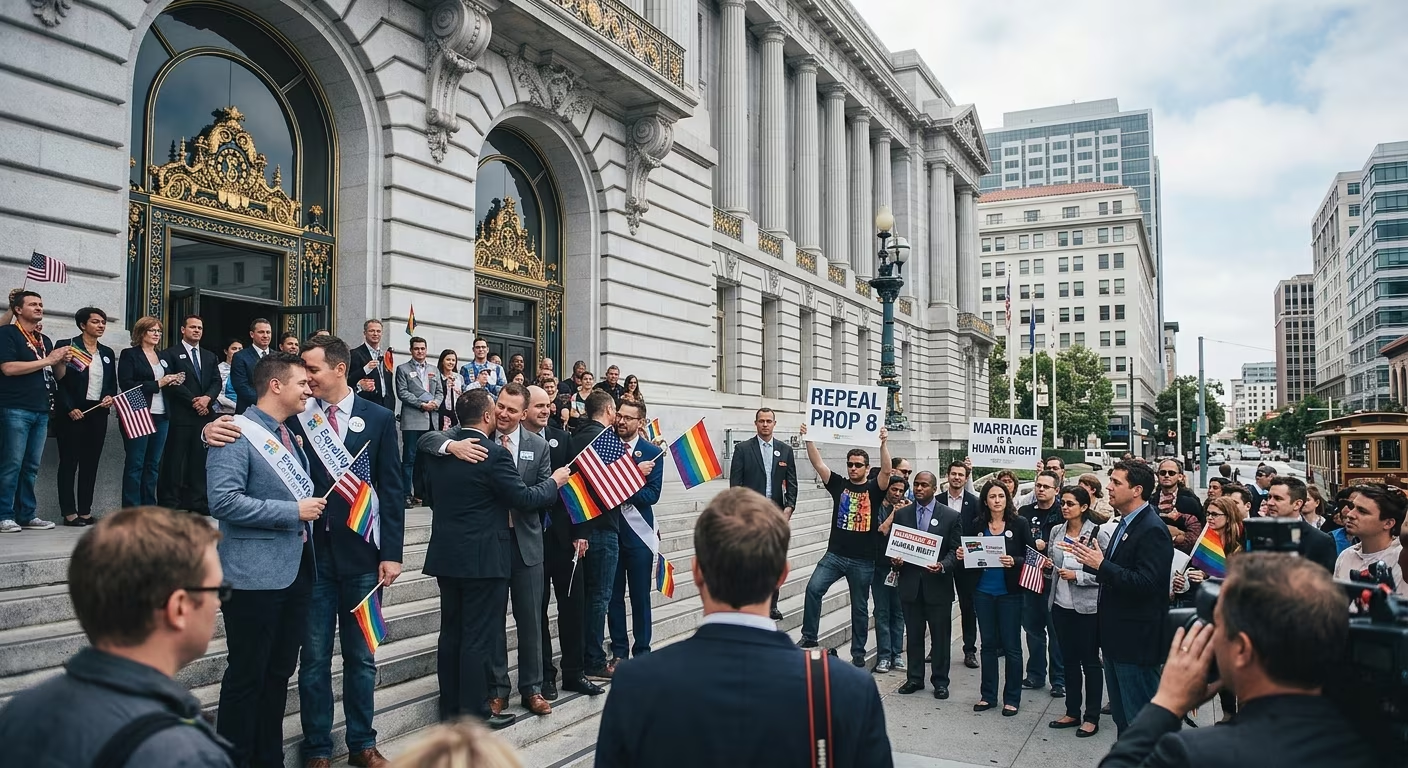
The trajectory of civil rights in the United States is rarely a straight line. It is characterized by periods of profound progress followed by rapid conservative backlash. A prime example of this dynamic is California’s Proposition 8, a ballot initiative that temporarily stripped same-sex couples of their right to marry . Approved by voters in 2008, this measure ignited a ferocious legal battle that spanned state courts, federal district courts, and ultimately reached the United States Supreme Court. The fight against Proposition 8 not only transformed the lives of thousands of families in California but also laid the critical judicial groundwork for the nationwide legalization of same-sex marriage.
By analyzing the constitutional arguments, the appellate maneuvers, and the legacy of this dispute, we can better understand the precarious nature of civil liberties and the mechanisms required to defend them in the American legal framework. This litigation exposed the tension between direct democracy and the unalienable rights guaranteed by the federal Constitution, proving that the protection of minority groups often relies on the structural safeguards of the federal judiciary.
The Catalyst: California’s Initial Recognition of Same-Sex Marriage
To comprehend the magnitude of the Proposition 8 litigation, one must first look at the legal landscape of California in early 2008. In May of that year, the California Supreme Court issued a monumental decision, striking down existing state statutes that limited marriage strictly to a union between a man and a woman. The court determined that relegating same-sex couples to domestic partnerships—a distinct but supposedly equivalent legal status—amounted to a “separate but equal” doctrine that explicitly violated the equal protection clause of the California Constitution.
This ruling recognized that the right to marry is a fundamental liberty interest. Almost immediately, same-sex couples across the state began obtaining marriage licenses and planning their futures. Between June and November 2008, an estimated 18,000 same-sex couples were legally wed in California. However, opponents of marriage equality swiftly mobilized, funding a massive campaign to amend the state constitution through a direct ballot initiative, setting the stage for one of the most contentious political showdowns in state history.
The November Election and the Enactment of Proposition 8
On November 4, 2008, California voters passed Proposition 8 with a 52.3% majority . The initiative added a single, highly restrictive sentence to Article I of the California Constitution: “Only marriage between a man and a woman is valid or recognized in California.” The immediate effect was devastating for civil rights advocates. The issuance of marriage licenses to same-sex couples came to a grinding halt .
While the California Supreme Court later ruled that the 18,000 marriages performed prior to the election would remain legally valid, the door was firmly shut for any future unions. This legislative whiplash demonstrated the vulnerability of minority rights when subjected to the popular vote. In response, legal advocates made a calculated decision to shift their focus away from state-level protections and look toward the broader, more robust guarantees of the United States Constitution.
Shifting the Battleground: The Federal Case of Hollingsworth v. Perry
Realizing that the state constitution had been successfully weaponized against them, proponents of marriage equality filed a federal lawsuit. Originally known as Perry v. Schwarzenegger, the case argued that Proposition 8 violated the Equal Protection and Due Process Clauses of the Fourteenth Amendment to the U.S. Constitution . The legal strategy was audacious: instead of relying on state law, the plaintiffs argued that a state cannot systematically disenfranchise a specific class of citizens without a compelling governmental interest.
In constitutional law, the Equal Protection Clause demands that governments treat similarly situated individuals equally. When a law discriminates against a specific group, courts apply varying levels of judicial scrutiny. The legal team fighting Prop 8 argued that laws targeting gay and lesbian individuals should be subject to heightened scrutiny because sexual orientation is a fundamental, immutable characteristic. However, even under the lowest standard of review—rational basis—Chief Judge Vaughn Walker of the U.S. District Court for the Northern District of California concluded that Proposition 8 failed.
Following a highly publicized trial involving extensive testimony from sociologists, historians, and legal experts, Judge Walker’s 2010 ruling became a watershed moment. He meticulously dismantled the proponents’ arguments, finding that Proposition 8 served no rational basis other than moral disapproval and animus toward gay and lesbian individuals . He ruled that tradition alone cannot justify discrimination, and he issued an injunction against the enforcement of the initiative.
The Appellate Limbo and Article III Standing
Despite the victory in the district court, the legal saga was far from over. Under normal circumstances, a state’s attorney general and governor would appeal an adverse ruling to defend state law. However, California’s state officials, recognizing the discriminatory nature of the law, refused to defend Proposition 8 on appeal . In their absence, the official proponents of the ballot measure stepped in to appeal the decision to the Ninth Circuit Court of Appeals, which ultimately affirmed Judge Walker’s ruling.
The case then advanced to the United States Supreme Court as Hollingsworth v. Perry. In June 2013, the Supreme Court delivered a decisive, albeit highly technical, ruling. In a 5-4 decision, the Court concluded that the private citizens who sponsored Proposition 8 lacked “Article III standing” to defend the law in federal court . Because the state officials had declined to appeal, the Court ruled there was no actual “case or controversy” for the Supreme Court to adjudicate. Consequently, the Supreme Court vacated the Ninth Circuit’s ruling and left Judge Walker’s original district court injunction in place. Marriage equality was officially restored in California .
Paving the Way for Nationwide Equality: Obergefell v. Hodges
The fall of Proposition 8 served as a massive catalyst for the national marriage equality movement. The detailed factual findings established during the federal trial provided an authoritative evidentiary record that other courts relied upon to strike down similar bans across the country. Before 2015, the United States operated under a chaotic patchwork of marital laws. A legally married couple in California could cross a state line and instantly lose their marital status, severing their rights to hospital visitation, tax benefits, and parental recognition.
The momentum generated by the California victory culminated in the 2015 Supreme Court decision Obergefell v. Hodges . In a historic 5-4 ruling authored by Justice Anthony Kennedy, the Court declared that the right to marry is a fundamental liberty protected by the Due Process and Equal Protection Clauses of the Fourteenth Amendment . The ruling effectively mandated that all fifty states must license same-sex marriages and recognize those lawfully performed in other jurisdictions. By extending these rights, the Court eradicated the discriminatory legal patchwork and provided federal guarantees for LGBTQ+ families.
The Lingering Shadow of Proposition 8 in a Post-Roe Era
While Obergefell settled the federal question, the ghost of Proposition 8 continues to haunt California’s legal framework. Because the U.S. Supreme Court decision superseded state law but did not physically erase it, the discriminatory language of Proposition 8 remains embedded in the California Constitution . For years, this dormant text was considered a harmless relic. However, the legal landscape shifted dramatically in 2022.
With the Supreme Court’s ruling in Dobbs v. Jackson Women’s Health Organization, which overturned the federal right to abortion, legal scholars raised alarms. In a concurring opinion, Justice Clarence Thomas explicitly suggested that the Court should reconsider other substantive due process precedents, including Obergefell. This development highlighted several critical vulnerabilities:
- The Supremacy Clause Vulnerability: If federal constitutional protections disappear, state constitutions become the ultimate authority on civil rights within state borders.
- Dormant Constitutional Text: Proposition 8 was never physically deleted. If Obergefell is abrogated, the dormant text of Proposition 8 would automatically reactivate, instantly banning same-sex marriage in California again .
- Judicial Re-evaluation: The current ideological makeup of the Supreme Court invites active challenges to long-standing civil liberties.
Recognizing this existential threat, California lawmakers have initiated efforts to permanently remove the Proposition 8 language. Proposed constitutional amendments aim to replace the exclusionary text with an affirmative declaration of the fundamental right to marry, demonstrating that civil rights must be proactively codified and guarded.
Timeline of California’s Marriage Equality Legal Battle
| Date | Legal Event | Impact on Marriage Rights |
|---|---|---|
| May 2008 | In re Marriage Cases Ruling | California Supreme Court legalizes same-sex marriage under the state constitution. |
| November 2008 | Proposition 8 Passes | Voters amend the state constitution, halting all future same-sex marriages. |
| August 2010 | Federal District Court Ruling | Judge Vaughn Walker strikes down Proposition 8 as a violation of the U.S. Constitution. |
| June 2013 | Hollingsworth v. Perry | U.S. Supreme Court dismisses the appeal for lack of standing; marriage equality is restored in California. |
| June 2015 | Obergefell v. Hodges | U.S. Supreme Court legalizes same-sex marriage nationwide, establishing federal constitutional protection. |
Frequently Asked Questions (FAQ)
What exactly was California’s Proposition 8?
Proposition 8 was a 2008 ballot initiative that amended the California Constitution to define marriage exclusively as a union between one man and one woman. It effectively eliminated the right of same-sex couples to marry, overriding a prior ruling by the state’s highest court.
Why did the U.S. Supreme Court dismiss the Proposition 8 appeal?
In the 2013 case Hollingsworth v. Perry, the U.S. Supreme Court ruled that the private citizens who sponsored Proposition 8 did not have the legal authority (Article III standing) to defend the law in federal court after state officials refused to do so. Because of this lack of standing, the lower court’s ruling—which declared the ban unconstitutional—was left intact.
How did the fight against Proposition 8 impact the entire country?
The extensive trial proceedings in the federal challenge to Proposition 8 created a robust legal record demonstrating that same-sex marriage bans serve no legitimate state interest. This groundwork significantly influenced the judicial momentum that eventually led the U.S. Supreme Court to legalize same-sex marriage nationwide in 2015.
Is the language of Proposition 8 still in the California Constitution?
Yes. Although it is currently unenforceable due to federal rulings, the text remains in the state constitution. If the federal protections established by Obergefell v. Hodges were ever overturned by the Supreme Court, the state ban could theoretically go back into effect.
The Enduring Legacy of the Legal Fight
The legal battle over Proposition 8 serves as a masterclass in civil rights litigation. It highlights the dangerous volatility of subjecting minority liberties to a popular majority vote and underscores the federal judiciary’s essential role as a backstop against legislative overreach. The attorneys, plaintiffs, and advocates who dismantled California’s marriage ban did not merely change the law of one state; they dismantled the constitutional scaffolding of discrimination nationwide, proving that equality remains a fundamental promise of the American legal system.
References
- Frequently Asked Questions (FAQ) – Proposition 8 — California Department of Justice. 2013-06-28. https://oag.ca.gov/prop8
- Hollingsworth v. Perry — Legal Information Institute, Cornell Law School. 2013-06-26. https://www.law.cornell.edu/supct/cert/12-144
- Obergefell v. Hodges — Legal Information Institute, Cornell Law School. 2015-06-26. https://www.law.cornell.edu/wex/obergefell_v_hodges
- Proposition 8—End It and Mend It — UC Berkeley Law. 2023-02-28. https://law.berkeley.edu/article/proposition-8-end-it-and-mend-it/